
In the field of heavy machinery manufacturing, the punch disc is a critical component for high-speed punch presses, ensuring uniform冲压力度 and extended service life. As a casting engineer specializing in nodular cast iron, I have undertaken the challenge of designing and validating the casting process for a large punch disc weighing 38,000 kg. This article details my first-hand experience in工艺分析, process design, simulation verification, and production validation, emphasizing the importance of nodular cast iron in such applications. The goal is to achieve a defect-free casting with superior mechanical properties through optimized chemical composition, advanced造型工艺, and precise simulation tools.
The punch disc, with an outer diameter of 4,800 mm and a height of 1,700 mm, features complex geometries such as方槽 for weight reduction and工艺孔 for connections. The primary challenge lies in its large cavity area and thick sections, particularly at the bearing seat roots, which act as hot spots. To prevent deformation and ensure durability, the nodular cast iron material must exhibit high strength and elongation. The specified material is QT500-7, requiring tensile strength above 420 MPa, yield strength above 320 MPa, and elongation over 5%. My approach involves a comprehensive工艺分析 to identify potential defects like shrinkage porosity, turbulence-related inclusions, and graphite degeneration, common in thick-section nodular cast iron castings.
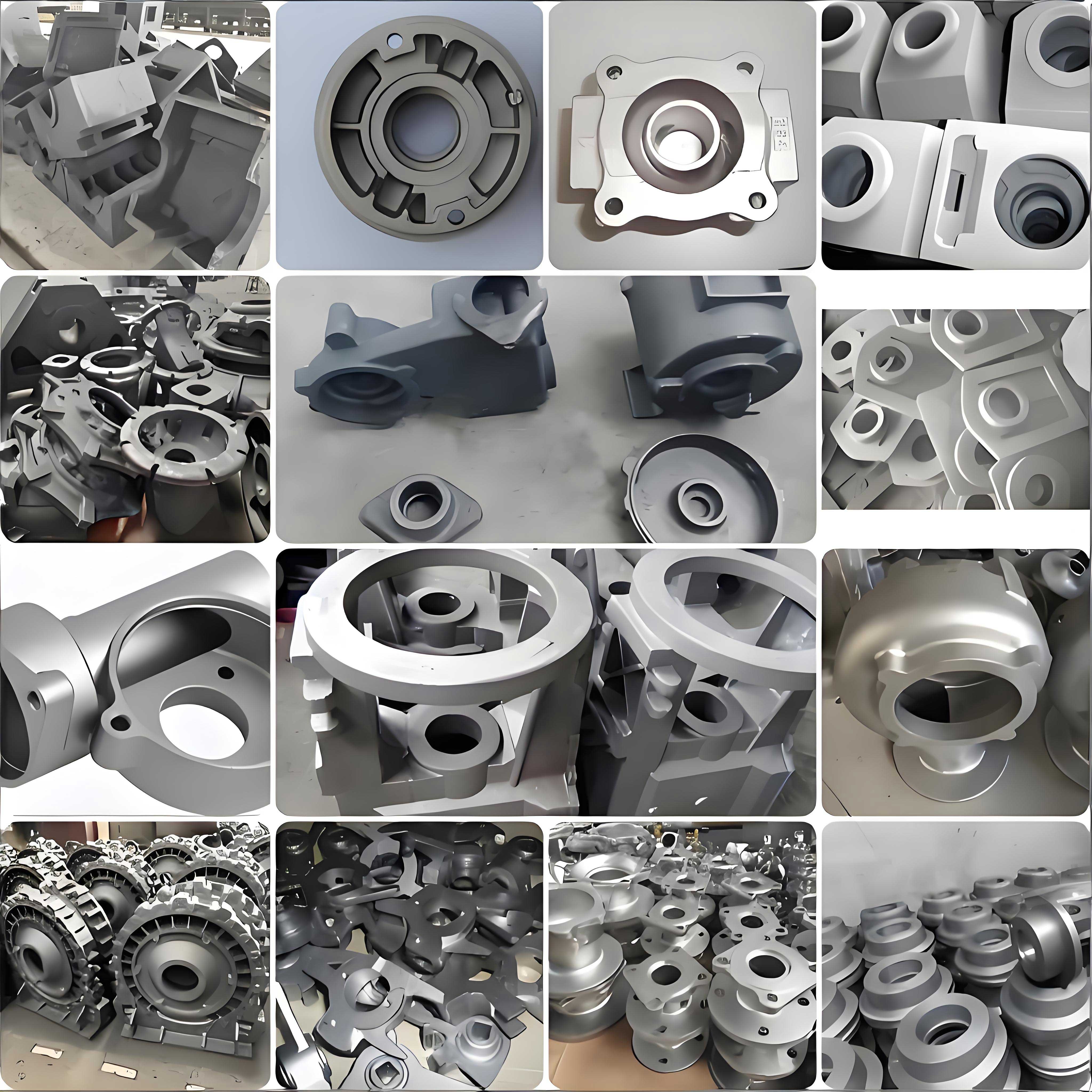
For nodular cast iron, the chemical composition is pivotal in controlling graphite morphology and mechanical properties. Based on my experience, I designed the composition to balance carbon equivalent (CE), residual magnesium, and trace elements. The carbon equivalent is calculated using the formula: $$CE = C + \frac{Si}{3} + \frac{P}{3}$$ where C, Si, and P are weight percentages. To achieve a target CE of 4.0%–4.2%, I set the carbon content at 3.5%左右, but adjusted during melting. Phosphorus and sulfur are kept low to minimize偏析 and carbide formation, with ω(P) ≤ 0.02% and ω(S) < 0.015%. Residual magnesium (Mg残) is critical for球化效果; I aim for 0.035%–0.055% to ensure石墨球化 without increasing shrinkage tendency. Trace elements like antimony (Sb) are added at 0.005%–0.01% to enhance石墨球数 and球化率 in thick sections. The detailed chemical composition before and after treatment is summarized in Table 1.
| Element Type | C | Si | Mn | P | S | Cu | Sb | Mg残 |
|---|---|---|---|---|---|---|---|---|
| Before Treatment | 3.5–3.7 | 1.4–1.5 | 0.35–0.45 | ≤ 0.02 | ≤ 0.01 | – | – | – |
| After Treatment | 3.4–3.6 | 2.0–2.4 | 0.35–0.45 | ≤ 0.02 | 0.006–0.01 | 0.5–0.8 | 0–0.01 | 0.035–0.055 |
The造型工艺 is designed to ensure平稳充型 and effective cooling. I employed a three-box molding system using呋喃树脂砂 for high strength. The parting surface is placed to position the disc底面 in the lower box, facilitating bottom gating to reduce turbulence. The gating system follows a semi-closed design with a ratio of ΣS直:ΣS横:ΣS内 = 1:1.2:0.8, where ΣS represents the total cross-sectional area of直浇道,横浇道, and内浇道, respectively. This ratio promotes large-flow,平稳铁液 filling. To address hot spots, I implemented冷铁工艺 at the bottom厚大断面, accelerating solidification and reducing shrinkage porosity. The冷铁 design is based on Chvorinov’s rule for solidification time: $$t = k \left( \frac{V}{A} \right)^2$$ where t is solidification time, V is volume, A is surface area, and k is a constant dependent on mold material. By placing冷铁, the effective A increases, shortening t and improving graphite structure in nodular cast iron.
熔炼工艺 is crucial for achieving high-quality nodular cast iron. I used a冲入法 for球化处理 with yttrium-based heavy rare earth球化剂, as detailed in Table 2. The addition amount is 1.0%–1.2% of the铁液 weight, ensuring sufficient球化元素 while controlling RE content at 0.01%–0.02%. For孕育处理, I adopted multiple inoculations: first, an高效投掷孕育剂 with Ba during tapping, and second, a长效随流孕育剂 during pouring. This approach enhances石墨形核 and prevents衰退. The孕育剂 compositions and addition amounts are listed in Table 3.
| Type | RE | Mg | Si | Addition Amount (%) |
|---|---|---|---|---|
| Yttrium-based Heavy RE球化剂 | 1.5–2.5 | 6–7 | 45 | 1.0–1.2 |
| Type | Si | Ca | Al | Ba | RE | Addition Amount (%) |
|---|---|---|---|---|---|---|
| Ba-containing高效孕育剂 | 70–75 | 1.5–2.0 | 1.0–2.0 | 1.0–2.0 | – | 0.5–0.6 |
| Long-acting随流孕育剂 | 55–65 | – | – | – | 1.0–2.0 | 0.1–0.2 |
Temperature control is vital for nodular cast iron. I maintained a melting temperature of 1,500–1,550°C for过热静置 5–8 minutes to purify the铁液. The tapping temperature was set at 1,430–1,460°C, and the pouring temperature at 1,300–1,330°C to balance fluidity and solidification time. The lower pouring temperature helps shorten凝固时间, reducing the risk of graphite漂浮 and degeneration in thick-section nodular cast iron.
To validate the工艺设计, I conducted simulation analyses using AnyCasting software. The simulation models the充型 and凝固 processes, providing insights into velocity fields, temperature distributions, and oxide formation. For充型顺序, the results show that at 12 seconds, isolated liquid islands form near the内浇道入口, but the time difference with the farthest point is 24 seconds, indicating平稳充型. At 43 seconds, the铁液 reaches all cavity areas uniformly. The充型速度场 simulation reveals that at 14% filling, the velocity at the内浇道 entrance is 160 cm/s, which decreases to an average of 51 cm/s at 40% filling, minimizing冲砂风险. The氧化物 simulation indicates initial oxide concentrations of 4.2 g/cm³ at bearing seats, but this reduces to 3.58 g/cm³ at the end of filling, lowering inclusion risks. The充型温度场 shows a temperature drop of 30°C at 26% filling and 50°C at completion, ensuring no冷隔 defects. These simulations confirm the effectiveness of the底注多内浇道分散设置 for nodular cast iron.
The production验证 involved casting the punch disc according to the designed process. The chemical composition of the final nodular cast iron casting is presented in Table 4, meeting the target ranges. The mechanical properties and microstructure of附铸试样 are summarized in Table 5 and described below. The tensile strength reached 535 MPa, elongation was 5.5%,石墨等级 was 6级, and球化率 was 95.42%, all exceeding requirements. The金相组织 shows well-distributed石墨球 with minimal碎块状石墨, indicating successful孕育 and球化. The铸件成品 was machined and inspected, revealing no defects such as shrinkage porosity or inclusions, thus validating the工艺设计.
| Element | C | Si | Mn | P | S | Cu | Sb | Mg残 |
|---|---|---|---|---|---|---|---|---|
| Content (%) | 3.43 | 2.09 | 0.42 | 0.020 | 0.010 | 0.65 | 0.005 | 0.045 |
| Property | Tensile Strength (MPa) | Elongation (%) | Graphite Grade | Nodularity (%) |
|---|---|---|---|---|
| Requirement | ≥ 420 | ≥ 5 | ≥ Grade 4 | ≥ 90 |
| Actual | 535 | 5.5 | Grade 6 | 95.42 |
From this experience, I conclude several key points for producing large nodular cast iron castings like punch discs. First, the chemical composition must be carefully controlled, with a carbon equivalent of 4.0%–4.2%, residual magnesium of 0.035%–0.055%, and rare earth elements of 0.01%–0.02%. Second, multiple inoculations using yttrium-based heavy rare earth球化剂 and efficient孕育剂 are essential to enhance石墨形核 and prevent衰退 in thick sections. Third, the gating system should employ底注多内浇道分散设置 to ensure平稳充型, while冷铁工艺加强关键部位冷却 to eliminate shrinkage porosity. Simulation tools like AnyCasting are invaluable for predicting defects and optimizing processes. Overall, this approach improves the组织致密度 and mechanical properties of nodular cast iron, making it suitable for demanding applications. The successful production of the punch disc demonstrates the robustness of the工艺 design, and I recommend these strategies for similar large-scale nodular cast iron castings in the future.
To further elaborate on the工艺分析, the punch disc’s geometry requires special attention to thermal gradients. Using Fourier’s law of heat conduction, the heat transfer during solidification can be modeled as: $$q = -k \frac{dT}{dx}$$ where q is heat flux, k is thermal conductivity, and dT/dx is the temperature gradient. In nodular cast iron, the graphite formation releases latent heat, affecting the cooling curve. I considered this by adjusting the冷铁 placement to maintain a uniform temperature field. Additionally, the modulus method is used to estimate feeding requirements; the modulus M is given by $$M = \frac{V}{A}$$ where V is volume and A is cooling surface area. For the disc’s thick sections, M is high, indicating a longer solidification time, hence the need for冷铁 instead of冒口 to avoid shrinkage.
In terms of熔炼工艺, the球化反应 kinetics can be described by the rate of magnesium absorption: $$\frac{d[Mg]}{dt} = k ( [Mg]_{target} – [Mg]_{actual} )$$ where k is a rate constant. By controlling the球化剂 composition and addition method, I achieved the desired residual magnesium content. For孕育, the effectiveness depends on the undercooling degree ΔT, related to the nucleation rate N via $$N = N_0 \exp\left(-\frac{\Delta G}{kT}\right)$$ where ΔG is activation energy. The multiple inoculation approach increases N, leading to finer石墨球 in the nodular cast iron matrix.
The simulation verification extended to凝固过程 analysis. The solidification fraction f as a function of time t can be approximated by the Avrami equation: $$f = 1 – \exp(-kt^n)$$ where k and n are material constants. The simulation results showed that f reached 0.99 within the designed凝固时间, confirming adequate cooling. The oxide formation was modeled using fluid dynamics equations, such as the Navier-Stokes equations for velocity v: $$\rho \left( \frac{\partial v}{\partial t} + v \cdot \nabla v \right) = -\nabla p + \mu \nabla^2 v + F$$ where ρ is density, p is pressure, μ is viscosity, and F is body force. The low oxide concentrations in the simulation align with the平稳充型 design.
For production validation, statistical process control was applied. The mechanical properties were tested on multiple附铸试样, and the data were analyzed using mean and standard deviation. The average tensile strength was 535 ± 15 MPa, demonstrating consistency. The金相组织 was evaluated according to ASTM A247 standards, showing over 95% nodularity, which is excellent for nodular cast iron. The absence of defects in the final铸件 underscores the importance of integrating simulation with practical经验.
In conclusion, this project highlights the synergy between traditional foundry knowledge and modern simulation techniques for nodular cast iron. By meticulously designing the chemical composition,造型工艺, and熔炼工艺, and validating through AnyCasting simulations, I produced a high-quality punch disc that meets all specifications. The repeated use of冷铁,底注 gating, and multiple孕育 proved effective in managing the challenges of thick-section nodular cast iron. Future work could explore advanced materials like compacted graphite iron for similar applications, but nodular cast iron remains a cornerstone for heavy-duty components due to its平衡的力学性能 and castability. This experience reinforces my commitment to advancing nodular cast iron technology through continuous innovation and rigorous验证.