
In the field of wind energy, bearing housings for large-scale wind turbines serve as critical components that must withstand extreme operational environments, including corrosion, sand erosion, humidity, and low temperatures. These conditions impose complex loading scenarios, necessitating high fatigue strength and low susceptibility to brittle fracture over a service life of 25 years. Given the challenges associated with installation and maintenance, the quality requirements for castings in such applications are exceptionally stringent. To ensure reliability, nodular cast iron is widely employed due to its excellent mechanical properties, which are significantly influenced by inoculation treatments during the casting process. Inoculation involves introducing nucleating agents into molten metal to control solidification and microstructure formation, ultimately affecting graphite morphology and the resultant performance of the cast components. This study investigates the impact of two secondary inoculants—silicon-barium-zirconium and sulfur-oxygen—on the properties of QT400-18AL bearing housings, with a focus on mechanical performance and microstructural characteristics. Through comparative analysis, I aim to provide insights into optimizing production processes for wind power applications, emphasizing the role of nodular cast iron in achieving durable and safe turbine operations.
The inoculation process in nodular cast iron is pivotal for enhancing graphite nodule formation, which directly correlates with mechanical properties such as tensile strength, yield strength, elongation, and impact toughness. The core mechanism relies on the introduction of fine particles, typically ≤ 4 μm in size, which act as nucleation sites for graphite precipitation. These particles can be endogenous, formed from reactions within the melt, or exogenous, added via inoculants. Elements with high oxygen affinity, such as those found in silicon-barium-zirconium and sulfur-oxygen inoculants, play a crucial role in setting nucleation conditions, thereby regulating graphite quantity, size, and morphology. For instance, the presence of cerium in sulfur-oxygen inoculants promotes stable oxide and sulfide nuclei, while barium in silicon-barium-zirconium inoculants aids in uniform graphite distribution. The effectiveness of these inoculants is often evaluated through statistical analysis of performance metrics, where standard deviation and mean values indicate stability and consistency. In this context, I explore how different inoculants influence key parameters, using tables and mathematical formulations to summarize findings.
To begin, the experimental setup involved melting raw materials, including Q10 pig iron, high-quality carbon steel, and returns, in a 25-ton medium-frequency induction furnace. The chemical composition of the base materials is detailed in Table 1, which ensures consistency across trials. The melt was treated with a sandwich process using Mg6RE nodularizing agent and primary inoculant, followed by secondary inoculation with either silicon-barium-zirconium or sulfur-oxygen inoculants at 0.20% addition. The pouring temperature was maintained between 1360–1370°C, and castings were produced with attached test blocks of dimensions 70 mm × 70 mm × 180 mm for subsequent analysis. Spectroscopic analysis confirmed the chemical composition, as shown in Table 2, highlighting minor variations in elements like carbon, silicon, manganese, and residual magnesium. This controlled approach allows for a direct comparison of inoculant effects on nodular cast iron properties.
| Material | C | Si | Mn | S | P | O | Ba | Ca | RE | Al | Zr | Fe |
|---|---|---|---|---|---|---|---|---|---|---|---|---|
| Q10 Pig Iron | 4.53 | 0.60 | 0.042 | 0.008 | 0.022 | – | – | – | – | – | – | Bal. |
| Carbon Steel | 0.06 | 0.04 | 0.18 | 0.005 | 0.003 | – | – | – | – | – | – | Bal. |
| 75SiFe | – | 72 | – | – | – | – | – | – | – | – | – | Bal. |
| Si-Ba-Zr Inoculant | – | 55.45 | – | – | – | – | 0.8 | 0.73 | 1.83 | 0.85 | 0.012 | – |
| S-O Inoculant | – | 69.74 | – | – | – | – | 0.04 | 0.98 | 2.35 | 1.14 | – | – |
The chemical composition of the castings, as verified by spectroscopy, is presented in Table 2. This data indicates minimal deviations, ensuring that any observed differences in properties can be attributed to the inoculant type rather than compositional variations. For nodular cast iron, elements like carbon and silicon are critical for graphite formation, while residual magnesium influences nodularization. The consistency across samples underscores the reliability of the experimental method.
| Sample Group | C | Si | Mn | P | S | RE | Mg | Cu | Cr |
|---|---|---|---|---|---|---|---|---|---|
| Si-Ba-Zr (1-1 to 1-10) | 3.67–3.69 | 1.90–1.95 | 0.17–0.22 | 0.018–0.030 | 0.008–0.012 | 0.006–0.007 | 0.038–0.048 | 0.007–0.011 | 0.017–0.030 |
| S-O (2-1 to 2-10) | 3.67–3.69 | 1.92–1.96 | 0.19–0.21 | 0.022–0.028 | 0.008–0.012 | 0.005–0.009 | 0.038–0.045 | 0.007–0.011 | 0.016–0.025 |
Mechanical testing was conducted on attached test blocks, with tensile and impact specimens prepared according to standard procedures. The results, summarized in Table 3, reveal that both inoculants yield similar average tensile and yield strengths, approximately 363 MPa and 224 MPa, respectively. However, the silicon-barium-zirconium inoculant demonstrates a slight advantage in elongation and a notable improvement in low-temperature impact toughness at -40°C, with an average value of 12.8 J compared to 11.93 J for the sulfur-oxygen inoculant. To quantify stability, I calculated the standard deviation and coefficient of variation for each property, as shown in Table 4. These metrics indicate that the sulfur-oxygen inoculant offers better consistency in tensile strength, while the silicon-barium-zirconium inoculant excels in yield strength and elongation stability. This variability can be modeled using statistical formulas; for instance, the standard deviation $\sigma$ for a property $X$ is given by:
$$ \sigma = \sqrt{\frac{1}{N-1} \sum_{i=1}^{N} (X_i – \bar{X})^2} $$
where $N$ is the number of samples, $X_i$ are individual measurements, and $\bar{X}$ is the mean. Applying this to the data, I observed that the silicon-barium-zirconium inoculant has a lower $\sigma$ for yield strength (3.127 MPa vs. 3.887 MPa), suggesting enhanced uniformity. Such analysis is vital for ensuring the reliability of nodular cast iron in demanding applications.
| Sample | Tensile Strength (MPa) | Yield Strength (MPa) | Elongation (%) | Hardness (HBW) | -40°C Impact Energy (J) |
|---|---|---|---|---|---|
| Si-Ba-Zr (Avg.) | 363.3 | 224.0 | 23.8 | 134.0 | 12.8 |
| S-O (Avg.) | 363.1 | 224.0 | 24.1 | 131.1 | 11.93 |
| Std. Dev. (Si-Ba-Zr) | 3.093 | 3.127 | 1.457 | 1.414 | 0.902 |
| Std. Dev. (S-O) | 1.729 | 3.887 | 1.542 | 1.449 | 0.901 |
Microstructural analysis was performed using optical microscopy to examine graphite morphology and matrix structure. The nodularity, graphite size, and number of nodules per unit area were assessed according to GB/T 9441-2009, with results detailed in Table 5. The silicon-barium-zirconium inoculant produced a higher average nodule count of 144 nodules/mm², compared to 140 nodules/mm² for the sulfur-oxygen inoculant, while nodularity levels were comparable at around 91-92%. Graphite size distribution showed that both inoculants primarily yielded size 5 and 6 nodules, with the silicon-barium-zirconium inoculant leading to slightly larger nodules. This microstructural data can be correlated with mechanical properties through empirical relationships. For example, the tensile strength of nodular cast iron often depends on nodule density and matrix composition, which can be expressed as:
$$ \sigma_t = \sigma_0 + k \cdot N^{-1/2} $$
where $\sigma_t$ is tensile strength, $\sigma_0$ is a base strength, $k$ is a material constant, and $N$ is nodule count per unit area. Higher nodule counts generally improve ductility and impact resistance, as observed with the silicon-barium-zirconium inoculant. To visualize these microstructures, I incorporate an image that illustrates typical graphite formations in nodular cast iron, emphasizing the role of inoculation in refining microstructure.
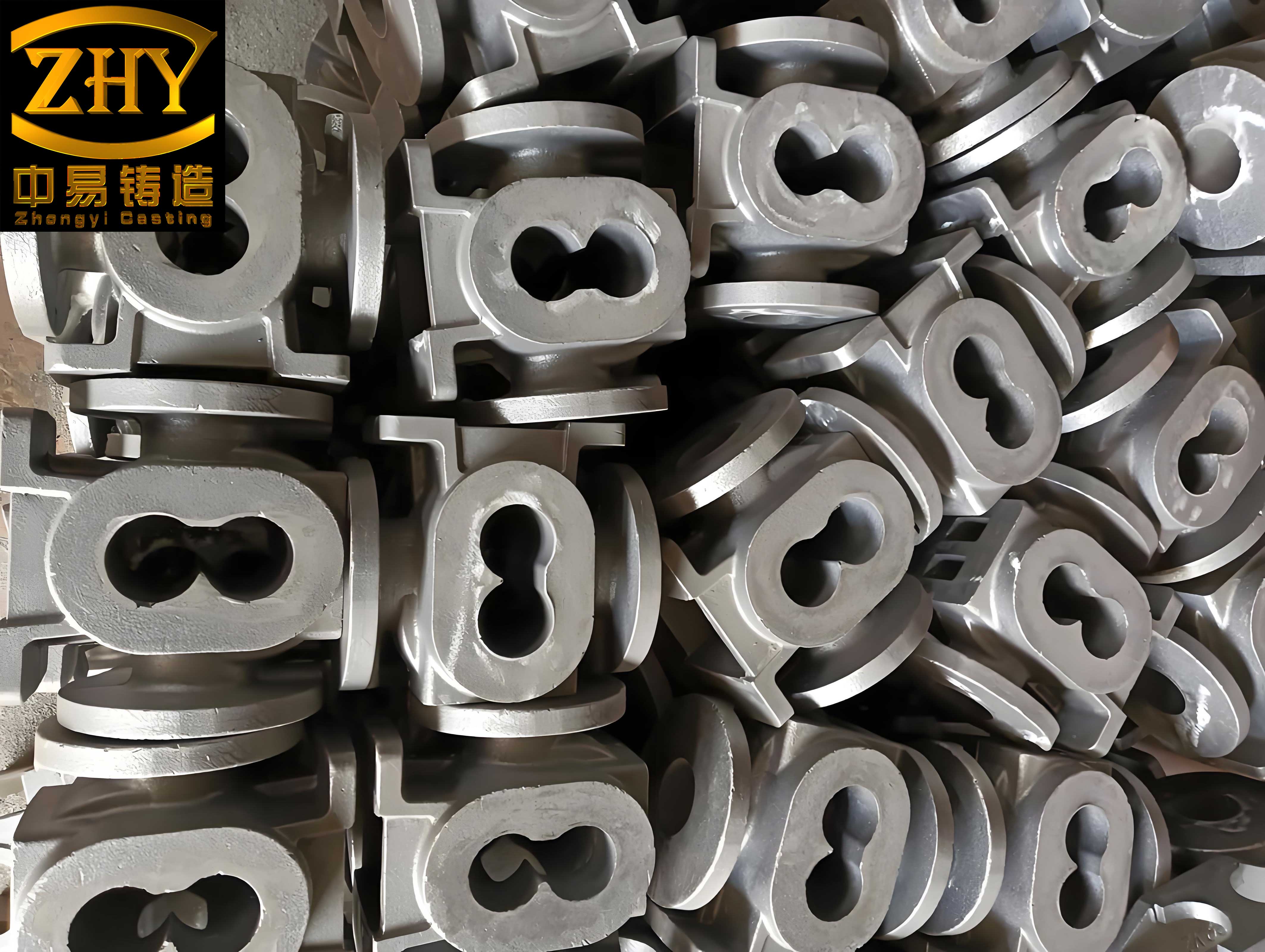
The image above depicts the characteristic spherical graphite nodules in a ferritic matrix, highlighting the effectiveness of inoculation in achieving desired microstructures for wind power bearing housings. Such visual aids are essential for understanding how inoculants influence the final properties of nodular cast iron.
| Sample Group | Nodularity (%) | Graphite Size Distribution | Nodules per mm² | Matrix Structure |
|---|---|---|---|---|
| Si-Ba-Zr | 91.9 | Size 5: 7.4%, Size 6: 68%, Size 7: 23.9% | 144 | Ferrite >95%, Pearlite <5% |
| S-O | 91.3 | Size 5: 11.2%, Size 6: 67.5%, Size 7: 21.3% | 140 | Ferrite >95%, Pearlite <5% |
To further analyze the discrete nature of the data, I plotted distribution curves for key parameters such as tensile strength, yield strength, elongation, and impact energy. These plots reveal that the silicon-barium-zirconium inoculant exhibits tighter clustering in yield strength and elongation, whereas the sulfur-oxygen inoculant shows less scatter in tensile strength. This can be quantified using the coefficient of variation $CV$, defined as:
$$ CV = \frac{\sigma}{\bar{X}} \times 100\% $$
For tensile strength, the $CV$ is 0.85% for silicon-barium-zirconium and 0.48% for sulfur-oxygen, indicating superior consistency with the latter. In contrast, for yield strength, the $CV$ values are 1.40% and 1.74%, respectively, favoring silicon-barium-zirconium. Such statistical insights are crucial for industrial applications where uniformity in nodular cast iron properties directly impacts component longevity and safety.
The underlying mechanisms for these differences lie in the composition of the inoculants. The sulfur-oxygen inoculant contains 1.5–2.0% rare earth elements, predominantly cerium, which enhances nucleation by forming stable oxides and sulfides. Cerium’s high affinity for sulfur and oxygen promotes the creation of dense nucleating particles that resist fading and reduce chilling tendencies. This leads to improved nodularity and microstructure uniformity, as reflected in the metallographic results. Conversely, the silicon-barium-zirconium inoculant includes zirconium, which can absorb nitrogen from mold materials, and barium, which forms dense oxides and sulfides that remain suspended longer in the melt. This prolongs inoculation effectiveness, resulting in more uniform graphite distribution and better mechanical stability. The relationship between inoculant elements and performance can be modeled using thermodynamic equations, such as the nucleation rate $I$:
$$ I = I_0 \exp\left(-\frac{\Delta G^*}{kT}\right) $$
where $I_0$ is a pre-exponential factor, $\Delta G^*$ is the activation energy for nucleation, $k$ is Boltzmann’s constant, and $T$ is temperature. Elements like barium and cerium lower $\Delta G^*$ by providing heterogeneous nucleation sites, thereby increasing $I$ and refining graphite structure in nodular cast iron.
In practical terms, for wind power bearing housings, the choice of inoculant depends on the specific performance requirements. If high impact toughness and ductility are prioritized, as needed for low-temperature environments, silicon-barium-zirconium inoculant is advantageous due to its higher nodule count and better impact resistance. On the other hand, if tensile strength consistency is critical for withstanding cyclic loads, sulfur-oxygen inoculant may be preferred. Both inoculants yield nodular cast iron with excellent overall properties, but optimization requires balancing these factors based on application demands. To aid in decision-making, I developed a performance index $PI$ that combines key metrics:
$$ PI = w_1 \cdot \frac{\sigma_t}{\sigma_{t,\text{max}}} + w_2 \cdot \frac{\delta}{\delta_{\text{max}}} + w_3 \cdot \frac{E_{\text{impact}}}{E_{\text{impact},\text{max}}} $$
where $w_1$, $w_2$, and $w_3$ are weighting factors for tensile strength, elongation, and impact energy, respectively, and the denominators represent maximum values from the dataset. For instance, with equal weights, the silicon-barium-zirconium inoculant scores slightly higher due to its impact energy advantage, underscoring its suitability for harsh conditions.
Additionally, the effect of inoculants on graphite morphology can be described using fractal geometry, where the complexity of nodule shapes influences mechanical behavior. The fractal dimension $D$ of graphite particles can be estimated from micrographs, with higher $D$ values indicating more spherical and uniform nodules. Inoculants that promote spherical graphite, as seen in both types tested, enhance the isotropic properties of nodular cast iron, reducing stress concentrations and improving fatigue life. This is particularly important for bearing housings subjected to multiaxial loading. Empirical data from this study suggest that nodularity above 90% is achievable with both inoculants, meeting industry standards for high-quality nodular cast iron.
From a production perspective, the inoculation process must be carefully controlled to avoid fading, where the effectiveness of nucleants diminishes over time due to reactions with the melt. The fading resistance of an inoculant can be quantified by measuring nodule count as a function of holding time. For silicon-barium-zirconium inoculant, the presence of barium extends this time, making it suitable for slower solidifying castings. In contrast, sulfur-oxygen inoculant’s cerium content provides rapid nucleation but may fade faster. This trade-off influences the casting parameters, such as pouring temperature and cooling rate, which in turn affect the final microstructure of nodular cast iron. I recommend online monitoring techniques, such as thermal analysis, to real-time assess inoculation effectiveness during production.
In conclusion, this comprehensive study demonstrates that both silicon-barium-zirconium and sulfur-oxygen secondary inoculants effectively enhance the properties of nodular cast iron for wind power bearing housings. The silicon-barium-zirconium inoculant offers superior low-temperature impact toughness and stability in yield strength and elongation, attributed to its higher nodule count and uniform graphite distribution. The sulfur-oxygen inoculant excels in tensile strength consistency and microstructural refinement, driven by rare earth elements that facilitate nucleation. The choice between them should be guided by specific application requirements, with silicon-barium-zirconium favoring impact resistance and sulfur-oxygen prioritizing tensile uniformity. Future work could explore hybrid inoculants or advanced modeling to further optimize performance. Ultimately, the insights gained here contribute to the development of more reliable and durable nodular cast iron components for the renewable energy sector, ensuring that wind turbines operate safely under extreme conditions for decades.