
In the field of industrial machinery, reciprocating compressors play a pivotal role in processes such as chemical processing, air separation, and natural gas compression. These compressors rely heavily on robust cylinder blocks, which must withstand high pressures and thermal stresses. Traditionally, the casting of these cylinder blocks, often made from nodular cast iron, involved extensive use of risers to mitigate shrinkage defects. However, in my extensive experience as a casting engineer, I have pioneered a non-riser casting process for large nodular cast iron cylinders, which not only enhances efficiency but also improves material properties. This article delves into the intricacies of this innovative approach, emphasizing the critical role of nodular cast iron in achieving success.
Nodular cast iron, also known as ductile iron, is a material of choice for demanding applications due to its exceptional combination of strength, ductility, and thermal conductivity. The graphite in nodular cast iron forms spheroidal structures, which inhibit crack propagation and enhance mechanical performance. For compressor cylinders, where internal water and air cavities intersect creating complex geometries, the use of nodular cast iron is paramount. The traditional casting method typically employed annular risers to feed molten metal during solidification, but this approach often led to high scrap rates, increased machining time, and material waste. My goal was to develop a non-riser process that leverages the inherent properties of nodular cast iron to achieve sound castings without compromising quality.
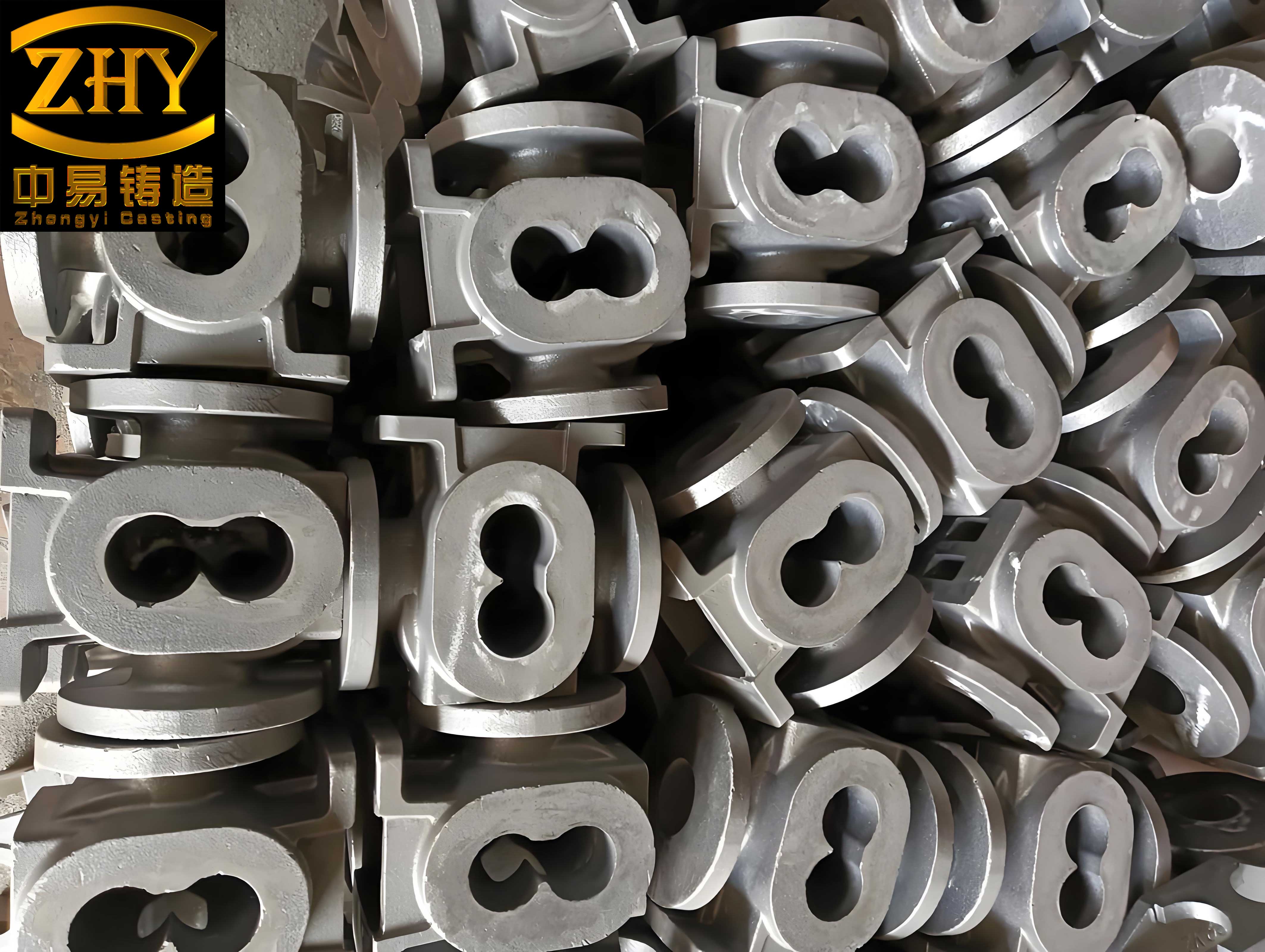
The fundamental principle behind non-riser casting for nodular cast iron lies in harnessing graphite expansion during solidification. When nodular cast iron solidifies, the precipitation of graphite spheroids causes a volumetric expansion that can compensate for liquid and solidification shrinkage. This phenomenon is mathematically described by the expansion coefficient, which depends on the carbon equivalent (CE) and cooling rate. For a successful non-riser process, the chemical composition must be meticulously controlled to promote sufficient graphite nucleation and growth. The carbon equivalent is a key parameter, calculated as:
$$CE = C + \frac{Si}{3}$$
where C and Si are the weight percentages of carbon and silicon, respectively. In our process, we target a CE range of 4.4% to 4.6%, ensuring adequate graphite expansion to counteract shrinkage. This is critical for nodular cast iron, as deviations can lead to shrinkage porosity or excessive pearlite formation. Additionally, other elements are optimized to enhance the properties of nodular cast iron. For instance, manganese and copper are added to stabilize pearlite and improve strength, while magnesium is controlled to facilitate nodularization without causing slag defects. The following table summarizes the target chemical composition for the nodular cast iron used in our compressor cylinders:
| Element | Weight Percentage (w%) | Role in Nodular Cast Iron |
|---|---|---|
| Carbon (C) | 3.6–3.8 | Promotes graphite formation and fluidity |
| Silicon (Si) | 2.2–2.3 | Enhances graphitization and ferrite formation |
| Manganese (Mn) | 0.30–0.45 | Increases pearlite content for strength |
| Copper (Cu) | 0.5–0.6 | Improves hardenability and corrosion resistance |
| Magnesium (Mg) | 0.035–0.055 | Essential for graphite nodularization |
| Sulfur (S) | 0.01–0.03 | Minimized to prevent sulfide inclusions |
The casting process begins with a detailed structural analysis of the cylinder block. The component has dimensions of approximately 1640 mm × 1200 mm × 1450 mm, with a nominal wall thickness of 35 mm. However, local hotspots exist where water and air cavities intersect, creating thermal gradients that can lead to shrinkage defects. In traditional riser-based methods, an annular riser was placed around these hotspots, but this added weight and complexity. For our non-riser approach, we employ chills—metal inserts placed in the mold—to accelerate cooling at these critical areas. The chills act as heat sinks, promoting directional solidification and minimizing shrinkage. The design involves replacing the annular riser with multiple conical vent pins (ø40 mm) to allow gas escape during pouring, as illustrated in earlier schematics. This modification reduces the sand-to-metal ratio, saving molding time and material.
Pouring temperature is another vital parameter in non-riser casting of nodular cast iron. We adhere to the principle of high tapping temperature and low pouring temperature. The molten nodular cast iron is tapped from the furnace at 1490°C to ensure proper homogeneity and nodularization treatment, but it is poured into the mold at 1370–1390°C. This range minimizes oxidation and turbulence, which can introduce defects, while still maintaining sufficient fluidity to fill the complex cavities. The relationship between pouring temperature and solidification time can be expressed using Chvorinov’s rule, where solidification time t is proportional to the volume-to-surface area ratio:
$$t = k \left( \frac{V}{A} \right)^n$$
where k is a mold constant, V is the volume, A is the surface area, and n is an exponent typically around 2 for sand molds. By controlling the pouring temperature, we optimize the solidification sequence to align with graphite expansion, ensuring that the nodular cast iron compensates for shrinkage naturally.
To validate the non-riser process, we conduct extensive computer-aided engineering (CAE) simulations. Using finite element analysis, we model the solidification process of the nodular cast iron cylinder. The simulation accounts for heat transfer, phase transformations, and graphite expansion. The results indicate that while minor point-like shrinkage may occur in isolated hotspots, these defects are negligible and do not compromise the structural integrity of the casting. The simulation output, as seen in thermal contour plots, confirms that the use of chills effectively redirects solidification fronts, eliminating the need for risers. This predictive capability is crucial for scaling the process to other components made from nodular cast iron.
In practice, we have produced a series of eight cylinder blocks using this non-riser method. Each casting, weighing 4600 kg and made from QT450-10A nodular cast iron, underwent rigorous non-destructive testing. Ultrasonic testing (UT) was performed on all machined surfaces, and attached test coupons were evaluated for mechanical properties. The results consistently met national standards and customer specifications, with tensile strengths exceeding 450 MPa and elongations over 10%. Subsequent machining and pressure testing revealed no leaks or failures, demonstrating the reliability of the non-riser process for nodular cast iron components.
The advantages of the non-riser casting process over traditional methods are substantial. Below is a comparative table highlighting key benefits:
| Aspect | Traditional Riser Process | Non-Riser Process for Nodular Cast Iron |
|---|---|---|
| Sand-to-Metal Ratio | High, due to large riser cavities | Reduced by 20–30%, saving molding materials |
| Metal Utilization | Low, with ~1 ton of extra metal in risers | Improved yield, saving approximately 1000 kg of nodular cast iron per casting |
| Machining Time | Extended for riser removal and surface finishing | Significantly reduced, as no riser cutting is required |
| Defect Incidence | Risk of shrinkage at riser junctions | Minimized through controlled solidification and chills |
| Scalability | Limited by riser design complexity | Easily adaptable to various nodular cast iron parts |
From a metallurgical perspective, the success of non-riser casting hinges on the precise control of nodular cast iron’s microstructure. The graphite spheroids in nodular cast iron act as internal reservoirs that expand during the eutectic reaction, countering shrinkage strains. This can be quantified by the expansion pressure P_exp generated by graphite precipitation, given by:
$$P_{\text{exp}} = \alpha \cdot \Delta V_{\text{graphite}} \cdot E$$
where α is a material constant, ΔV_graphite is the volume change due to graphite formation, and E is the modulus of elasticity of the austenite matrix. In nodular cast iron, this pressure can reach several megapascals, sufficient to feed remote sections of the casting. By optimizing inoculation practices—adding ferrosilicon-based inoculants during tapping and pouring—we enhance graphite nucleation, ensuring a uniform distribution of spheroids. This uniformity is vital for consistent expansion across the entire casting, a hallmark of high-quality nodular cast iron.
Looking ahead, the non-riser process for nodular cast iron compressor cylinders has broad implications for the foundry industry. It aligns with sustainability goals by reducing material waste and energy consumption. Moreover, it opens avenues for casting even larger components from nodular cast iron, such as those used in wind turbines or heavy machinery. Ongoing research focuses on refining chill designs and integrating real-time monitoring systems to further optimize the process. For instance, we are exploring the use of advanced sensors to track temperature gradients during solidification, allowing for dynamic adjustments in pouring parameters.
In conclusion, the non-riser casting of nodular cast iron cylinders represents a significant advancement in foundry technology. By leveraging the intrinsic properties of nodular cast iron—particularly its graphite expansion—and combining it with meticulous process control, we have eliminated the need for risers in complex compressor components. This approach not only enhances economic efficiency but also improves the mechanical performance of the castings. As nodular cast iron continues to be a material of choice for critical applications, innovations like this will drive the industry toward more efficient and reliable manufacturing practices. The journey from traditional methods to riser-free casting underscores the importance of material science and simulation in modern engineering, with nodular cast iron at its core.