
In recent years, the demand for high-performance materials in cryogenic environments has surged, particularly for applications in轨道交通 systems such as subways and high-speed trains. Among these materials, ferritic nodular cast iron, specifically grade QT400-18, has gained attention due to its excellent combination of strength, ductility, and toughness. However, achieving consistent mechanical properties at ultra-low temperatures, such as -60°C, remains a significant challenge. This study focuses on the development of a ferritic nodular cast iron tailored for subway transmission boxes operating under such extreme conditions. Through meticulous adjustment of chemical composition, optimization of smelting processes, and implementation of advanced heat treatment protocols, we aim to enhance the microstructure and comprehensive mechanical properties of nodular cast iron. The goal is to meet stringent standards for tensile strength, elongation, hardness, and low-temperature impact toughness, thereby enabling reliable performance in寒冷 regions.
The importance of nodular cast iron in industrial applications cannot be overstated. Nodular cast iron, also known as ductile iron, is characterized by its spherical graphite nodules embedded in a metallic matrix, which impart superior mechanical properties compared to traditional cast irons. For地铁 transmission boxes, which are critical components in train propulsion systems, materials must withstand not only mechanical loads but also thermal stresses induced by low-temperature operations. Previous studies have highlighted the influence of elements like silicon and manganese on the low-temperature impact toughness of nodular cast iron. For instance, researchers have demonstrated that reducing silicon content and controlling manganese levels can significantly improve impact resistance at cryogenic temperatures. However, most existing work focuses on temperatures down to -40°C, with limited exploration of -60°C and beyond. This gap necessitates further investigation into the冶金 factors governing ultra-low temperature performance.
In this work, we adopt a systematic approach to develop a ferritic nodular cast iron with enhanced low-temperature properties. Building on prior research into QT350-22LT for -80°C applications, we modify the composition and processing parameters to achieve QT400-18 grade suitable for -60°C environments. The key aspects include selecting high-purity raw materials, optimizing球化 and inoculation treatments, and designing a tailored heat treatment cycle. By analyzing the microstructure through metallography and evaluating mechanical properties via tensile and impact tests, we aim to correlate process variables with performance outcomes. This article presents a detailed account of our methodology, results, and insights, emphasizing the role of nodular cast iron in advancing轨道交通 technology.
The fundamental principle behind improving low-temperature toughness in nodular cast iron lies in controlling the matrix structure and graphite morphology. In ferritic nodular cast iron, the matrix consists primarily of铁素体, which offers good ductility but limited strength. However, at cryogenic temperatures, the presence of even small amounts of pearlite or carbides can detrimentally affect impact resistance. Therefore, our development strategy centers on achieving a fully ferritic matrix with fine, uniformly distributed graphite nodules. This requires precise control over chemical composition, particularly for elements that influence graphitization and matrix formation. The following sections delve into the specifics of our experimental procedures and findings.
Chemical Composition Design and Raw Materials
The chemical composition of nodular cast iron plays a pivotal role in determining its microstructure and mechanical properties. For ultra-low temperature applications, we target a balance between strength and toughness by optimizing the levels of key elements. Based on prior studies, we identify silicon, manganese, phosphorus, sulfur, and titanium as critical factors. High silicon content can embrittle the matrix at low temperatures, while manganese tends to promote pearlite formation, both of which are undesirable. Therefore, we aim for lower limits of these elements. Additionally, we incorporate nickel to enhance toughness without compromising ferrite stability.
Our raw materials consist of low-titanium pig iron and high-quality low-carbon steel. The low-titanium pig iron is selected to minimize the presence of titanium, which can form harmful carbides and reduce impact toughness. The chemical composition of the low-titanium pig iron is summarized in Table 1.
| Element | C | Si | Mn | P | S | Ti |
|---|---|---|---|---|---|---|
| Content | 4.41 | 0.87 | 0.08 | 0.03 | ≤0.016 | ≤0.027 |
The nodularizer used for球化 treatment is a magnesium-based alloy with rare earth additions to promote graphite nodule formation. Its composition is detailed in Table 2.
| Element | Si | Mg | Ca | RE |
|---|---|---|---|---|
| Content | 45.50 | 5.40 | 1.92 | 0.98 |
For inoculation, we employ two types of孕育剂: a primary inoculant and a随流孕育剂 for late-stage treatment. The compositions are provided in Tables 3 and 4.
| Element | Si | Al | Ca | Ba |
|---|---|---|---|---|
| Content | 64.30 | 1.16 | 1.71 | 7.77 |
| Element | Si | Al | Ca | Bi | RE |
|---|---|---|---|---|---|
| Content | 68.74 | 1.02 | 1.54 | 1.27 | 0.43 |
The charge ratio for smelting is carefully calculated to achieve the desired final composition. We use a mixture of 80% low-titanium pig iron and 17.0-17.05% high-quality low-carbon steel, along with additions of nodularizer, inoculants, and nickel. The exact proportions are listed in Table 5.
| Material | Low-Titanium Pig Iron | High-Quality Low-Carbon Steel | Nodularizer | Primary Inoculant | 随流孕育剂 | Nickel |
|---|---|---|---|---|---|---|
| Percentage (wt.%) | 80 | 17.0-17.05 | 1.40 | 0.60 | 0.15-0.20 | 0.80 |
Nickel is added to improve the low-temperature toughness of the nodular cast iron. The optimal amount is determined based on previous studies, aiming for a balance between cost and performance. The overall target composition for the nodular cast iron is designed to meet the requirements for QT400-18 grade, with adjustments for enhanced cryogenic properties.
Smelting and Processing Optimization
The smelting process is conducted in a 1-ton medium-frequency induction furnace to ensure precise temperature control and homogeneous melting. We begin by charging the raw materials according to Table 5 and heating to approximately 1470°C. At this temperature, we perform rapid carbon equivalent analysis and prepare光谱试块 for compositional verification using a光谱分析仪. This step is crucial for实时调整 of the melt composition. The target carbon equivalent (CE) is calculated using the formula:
$$ CE = C + \frac{Si + P}{3} $$
where C, Si, and P are the weight percentages of carbon, silicon, and phosphorus, respectively. For nodular cast iron, a CE of around 4.3-4.5 is typical to ensure good fluidity and graphitization. However, for low-temperature applications, we aim for a slightly lower CE to reduce the risk of shrinkage defects and improve toughness.
Once the composition is confirmed, we proceed to the球化 treatment. The nodularizer is placed at the bottom of a treatment ladle and compacted to prevent floating during铁液冲入. It is covered with primary inoculant and iron chips, followed by a covering agent to minimize oxidation. The molten iron is then poured into the ladle, initiating the球化 reaction. When about two-thirds of the iron has been transferred, we add secondary inoculant to enhance石墨形核. After completion, the slag is removed, and聚渣剂 is applied to protect the melt.
浇注 is carried out immediately after球化. The随流孕育剂 is pre-dried and added during浇注 using a专用装置 to promote late-stage inoculation, which refines the graphite nodules. Y-block samples are cast from the latter part of the melt for subsequent testing. This systematic approach ensures consistent quality across batches.
The heat treatment process is critical for achieving a fully ferritic matrix. We design a thermal cycle that involves austenitizing at 930°C for 3 hours, followed by controlled cooling to 630°C at a rate of 70°C/h, and finally炉冷 to 100°C before air cooling. This protocol aims to eliminate pearlite and carbides, promoting the formation of fine, equiaxed ferrite grains. The heating and cooling rates are optimized based on the kinetics of phase transformations in nodular cast iron. The transformation from austenite to ferrite can be described by the Avrami equation:
$$ f = 1 – \exp(-kt^n) $$
where \( f \) is the fraction transformed, \( k \) is a rate constant, \( t \) is time, and \( n \) is the Avrami exponent. For ferrite formation in nodular cast iron, \( n \) typically ranges from 1 to 2, depending on the nucleation and growth mechanisms. By controlling the cooling rate, we can manipulate the ferrite grain size, which directly impacts toughness.
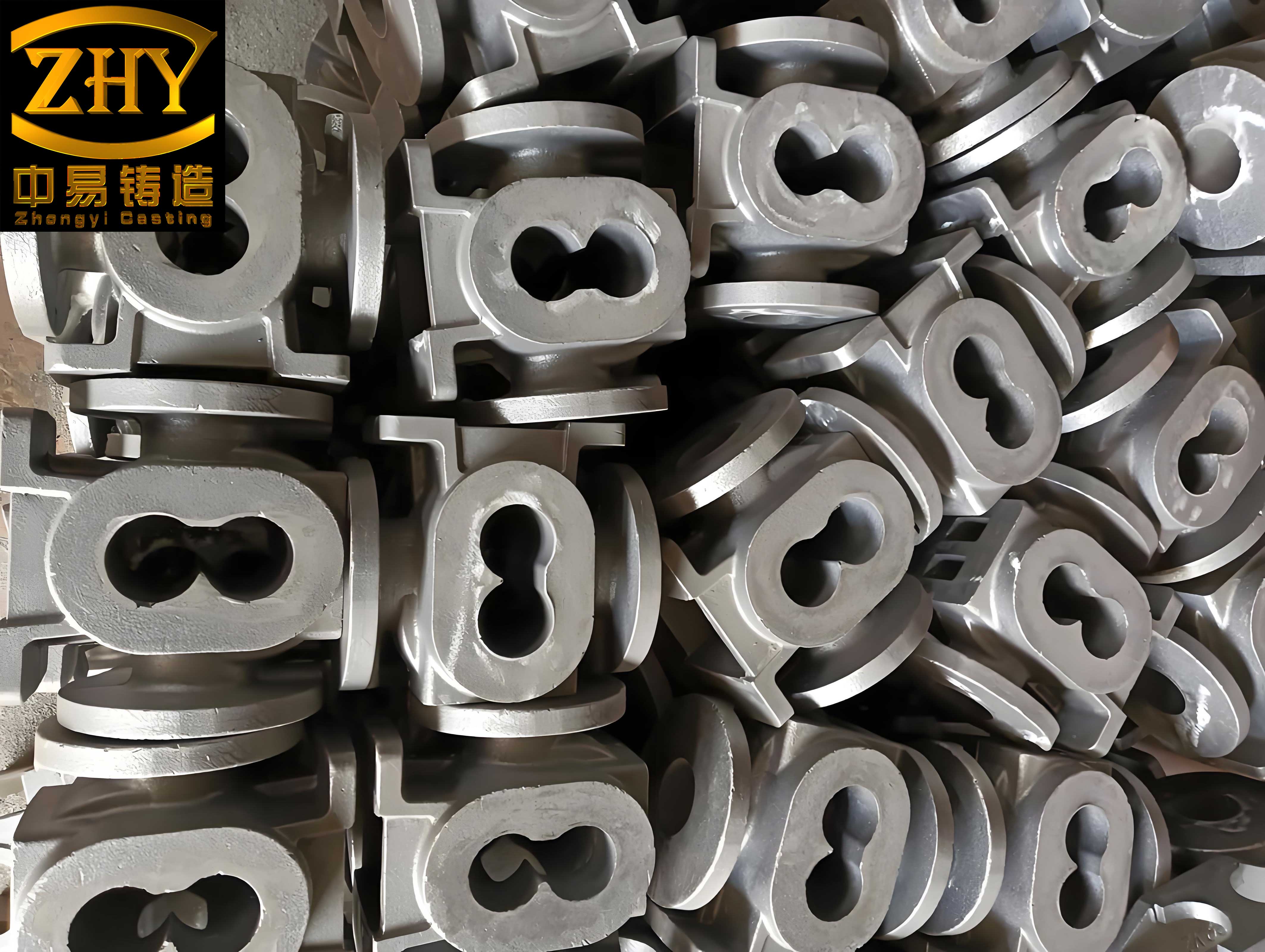
After heat treatment, the cast components, including subway transmission boxes, are machined to final dimensions. The成品 exhibits a fine microstructure suitable for cryogenic service.
Microstructural Characterization and Mechanical Properties Evaluation
To assess the effectiveness of our development, we conduct comprehensive microstructural and mechanical tests on samples extracted from Y-blocks. Metallographic analysis is performed using an optical microscope to examine the石墨 morphology and matrix structure. The nodularity, defined as the percentage of graphite particles with spherical shape, is calculated using image analysis software. Additionally, the average graphite nodule diameter and distribution are measured.
The results reveal a significant improvement in microstructure after optimization. The nodular cast iron exhibits a fully ferritic matrix with石墨球化率达到 86.3%, average nodule diameter of 39 μm, and uniform distribution. The ferrite grains are fine and equiaxed, indicating effective heat treatment. This refined microstructure is conducive to enhanced mechanical properties, particularly low-temperature impact toughness.
Mechanical testing includes tensile tests, hardness measurements, and Charpy impact tests at various temperatures. Tensile tests are conducted on standard specimens using a hydraulic universal testing machine, while hardness is measured using the Brinell method. Impact tests are performed on V-notched specimens at -20°C, -40°C, and -60°C according to ISO 148-1-2009 standards. The data are summarized in Table 6.
| Sample State | Tensile Strength (MPa) | Yield Strength (MPa) | Elongation (%) | Hardness (HB) | Impact Energy at -20°C (J) | Impact Energy at -40°C (J) | Impact Energy at -60°C (J) |
|---|---|---|---|---|---|---|---|
| As-Cast | 421 | 296 | 15 | 213 | – | – | – |
| Heat-Treated | 408 | 281 | 20 | 137 | 15.1 | 13.6 | 12.7 |
| Heat-Treated | 411 | 273 | 21 | 141 | 14.6 | 12.9 | 12.3 |
| Heat-Treated | 405 | 285 | 21 | 140 | 15.3 | 13.9 | 12.3 |
The data demonstrate that the heat-treated nodular cast iron meets and exceeds the requirements for QT400-18 grade. The tensile strength is above 400 MPa, elongation exceeds 18%, hardness falls within 135-180 HB, and impact energy at -60°C is consistently above 12 J. These values satisfy the stringent standards for subway transmission boxes in ultra-low temperature environments.
To further analyze the impact toughness, we consider the relationship between temperature and impact energy. The ductile-to-brittle transition temperature (DBTT) is a critical parameter for nodular cast iron. Lower DBTT indicates better low-temperature performance. Our developed material shows a gradual decrease in impact energy with temperature, but remains above the threshold of 12 J even at -60°C. This behavior can be modeled using an exponential decay function:
$$ E = E_0 \exp\left(-\frac{T – T_0}{\theta}\right) $$
where \( E \) is impact energy, \( E_0 \) is the energy at reference temperature \( T_0 \), \( T \) is the test temperature, and \( \theta \) is a material constant. For our nodular cast iron, \( \theta \) is estimated to be around 50 K, indicating good retention of toughness at cryogenic temperatures.
Discussion on Factors Influencing Low-Temperature Performance
The success in developing this ultra-low temperature nodular cast iron can be attributed to several key factors. First, the chemical composition is meticulously controlled to minimize elements that impair toughness. Silicon, while essential for graphitization, is kept at moderate levels to avoid embrittlement. Manganese is reduced to below 0.1% to prevent pearlite formation. Nickel addition enhances both strength and toughness by solid solution strengthening and promoting ferrite stability.
Second, the smelting and processing optimizations ensure high purity and homogeneity of the melt. The use of low-titanium pig iron reduces the risk of titanium carbides, which can act as stress concentrators. The球化 and inoculation treatments promote the formation of fine, spherical graphite nodules, which improve mechanical properties by reducing stress concentrations around graphite particles. The effectiveness of inoculation can be quantified by the nodule count per unit area, which we observed to increase with proper随流孕育剂 addition.
Third, the heat treatment protocol is designed to achieve a fully ferritic matrix. The austenitizing temperature and time are sufficient to dissolve carbides, while the controlled cooling rate allows for complete ferrite transformation without pearlite formation. The resulting fine ferrite grains enhance both strength and toughness through the Hall-Petch relationship:
$$ \sigma_y = \sigma_0 + k_y d^{-1/2} $$
where \( \sigma_y \) is yield strength, \( \sigma_0 \) is friction stress, \( k_y \) is a constant, and \( d \) is grain diameter. Smaller grain sizes lead to higher strength and improved toughness, as they impede crack propagation.
Moreover, the impact toughness of nodular cast iron at low temperatures is influenced by the matrix microstructure and graphite morphology. In fully ferritic nodular cast iron, the primary failure mode is ductile fracture with dimpled surfaces. However, at cryogenic temperatures, brittle fracture may occur if the matrix contains residual stresses or inclusions. Our microstructural analysis confirms the absence of such defects, contributing to the high impact values.
Comparing our results with prior studies, we note that previous attempts to achieve -60°C impact toughness in nodular cast iron often fell short of 12 J. By integrating composition design, process optimization, and heat treatment, we have successfully developed a material that meets this benchmark. This advancement opens up new possibilities for nodular cast iron in extreme环境 applications.
Applications and Future Perspectives
The developed ferritic nodular cast iron is particularly suitable for地铁 transmission boxes, where components must operate reliably under ultra-low temperatures. Transmission boxes are subjected to cyclic loads and thermal shocks, requiring materials with excellent fatigue resistance and toughness. Our material not only meets the mechanical property standards but also offers good machinability and cost-effectiveness compared to alternative materials like steel or aluminum alloys.
Beyond subway systems, this nodular cast iron could be applied in other cryogenic environments, such as wind turbine hubs, offshore platforms, and aerospace components. The versatility of nodular cast iron makes it a promising candidate for various engineering challenges. Future work could focus on further refining the composition to achieve even lower DBTT, perhaps down to -80°C or below. Additionally, investigating the effects of other alloying elements, such as copper or molybdenum, may yield further improvements.
Another area for exploration is the integration of advanced manufacturing techniques, such as additive manufacturing, for producing complex geometries in nodular cast iron. This could enhance design flexibility and reduce material waste. Furthermore, long-term durability studies under simulated service conditions would validate the performance of this material in real-world applications.
In conclusion, the development of ultra-low temperature ferritic nodular cast iron represents a significant step forward in materials science for轨道交通. By addressing the challenges of cryogenic performance, we contribute to the safety and efficiency of subway systems in寒冷 regions. The methodologies and insights presented here can guide future research and industrial applications of nodular cast iron.
Conclusion
In this study, we have successfully developed a ferritic nodular cast iron with enhanced mechanical properties for ultra-low temperature applications, specifically targeting subway transmission boxes. Through careful adjustment of chemical composition, optimization of smelting and球化 processes, and implementation of a tailored heat treatment cycle, we achieved a microstructure characterized by fine, spherical graphite nodules in a fully ferritic matrix. The resulting material meets the QT400-18 grade requirements, with tensile strength above 400 MPa, elongation over 18%, hardness in the range of 135-180 HB, and impact energy at -60°C exceeding 12 J. These properties satisfy the stringent standards for cryogenic service, demonstrating the potential of nodular cast iron in advanced轨道交通 systems. Our work underscores the importance of integrated process control in材料开发 and paves the way for further innovations in nodular cast iron technology.
The success of this development hinges on the synergistic effects of composition design and processing optimizations. By minimizing detrimental elements like silicon and manganese, and incorporating nickel for toughness enhancement, we have crafted a nodular cast iron that performs reliably under extreme conditions. The heat treatment protocol, involving austenitizing and controlled cooling, ensures a fully ferritic matrix with fine grains, which is crucial for maintaining toughness at low temperatures. Future research could explore additional alloying strategies and advanced manufacturing methods to push the boundaries of nodular cast iron performance even further.
Overall, this study highlights the versatility and potential of nodular cast iron as a high-performance material for demanding applications. As the demand for cryogenic-resistant materials grows, particularly in轨道交通 and renewable energy sectors, the insights gained from this work will be invaluable. We hope that our findings inspire further research and development in the field of nodular cast iron, ultimately contributing to technological advancements and improved safety in various industries.