
In the realm of internal combustion engines, piston rings are indispensable components that must exhibit high wear resistance and strength. As engine designs increasingly trend toward higher loads, the performance demands on these rings have escalated. Nodular cast iron, known for its superior properties, has become a prevalent material for manufacturing piston rings. In this article, I delve into the common casting defects encountered during the production of nodular cast iron piston rings and propose effective remedial strategies. My analysis is grounded in practical production experiences, focusing on the inherent characteristics of nodular cast iron and how they influence the casting process.
The unique solidification behavior of nodular cast iron is central to understanding its casting challenges. This material typically has a carbon content around 4.9% by mass, placing it near the eutectic composition. When hypereutectic iron melt is treated with nodularizing agents and cooled, graphite nucleates in a spheroidal form and grows. As the temperature drops, an austenite shell forms around the graphite nodules, and carbon atoms diffuse through this shell to feed the growing graphite, while iron atoms diffuse outward, thickening the austenite layer. This process, however, is characterized by relatively slow diffusion rates.
A comparative look at the cooling curves of gray iron and nodular cast iron reveals critical differences. The solidification of nodular cast iron involves a wide temperature range during the eutectic reaction. Due to its lower thermal conductivity compared to gray iron, heat dissipation is slower, necessitating greater undercooling to promote graphite growth. This results in a mushy or pasty solidification mode, where the entire casting remains in a semi-solid state internally even after the surface has solidified, rather than forming a fully solid shell. The eutectic transformation occurs at lower temperatures, with graphite nodules growing in a dispersed, non-continuous manner, leading to a structure where the solid and liquid phases coexist extensively. This mushy solidification is a defining trait of nodular cast iron and is responsible for many casting defects, as it can block feeding channels and create isolated liquid pockets.
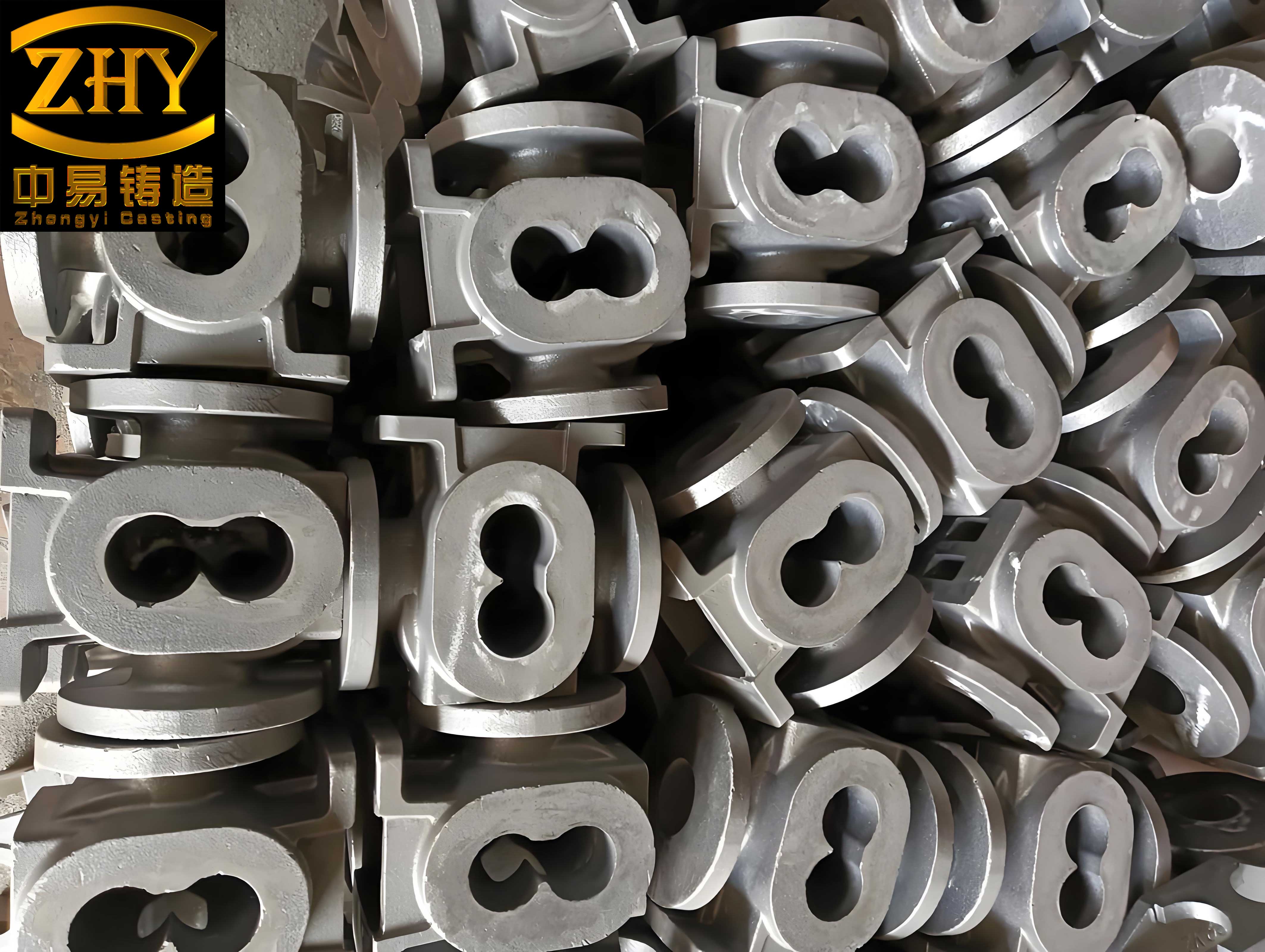
The following table contrasts key solidification parameters between gray iron and nodular cast iron, highlighting the challenges inherent in working with nodular cast iron.
| Parameter | Gray Cast Iron | Nodular Cast Iron |
|---|---|---|
| Solidification Mode | Directional, with a distinct solid front | Mushy or pasty, with simultaneous solidification throughout |
| Thermal Conductivity | Higher, facilitating faster heat transfer | Lower, leading to slower cooling and greater undercooling needs |
| Eutectic Temperature Range | Narrower | Wider, extending the solidification time |
| Graphite Morphology | Flake-like, interconnected | Spheroidal, isolated nodules |
| Feeding Characteristics | Easier due to directional solidification | Difficult due to blocked interdendritic channels |
The mushy solidification of nodular cast iron directly contributes to defects such as shrinkage porosity, gas holes, and inclusions. In the following sections, I will analyze these defects in detail, starting with subcutaneous blowholes and slag inclusions, which are particularly problematic in piston ring casting.
Subcutaneous Blowholes: Causes and Countermeasures
Subcutaneous blowholes often appear as spherical voids located just beneath the casting surface, typically within 1-2 mm. In cylinder liner castings, they are found near the outer cylindrical surface, while in double-ring castings, they appear closer to the upper face. These defects become visible only after machining and are primarily composed of hydrogen gas. The formation of subcutaneous blowholes is complex, involving gas sources from both external invasion and internal evolution within the iron melt.
Root Causes of Subsurface Porosity
The primary gas involved is hydrogen. Externally, hydrogen can originate from moisture in the mold sand reacting with the melt. Internally, hydrogen arises from decomposition of moisture in charge materials, lining materials, or from chemical reactions during treatment. Key reactions include the interaction of magnesium vapor—a residue from nodularizing treatment—with water vapor from the mold:
$$ \text{Mg} + \text{H}_2\text{O} \rightarrow \text{MgO} + 2\{\text{H}\} $$
Magnesium also acts as a catalyst, facilitating the reaction between carbon and water:
$$ \text{C} + \text{H}_2\text{O} \rightarrow \text{CO} + \text{H}_2 $$
Additionally, water can react with iron and magnesium carbides to form acetylene, which decomposes into hydrogen:
$$ \{\text{Fe} \cdot \text{Mg}\}\text{C} + \text{H}_2\text{O}(\text{g}) \rightarrow (\text{Fe} \cdot \text{Mg})\text{O} + \text{C}_2\text{H}_2 $$
$$ \text{C}_2\text{H}_2 \rightarrow 2\text{C} + \text{H}_2 $$
Furthermore, after nodularizing treatment, an oxide film forms on the melt surface due to magnesium’s activation. This film increases the interfacial tension between the mold and the metal, trapping gases at the interface. As the surface layer solidifies, these gases are encapsulated, forming blowholes.
Preventive Measures for Blowholes
To mitigate subcutaneous blowholes, control over mold sand and melt chemistry is crucial. The table below summarizes effective strategies based on my observations in production settings.
| Factor | Target Control | Rationale |
|---|---|---|
| Mold Sand Moisture | Maintain at 4.1–4.5% for different casting types; permeability >80 units | Reduces water vapor generation at mold-metal interface |
| Preheating of Materials | Preheat nodularizing agents and treatment ladles to ~200°C | Minimizes hydrogen from residual moisture |
| Melt Sulfur and Magnesium Levels | Keep residual magnesium below 0.08% and sulfur low | Lowers oxide film formation temperature; reduces gas entrapment |
| Pouring Temperature | Optimize to avoid excessive superheat or low temperatures | Balances fluidity and gas evolution rates |
By adhering to these measures, the incidence of blowholes in nodular cast iron castings can be significantly reduced, enhancing the integrity of piston rings.
Slag Inclusions: Formation and Mitigation
Slag inclusions, or non-metallic inclusions, consist of oxides, sulfides, and silicates that become entrapped in the casting. These defects compromise the mechanical properties and surface quality of nodular cast iron piston rings.
Origins of Inclusion Defects
Inclusions primarily form during or after the nodularizing treatment. When magnesium and rare earth elements are added, they react with sulfur and oxygen to form compounds like magnesium silicate and rare earth oxides. These compounds have lower density than the melt and may float to the surface; however, incomplete slag removal or low melt temperatures can cause them to remain suspended. Moreover, magnesium promotes oxidation, leading to the formation of a viscous oxide film on the melt surface. This film, which exists in a semi-solid state, is difficult to remove entirely during slag skimming. As the melt is transferred or held, continued exposure to air exacerbates oxide formation, resulting in entrapped slag.
The tendency for slag formation can be quantified by considering the interplay of elements. The stability of oxides is influenced by the activity of magnesium and sulfur. A higher residual magnesium content increases the oxidation potential, while sulfur can combine with magnesium to form sulfides that may act as inclusion nuclei. The following empirical relation highlights factors affecting slag formation tendency $S_f$:
$$ S_f \propto \frac{[\text{Mg}]_{\text{res}} \cdot [\text{S}]_0}{T_{\text{pour}}} $$
where $[\text{Mg}]_{\text{res}}$ is residual magnesium content, $[\text{S}]_0$ is initial sulfur content, and $T_{\text{pour}}$ is pouring temperature. Lower pouring temperatures thicken the oxide film, increasing inclusion risk.
Process Strategies to Minimize Inclusions
Effective control of melt chemistry and processing parameters is essential. The table below outlines key practices I recommend for reducing slag inclusions in nodular cast iron.
| Process Parameter | Optimal Range or Action | Effect on Inclusions |
|---|---|---|
| Residual Magnesium | Keep as low as feasible, typically 0.03–0.05% | Reduces oxide film thickness and formation temperature |
| Initial Sulfur Content | Minimize below 0.015% | Decreases sulfide formation and slag volume |
| Rare Earth Addition | Control to necessary minimum (e.g., 0.01–0.02%) | Excess rare earth raises film temperature but may impair graphite spheroidization |
| Pouring Temperature | Maintain above 1350°C for thin sections | Higher temperature improves slag floatation and reduces film viscosity |
| Slag Removal | Thorough skimming post-treatment; use covering fluxes | Physically removes formed slag before pouring |
| Melt Handling | Minimize turbulence; use tundish or ceramic filters | Prevents re-oxidation and entrains existing inclusions |
Implementing these strategies requires careful monitoring, but it drastically cuts down inclusion-related rejects in nodular cast iron piston ring production.
Shrinkage Porosity in Nodular Cast Iron
Another critical defect arising from the mushy solidification of nodular cast iron is shrinkage porosity. Unlike concentrated shrinkage cavities, porosity appears as dispersed microvoids due to inadequate feeding during solidification. The wide solidification range and interdendritic fluid flow restrictions in nodular cast iron make it prone to this defect, especially in thick sections or hot spots of piston rings.
The propensity for shrinkage can be assessed using the feeding efficiency factor $F_e$, which relates to the solidification characteristics:
$$ F_e = \frac{\alpha \cdot G}{\sqrt{t_s}} $$
where $\alpha$ is thermal diffusivity, $G$ is temperature gradient, and $t_s$ is local solidification time. For nodular cast iron, low thermal diffusivity and high solidification time reduce $F_e$, indicating poor feeding. To combat this, directional solidification techniques are employed, such as using chills or optimizing gating and risering systems.
The table below compares factors influencing shrinkage in nodular cast iron versus gray iron, underscoring the need for tailored design in nodular cast iron castings.
| Aspect | Gray Cast Iron | Nodular Cast Iron |
|---|---|---|
| Solidification Shrinkage | ~1% volume contraction | ~4–6% volume contraction, requiring more feed metal |
| Feeding Path | Relatively open due to flake graphite | Blocked by graphite nodules and austenite dendrites |
| Riser Design | Smaller risers sufficient | Larger, more numerous risers needed; often use exothermic sleeves |
| Chill Usage | Less critical | Essential to promote directional solidification in critical areas |
In my practice, combining simulation software with empirical rules has proven effective in designing riser and chill layouts for nodular cast iron piston rings, minimizing shrinkage defects.
Graphite Degeneration and Mechanical Property Issues
Beyond macroscopic defects, nodular cast iron can suffer from graphite degeneration, where spheroidal graphite reverts to flake or vermicular forms, degrading mechanical properties. This is often linked to trace elements like titanium, lead, or antimony, or to insufficient nodularizing treatment. Maintaining high nodule count and ensuring spherical graphite morphology are vital for the fatigue strength and wear resistance of piston rings.
The nodule count $N$ per unit area correlates with mechanical performance. It can be estimated from cooling rate $R$ and melt treatment efficacy:
$$ N = k \cdot R^{1/2} \cdot [\text{Mg}]_{\text{eff}} $$
where $k$ is a constant and $[\text{Mg}]_{\text{eff}}$ is effective magnesium available for nodularization. Process controls include using high-purity charge materials, proper inoculation, and rapid cooling where feasible.
To ensure consistent quality, I advocate for rigorous melt control and testing. The following table summarizes key checks for maintaining graphite quality in nodular cast iron.
| Control Point | Method | Target Value for Piston Rings |
|---|---|---|
| Chemical Composition | Spectral analysis | C: 3.6–3.9%, Si: 2.0–2.5%, Mg: 0.03–0.05%, S < 0.015% |
| Nodule Count | Metallographic examination | >100 nodules/mm², >80% spheroidicity |
| Inoculation | Late inoculation with FeSi alloys | 0.2–0.4% addition, just before pouring |
| Cooling Rate | Design of mold and chills | Achieve cooling rates >10°C/s in critical sections |
By focusing on these parameters, the desired microstructure and properties of nodular cast iron can be consistently achieved.
Integrated Process Optimization for Nodular Cast Iron Piston Rings
To holistically address casting defects, an integrated approach covering melt preparation, mold design, and process monitoring is essential. From my experience, the synergy between various factors determines the final quality of nodular cast iron castings. Below, I present a comprehensive table that ties together key process variables and their interactions for producing defect-free piston rings.
| Process Stage | Critical Variables | Optimal Settings | Impact on Defects |
|---|---|---|---|
| Melt Preparation | Charge Material Purity | Low S, P, and trace elements | Reduces inclusions, improves nodularization |
| Nodularizing Treatment | Mg-Fe-Si alloys with controlled RE; treatment temp 1450–1500°C | ||
| Inoculation | FeSi75 with Ba/Ca; addition rate 0.3–0.5% | ||
| Mold Design | Sand Properties | Moisture 4.0–4.5%, bentonite 8–10%, permeability >80 | Minimizes gas defects, ensures dimensional stability |
| Gating and Riser System | Pressurized gating; risers sized per modulus method | ||
| Pouring and Solidification | Pouring Temperature | 1320–1380°C depending on section thickness | Controls fluidity, feeding, and gas evolution |
| Cooling Rate Control | Use of chills and insulating sleeves to direct solidification | ||
| Post-Casting | Heat Treatment | Annealing at 900–950°C to relieve stresses and improve machinability | Mitigates residual stresses that could exacerbate micro-porosity |
Implementing such a controlled process flow, backed by statistical process control, has enabled consistent production of high-quality nodular cast iron piston rings in my work.
Conclusion
In summary, the production of nodular cast iron piston rings is fraught with challenges stemming from the material’s mushy solidification and reactive nature. Defects like subcutaneous blowholes, slag inclusions, and shrinkage porosity can significantly impair performance. Through detailed analysis and practical experimentation, I have identified that controlling melt chemistry—particularly magnesium, sulfur, and rare earth levels—along with meticulous mold sand management and optimized pouring practices, are key to mitigating these issues. The use of chills and tailored riser designs further alleviates shrinkage concerns. Ultimately, a deep understanding of nodular cast iron’s solidification behavior, coupled with disciplined process execution, allows for the manufacture of durable, high-performance piston rings that meet the stringent demands of modern engines. Continued research and adaptation of advanced foundry techniques will further enhance the reliability and efficiency of nodular cast iron components in critical applications.