
The unique combination of castability, excellent mechanical properties, cost-effectiveness, and good machinability has cemented nodular cast iron as a cornerstone material in heavy machinery and equipment manufacturing. A critical aspect of its performance lies in the matrix microstructure, which can be tailored through alloying and heat treatment. While as-cast nodular cast iron offers a good baseline, achieving high-strength grades like QT700-3 or QT650-3 for demanding applications, especially in large-section castings, almost invariably requires a subsequent normalizing heat treatment. This article delves into the scientific principles and practical considerations of the normalizing process, with a specific focus on its application to large, copper-microalloyed components, exploring the critical interplay between temperature, cooling rate, and final properties.
The superior properties of nodular cast iron stem from its distinctive microstructure: spheroidal graphite nodules embedded in a metallic matrix. Unlike the flake graphite in gray iron, these spheroids blunt crack propagation, giving the material ductility and toughness. The matrix, typically comprising ferrite and pearlite, governs strength and hardness. The graphite acts as an internal carbon reservoir. During heat treatment, carbon atoms diffuse between the graphite nodules and the surrounding austenite, allowing precise control over the matrix’s carbon content and, consequently, its phase transformation behavior upon cooling. This characteristic is fundamental to heat treating nodular cast iron.
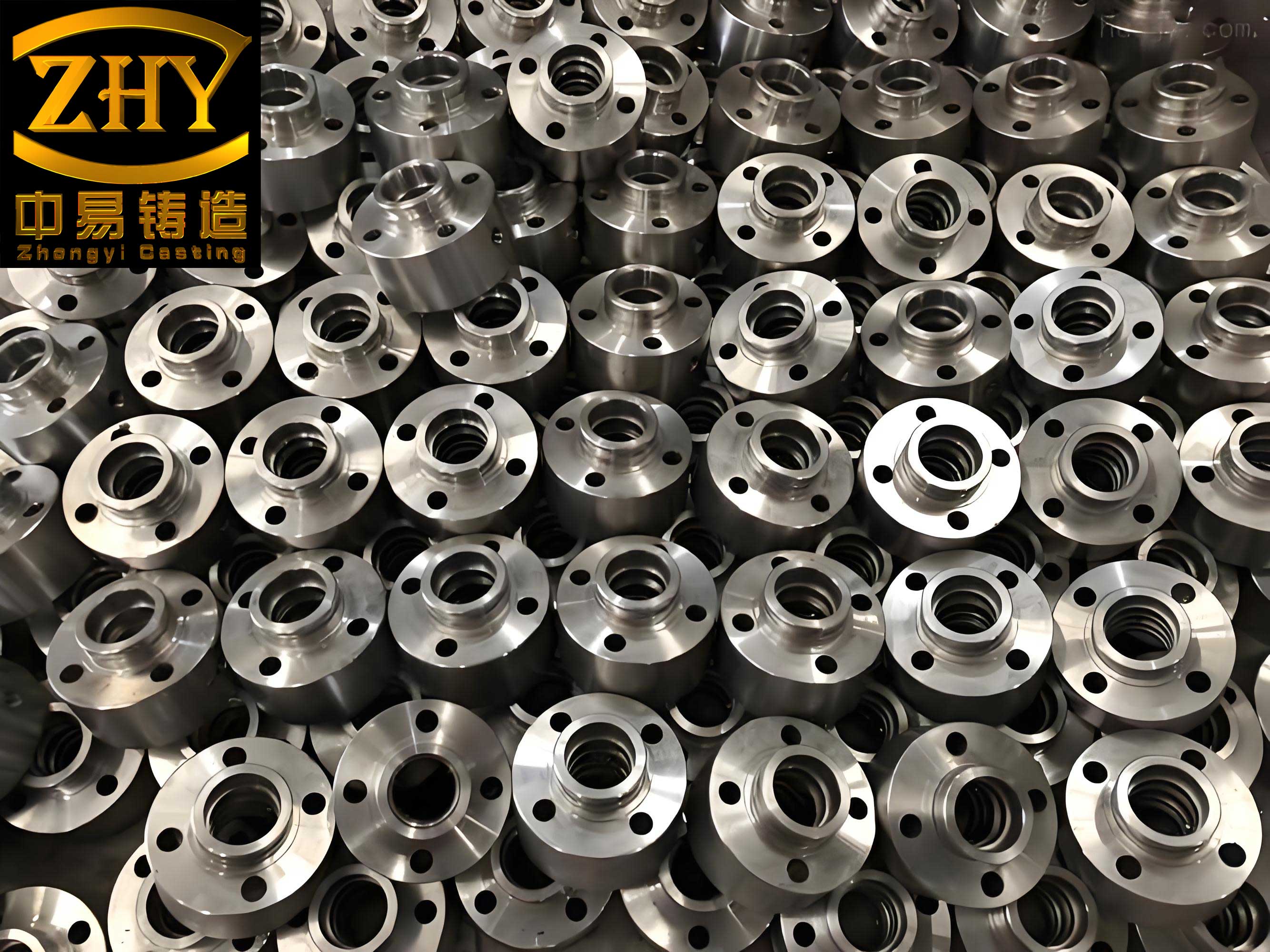
For large castings, such as heavy-duty travel wheels, the slow cooling rate inherent in the sand casting process often results in a predominantly ferritic matrix with a low pearlite fraction. This yields inadequate tensile strength for high-load applications. The challenge, therefore, is to design a normalizing cycle that promotes a high-pearlite-content matrix throughout the entire cross-section of a large, high-thermal-mass component. The addition of alloying elements like copper plays a pivotal role in this endeavor.
The Role of Copper Microalloying in Nodular Cast Iron
Copper is a potent and commonly used alloying element in nodular cast iron. Its effects are multifaceted:
- Pearlite Promotion: Copper significantly expands the temperature range for pearlite formation and retards the transformation of austenite to ferrite. It strongly promotes a pearlitic matrix, even at moderate cooling rates.
- Solid Solution Strengthening: Copper dissolves in the ferrite lamellae within pearlite, providing solid solution strengthening, which enhances the strength of the pearlitic matrix itself.
- Lowered Transformation Temperature: Copper lowers the eutectoid transformation temperature. This allows for effective austenitization at potentially lower temperatures, which can be beneficial for retaining some toughness as the austenite carbon content is kept lower.
- Enhanced Hardenability: It increases the stability of undercooled austenite, shifting the Continuous Cooling Transformation (CCT) curve to longer times. This makes it easier to obtain pearlite instead of ferrite during cooling, which is crucial for large castings.
A typical composition for a copper-microalloyed, high-strength nodular cast iron might be as summarized below:
| C | Si | Mn | P | S | Cu | Mg |
|---|---|---|---|---|---|---|
| 3.5 – 3.7 | 2.0 – 2.3 | 0.3 – 0.5 | < 0.04 | < 0.015 | 0.4 – 0.6 | 0.03 – 0.05 |
Despite the pearlite-promoting effect of copper, the as-cast microstructure of a large wheel might still contain only 40-50% pearlite, with a hardness around 180 HBW, falling short of the target specifications for QT650-3 or QT700-3, which typically require a minimum pearlite content of 80% and higher hardness.
| Grade | Tensile Strength, Rm (MPa), min | Yield Strength, Rp0.2 (MPa), min | Elongation, A (%) | Hardness (HBW) |
|---|---|---|---|---|
| QT650-3 | 650 | 420 | 3 | 220 – 280 |
| QT700-3 | 700 | 440 | 3 | 235 – 305 |
Fundamentals of the Normalizing Process for Nodular Cast Iron
Normalizing involves heating the nodular cast iron casting to a temperature above the upper critical (Ac3) temperature to achieve full austenitization, holding for sufficient time to homogenize carbon, followed by cooling in still or forced air. The process aims to:
- Eliminate the as-cast dendritic structure and chemical segregation.
- Obtain a fine, uniform pearlitic matrix (often with a small amount of ferrite).
- Increase strength, hardness, and wear resistance.
The process can be described by three key stages:
1. Austenitization
Heating to the normalizing temperature (TN) transforms the ferrite-pearlite matrix into austenite (γ). Carbon from the dissolving pearlite and, more importantly, from the graphite nodules diffuses into this newly formed austenite. The equilibrium carbon content in austenite (Cγ) at a given temperature is a critical parameter. It increases with increasing austenitizing temperature, approximately following the Acm line extension in the Fe-C phase diagram. For nodular cast iron, this can be estimated. The diffusion of carbon is governed by Fick’s laws. The carbon gradient and diffusion distance are crucial for homogeneous austenite. The approximate carbon content in austenite in equilibrium with graphite can be described by a simplified relation:
$$ C_{\gamma}(T) \approx C_0 + k \cdot (T – T_0) $$
Where \(C_{\gamma}(T)\) is the carbon content at temperature T, \(C_0\) is a base carbon content, \(k\) is a positive constant, and \(T_0\) is a reference temperature. Practically, at 850°C, the austenite carbon saturation is around 0.65-0.70%, while at 900°C, it approaches 0.75-0.80%.
2. Cooling and Transformation
Upon cooling, the undercooled austenite decomposes. The final microstructure depends on the cooling rate and the chemical composition (hardenability). The Time-Temperature-Transformation (TTT) or CCT diagram is the key map. The cooling curve for a given point in the casting must avoid the ferrite “nose” and pass through the pearlite transformation zone to achieve the desired high pearlite fraction. The critical cooling rate (\(V_{crit}\)) to avoid excessive ferrite formation is given by:
$$ V_{crit} = \frac{T_A – T_{Pnose}}{t_{Pnose}} $$
where \(T_A\) is the austenitizing temperature, \(T_{Pnose}\) is the temperature at the nose of the pearlite transformation curve, and \(t_{Pnose}\) is the time to the start of transformation at that nose. Elements like Cu, Mn, and Mo increase \(t_{Pnose}\), effectively lowering \(V_{crit}\), which is beneficial for large castings.
3. Tempering (Stress Relief)
Following normalizing, a tempering treatment at 550-600°C is commonly applied. This relieves internal stresses induced during cooling, slightly reduces hardness, and improves toughness and dimensional stability without significantly lowering strength.
The Critical Impact of Normalizing Temperature
The choice of normalizing temperature is arguably the most critical parameter for large-section nodular cast iron. The provided case study highlights a clear distinction between 850°C and 880°C.
Low-Temperature Normalizing (e.g., 850°C)
At 850°C, austenitization occurs, but the equilibrium carbon content in austenite (\(C_{\gamma}\)) is relatively low. Upon moderate cooling (e.g., forced air), the transformation sequence often involves:
- Precipitation of proeutectoid ferrite at austenite grain boundaries and around graphite nodules.
- Subsequent transformation of the remaining carbon-enriched austenite to pearlite.
For a large casting with slow effective cooling, the time spent in the ferrite formation zone is prolonged, leading to a significant volume fraction of ferrite (25-30% or more). The resulting microstructure consists of “broken” or networked ferrite surrounding graphite nodules, with islands of pearlite in the inter-nodular regions. This structure yields moderate strength and good ductility but fails to meet high-strength specifications. The tensile strength typically ranges between 650-700 MPa, which is at the lower threshold for QT700-3 and leaves no safety margin.
The mechanical outcome can be summarized by a rule of mixtures for strength, where the composite strength (\(\sigma_c\)) of the nodular cast iron is a function of the matrix strength and the graphite morphology. For the matrix:
$$ \sigma_{matrix} \approx V_{\alpha} \cdot \sigma_{\alpha} + V_{P} \cdot \sigma_{P} $$
where \(V_{\alpha}\) and \(V_{P}\) are the volume fractions of ferrite and pearlite, and \(\sigma_{\alpha}\) and \(\sigma_{P}\) are their respective strengths. With \(V_{\alpha}\) being high (0.25-0.30), the overall \(\sigma_{matrix}\) and consequently \(\sigma_c\) are lowered.
| Normalizing Temp. (°C) | Cooling Method | Tempering Temp. (°C) | Pearlite Fraction (%) | Tensile Strength (MPa) | Hardness (HBW) | Met Specification? |
|---|---|---|---|---|---|---|
| 850 | Forced Air | 550 | 70 – 75 | 650 – 690 | 220 – 235 | QT700-3: No |
| 880 | Forced Air | 550 | 95 – 98 | 750 – 850 | 255 – 280 | QT700-3: Yes |
High-Temperature Normalizing (e.g., 880°C)
Increasing the normalizing temperature to 880°C has several profound effects:
- Higher Austenite Carbon Content: The austenite dissolves more carbon from the graphite, approaching a higher saturation level. A carbon-rich austenite is more stable and less prone to decomposing into ferrite upon cooling.
- Shift in CCT Diagram: The increased carbon content in austenite shifts the CCT curve to longer times (rightward shift). This means that for a given cooling rate, the transformation to pearlite starts later and at a lower temperature, effectively suppressing the formation of proeutectoid ferrite. The time available for ferrite nucleation and growth before the pearlite “nose” is reduced.
- Complete Austenitization: Ensures any residual ferrite from the casting process is fully dissolved, providing a uniform starting point.
The transformation upon cooling now occurs predominantly in the pearlite region. The resulting microstructure is predominantly fine pearlite (>95%) with only trace amounts of ferrite. This leads to a dramatic increase in tensile strength (750-850 MPa) and hardness (255-280 HBW), comfortably exceeding the requirements for QT700-3. The relationship between austenitizing temperature (T), austenite carbon content (Cγ), and the start time for ferrite transformation (ts,α) can be conceptually modeled. An increase in T increases Cγ, which in turn increases ts,α:
$$ t_{s,\alpha} \propto f(C_{\gamma}) \approx A \cdot \exp\left(\frac{Q}{RT}\right) \cdot (C_{\gamma})^n $$
where A and n are constants, Q is an activation energy, and R is the gas constant. The exponential term shows the strong temperature dependence of diffusion-controlled processes.
The Imperative of Cooling Rate Control for Large Castings
While temperature governs the starting condition, the cooling rate determines the transformation path. For large nodular cast iron components, the core challenge is achieving a sufficiently high cooling rate throughout the section to match the shifted CCT curve. The cooling rate (\( \dot{T} \)) in a casting after austenitization is not constant and is governed by heat transfer:
$$ \rho C_p \frac{\partial T}{\partial t} = \nabla \cdot (k \nabla T) $$
where \( \rho \) is density, \( C_p \) is specific heat, \( k \) is thermal conductivity, and \( t \) is time. For a large slab-like section of thickness \( L \), a simplified analysis shows the time (\( \tau \)) to cool through the transformation range is proportional to \( L^2 \). Therefore, doubling the section thickness quadruples the cooling time, making ferrite formation more likely.
$$ \tau \propto \frac{L^2}{\alpha} $$
where \( \alpha = k/(\rho C_p) \) is thermal diffusivity.
To counteract this, practical measures must be taken:
- Forced Air Cooling: Using high-power fans directed at the castings significantly increases the convective heat transfer coefficient (h), moving the cooling curve to the left on the CCT diagram. The Biot number (Bi = hL/k) increases, leading to more Newtonian (surface-controlled) cooling.
- Optimized Loading: Castings should be placed to ensure maximal air exposure (e.g., standing on edges, spaced apart), avoiding stacking which creates insulating air gaps.
- Cooling Platforms: Using a conductive grate or metal platform instead of an insulating floor can enhance cooling from the bottom surface.
For the large travel wheel discussed, forced air cooling from multiple high-capacity fans is essential to achieve the necessary \( \dot{T} \) to obtain >95% pearlite even at the core when normalized at 880°C. A slower cooling method, like still air, would likely result in a mixed matrix even at the higher temperature.
| Cooling Method | Approx. Cooling Rate in 700-500°C range (°C/min) | Expected Pearlite Fraction in Core (for 880°C Normalize) | Risk of Distortion/Cracking |
|---|---|---|---|
| Furnace Cool | 1 – 5 | < 70% | Very Low |
| Still Air | 10 – 20 | 80 – 90% | Low |
| Forced Air | 30 – 60 | > 95% | Low-Medium |
| Oil Quench | 100 – 200 | High |
Synthesis and Practical Guidelines for Process Design
Based on the analysis, a robust normalizing process for large, high-strength nodular cast iron components, particularly those microalloyed with copper, should adhere to the following principles:
- Normalizing Temperature Selection: Favor a higher austenitizing temperature within the range of 880-920°C. This ensures high austenite carbon content and a favorable shift in the CCT diagram, maximizing the pearlite potential. The exact temperature may be fine-tuned based on the specific Si content (which raises transformation temperatures) and section size.
- Holding Time: The holding time at temperature must ensure thermal uniformity and carbon equilibration. A rule of thumb is 1 hour per 25 mm of section thickness, with a minimum of 2 hours for large castings.
- Cooling Strategy: Implement aggressive forced air cooling. The cooling system must be designed to handle the thermal mass of the load. Uniform airflow around all castings is critical to prevent soft spots and distortion.
- Tempering: A mandatory tempering at 550-600°C for 2-4 hours (depending on thickness) is required to relieve stresses from the normalizing cool. This step improves machinability and long-term dimensional stability without a major loss in strength.
- Chemical Composition Control: The alloy design should support the process. A copper content of 0.4-0.6% is highly recommended. Manganese (0.3-0.5%) also aids pearlite formation and hardenability. Phosphorus should be kept low (<0.04%) to avoid phosphide eutectics that embrittle the material.
The final mechanical properties can be correlated to the microstructure through empirical relationships. For instance, the hardness (HV) of a pearlitic nodular cast iron matrix can be related to the interlamellar spacing (S) of the pearlite:
$$ HV_{pearlite} \approx H_0 + \frac{k_s}{\sqrt{S}} $$
where \(H_0\) and \(k_s\) are constants. The normalizing process, by controlling the transformation temperature via cooling rate, directly influences S. Faster cooling from 880°C results in finer pearlite (lower S) and higher hardness and strength.
In conclusion, achieving the demanding mechanical properties specified for large-scale components like travel wheels in QT700-3 grade nodular cast iron requires a synergistic approach. While copper microalloying provides a essential foundation by enhancing hardenability, the heat treatment process must be deliberately designed to leverage this advantage. A high normalizing temperature (∼880°C) combined with vigorous forced air cooling is a proven strategy to overcome the slow cooling inherent to massive sections. This combination ensures the formation of a near-fully pearlitic matrix, translating to the high strength and adequate ductility required for heavy-duty service. Understanding the underlying metallurgical principles—carbon diffusion, CCT diagram shifts, and heat transfer dynamics—is key to reliably and consistently producing high-performance large nodular cast iron castings.