
In the realm of metallurgy and casting, nodular cast iron stands out as a material of exceptional importance due to its superior mechanical properties, which stem from its unique graphite morphology. The spherical graphite nodules in nodular cast iron provide a combination of strength, ductility, and toughness, making it ideal for critical applications in engineering machinery, automotive components, and heavy-duty equipment. However, the integrity of these graphite spheres can be compromised by the formation of abnormal graphite structures, among which chunk graphite is a frequent and detrimental issue. As a practitioner in the field, I have observed that chunk graphite severely degrades the performance of nodular cast iron castings, leading to premature failures and reliability concerns. This article delves into the intricacies of chunk graphite formation, its impact on material properties, and comprehensive strategies to mitigate its occurrence, all from my firsthand perspective in dealing with these challenges in industrial settings.
The emergence of chunk graphite in nodular cast iron is not merely a cosmetic defect but a fundamental alteration that undermines the material’s mechanical prowess. When graphite nodules deviate from their ideal spherical shape and fragment into irregular, interconnected chunks, the stress distribution within the iron matrix becomes uneven, creating stress concentrators that facilitate crack initiation and propagation. This phenomenon is particularly prevalent in thick-section castings or those produced using slow-cooling methods, such as resin sand molding. In my experience, the shift from spherical to chunk graphite can result in a dramatic loss in tensile strength and elongation, effectively crippling the component’s ability to withstand operational loads. For instance, in a typical wheel-shaped casting with a 60 mm thickness, the presence of chunk graphite has been shown to reduce tensile strength by approximately 30% and elongation by 50%, as illustrated in the performance data table below. Such declines underscore the urgency of addressing this issue in production environments where nodular cast iron is relied upon for safety-critical functions.
| Sample ID | Graphite Morphology | Tensile Strength (MPa) | Yield Strength (MPa) | Elongation (%) |
|---|---|---|---|---|
| 1 | Normal Spherical | 712 | 541 | 3.0 |
| 2 | Normal Spherical | 734 | 557 | 3.5 |
| 3 | Chunk Graphite Present | 564 | 402 | 2.0 |
| 4 | Chunk Graphite Present | 543 | 394 | 1.5 |
To comprehend the formation of chunk graphite in nodular cast iron, one must explore the solidification dynamics and elemental interactions within the molten iron. The prevailing hypothesis suggests that chunk graphite originates from spherical graphite nodules during the late stages of solidification, where the growth process becomes unstable. In a typical nodular cast iron solidification sequence, graphite nodules nucleate and grow within an enveloping austenite shell. If this austenite shell is incomplete or poorly coupled with the graphite nucleus—due to factors like excessive undercooling or solute segregation—carbon atoms may diffuse unevenly to the graphite surface. This irregular carbon supply can cause the graphite to grow in a fragmented manner, resulting in a spatially connected structure that appears spherical in macro-view but is composed of numerous small chunks. The role of carbon diffusion is paramount here, and it can be described by Fick’s second law of diffusion: $$ \frac{\partial C}{\partial t} = D \nabla^2 C $$ where \( C \) is the carbon concentration, \( t \) is time, and \( D \) is the diffusion coefficient of carbon in iron. When \( D \) is reduced due to factors like high silicon content or low cooling rates, the diffusion-limited growth promotes chunk formation.
Furthermore, the influence of trace elements, particularly rare earths like cerium (Ce) and lanthanum (La), cannot be overstated. In my investigations, I have consistently found that elevated levels of residual rare earths after spheroidization treatment correlate strongly with chunk graphite formation. These elements tend to segregate at the graphite-austenite interface, altering the interfacial energy and impeding the uniform growth of graphite nodules. Energy-dispersive X-ray spectroscopy (EDS) analyses of chunk graphite regions reveal significant enrichment of Ce and La compared to areas with normal graphite, as summarized in the table below. This segregation exacerbates undercooling, a critical parameter in solidification kinetics. The undercooling \( \Delta T \) can be expressed as: $$ \Delta T = T_m – T $$ where \( T_m \) is the equilibrium melting temperature and \( T \) is the actual temperature. Excessive undercooling, driven by rare earth segregation, can trigger a morphological transition from spherical to chunk graphite, often accompanied by the formation of ledeburite phases in severe cases.
| Element | Normal Graphite Region | Chunk Graphite Region |
|---|---|---|
| Carbon (C) | 8.40% | 6.22% |
| Silicon (Si) | 3.67% | 3.23% |
| Iron (Fe) | 87.51% | 89.44% |
| Antimony (Sb) | 0.30% | 0.01% |
| Lanthanum (La) | 0.04% | 0.57% |
| Cerium (Ce) | 0.08% | 0.52% |
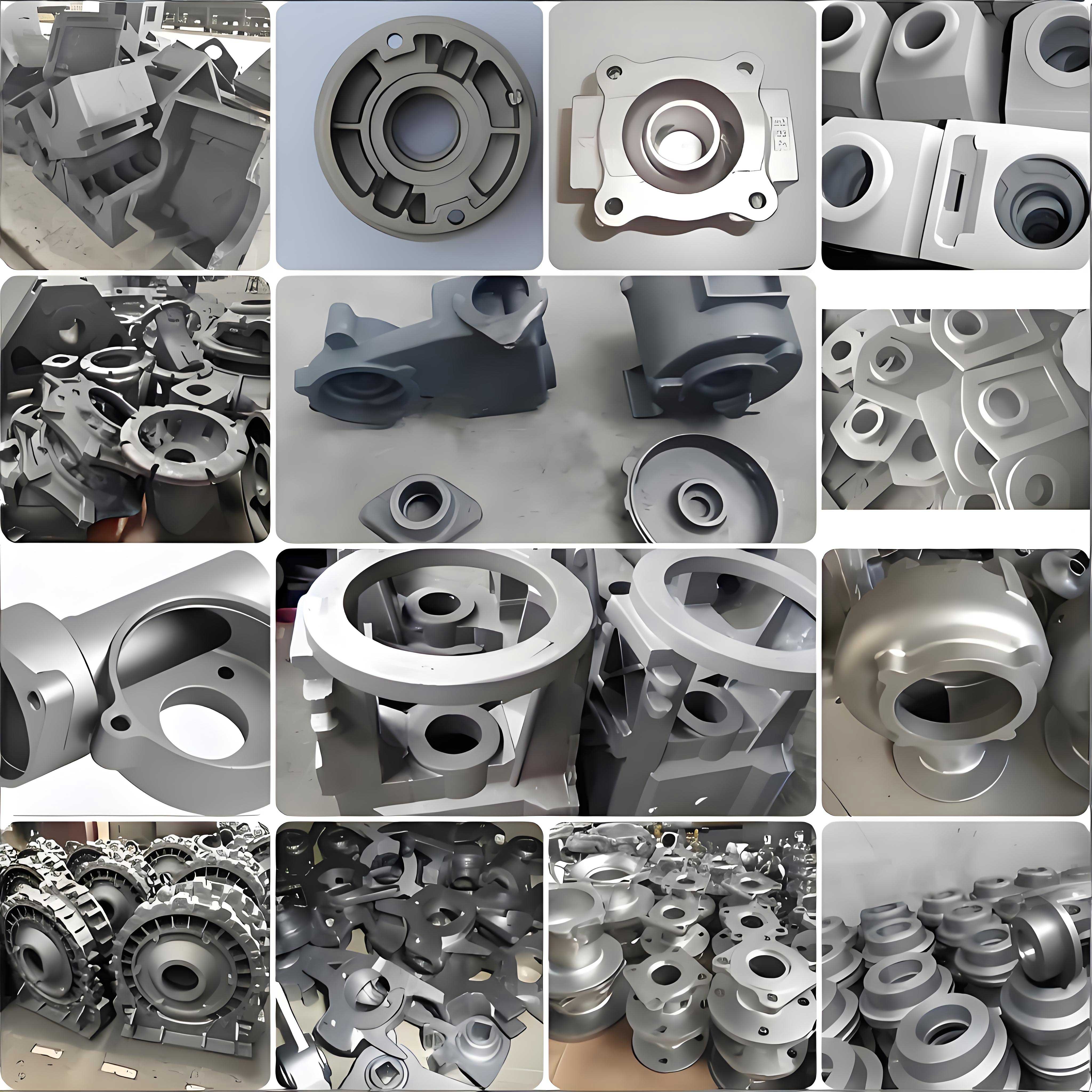
The visual representation above highlights the typical microstructure of nodular cast iron, where spherical graphite nodules are desired. However, when chunk graphite forms, it disrupts this uniformity, as seen in the interconnected, coarse fragments. Addressing this issue requires a multifaceted approach, grounded in both theoretical understanding and practical experience. Based on my work in foundries, I have identified several effective measures to prevent or minimize chunk graphite formation in nodular cast iron, each targeting specific aspects of the melting, treatment, and solidification processes.
First and foremost, rapid cooling stands out as a cornerstone strategy. Slow cooling rates, common in resin sand molds, prolong the solidification time and enhance solute redistribution, allowing rare earth elements to segregate and promote chunk graphite. By accelerating cooling—particularly in thick sections—the time available for segregation is reduced, and the undercooling is controlled. This can be achieved through techniques such as incorporating chills or cooling fins in mold designs, using metallic molds for critical areas, or optimizing pouring temperatures to minimize thermal mass. The cooling rate \( \dot{T} \) influences the solidification structure via the relationship: $$ \dot{T} = \frac{dT}{dt} $$ where a higher \( \dot{T} \) suppresses chunk formation by limiting diffusion-driven phenomena. In practice, I have found that localized chilling in resin sand castings can improve graphite morphology significantly, restoring the spherical shape in nodular cast iron components.
Second, reducing the residual rare earth content after spheroidization is crucial. Historically, high-rare-earth spheroidizers were used to counteract high sulfur levels from cupola melting and interference elements in charge materials. However, with the widespread adoption of induction furnaces, sulfur content has dropped, and charge quality has improved through the use of high-purity pig iron and scrap steel. Consequently, low-rare-earth spheroidizers, such as FeSiMg5RE1 with pure lanthanum, are now preferred. These alloys lower the residual Ce and La in the molten iron, diminishing their segregative tendency. The spheroidization efficiency can be quantified by the nodule count \( N \), which relates to rare earth content \( [RE] \) as: $$ N = k_1 – k_2 [RE] $$ where \( k_1 \) and \( k_2 \) are constants. By minimizing \( [RE] \), we not only curb chunk graphite but also reduce shrinkage porosity, enhancing the overall quality of nodular cast iron castings.
Third, the use of inoculants containing antimony (Sb) or bismuth (Bi) has proven beneficial. These elements act as modifiers that inhibit chunk graphite formation by altering the solidification front dynamics. They are typically added during inoculation, and their effectiveness hinges on precise dosage control. For instance, Bi levels between 0.002% and 0.003%, or Sb between 0.004% and 0.008% in the final iron composition, can stabilize graphite growth without inducing other abnormalities like flake graphite. The mechanism may involve the adsorption of Sb or Bi at the graphite interface, reducing the interfacial energy and promoting spherical growth. This can be modeled using an interfacial energy term \( \gamma \) in the growth equation: $$ \Delta G = \gamma A + \Delta G_v $$ where \( \Delta G \) is the total free energy change, \( A \) is the interface area, and \( \Delta G_v \) is the volume free energy change. By lowering \( \gamma \), Sb or Bi help maintain nodularity in nodular cast iron.
Fourth, controlling the addition of high-purity charge materials is essential. While high-purity pig iron and steel reduce impurity levels, excessive use can inadvertently promote chunk graphite due to the lack of nucleation sites or altered solidification paths. In my trials, a charge mix with 1000 kg high-purity pig iron, 1000 kg A3 steel, and 1000 kg returns showed less chunk graphite tendency compared to a mix with 2500 kg high-purity pig iron and 500 kg A3 steel. This suggests that moderate amounts of returns or less pure materials can provide beneficial nuclei or buffer effects. The charge composition impacts the overall chemistry, and balancing it requires careful calculation based on the desired final analysis for nodular cast iron.
Fifth, regulating the molten iron composition, particularly carbon and silicon contents, is vital. High carbon equivalents (CE) and silicon levels are known to foster chunk graphite by increasing graphitization potential and reducing cooling efficiency. The carbon equivalent is given by: $$ CE = C + \frac{Si + P}{3} $$ where C, Si, and P are weight percentages. For thick-section nodular cast iron castings, I recommend keeping silicon below 3.0% and carbon below 3.8% to mitigate chunk formation. Additionally, balancing other elements like magnesium and sulfur is important for optimal spheroidization. The following table summarizes the key control parameters and their recommended ranges to prevent chunk graphite in nodular cast iron production.
| Parameter | Recommended Range | Rationale |
|---|---|---|
| Residual Rare Earths (Ce+La) | < 0.02% | Minimizes segregation and undercooling |
| Cooling Rate in Thick Sections | > 10°C/min | Limits diffusion time for chunk formation |
| Antimony (Sb) Content | 0.004–0.008% | Stabilizes graphite growth without side effects |
| Bismuth (Bi) Content | 0.002–0.003% | Inhibits chunk graphite via interface modification |
| High-Purity Charge Proportion | < 50% of total charge | Prevents excessive purity that promotes chunking |
| Silicon (Si) Content | < 3.0% | Reduces graphitization pressure and undercooling |
| Carbon Equivalent (CE) | < 4.5% | Controls overall solidification behavior |
| Pouring Temperature | 1350–1400°C | Optimizes fluidity while minimizing thermal mass |
In conclusion, the battle against chunk graphite in nodular cast iron is a multifaceted endeavor that demands a deep understanding of solidification science and practical process control. From my experience, the formation of chunk graphite is primarily driven by rare earth segregation, slow cooling, and inappropriate compositions, all of which disrupt the delicate balance required for spherical graphite growth. By implementing rapid cooling techniques, switching to low-rare-earth spheroidizers, utilizing Sb or Bi inoculants, moderating high-purity charge inputs, and tightly controlling iron chemistry, foundries can effectively suppress this defect. These measures not only preserve the mechanical properties of nodular cast iron but also enhance its reliability in demanding applications. As the industry evolves with advanced melting and molding technologies, continuous refinement of these strategies will be key to producing high-integrity nodular cast iron components free from chunk graphite. The journey involves constant monitoring and adjustment, but the payoff—a superior nodular cast iron product—is well worth the effort.
To further elucidate the thermodynamic aspects, consider the Gibbs free energy change \( \Delta G \) for graphite nucleation in nodular cast iron: $$ \Delta G = \frac{16 \pi \gamma^3}{3 (\Delta G_v)^2} $$ where \( \gamma \) is the interfacial energy and \( \Delta G_v \) is the volume free energy difference. Chunk graphite formation may correspond to a higher \( \gamma \) due to rare earth adsorption, increasing the energy barrier for spherical growth. By controlling process variables, we can modulate these energies to favor nodularity. Additionally, the kinetics of solidification play a role, as described by the Johnson-Mehl-Avrami-Kolmogorov (JMAK) equation for phase transformation: $$ f = 1 – \exp(-kt^n) $$ where \( f \) is the transformed fraction, \( k \) is a rate constant, \( t \) is time, and \( n \) is the Avrami exponent. For nodular cast iron, a higher \( k \) from rapid cooling can shift the transformation toward spherical graphite. Through such interdisciplinary insights, the production of nodular cast iron can be optimized to avoid chunk graphite and achieve consistent quality.
Ultimately, the success in preventing chunk graphite hinges on a holistic approach that integrates material science, process engineering, and quality assurance. In my practice, I have seen that even small adjustments—like tweaking inoculation times or adjusting chill placements—can yield significant improvements in nodular cast iron microstructure. The key is to maintain vigilance and adapt to varying conditions, whether in charge materials, furnace operations, or environmental factors. By doing so, we ensure that nodular cast iron continues to serve as a robust and dependable material across industries, its graphite spheres intact and functional. This commitment to excellence is what drives innovation in nodular cast iron technology, pushing the boundaries of what these castings can achieve without the hindrance of chunk graphite.