
As a material scientist and engineer with extensive experience in metallurgy, I have witnessed the transformative impact of nodular cast iron, also known as ductile iron, since its development in the mid-20th century. This high-strength cast iron material, characterized by its spherical graphite nodules, offers a unique combination of properties that bridge the gap between traditional cast iron and steel. Its cost-effectiveness, superior toughness, wear resistance, and high strength have made it a cornerstone in modern manufacturing, particularly in the automotive industry. In this article, I will delve deeply into the fundamental properties of nodular cast iron, explore its metallurgical principles through formulas and data tables, and detail its pivotal role in automotive components. My aim is to provide a thorough understanding that underscores why nodular cast iron remains a material of choice for engineers seeking performance and economic efficiency.
The essence of nodular cast iron lies in its microstructure. Unlike gray iron where graphite exists as flakes, the graphite in nodular cast iron is present in spheroidal form. This morphological shift is achieved through a controlled inoculation process, typically involving the addition of magnesium or cerium-based agents during molten iron treatment. This spherical graphite structure acts as a “crack arrester,” significantly enhancing the material’s ductility and tensile strength. The matrix surrounding these nodules can be ferritic, pearlitic, or a combination through heat treatment, allowing for tailored properties. The general composition of nodular cast iron includes carbon (C) above 2.11%, silicon (Si), manganese (Mn), with stringent control over sulfur (S) and phosphorus (P) impurities. The carbon equivalent (CE), a critical parameter, is given by:
$$ CE = \%C + \frac{\%Si + \%P}{3} $$
For high-quality nodular cast iron, the CE is often controlled around 4.3-4.7 to optimize fluidity and prevent casting defects like graphite flotation. The superior mechanical properties stem from this unique structure. Let’s compare the key properties of nodular cast iron with other common ferrous materials.
| Material | Tensile Strength (MPa, min) | Yield Strength (MPa, min) | Elongation (%) | Modulus of Elasticity (GPa) | Impact Resistance (Joules) |
|---|---|---|---|---|---|
| Gray Cast Iron (Class 40) | 310 | N/A | < 1 | 110-130 | Low |
| Nodular Cast Iron (QT400-18) | 400 | 250 | 18 | 169-172 | High |
| Nodular Cast Iron (QT700-2) | 700 | 420 | 2 | 169-172 | Moderate |
| Cast Steel (ASTM A27) | 485 | 250 | 22 | 200 | Very High |
| Forged Steel (AISI 1045) | 625 | 415 | 12 | 205 | Very High |
The table clearly illustrates the strength advantage of nodular cast iron. Notably, certain grades of nodular cast iron exhibit a yield strength that surpasses many cast steels, a key factor in design against permanent deformation. The damping capacity, or ability to absorb vibrational energy, is another standout property. The graphite nodules effectively dissipate energy, making nodular cast iron components quieter and less prone to fatigue failure. This can be quantified by the damping coefficient, which is significantly higher for nodular cast iron than for steel.
The production of high-quality nodular cast iron is a precise science. The process begins with careful charge selection and melting in cupola or electric induction furnaces. The critical step is the nodularizing treatment. Magnesium is the most common nodularizing element due to its strong affinity for sulfur and oxygen. The reaction can be simplified as:
$$ [Mg] + [S] \rightarrow MgS_{(slag)} $$
$$ [Mg] + [O] \rightarrow MgO_{(slag)} $$
These reactions desulfurize and deoxidize the melt, creating conditions favorable for graphite to precipitate as spheres. The residual magnesium content, typically between 0.03% and 0.06%, is crucial for maintaining the nodular structure. However, raw iron in many regions, including historical practices, contained high levels of sulfur and interfering elements like titanium (Ti), lead (Pb), and antimony (Sb). This necessitated the use of rare earth (RE) elements such as cerium (Ce) and lanthanum (La) in the nodularizing alloy. Rare earths neutralize these interferents, allowing successful nodularization even with less-than-ideal base iron. The effectiveness of a combined Mg-RE treatment can be assessed by the nodule count and shape factor. A high nodule count (e.g., >150 nodules/mm²) correlates with improved mechanical properties. The relationship between nodule count (N) and tensile strength (σ) can be empirically modeled for a ferritic matrix:
$$ \sigma_{TS} \approx A + B \cdot \ln(N) $$
where A and B are material constants. Following nodularization, an immediate inoculation (post-inoculation) is performed using ferrosilicon-based alloys containing elements like calcium (Ca), aluminum (Al), or strontium (Sr). Inoculation increases the number of graphite nucleation sites, refines the graphite nodules, and prevents chilling (formation of cementite). The entire treatment sequence must be tightly controlled for time and temperature to prevent fade—the loss of nodularizing effect. Modern methods like the sandwich technique in the ladle or, more effectively, the in-mold process, improve efficiency and consistency. In the in-mold process, the nodularizing and inoculating alloys are placed in a reaction chamber within the gating system. As the iron flows through, treatment occurs instantly, minimizing oxidation and magnesium loss.
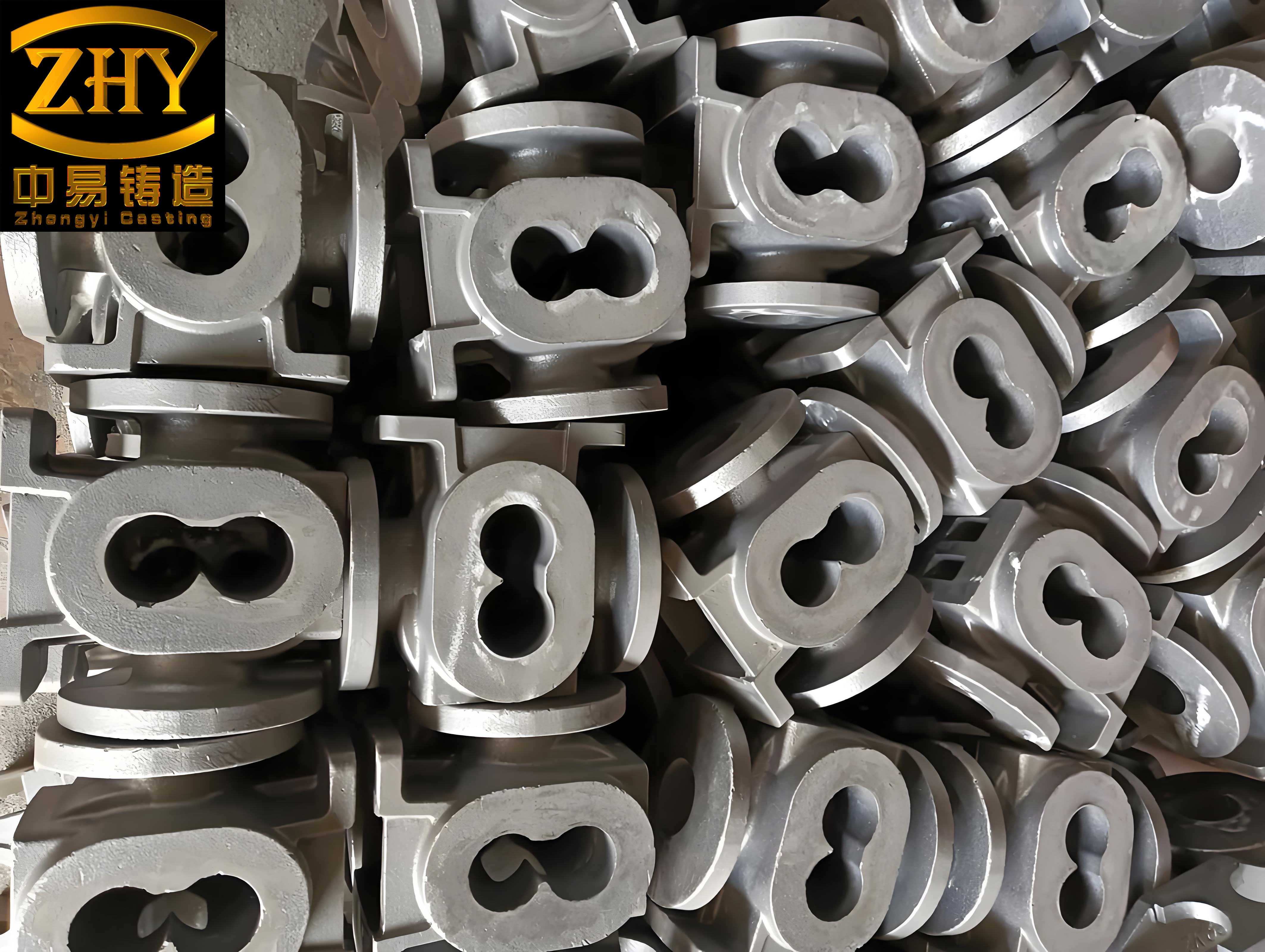
The foundry practices for nodular cast iron also demand attention. Due to the higher melting temperature and the exothermic nature of the treatment, pouring temperatures are generally higher than for gray iron, often in the range of 1350°C to 1400°C. The solidification shrinkage of nodular cast iron is greater than that of gray iron but less than that of steel, necessitating proper feeding systems with risers to avoid shrinkage porosity. The mechanical properties are highly dependent on the matrix structure, which is controlled by composition and heat treatment. For example, a fully ferritic matrix (achieved by annealing) provides maximum ductility (as in grade QT400-18), while a pearlitic matrix (achieved by faster cooling or alloying with copper or tin) provides higher strength and wear resistance (as in grade QT700-2). Austempered Ductile Iron (ADI) represents the pinnacle of performance, where a special austempering heat treatment creates an ausferritic matrix of acicular ferrite and high-carbon austenite. ADI offers strengths exceeding 1200 MPa with considerable ductility and wear resistance, often replacing forged steel components.
Now, let’s focus on the automotive sector, where the virtues of nodular cast iron are exploited to the fullest. The automotive industry’s relentless drive for lightweighting, cost reduction, durability, and performance makes nodular cast iron an ideal candidate. A modern vehicle contains numerous components made from various grades of nodular cast iron. The applications span the powertrain, chassis, and driveline systems. I will detail some of the most critical applications.
| Component | Typical Nodular Cast Iron Grade | Key Property Requirements | Advantages Over Alternatives |
|---|---|---|---|
| Crankshaft | QT700-2, QT800-2, or ADI | High fatigue strength, wear resistance, stiffness, damping capacity | Lower cost than forged steel, excellent machinability, inherent damping reduces NVH (Noise, Vibration, Harshness) |
| Camshaft | QT700-2, Alloyed Nodular Cast Iron | Wear resistance at cam lobes, hardness, good castability for complex shapes | Integral casting of lobes and journals, cost-effective for high-volume production, chills can be used for localized hardening |
| Differential Carriers & Housings | QT400-18, QT450-10 | Strength to withstand gear loads, good machinability, dimensional stability | Excellent stiffness-to-weight ratio, simplifies assembly compared to welded structures, good damping |
| Steering Knuckles & Suspension Arms | QT400-18, QT450-10, ADI | High ductility and impact toughness, fatigue strength, weight savings | Enables thin-wall designs (3-5 mm), lighter than steel forgings or weldments, good corrosion resistance |
| Brake Calipers | QT500-7, QT600-3 | Thermal stability, rigidity, resistance to brake fluid | Good casting integrity for pressure-containing parts, reliable performance |
| Exhaust Manifolds | Si-Mo Alloyed Nodular Cast Iron (e.g., D5S) | High-temperature oxidation resistance, thermal fatigue resistance, growth resistance | Withstands exhaust gas temperatures >800°C, better durability than many cast steels, cost-effective |
The crankshaft is perhaps the most iconic application. Replacing forged steel crankshafts with nodular cast iron versions, particularly those made of high-strength grades or ADI, results in significant cost savings without compromising performance. The fatigue strength of a nodular cast iron crankshaft is paramount, often enhanced by surface hardening processes like induction hardening or fillet rolling. The bending fatigue limit (σ_f) can be estimated using parameters like the ultimate tensile strength (σ_UTS) and the stress concentration factor (K_t):
$$ \sigma_f \approx \frac{\sigma_{UTS}}{K_t \cdot S_f} $$
where S_f is a safety factor. The damping capacity of nodular cast iron absorbs torsional vibrations, reducing the need for larger harmonic dampers. For suspension components like control arms, the shift from steel stampings/weldments to thin-wall nodular cast iron allows for part consolidation, weight reduction, and improved packaging. The design freedom of casting enables optimal stress-flow geometries. The fatigue performance under cyclic road loads is excellent due to the material’s inherent fatigue crack growth resistance imparted by the spherical graphite.
Another growing area is the use of austempered ductile iron for critical safety components. For instance, ADI is being used for brackets, hubs, and even powertrain components. Its high strength allows for downsizing, contributing to vehicle lightweighting—a key goal for improving fuel efficiency and reducing emissions. The specific strength (strength-to-density ratio) of ADI competes favorably with aluminum alloys and some steels. The weight reduction (ΔW) when substituting a steel part with an ADI part of equivalent strength can be approximated if the density (ρ) and allowable stress (σ) are known:
$$ \Delta W \propto \left(1 – \frac{\rho_{ADI} \cdot \sigma_{steel}}{\rho_{steel} \cdot \sigma_{ADI}}\right) $$
Given that ρ_steel ≈ 7.85 g/cc, ρ_nodular cast iron ≈ 7.1 g/cc, and σ_ADI can be double that of standard steel, significant mass savings are possible. Furthermore, the corrosion resistance of nodular cast iron, especially when alloyed with silicon and copper, is adequate for underbody applications, often enhanced by coating systems. The machinability of ferritic and pearlitic grades is superior to that of steel, reducing tool wear and production time. The chips break easily due to the graphite nodules, leading to better surface finishes.
However, the successful implementation of nodular cast iron in automobiles hinges on stringent quality control. This starts with raw material purity. Charge materials must be low in elements that promote carbide formation (like chromium) or interfere with nodularization. Spectroscopic analysis is standard for melt control. The nodularizing and inoculating treatment processes are monitored via thermal analysis cups, which provide rapid feedback on the likely microstructure and carbon equivalent. The final product quality is verified through destructive and non-destructive testing. Tensile tests, impact tests, and hardness surveys are routine. Microstructural evaluation per standards like ASTM A247 is critical: assessing nodule count, nodularity (percentage of nodules vs. imperfect forms), and matrix structure. A minimum nodularity of 80-90% is typically required for automotive grades. Porosity, shrinkage, and inclusions are checked using radiographic or ultrasonic testing for critical safety parts.
Looking ahead, the role of nodular cast iron in the automotive industry is evolving with trends towards electrification. Electric vehicles (EVs) present new challenges and opportunities. While the internal combustion engine components like crankshafts may diminish, other applications will grow. The high-strength and damping properties of nodular cast iron are valuable for electric motor housings, which need to suppress electromagnetic noise and vibration. Reducers and differential housings in electric axles will continue to utilize nodular cast iron. Furthermore, brake components for heavier EVs (due to batteries) may benefit from the thermal properties of alloyed nodular cast iron. Research is ongoing into new alloy formulations and treatment processes to further enhance the properties of nodular cast iron. For instance, the development of high-silicon ductile irons for improved high-temperature performance in exhaust systems or the optimization of austempering processes to achieve even higher toughness in ADI. Additive manufacturing (3D printing) of sand molds for complex nodular cast iron parts is also gaining traction, allowing for rapid prototyping and production of optimized, lightweight geometries that were previously impossible to cast.
In conclusion, from my professional perspective, nodular cast iron is a remarkably versatile and economical engineering material. Its unique combination of strength, ductility, damping, and castability, all derived from its spherical graphite microstructure, makes it indispensable for demanding applications. In the automotive industry, nodular cast iron has proven its worth for decades in critical components, contributing to vehicle performance, reliability, and cost-effectiveness. The continuous advancements in metallurgy and processing, such as austempering and improved treatment methods, ensure that nodular cast iron will remain at the forefront of material selection. As the industry transitions to new propulsion systems, the inherent advantages of nodular cast iron—its adaptability, performance, and cost profile—will ensure it finds new and vital roles in the vehicles of the future. The journey of understanding and utilizing nodular cast iron is a testament to the power of materials science in driving industrial progress.