
In the field of heavy machinery and automotive engineering, the production of high-integrity engine blocks stands as a testament to advanced foundry capabilities. As a process engineer specializing in grey iron casting, I have been intimately involved in the design, optimization, and validation of casting processes for complex components. Grey iron, with its excellent castability, good machinability, and favorable damping characteristics, remains the material of choice for these critical applications. The successful production of a sound casting is not a single decision but the culmination of a meticulously planned sequence of interdependent steps. This article delves into the core principles and methodologies of modern grey iron casting process design, drawing upon practical experiences to elucidate strategies for tackling complexity, ensuring dimensional accuracy, and achieving superior internal soundness.
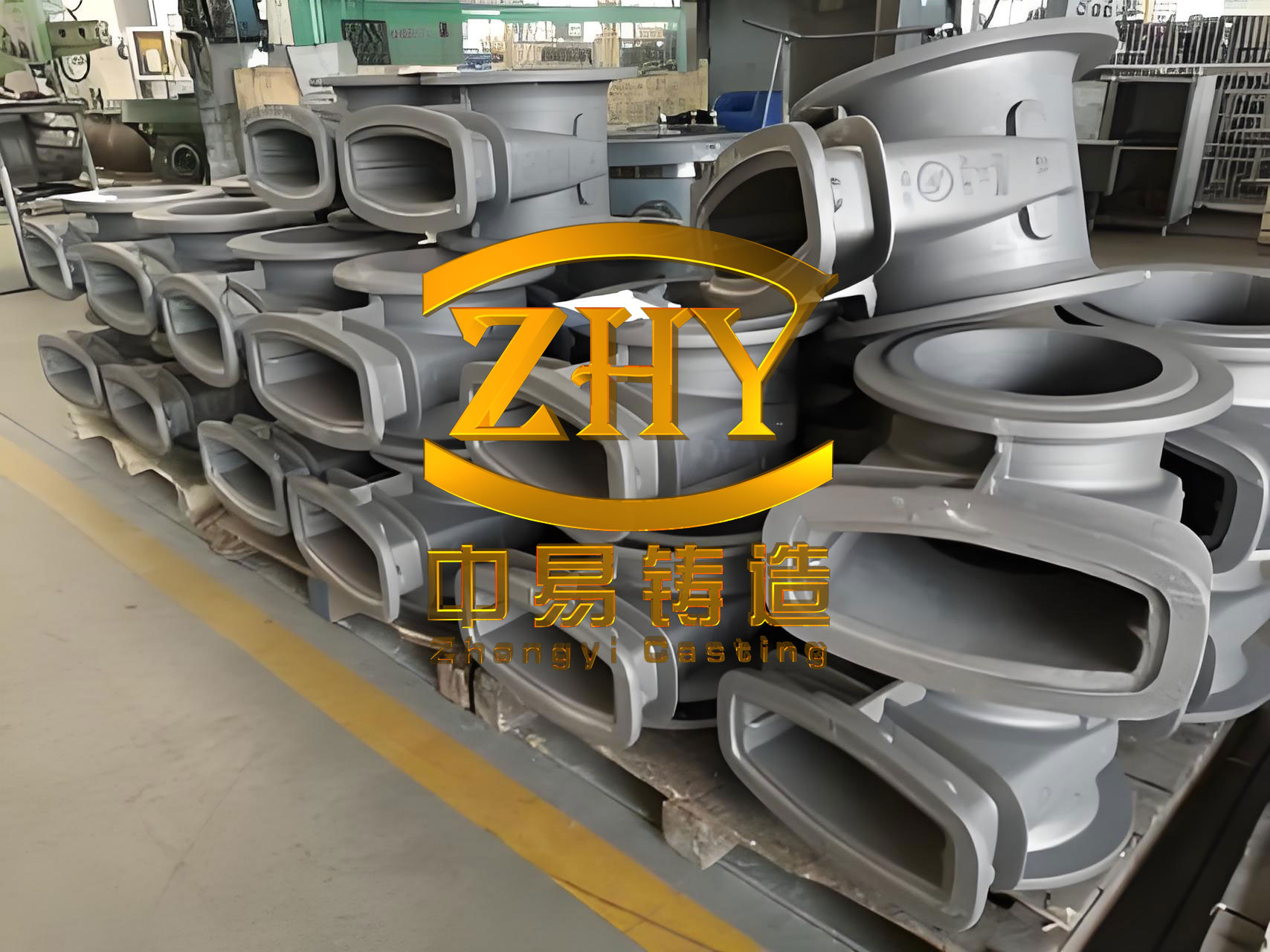
The journey of a grey iron casting begins long before metal is poured. It starts with a comprehensive analysis of the component’s design for manufacturability. Factors such as wall thickness uniformity, presence of hot spots, ease of core assembly, and accessibility for machining must be evaluated. For engine blocks, which are essentially complex pressure vessels with intricate coolant and lubrication passages, this analysis is paramount. The primary goal is to devise a process that directs solidification progressively from the extremities toward designated feeding points, minimizing the risk of shrinkage porosity. This is the fundamental challenge in grey iron casting for such components.
Following the structural review, a detailed casting process plan is formulated. This encompasses selecting the molding method (e.g., high-pressure green sand lines, chemically-bonded sand systems, or specialized techniques like stack molding), determining the parting line orientation, and establishing the core assembly strategy. A critical phase is the definition of precise casting process parameters. These are not arbitrary values but are calculated based on the alloy’s behavior and the component’s geometry. The most fundamental of these is the linear casting shrinkage allowance, often expressed as a percentage. For a typical grey iron grade like HT250 or HT280, the shrinkage is not isotropic. Empirical data and simulation software guide the selection of different values for length, width, and height dimensions. For instance, a common finding is that longitudinal shrinkage can be slightly higher than transverse shrinkage due to constraints from the mold and cores. This can be summarized as:
$$ S_L > S_W \approx S_H $$
where $S_L$, $S_W$, and $S_H$ represent the shrinkage percentages in the length, width, and height directions, respectively. Values typically range from 0.8% to 1.2%, with specific adjustments for local features.
Machining allowances are another cornerstone parameter. They compensate for potential distortion, surface scale, and provide a clean, sound surface for final machining. The allowance is not uniform; it varies based on the significance of the feature. Critical bearing bore surfaces or cylinder liners require larger stock than non-functional exterior walls. A systematic approach is tabulated during process design. Furthermore, parameters like draft angles, mold wall movement allowance, and finishing allowances (for shot blasting) are all precisely defined to ensure the final as-cast shape yields the intended finished component after machining.
| Parameter | Typical Value / Description | Remarks / Formula Basis |
|---|---|---|
| Linear Shrinkage (Length) | 1.0% – 1.1% | Influenced by core restraint; often the highest value. |
| Linear Shrinkage (Width/Height) | 0.9% – 1.0% | $$ Pattern\ Dimension = Final\ Dimension \times (1 + S/100) $$ |
| Cylinder Bore Machining Allowance | 4.5 – 5.5 mm (radius) | Critical functional surface. |
| Main Bearing Cap Side Allowance | 5.0 – 5.5 mm | Accounts for potential core shift. |
| Top/Bottom Face Allowance | 4.0 – 5.5 mm | General machining stock. |
| Draft Angle | 1° – 3° | Essential for pattern stripping. |
The heart of a complex grey iron casting like an engine block lies in its core assembly. Modern grey iron casting heavily relies on advanced core-making technologies such as cold box (amine or SO₂) and hot box processes. The design of individual cores—like the main block core, water jacket core, camshaft gallery core, and oil passage cores—must ensure not only accurate formation of internal cavities but also provide robust print support for positioning and venting. Core assembly, whether performed manually on a fixture or automatically via a robotic cell, is a precision operation. The use of adhesives and alignment pins ensures the core package maintains its integrity during handling and mold closing. For critical areas prone to burn-in or veining, such as the water jacket, specialty sands like chromite are often employed due to their higher thermal conductivity and resistance to metal penetration compared to silica sand.
Perhaps no other system is as crucial to the quality of the final part as the gating and feeding design. The objective of the gating system in grey iron casting is to deliver clean, quiescent, and temperature-controlled metal into the mold cavity with minimal turbulence, oxidation, and sand erosion. For tall, vertical castings like engine blocks, a bottom-gating or stepped (combination bottom and mid-height) gating system is often preferred. This promotes upward filling against gravity, which is quieter and helps float impurities into the upper portions of the mold or specifically designed slag traps. The cross-sectional area progression of the gating channels—from the pouring basin downspout (sprue) to the horizontal runners (gates) and finally the in-gates (ingates)—defines whether the system is pressurized, unpressurized, or partially pressurized.
A partially pressurized system is common for grey iron casting. Here, the choke is at the sprue base or a later runner, ensuring the system remains full of metal shortly after pouring begins, preventing slag aspiration. The area ratios are key. A classic ratio might be expressed as:
$$ A_{sprue\ base} : A_{runner} : A_{ingates} = 1.1 : 1.0 : 1.5 $$
This indicates the total ingate area is the largest, followed by the sprue choke area, with the runner in between. This ratio helps slow the metal as it enters the cavity. The ingates are numerous, thin, and wide to distribute flow evenly and facilitate easy breaking-off during cleaning. The total ingate area $A_{ingates-total}$ can be estimated based on the desired pour time $t$ (seconds), casting weight $W$ (kg), and an empirical constant $k$:
$$ A_{ingates-total} = k \cdot \frac{W}{t} $$
where $k$ accounts for fluidity of the iron and head height.
| Block Type | Gating Strategy | Area Ratio (Sprue:Runner:Ingate) | Pour Time (Approx.) | Metal Entry |
|---|---|---|---|---|
| Inline-6 Medium Duty | Stepped (Bottom/Mid) | 1.12 : 1.00 : 1.53 | 25-30 sec | Along side, multiple points |
| V-Type Heavy Duty | Bottom Gated | 1.13 : 1.00 : 1.80 | 40-50 sec | Between cylinders, both sides |
| Large Inline (Vertical Pour) | Open (Bottom Gated) | 1.00 : 1.52 : 2.18 | 60-90 sec | From one end, along bottom |
Equally critical to the gating system is the exhaust system. The mold and cores contain vast amounts of air and generate gases from binder decomposition. Without efficient venting, these gases become trapped, leading to blows, pores, or incomplete filling. The venting strategy in grey iron casting is multi-faceted. First, core prints are designed with ample clearance or integrated porous vent channels to allow gases from deep within the core package to escape into the surrounding mold sand, which is permeable. Second, strategic vents or “risers” are placed at the highest points of the mold cavity. These serve a dual purpose: they act as atmospheric vents during filling, and often as “flow-off” risers to receive the first, cooler, and possibly oxide-laden metal that enters the cavity, effectively purging the cavity. These flow-offs are later removed. Their volume is not for feeding but for overflow, and their size can be related to the volume of the cavity zone they serve.
For a top section of a block, the required flow-off volume $V_{flow-off}$ can be conceptually linked to the cavity volume $V_{cavity}$ it is intended to purge:
$$ V_{flow-off} \approx C \cdot V_{cavity}^{2/3} $$
where $C$ is an empirical coefficient dependent on section thickness and desired purging effectiveness. Additionally, small vent pins or slots are often added at the mold parting line and on top of core prints to provide direct escape paths for gas. The synergy between gating and venting dictates the hydraulic efficiency of the fill and the soundness of the casting surface.
To solidify these concepts, let’s consider the application to different engine block architectures. For a compact, inline-six cylinder block with thin walls (~6mm), a horizontal molding and pouring approach can be advantageous. This allows the complex side features to be formed by precision cores in the drag (bottom mold half), while the simpler top and bottom faces are formed by the cope (top half). The gating is typically stepped, introducing metal at the bottom and again at a mid-height to balance fill temperatures. Exhaust is primarily through the cope, using an array of flow-off risers at the top deck (fire deck) and along the highest rails.
In contrast, a very large, heavy inline or V-type block for stationary engines presents different challenges. The sheer mass and height often necessitate a vertical pouring process, sometimes using a “stack” or “pit” molding technique. Here, the mold is built vertically, and the metal is poured from the top directly into a sprue that runs the full height of the casting at one end. The gating is open and unpressured, with large ingates distributing metal along the entire bottom length of the block. Solidification progresses steadily from the bottom upwards and from the thick crankcase areas towards the thinner upper sections and the heavy feeder heads placed at the top of the casting. The thermal dynamics are governed by Chvorinov’s Rule, where solidification time $t_s$ for a section is proportional to the square of its volume-to-surface area ratio $ (V/A)^2 $, modified by the mold material constant $B$:
$$ t_s = B \cdot \left( \frac{V}{A} \right)^n $$
where the exponent $n$ is typically close to 2 for sand molds. The feeder design must ensure it remains liquid longer than the section it feeds. For grey iron, which experiences graphite expansion during solidification, feeding requirements are less severe than for steel, but careful thermal control is still needed for heavy sections.
| Feature | Medium Inline Block (Horizontal Pour) | Large Heavy Block (Vertical Pour) |
|---|---|---|
| Molding Method | High-Pressure Green Sand (Automated Line) | Chemically-Bonded Sand (Pit or Stack) |
| Core Technology | Cold Box (majority), Hot Box (water jacket) | Cold Box, sometimes Shell |
| Pouring Orientation | Mold on its side, metal enters horizontally | Mold upright, metal enters from top/bottom |
| Key Gating Goal | Quiet, non-turbulent fill; temperature uniformity | Controlled fill rate; thermal gradient management |
| Primary Feeding Concern | Micro-shrinkage in web junctions & thick bosses | Macro-shrinkage in heavy crankcase sections |
| Dominant Venting Path | Through top mold half (cope) via flow-offs | Through top of mold and up large central sprue |
Finally, no process design is complete without rigorous validation. Today, this heavily involves simulation software that models fluid flow, heat transfer, solidification, and stress development. These tools allow for virtual prototyping of the gating, venting, and feeding systems, predicting potential defects like cold shuts, mistruns, shrinkage, and porosity. However, physical validation remains essential. This includes dimensional checks via 3D scanning of first-article castings to verify shrinkage allowances, and mechanical sectioning of sacrificial castings to inspect internal soundness at critical junctions—such as the areas between cylinders, under valve seats, and around main bearing webs. A successful grey iron casting process is one that consistently produces dimensionally accurate components free of detrimental defects, ready for precision machining. The continuous refinement of these methodologies—balancing empirical knowledge with advanced simulation—is what drives excellence in the production of these foundational components through the art and science of grey iron casting.
In summary, the process design for a complex grey iron casting is a holistic engineering discipline. It requires a deep understanding of metallurgy, fluid dynamics, heat transfer, and material science. From the initial assessment of the component’s geometry to the final validation of the produced part, each step is interconnected. The precision in setting shrinkage allowances, the ingenuity in core design and assembly, the hydraulic calculation behind the gating system, and the strategic placement of vents all converge to transform molten grey iron into a high-performance engine block. The tables and formulas presented herein are not mere academic exercises; they are the practical tools used daily on the foundry floor to translate a design blueprint into a robust, reliable, and castable component. As demands for lighter, stronger, and more efficient engines grow, the principles of grey iron casting will continue to evolve, but the foundational goal remains unchanged: to achieve controlled and predictable solidification in the most complex of shapes.