
In the demanding world of industrial manufacturing, few challenges are as persistent and costly as casting defects. I recall a period in our foundry that tested our resolve and technical expertise to its limits. We had undertaken the production of a series of grey iron bearing caps for diesel engines. These were not particularly complex components—simple, compact shapes without internal cores. However, from the outset, our production was plagued by an alarmingly high scrap rate. At its peak, nearly 30% of the castings were being rejected, primarily due to sand inclusions and blowholes. The financial loss was significant, but more critically, it threatened our production schedules and commitments to our clients. The urgency to solve this problem became our primary focus, launching a detailed investigation and a phased campaign of process refinement focused entirely on improving the integrity of our grey iron casting process.
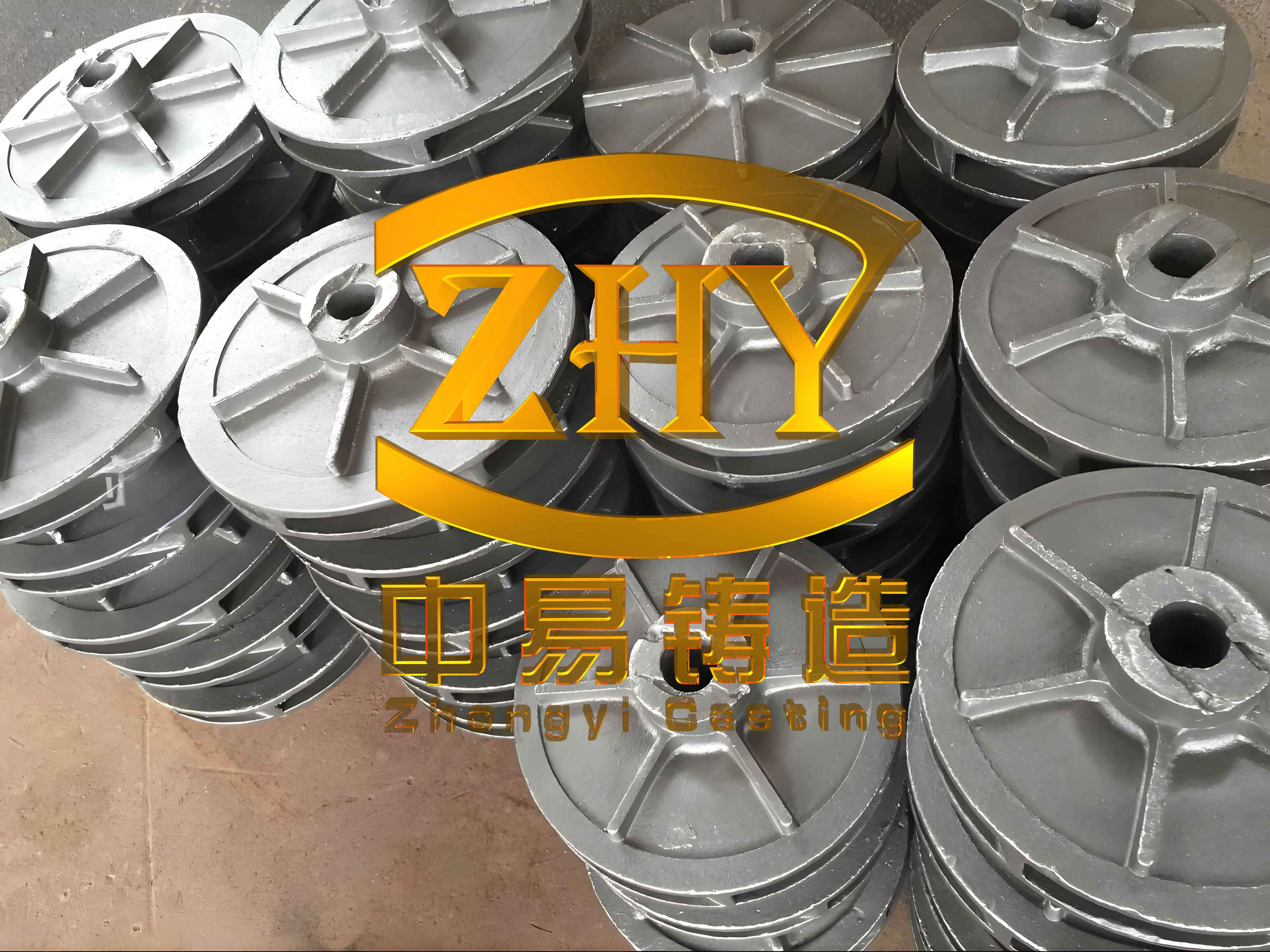
The initial process seemed sound on paper. The bearing caps, material grade HT250, were produced on a high-pressure molding line. To maximize productivity, the pattern plate was densely arranged, often with 12 impressions per mold. The gating system was conventional. Yet, the results were disappointing. Visual inspection of the scrap parts revealed distinct sand holes, where embedded sand particles created surface voids, and pinhole-type porosity, indicative of trapped gas. Our first task was to hypothesize the root causes within the context of grey iron casting.
We began with the most apparent suspects: the gating system and ventilation. In the first stage of our improvement plan, we theorized that turbulent metal entry was eroding the sand at the ingates, leading to sand wash and subsequent inclusions. Concurrently, we suspected that inadequate venting of the mold cavity was preventing the escape of air and gases generated during the pour, resulting in blowholes. Our modifications were direct:
- We added a fillet radius (R2) at the root of each ingate where it met the runner. The objective was to streamline the metal flow, reducing turbulence and shear stress on the sand at this critical junction. The shear stress ($\tau$) in a flowing liquid near a wall can be approximated by: $$\tau = \mu \frac{du}{dy}$$ where $\mu$ is the dynamic viscosity and $du/dy$ is the velocity gradient perpendicular to the wall. A sharp corner creates a steep velocity gradient, increasing $\tau$ and the risk of sand erosion. The fillet smoothens this transition.
- We added additional venting pins directly onto the pattern in areas suspected of trapping air.
The outcome of this first stage was sobering. While there was a marginal improvement, the scrap rate remained unacceptably high, still hovering above 25%. This was a clear signal that our initial diagnosis was incomplete. The gating was a contributor, perhaps, but not the dominant cause of the sand inclusion problem in this grey iron casting operation.
This forced a more meticulous observation of the molding process itself. We spent hours on the shop floor watching the pattern draw from the compacted sand mold. A critical flaw became evident: as the pattern was withdrawn, it often “dragged” or “scrapped” sand, particularly at the vertical edges of the bearing cap pattern. The resulting mold cavity in these areas was not crisp and firm; instead, the sand was loose and friable. A gentle touch could dislodge it. The reason was clear upon examining the pattern tooling. The patterns were integral to the plate, with sharp, 90-degree corners at their base. During pattern withdrawal, these sharp corners acted like plows, catching and tearing the sand rather than allowing a clean release.
Our second-stage intervention was purely geometric. We manually applied a resin-based filler to create a consistent R2 fillet around the entire root perimeter of every bearing cap pattern on the plate. The mechanics are described by the stress concentration factor ($K_t$). For a sharp corner (theoretical notch), $K_t$ approaches infinity, meaning even small tensile stresses during stripping can cause failure (sand cracking). Introducing a fillet reduces $K_t$ significantly. For a semi-circular notch, $K_t$ can be estimated as: $$K_t \approx 1 + 2\sqrt{\frac{t}{r}}$$ where $t$ is the depth and $r$ is the fillet radius. Increasing $r$ directly reduces $K_t$, lowering the stress on the sand during pattern draw. This modification yielded a cleaner strip and a much firmer mold wall. Post-implementation data showed the scrap rate dip to around 27.2%. Progress, but still far from our goal. The problem of sand inclusions, while reduced, persisted.
We were now confronting a more subtle issue: mold crushing or “sand squeeze.” Even with a firm cavity, we observed that the leveled sand mold’s surface was sometimes slightly higher than the mold flask’s parting plane. During mold handling and closing (coping on drag), this over-height could cause the edges of the cavity to be crushed or sheared off. Furthermore, any minor misalignment during closing could cause similar damage. These dislodged sand fragments would then be suspended in the mold cavity, ready to be entrained by the incoming molten iron. This phenomenon is distinct from sand erosion and is a common yet often overlooked defect in high-volume grey iron casting.
The solution, elegant in its simplicity, defined our third and most effective stage of improvement. We applied a thin, continuous strip of shim material, precisely 0.5 mm thick, around the perimeter of each pattern, set back slightly from the cavity edge. This created what is known as a “relief” or “crush pad.” When the sand was compacted, the area over this pad was compacted to a height 0.5 mm lower than the main cavity. This ensured that during mold closing, the flask surfaces met first, preventing any contact and subsequent crushing of the delicate cavity edges. The clamping force was borne by the flask, not the sand. The improvement was dramatic and immediate.
| Improvement Phase | Key Modification | Theoretical Basis | Primary Target Defect | Resulting Approx. Scrap Rate |
|---|---|---|---|---|
| Initial State | Baseline Process | N/A | Sand Inclusions & Blowholes | 30% |
| Stage 1 | Ingate Fillet (R2) & Added Vents | Reduce fluid shear stress ($\tau$); Improve gas evacuation | Blowholes, Sand Wash | >25% |
| Stage 2 | Pattern Root Fillet (R2) | Reduce stress concentration ($K_t$) during strip | Sand Drag/Loose Molds | 27.2% |
| Stage 3 | 0.5 mm Peripheral Relief Pad | Prevent mechanical crushing of cavity edge | Sand Squeeze/Inclusions | ~3.5% (Final: ~3%) |
The cumulative effect of all three stages transformed the production line. After implementing the final change, a controlled batch run produced a scrap rate of just 3.5%. As the process stabilized across all variants of the bearing cap, the long-term scrap rate settled consistently around 3%. This represented a 90% reduction in waste, a triumph for quality and efficiency in grey iron casting.
This experience provided profound insights that extend beyond a single component. It underscored that in grey iron casting, defects often have interconnected and layered causes. A systematic, data-driven approach is essential. The journey can be summarized by a general defect prevention function for such geometrical issues: $$ P_d = f(S_g, S_m, G_v, A_c) $$ where:
- $P_d$ is the probability of a defect (sand inclusion/blowhole),
- $S_g$ is the gating system shear factor (minimized by fillets),
- $S_m$ is the mold strip damage factor (minimized by pattern fillets),
- $G_v$ is the gas venting efficiency (maximized by vents),
- $A_c$ is the alignment/crushing risk factor (minimized by relief pads).
Our work optimized each variable in sequence.
To generalize the findings for other grey iron casting applications, the following principles emerged:
| Problem Area | Recommended Action | Technical Rationale | Expected Outcome |
|---|---|---|---|
| Metal Entry Turbulence | Incorporate radii at all gating junctions (R2 min). | Lowers fluid shear stress ($\tau$), reducing sand erosion potential. Governed by Reynolds number transition: $Re = \frac{\rho v D}{\mu}$. Fillets help maintain laminar or less turbulent flow. | Reduced sand wash and slag entrainment. |
| Pattern Stripping | Ensure all pattern vertical faces have a draft and root fillet (R2-R5). | Drastically reduces stress concentration factor ($K_t$), allowing sand to elastically recover during draw without cracking or dragging. | Clean mold cavities with high, uniform surface strength. |
| Mold Handling & Closing | Use relief pads/crush strips (0.5-1.0 mm) around pattern periphery. | Creates a “stand-off” to transfer closing force to flask, not sand. Prevents brittle fracture of cavity edges. The required relief ($h_r$) can be estimated: $h_r \ge \Delta_h + \sigma_m$ where $\Delta_h$ is sand height variation and $\sigma_m$ is misalignment. | Elimination of crush-related sand inclusions. |
| Mold Venting | Place vents at highest points and potential air traps. Consider permeable coatings. | Ensures air escapes ahead of molten metal front. The pressure of trapped air ($P_{air}$) must be less than the metallostatic pressure ($\rho g h$) to avoid blowholes: $P_{air} < \rho g h$. | Minimized gas porosity (blowholes, pinholes). |
In conclusion, the battle against defects in high-volume grey iron casting is won through a combination of fluid dynamics, solid mechanics, and meticulous attention to tooling geometry. While material properties and melting practice are foundational, the events that occur from pattern draw to mold fill are often the decisive factors. The journey from a 30% to a 3% scrap rate was not achieved by a single revolutionary change, but through the disciplined, sequential analysis and correction of multiple, often subtle, process interactions. The key was recognizing that the sand mold itself is a fragile, precision component that must be created, handled, and filled with utmost care. This holistic view of the process is what ultimately ensures the reliable and economical production of sound grey iron casting components, turning a quality crisis into a benchmark of operational excellence.