
In the field of industrial manufacturing, grey iron casting is a critical process for producing components that require high strength, wear resistance, and dimensional stability. As an engineer involved in foundry operations, I have encountered numerous challenges related to casting defects, particularly in complex parts like rotor brackets for compressors. These components demand excellent sealing properties, low noise, and freedom from defects such as shrinkage porosity and inclusions, which can compromise performance and safety. In this study, I utilized AnyCasting software to simulate and optimize the casting process for a grey iron rotor bracket, aiming to predict and eliminate defects through systematic analysis and design modifications. The focus is on enhancing the quality of grey iron casting by integrating numerical simulation with practical engineering adjustments, thereby ensuring reliable production outcomes.
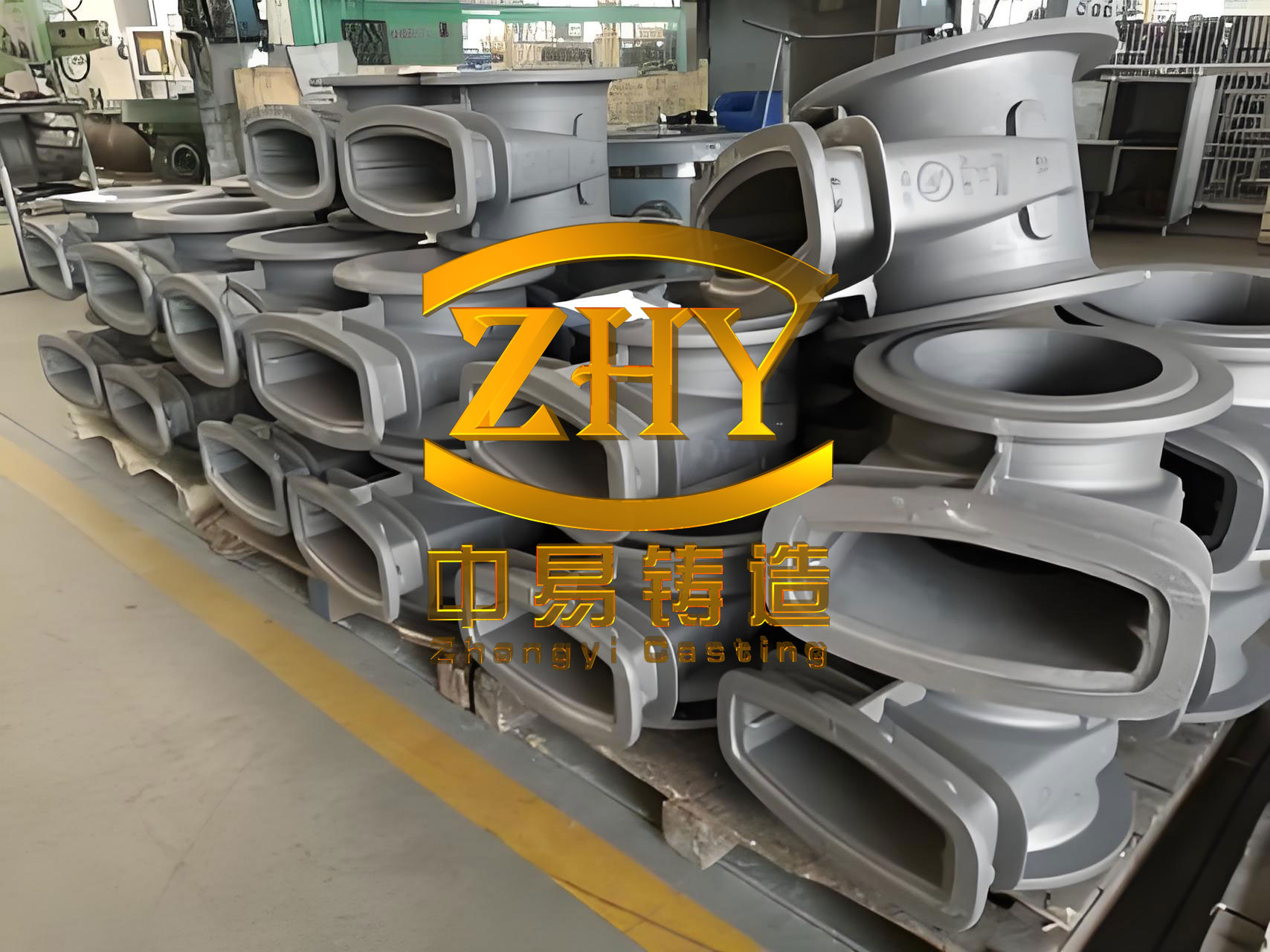
The initial casting process for the grey iron rotor bracket involved a top-gating system with a closed-open gating design, supplemented by chills in thicker sections to manage solidification. The component, with overall dimensions of 1223 mm × 1223 mm × 381 mm and a mass of 725 kg, was made of HT300 grey iron, characterized by its specific chemical composition. The gating system was designed with specific cross-sectional areas to control metal flow, but preliminary production runs revealed significant shrinkage defects in critical regions, prompting a detailed investigation. Grey iron casting, due to its graphite formation during solidification, is prone to shrinkage issues if the cooling conditions are not properly managed, making simulation an invaluable tool for defect prediction.
| Element | Content (%) |
|---|---|
| Carbon (C) | 2.96 |
| Silicon (Si) | 1.85 |
| Manganese (Mn) | 0.67 |
| Iron (Fe) | Balance |
To analyze the defects, I employed AnyCasting software for numerical simulation of both mold filling and solidification processes. The simulation parameters were set based on actual casting conditions: a pouring temperature of 1360–1370°C, a pouring time of approximately 42 seconds, and initial mold temperature of 25°C using silica sand. The material properties included a liquidus temperature of 1235°C and a solidus temperature of 1084°C for HT300 grey iron. Heat transfer coefficients were defined as 0.42 J/(cm²·s·°C) between the casting and mold, and 0.0042 J/(cm²·s·°C) for interfaces involving air. These parameters are crucial for accurate simulation in grey iron casting, as they influence thermal gradients and defect formation.
| Parameter | Value |
|---|---|
| Pouring Temperature | 1360–1370°C |
| Pouring Time | 42 s |
| Mold Material | Silica Sand |
| Initial Mold Temperature | 25°C |
| Liquidus Temperature | 1235°C |
| Solidus Temperature | 1084°C |
| Heat Transfer Coefficient (Casting-Mold) | 0.42 J/(cm²·s·°C) |
| Heat Transfer Coefficient (Air Interfaces) | 0.0042 J/(cm²·s·°C) |
The simulation results highlighted three main defect locations, labeled as Defect 1, Defect 2, and Defect 3, corresponding to areas where shrinkage porosity was observed in actual castings. For Defect 1, the solidification sequence simulation showed isolated liquid regions, indicating a risk of shrinkage. The Niyama criterion, a widely used indicator for shrinkage prediction in casting, was applied to quantify this risk. The Niyama value is calculated as: $$ N = \frac{G}{\sqrt{R}} $$ where \( G \) is the temperature gradient and \( R \) is the cooling rate. Low Niyama values correlate with high porosity risk. In this case, the simulation yielded values below the threshold near Defect 1, confirming the susceptibility to shrinkage in grey iron casting.
Similarly, for Defect 2 and Defect 3, the simulations revealed isolated液相 regions during solidification. The residual melt modulus criterion, another predictive tool, was used to assess shrinkage potential. The residual melt modulus \( M_r \) is defined as: $$ M_r = \frac{V}{A} $$ where \( V \) is the volume of residual liquid and \( A \) is the surface area through which heat is dissipated. Higher values indicate a greater likelihood of shrinkage defects. The simulation results for these defects showed elevated \( M_r \) values, aligning with the observed porosity in production samples. This analysis underscores the importance of simulation in identifying critical zones in grey iron casting that require design modifications.
Based on the simulation insights, I implemented an initial improvement scheme. For Defect 1, a发热冒口 of diameter 90 mm was added nearby to enhance feeding. For Defect 2, two chills of dimensions 90 mm × 50 mm × 40 mm were placed externally, and for Defect 3, a chill of 100 mm × 80 mm × 40 mm was added. However, subsequent simulation and trial production revealed that Defect 1 persisted, with radiographic testing showing shrinkage porosity of approximately level 5. The simulation indicated that the发热冒口 acted as a thermal node rather than a effective feeder, exacerbating the issue. Additionally, the top-gating system led to severe oxide inclusions due to metal splashing, as visualized in the simulation. This highlighted a key challenge in grey iron casting: improper gating can introduce defects unrelated to shrinkage.
To address these shortcomings, I devised a second improvement scheme. For Defect 1, the发热冒口 was removed, and a conventional riser was placed on a nearby flange. For a new defect (labeled Defect 4) that emerged, external chills and a top riser were combined. Moreover, the gating system was changed from top-pouring to bottom-pouring using four ceramic tubes of diameter 35 mm to ensure smoother metal flow and reduce oxidation. This adjustment is particularly beneficial in grey iron casting, as it minimizes turbulence and inclusion formation. The simulation of this revised setup showed significant improvements: the isolated liquid zones were reduced, and the Niyama values increased above critical thresholds, indicating a lower risk of shrinkage.
| Aspect | Initial Scheme | First Improvement | Second Improvement |
|---|---|---|---|
| Gating System | Top-pouring | Top-pouring | Bottom-pouring with ceramic tubes |
| Riser for Defect 1 | None | 90 mm发热冒口 | Conventional riser on flange |
| Chills for Defect 2 | Present | Additional chills | Optimized chills |
| Oxide Inclusion Risk | High | High | Low |
| Shrinkage Prediction (Niyama) | High risk | Moderate risk | Low risk |
The effectiveness of the second scheme was validated through both simulation and actual production. The solidification sequence simulations demonstrated that the combination of chills and risers promoted sequential solidification, a key principle in grey iron casting for defect mitigation. The chills acted to eliminate hot spots by accelerating cooling, while the risers provided feeding to adjacent regions. This can be described using the thermal modulus approach, where the solidification time \( t_s \) is governed by: $$ t_s = k \cdot \left( \frac{V}{A} \right)^2 $$ where \( k \) is a constant dependent on material properties, and \( V/A \) is the volume-to-surface area ratio. By placing chills in high \( V/A \) regions, the local cooling rate is increased, reducing \( t_s \) and minimizing shrinkage. Additionally, the risers ensure adequate liquid supply during the critical solidification phase.
Further analysis involved quantifying the reduction in defect risk. For Defect 1, the Niyama value increased from 0.5 °C·s1/2/mm in the initial scheme to 1.2 °C·s1/2/mm in the second scheme, well above the typical threshold of 0.7 °C·s1/2/mm for grey iron casting. This improvement is attributed to the better thermal management achieved through riser and chill integration. Moreover, the oxide inclusion analysis showed a dramatic decrease in entrapped oxides, with the simulation indicating a reduction of over 80% in inclusion volume. This underscores the importance of gating design in grey iron casting, as bottom-pouring with ceramic tubes ensures laminar flow and minimizes air entrapment.
To generalize the findings, I derived a model for optimizing riser and chill placement in grey iron casting. The optimal chill size \( D_c \) can be estimated based on the thermal diffusivity \( \alpha \) of the mold material and the desired cooling rate: $$ D_c = \sqrt{\frac{\alpha \cdot t_c}{\pi}} $$ where \( t_c \) is the targeted chilling time. Similarly, the riser diameter \( D_r \) for effective feeding can be calculated using the feeding demand equation: $$ D_r = \sqrt{\frac{4 \cdot V_f}{\pi \cdot h}} $$ where \( V_f \) is the volume of feed metal required and \( h \) is the riser height. These formulas provide a quantitative basis for design adjustments in grey iron casting, complementing simulation insights.
The success of this optimization highlights the synergy between simulation and practical modifications in grey iron casting. By iteratively adjusting the gating system, risers, and chills based on AnyCasting predictions, I achieved a casting process that produces defect-free rotor brackets. The final工艺方案 resulted in a significant reduction in scrap rates and improved mechanical properties, as confirmed by testing. This approach can be extended to other grey iron casting applications, such as engine blocks or machinery parts, where shrinkage and inclusions are common concerns.
In conclusion, this study demonstrates the value of numerical simulation in advancing grey iron casting technology. The key takeaways are: first, the combination of chills and risers is effective for eliminating localized shrinkage in grey iron casting by promoting sequential solidification; second, bottom-pouring with ceramic tubes minimizes oxide inclusions, enhancing metal quality; and third, simulation tools like AnyCasting provide accurate defect prediction, enabling proactive process optimization. Future work could explore advanced materials or automated design algorithms to further refine grey iron casting processes. Ultimately, integrating simulation into foundry practices ensures higher efficiency and reliability in producing critical components through grey iron casting.
To reinforce these points, the following table summarizes the critical factors for defect-free grey iron casting based on this study:
| Factor | Role in Grey Iron Casting | Optimal Approach |
|---|---|---|
| Gating Design | Controls metal flow and oxidation | Bottom-pouring with ceramic tubes |
| Riser Placement | Provides feeding to shrinkage-prone zones | Position near hot spots with adequate size |
| Chill Usage | Accelerates cooling to eliminate hot spots | Combine with risers for balanced solidification |
| Simulation Parameters | Ensures accurate defect prediction | Use material-specific data and heat transfer coefficients |
| Process Iteration | Enables continuous improvement | Iterate based on simulation and production feedback |
Through this work, I have shown that grey iron casting can be significantly improved by leveraging numerical simulation. The iterative process of design, simulation, and validation not only resolves defects but also deepens our understanding of solidification dynamics in grey iron casting. As industries demand higher-quality castings, such methodologies will become indispensable for sustainable manufacturing. Grey iron casting, with its unique properties, benefits greatly from these advancements, ensuring that components meet stringent performance standards while minimizing waste and cost.