
In our production facility, we manufacture exhaust manifolds primarily for export. The specified material for these components is FC200, a grade equivalent to the common HT200 grey iron. For an extended period, a significant challenge plagued our production line: internal casting defects, often only revealed during final machining stages. This led to severe consequences, including escalated production costs and critical delays in delivery schedules. The high scrap rate demanded a systematic investigation and a fundamental redesign of our foundry practice. This document details our first-person journey from problem identification through analysis to the implementation of a successful, optimized casting process for this demanding grey iron casting.
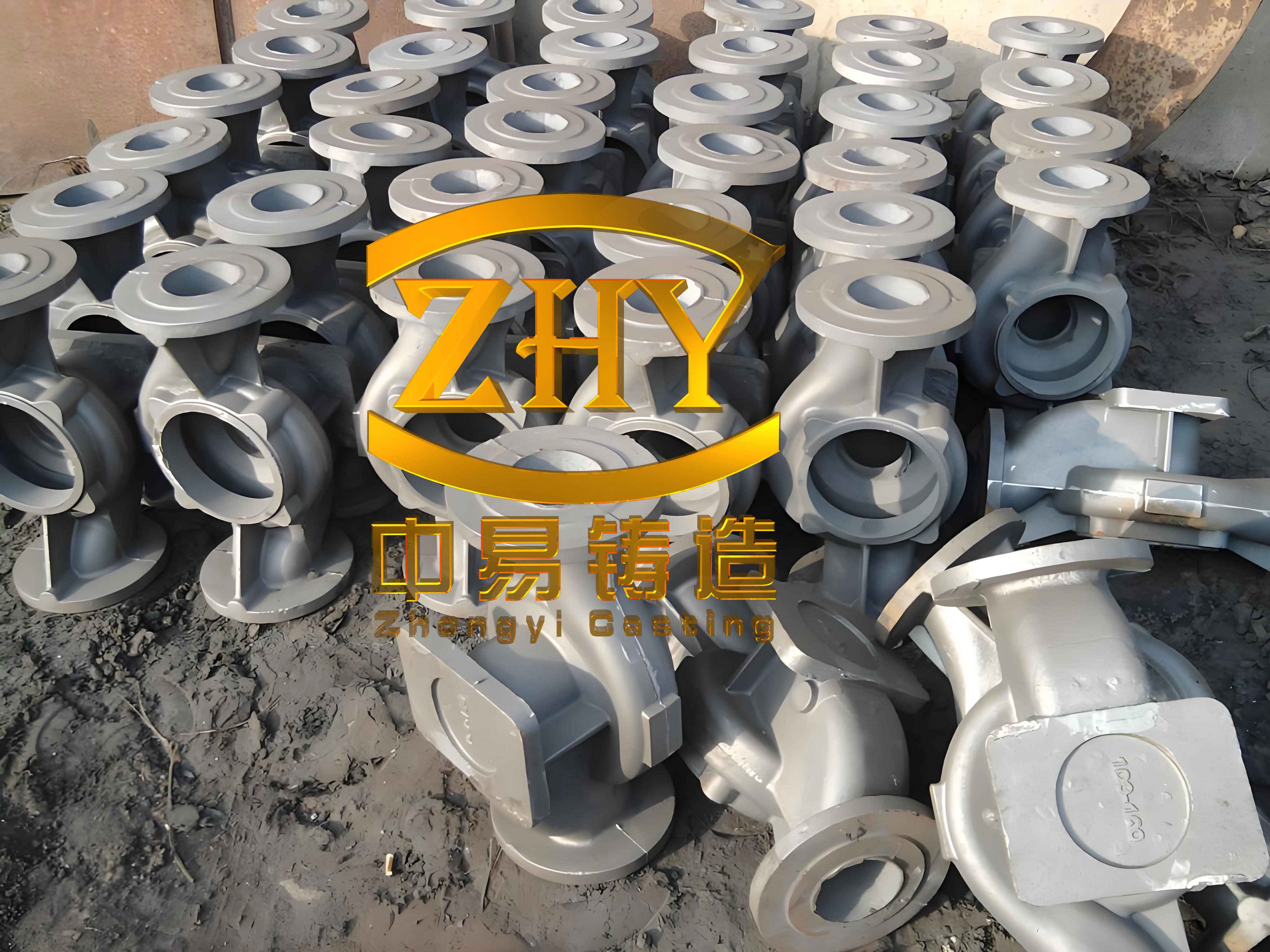
The exhaust manifold, a classic yet challenging grey iron casting, possessed several features that contributed to its difficulty. The component was relatively long and slender with a curved tubular section. A critical area was the flange connection point, which formed an isolated thermal mass or hot spot. Furthermore, one end featured an extended open-channel section, creating a large, thin-walled area susceptible to distortion. Controlling solidification and ensuring complete, sound filling in such a geometry is a core task in grey iron casting.
| Feature | Specification |
|---|---|
| Material | FC200 (Grey Iron, ~HT200) |
| Part Weight | 3.1 kg |
| Overall Length | 487 mm |
| Nominal Wall Thickness | 5 mm |
| Critical Hot Spot | Flange Boss |
| Problem Area | Open-channel section (32mm x 38mm x 304mm) |
Our initial casting strategy was developed based on standard practices for grey iron casting. To prevent distortion of the open channel, the mold was oriented with this channel facing upwards. Temporary reinforcing ribs were added to this section to maintain dimensional stability during casting and cooling, to be removed after stress-relief heat treatment. The molding was conducted on a high-pressure molding line with a four-cavity pattern. All castings were placed in the drag (lower half of the mold) for easier core setting and inspection. The sand cores were vented through the cope (upper half of the mold).
The gating system was designed for rapid filling to avoid cold shuts in the thin walls. It featured four in-gates arranged along one side of the casting, aiming to distribute the metal flow and thermal points. A hot top riser was attached to the top of the flange, the heaviest section, intended to feed solidification shrinkage. The metallurgy for this grey iron casting was carefully controlled. The charge composition targeted a Si/C ratio of approximately 0.75 and a eutectic saturation degree (Sc) between 0.93 and 0.94 to promote a good graphite structure. Melting was performed in medium-frequency induction furnaces, with a tapping temperature of 1440-1450°C. In-mold inoculation with 75% FeSi was employed to ensure a fine, uniform Type A graphite formation.
| Process Parameter | Initial Setting | |
|---|---|---|
| Mold Orientation | Open channel UP | |
| Pattern | 4-cavity | |
| Gating Type | Side Gate, 4 In-gates | |
| Riser Type | Hot Top Riser on Flange | |
| Si/C Target | ~0.75 | |
| Eutectic Saturation (Sc) Target | 0.93 – 0.94 | |
| Tapping Temperature | 1440 – 1450 °C |
Despite this seemingly sound approach for a grey iron casting, the results were dismal. Over a six-month period, the average scrap rate exceeded 50%, peaking at nearly 62% in one month. The dominant failure modes were subsurface blowholes and “peel” or “fold” defects (cold laps), concentrated predominantly at the highest point of the casting—the top of the flange boss, directly adjacent to the riser neck.
We initiated a root-cause analysis. The confluence of defects at the flange top was the primary clue. We hypothesized that the defects were not purely shrinkage-based but were heavily influenced by gas entrapment and surface turbulence. The use of a hot top riser, while good for feeding, meant it remained liquid longest, collecting gases pushed ahead of the solidifying metal. These gases, trapped under the rapidly forming oxide skin of the cooling iron, created blowholes or prevented proper fusion of metal streams, leading to peel defects. The multiple in-gates, intended to fill quickly, likely caused turbulent flow and excessive air entrainment within the mold cavity.
To verify this, we performed a solidification simulation, focusing on the fill pattern. The software visualization clearly showed the problematic flow: multiple metal streams collided and created turbulence. The last metal to fill was directed toward the flange top, but by this time its temperature had dropped, and its velocity was low. The entrapped gases from the turbulent fill could not float out rapidly through this cooler, viscous metal and its surface oxide, becoming permanently trapped just beneath the casting surface. This analysis confirmed that our gating system, not just the risering, was a key contributor to the failure of this grey iron casting.
The optimization strategy became clear: we needed to calm the metal flow and provide a dedicated, passive escape route for mold and entrained gases away from the critical casting area. The principle of “quiet, progressive filling” was adopted. The revised gating system for our grey iron casting was radically simplified. We reduced the number of in-gates from four to one, located at a thin-wall section. This forced the metal to fill the cavity in a more controlled, sequential manner, minimizing turbulence. The most critical change was to the riser system. The hot top riser was eliminated. In its place, a small, blind riser (essentially a gas-collecting chamber) was attached via a narrow, upward-sloping channel to the side of the flange, not its top. This channel’s entrance was placed level with the highest point of the flange.
The physics behind this is captured in a simple relationship for gas bubble floatation. The terminal velocity ($$v_t$$) of a bubble rising through liquid iron is governed by Stokes’ law, modified for high Reynolds numbers:
$$v_t = \sqrt{\frac{4 g d_b (\rho_{Fe} – \rho_{gas})}{3 C_D \rho_{Fe}}}$$
Where $$g$$ is gravity, $$d_b$$ is bubble diameter, $$\rho$$ denotes density, and $$C_D$$ is the drag coefficient. By providing a calm metal pool and a dedicated, hot path (the sloping channel) leading to an unpressurized chamber (the blind riser), we maximized $$v_t$$ and gave gases a clear escape route before being trapped by solidification.
Furthermore, we tightened control over the pouring time. The theoretical filling time ($$t_{pour}$$) is related to the effective head height ($$H$$), casting volume ($$V$$), and gating cross-sectional area ($$A_g$$) approximated by:
$$t_{pour} \approx \frac{V}{A_g \sqrt{2gH}}$$
We optimized the gating dimensions to achieve a target pour time that balanced minimal turbulence with avoidance of cold shuts, closely monitoring the temperature of the last mold poured to ensure it remained within a strict window.
| Defect Observed | Location | Root Cause (Initial Process) | Corrective Action |
|---|---|---|---|
| Subsurface Blowholes, Peel Defects | Top of Flange Boss | Turbulent fill entraining gas; hot riser collecting & trapping gas at casting surface. | 1. Single in-gate for calm fill. 2. Replace hot riser with side-blind riser + sloping vent channel. |
| Potential Cold Shuts | Thin-wall sections | Overly restricted/poorly timed fill from turbulent flow. | Calm, progressive fill from single gate; strict pour time/temp control. |
| General Scrap Rate | N/A | Combination of above factors. | Holistic gating/risering redesign and process discipline. |
The implementation of the new process for this grey iron casting yielded transformative results. The optimized gating and venting system is illustrated in the following conceptual diagram, which shows the single in-gate, the calm fill progression, and the critical gas-venting path via the sloped channel to the blind riser.
The improvement was immediate and sustained. Over a three-month evaluation period following the implementation, the scrap rate for this challenging grey iron casting plummeted from an average of over 50% to a consistent rate below 4%. Destructive and non-destructive testing confirmed the elimination of the subsurface gas and peel defects. Machined surfaces were clean and sound. Dimensional checks on the open-channel section using go/no-go gauges confirmed stability and compliance. Mechanical property tests from attached coupons met all FC200 specifications, with tensile strengths consistently around 240 MPa.
| Parameter | Initial Process | Optimized Process | Impact of Change |
|---|---|---|---|
| Number of In-gates | 4 | 1 | Eliminated turbulent flow, reduced oxide formation and gas entrainment. |
| Riser Type & Location | Hot Top, on flange top | Blind Side Riser, connected via sloped channel | Provided passive, effective vent for gases away from casting critical zone. |
| Metal Flow Pattern | Turbulent, multi-source | Calm, progressive, directional | Promoted laminar fill, allowing gases to rise and escape. |
| Primary Defect Rate | >50% (Gas/Peel) | < 4% | Direct result of improved fluid dynamics and venting. |
| Process Control Focus | Fill speed, chemistry | Fill calmness, pour time, venting efficiency | Shifted priority to managing the mold cavity environment. |
This case study underscores several fundamental principles in producing high-integrity grey iron castings, especially for complex, thin-walled components like exhaust manifolds. First, the prevention of turbulence during mold filling is often more critical than ultra-rapid filling. The governing equation for fluid flow in a gating system, the Bernoulli equation, highlights the trade-off:
$$H = \frac{v^2}{2g} + \frac{p}{\rho g} + z$$
Where $$H$$ is the total head, $$v$$ is velocity, $$p$$ is pressure, $$\rho$$ is density, $$g$$ is gravity, and $$z$$ is height. Our initial design prioritized the velocity term ($$v$$) via multiple gates, leading to high kinetic energy that dissipated as turbulence. The optimized design managed the elevation head ($$z$$) and pressure to control velocity, promoting quieter flow.
Second, effective venting is a non-negotiable requirement for quality grey iron casting. It must be designed as intentionally as the gating system. The vent must be located at the natural high point where gases will collect, and it must remain open and connected to a low-pressure zone (like a blind riser) until the metal in that area skins over. The design of our sloped vent channel ensured it was the last point to fill, maximizing venting time.
Third, process control parameters must align with the physical design. Strict control over pouring time and temperature was the enabling factor that allowed the optimized gating design to work consistently. The relationship between solidification time ($$t_s$$), modulus ($$M$$), and material constants is given by Chvorinov’s rule:
$$t_s = B \cdot M^n$$
Where $$B$$ is the mold constant. By ensuring a consistent, appropriate pouring temperature, we controlled the initial conditions for solidification across all molds, allowing the designed feeding and venting pathways to function predictably.
In conclusion, the journey to salvage this problematic grey iron casting project moved from a focus solely on feeding (risering) and speed (gating) to a holistic understanding of mold cavity fluid dynamics and gas management. The successful optimization hinged on recognizing that the defects were primarily driven by entrained gases from turbulent flow, which were then trapped at the highest point by an ill-suited riser. By redesigning the system for calm, progressive filling and incorporating a dedicated, passive gas escape route, we achieved a dramatic and sustainable improvement in quality. This experience serves as a potent reminder that in grey iron casting, sometimes the most effective solution involves not adding more complexity, but thoughtfully simplifying the path the metal—and the air it displaces—must travel.