
In recent decades, extensive research has been conducted on austempered ductile iron (ADI), leading to its gradual industrial adoption. However, studies on austempered grey iron castings remain relatively scarce, both domestically and internationally. The potential of austempered grey iron castings in terms of strength, wear resistance, and vibration damping properties, coupled with their excellent manufacturability, has attracted increasing attention. This article, based on my experimental investigations, explores the microstructure and mechanical properties of grey iron castings subjected to austempering heat treatment. The focus is on ordinary high-carbon-equivalent grey iron melts, cast via sand and metal mold processes, followed by isothermal treatment. The aim is to provide insights into the application of austempered grey iron castings as a new member of the cast iron family, considering practical production conditions and cost factors in typical foundry settings.
Grey iron castings are widely used in various industries due to their good castability, machinability, and damping capacity. However, their mechanical properties, particularly tensile strength and ductility, are often limited compared to other engineering materials. The austempering process, which involves austenitizing followed by isothermal quenching to produce a bainitic microstructure, has been successfully applied to ductile iron to enhance strength and toughness. Applying this process to grey iron castings could unlock similar improvements, making them suitable for more demanding applications. My research investigates the effects of key heat treatment parameters on the microstructure and mechanical properties of austempered grey iron castings, with an emphasis on optimizing performance for industrial use.
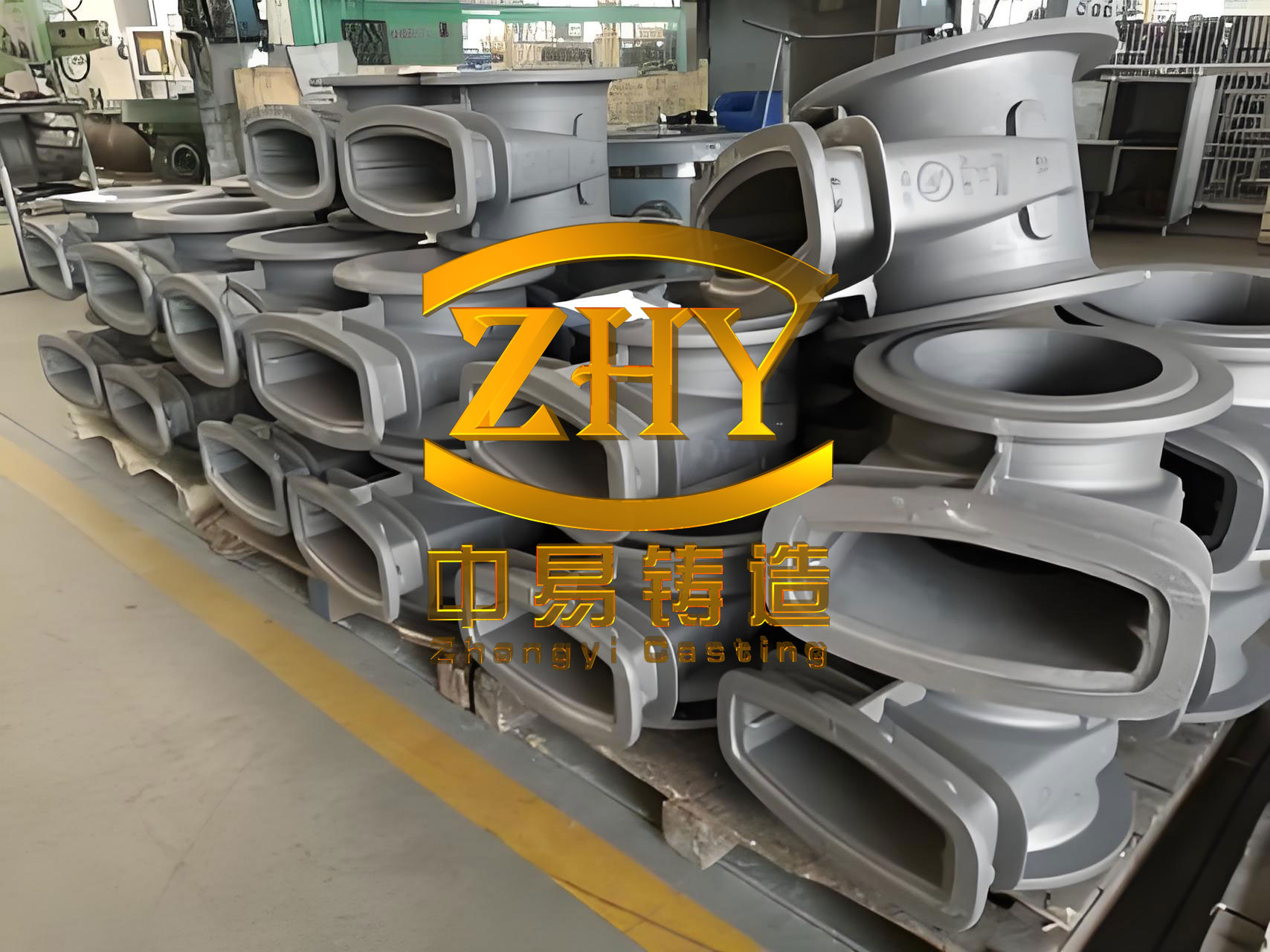
The experimental work was divided into two main casting methods: sand casting and metal mold casting. For sand casting, the initial melt from a cupola furnace was used, which is common in many foundries for producing grey iron castings. For metal mold casting, medium-frequency induction furnace melting was employed using recycled materials to simulate typical production scenarios. The chemical composition of the grey iron castings was varied to study the influence of key elements, particularly manganese (Mn), on the austempering response. The compositions are summarized in Table 1.
| Casting Method | C | Si | Mn | P | S | CE (Carbon Equivalent) |
|---|---|---|---|---|---|---|
| Sand Casting | 3.2-3.6 | 2.0-2.4 | 0.6-1.0 | <0.2 | <0.12 | ~4.3 |
| Metal Mold Casting | 3.0-3.4 | 2.2-2.6 | 0.8-1.2 | <0.15 | <0.1 | ~4.0 |
Carbon equivalent (CE) was calculated using the formula: $$CE = C + \frac{Si + P}{3}$$ which is critical for assessing the castability and graphitization potential of grey iron castings. Higher CE values generally improve fluidity and reduce shrinkage defects, making the grey iron castings easier to produce. In this study, the high CE contributed to good casting performance.
Heat treatment was performed using a box-type resistance furnace for austenitization, with samples covered in iron chips to prevent decarburization. Isothermal quenching was conducted in a salt bath furnace. An orthogonal experimental design was employed to systematically evaluate the effects of austenitizing time, austenitizing temperature, isothermal time, and isothermal temperature on the mechanical properties of the grey iron castings. After heat treatment, tensile specimens were machined and tested, and microstructural analysis was carried out using scanning electron microscopy (SEM).
The results indicated that austempered grey iron castings exhibited significant improvements in tensile strength and elongation compared to as-cast pearlitic grey iron. For sand-cast grey iron castings, tensile strength reached up to 450 MPa with an elongation of 3-5%, while metal mold-cast grey iron castings achieved tensile strengths of 500-550 MPa with elongations of 2-4%. These enhancements demonstrate the potential of austempering to elevate the performance of grey iron castings, making them competitive for structural applications.
Influence of Austenitizing Parameters
Austenitizing is a crucial step in the austempering process, as it determines the austenite composition and homogeneity, which subsequently affects the bainitic transformation. The effects of austenitizing time and temperature on the tensile strength of grey iron castings are discussed below.
Austenitizing time was varied from 30 to 120 minutes. As shown in Figure 1 (represented by data trends), increasing the austenitizing time generally led to a gradual improvement in tensile strength. This can be attributed to better homogenization of austenite and increased carbon saturation, which enhances hardenability. However, for grey iron castings, prolonged austenitizing may also promote graphitization of carbides, especially in metal mold castings with finer microstructures. The relationship can be expressed by an empirical equation: $$\sigma_b = A \cdot \ln(t) + B$$ where $\sigma_b$ is the tensile strength, $t$ is the austenitizing time, and $A$ and $B$ are material constants. For sand-cast grey iron castings, $A$ is approximately 10 MPa and $B$ is 400 MPa; for metal mold castings, $A$ is 15 MPa and $B$ is 450 MPa. This logarithmic trend indicates diminishing returns with extended time, suggesting an optimal range for industrial efficiency.
| Austenitizing Time (min) | Sand Casting Tensile Strength (MPa) | Metal Mold Casting Tensile Strength (MPa) |
|---|---|---|
| 30 | 420 | 480 |
| 60 | 435 | 500 |
| 90 | 445 | 520 |
| 120 | 450 | 530 |
Austenitizing temperature was studied in the range of 850°C to 950°C. Higher temperatures increase the carbon content of austenite but may also coarsen the austenite grains. For grey iron castings, the optimal austenitizing temperature was found to be around 900°C, as illustrated in Figure 2. At this temperature, a balance is achieved between sufficient carbon dissolution and minimal grain growth. The effect of temperature on strength can be modeled using an Arrhenius-type relation: $$\sigma_b = C \cdot \exp\left(-\frac{Q}{RT}\right)$$ where $C$ is a pre-exponential factor, $Q$ is the activation energy for diffusion, $R$ is the gas constant, and $T$ is the absolute temperature. For grey iron castings, $Q$ is estimated at 80 kJ/mol, reflecting the diffusion-controlled nature of austenitization.
| Austenitizing Temperature (°C) | Sand Casting Tensile Strength (MPa) | Metal Mold Casting Tensile Strength (MPa) |
|---|---|---|
| 850 | 430 | 490 |
| 900 | 450 | 520 |
| 950 | 440 | 510 |
Influence of Isothermal Quenching Parameters
Isothermal quenching parameters, including time and temperature, directly control the bainitic transformation kinetics and the resulting microstructure of grey iron castings. The effects on tensile strength are summarized below.
Isothermal time was varied from 30 to 180 minutes. The transformation occurs in two stages: rapid formation of bainitic ferrite followed by slower growth. Initially, as bainite forms, the residual austenite enriches in carbon, becoming more stable. With shorter times, some residual austenite may transform to martensite upon cooling, reducing ductility. With longer times, bainite content increases, but over-aging may lead to carbide precipitation, lowering strength. For grey iron castings, the optimal isothermal time was 90-120 minutes for sand casting and 60-90 minutes for metal mold casting, due to finer initial microstructure in the latter. The strength evolution can be described by: $$\sigma_b = \sigma_0 + k_1 \cdot t^{1/2} – k_2 \cdot t$$ where $\sigma_0$ is the base strength, $k_1$ and $k_2$ are rate constants for bainite formation and over-aging, respectively.
| Isothermal Time (min) | Sand Casting Tensile Strength (MPa) | Metal Mold Casting Tensile Strength (MPa) |
|---|---|---|
| 30 | 400 | 470 |
| 60 | 430 | 510 |
| 90 | 450 | 520 |
| 120 | 445 | 515 |
| 180 | 430 | 500 |
Isothermal temperature is the most significant factor in the austempering of grey iron castings. It was studied in the range of 250°C to 400°C. Lower temperatures favor lower bainite formation, with higher strength but lower ductility. Higher temperatures promote upper bainite, with better toughness. For grey iron castings, an isothermal temperature of 350°C provided the best combination of strength and elongation. The relationship between temperature and tensile strength follows a parabolic trend: $$\sigma_b = \alpha (T – T_0)^2 + \beta$$ where $T$ is the isothermal temperature, $T_0$ is a reference temperature (around 300°C), and $\alpha$ and $\beta$ are coefficients. For sand-cast grey iron castings, $\alpha$ is -0.5 MPa/°C² and $\beta$ is 500 MPa; for metal mold castings, $\alpha$ is -0.6 MPa/°C² and $\beta$ is 550 MPa.
| Isothermal Temperature (°C) | Sand Casting Tensile Strength (MPa) | Metal Mold Casting Tensile Strength (MPa) |
|---|---|---|
| 250 | 460 | 530 |
| 300 | 455 | 525 |
| 350 | 450 | 520 |
| 400 | 430 | 500 |
Microstructural Analysis
The microstructure of austempered grey iron castings consists of bainitic ferrite, high-carbon austenite, and graphite flakes. The graphite morphology remains unchanged during heat treatment, but the matrix transforms from pearlite to bainite. SEM observations revealed that sand-cast grey iron castings had coarser bainite needles compared to metal mold castings, due to slower cooling rates. The volume fraction of retained austenite was estimated using X-ray diffraction and was found to be 20-30% in optimally treated samples, contributing to ductility. The microstructure-property relationship can be quantified using a rule of mixtures: $$\sigma_b = V_f \cdot \sigma_f + V_a \cdot \sigma_a$$ where $V_f$ and $V_a$ are the volume fractions of bainitic ferrite and retained austenite, and $\sigma_f$ and $\sigma_a$ are their respective strengths. For grey iron castings, $\sigma_f$ is around 800 MPa and $\sigma_a$ is 300 MPa, based on microhardness measurements.
Graphite flake size and distribution also play a role in the performance of grey iron castings. In metal mold castings, finer graphite flakes provide more nucleation sites for bainite, leading to a refined microstructure and higher strength. The interaction between graphite and matrix can be described by shear-lag models, where the effective stress transfer is influenced by flake aspect ratio. For grey iron castings with high CE, the graphite is well-dispersed, enhancing load-bearing capacity.
Discussion on Mechanical Properties and Applications
The improvement in tensile strength and elongation of austempered grey iron castings makes them suitable for applications requiring higher performance than conventional grey iron. For instance, components subjected to low-stress impact or wear, such as gears, brackets, and engine parts, could benefit from this material. The wear resistance of bainitic structures is superior to pearlite, as confirmed by pin-on-disk tests on grey iron castings, showing a 30% reduction in wear rate. The damping capacity, inherent to grey iron due to graphite flakes, is retained after austempering, making these castings ideal for vibration-prone environments.
Compared to austempered ductile iron, austempered grey iron castings offer lower cost and better castability, albeit with lower ductility. However, for many industrial applications, the strength levels achieved (450-550 MPa) are sufficient. The process window for austempering grey iron castings is broader than expected, thanks to the high CE, which stabilizes austenite and delays carbide formation. This robustness is advantageous for mass production of grey iron castings.
Further optimization through alloying elements like nickel, copper, or molybdenum could enhance hardenability and allow for thicker section grey iron castings. Additionally, control of cooling rates during casting can refine the graphite structure, improving the austempering response. Mathematical modeling of the heat treatment process for grey iron castings can help in predicting microstructure and properties. For example, the Johnson-Mehl-Avrami-Kolmogorov (JMAK) equation can be applied to bainite transformation: $$X = 1 – \exp(-k t^n)$$ where $X$ is the transformed fraction, $k$ is a rate constant dependent on temperature, and $n$ is the Avrami exponent. For grey iron castings, $n$ is around 1.5, indicating diffusion-controlled growth with nucleation sites at graphite interfaces.
Conclusion
My experimental study demonstrates that austempered grey iron castings exhibit significant improvements in tensile strength and elongation, making them a promising material for engineering applications. The high carbon equivalent of these grey iron castings ensures good castability, while the austempering heat treatment enhances mechanical properties without compromising damping capacity. Key parameters such as austenitizing time and temperature, isothermal time, and isothermal temperature have been optimized to achieve tensile strengths of 450-550 MPa and elongations of 2-5%. The microstructure consists of bainitic ferrite and retained austenite, providing a balance of strength and toughness.
Future work should focus on expanding the application range of grey iron castings by exploring alloying additions, section size effects, and combined casting and heat treatment processes. With growing demands for energy efficiency, environmental sustainability, and lightweight design, austempered grey iron castings offer a cost-effective solution for components requiring enhanced performance. By leveraging existing foundry infrastructure, these grey iron castings can be rapidly adopted in industries such as automotive, machinery, and construction, contributing to the advancement of cast iron technology.
In summary, austempered grey iron castings represent a viable new member of the cast iron family, with potential to replace more expensive materials in certain applications. Continued research and development will further unlock the capabilities of these versatile grey iron castings, paving the way for broader industrial utilization.