
In my role as a foundry engineer specializing in the development of casting processes for iron components, I have encountered numerous challenges related to defect formation in grey iron castings. One particularly persistent issue that recently impacted production at our facility was the occurrence of shrinkage depression, or surface sinkholes, on the upper planes of medium-speed engine flywheels. These defects, often exceeding 3 mm in depth and leading to significant scrap rates, threatened both cost efficiency and order fulfillment. This article details my first-hand investigation into the root causes of this problem and the comprehensive set of corrective actions we implemented, leveraging both empirical analysis and advanced simulation tools. The insights gained are broadly applicable to the production of thick-sectioned grey iron castings where soundness is critical.
Grey iron castings, such as the flywheel in question, derive their properties from a microstructure dominated by graphite flakes within a pearlitic matrix. The solidification characteristics of these castings are unique due to the expansion associated with graphite precipitation, which can compensate for the inherent shrinkage of the iron liquid and austenite. However, this compensation is not always complete, especially in heavier sections or under suboptimal process conditions. The balance between shrinkage and expansion is delicate, influenced by composition, cooling rates, and mold rigidity. Our flywheel, with a minimum wall thickness of 46 mm, represents a classic case where this balance was disrupted, leading to macro-scale shrinkage defects on the cope surface.
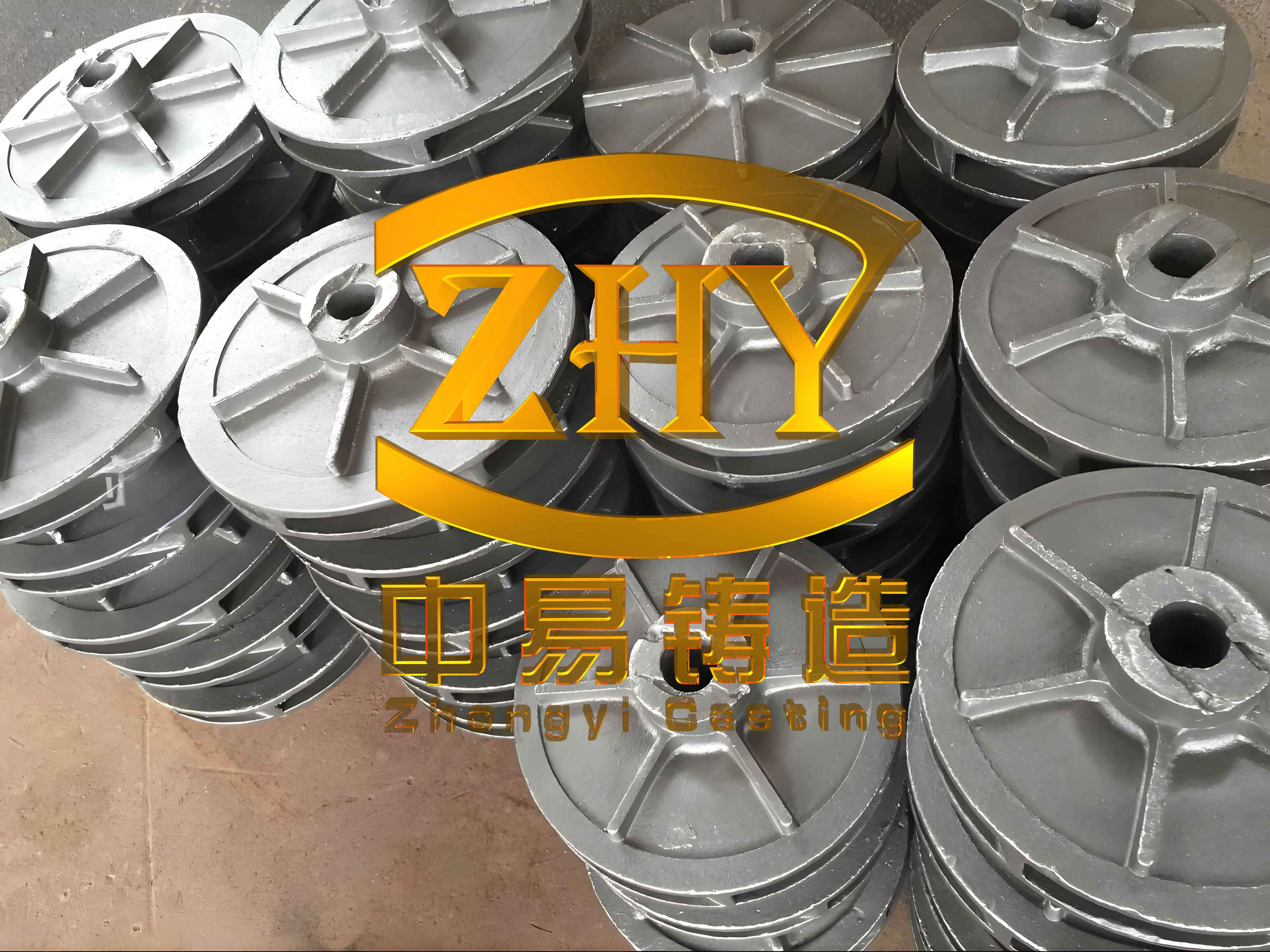
The subject flywheel casting had a rough outline dimension of Ø702 mm × 133 mm and a weight of approximately 245 kg. The specified material was HT250 grey iron, with a hardness requirement of 190–240 HBW. The metallographic structure was mandated to be primarily Type A graphite, with minor amounts of Type B permitted, and a flake length no finer than Grade 4. The pearlite content was required to be at least 98%, and the castings underwent a stress relief annealing treatment. The production of such grey iron castings was carried out on a high-volume molding line using alkaline phenolic resin-bonded sand. The mold configuration was two castings per mold box, arranged symmetrically.
The original gating system design was a traditional pressurized (choke) system. The cross-sectional area ratios were defined as: ∑Asprue : ∑Arunner : ∑Agate = 1.64 : 2.05 : 1. The ingates, with a height of only 5 mm, acted as the choke point. The melting practice aimed for a composition, as shown in Table 1, which resulted in a relatively low carbon equivalent.
| Element | C | Si | Mn | P | S | Cu | Cr |
|---|---|---|---|---|---|---|---|
| Content | 3.25 | 1.90 | 0.95 | 0.04 | 0.09 | 0.40 | 0.28 |
The carbon equivalent (CE) for grey iron castings can be calculated using a common formula:
$$CE = C + \frac{Si + P}{3}$$
For the original composition, this yields:
$$CE = 3.25 + \frac{1.90 + 0.04}{3} = 3.25 + 0.647 \approx 3.90$$
This value places the iron in a hypo-eutectic range. The pouring temperature was maintained between 1350°C and 1360°C, with two molds poured from a single ladle.
The defects manifested as distinct depressions on the upper (cope) surface of the flywheel. Upon closer examination, some depressions contained small, spherical “iron beads” that were free of the refractory coating present on the rest of the cavity surface. This was a critical clue. The depression itself is a volumetric deficit caused by contraction of the metal from the pouring temperature down to the solidus temperature. The iron beads were formed in the final stages of solidification; as the graphite expanded in the mushy zone, it displaced a small amount of residual liquid iron into the already-formed shrinkage cavity, where it solidified rapidly without contacting the mold coat. This confirmed the defect as a shrinkage depression, not a gas blowhole or sand inclusion.
A thorough root cause analysis was conducted, focusing on the fundamental principles governing the soundness of grey iron castings.
1. Suboptimal Carbon Equivalent: The original CE of ~3.90 was偏低 for a section of this thickness. Hypo-eutectic grey irons have a wider solidification range between the liquidus and eutectic temperatures. The total volumetric contraction during solidification ($\Delta V_{total}$) can be conceptually broken down into three stages:
$$ \Delta V_{total} = \Delta V_{liquid} + \Delta V_{liquidus-solidus} + \Delta V_{graphite-expansion}$$
Where $\Delta V_{liquid}$ is the contraction of the superheated liquid, $\Delta V_{liquidus-solidus}$ is the contraction during the austenite formation (mushy zone), and $\Delta V_{graphite-expansion}$ is the expansion due to graphite precipitation (a negative value). In hypo-eutectic irons, the $\Delta V_{liquidus-solidus}$ term is more significant. A higher CE, closer to the eutectic point (~4.3), reduces this range and promotes more graphite expansion earlier in the solidification process, enhancing self-feeding. Therefore, the low CE was a primary contributor to excessive shrinkage potential in these grey iron castings.
2. Excessive Pouring Temperature: The high pouring temperature of 1350–1360°C increased the $\Delta V_{liquid}$ term. The liquid contraction coefficient for iron is approximately $1.0 \times 10^{-4} / ^{\circ}C$. The extra superheat above the liquidus temperature ($T_{liquidus} \approx 1180^{\circ}C$ for this CE) resulted in additional volumetric shrinkage before solidification even began, demanding more feed metal.
3. Inadequate Mold Stiffness: The resin sand mold, while having good collapsibility, must possess sufficient hot strength and rigidity to resist metallostatic pressure and the expansion forces from graphite formation. If the mold wall yields or deforms, it creates extra volume that the solidifying metal must fill, effectively worsening the shrinkage defect. The original molding process parameters may not have ensured optimal compaction.
4. Non-ideal Gating System Design: This was a multifaceted issue critical for grey iron castings.
- Uncontrolled Fill and Early Choke-off: The fully pressurized system with the choke at the ingate led to very high metal velocity at the point of entry. Using Bernoulli’s principle, the velocity ($v$) at the ingate can be estimated: $$v = \mu \sqrt{2gh}$$ where $\mu$ is the discharge coefficient, $g$ is gravity, and $h$ is the metallostatic head. This high velocity caused turbulent filling and likely air entrainment. More importantly, it led to an unstable liquid level in the pouring basin/sprue. By the time pouring stopped, the level dropped significantly, reducing the effective feeding pressure head at the critical moment of liquid contraction.
- Premature Ingate Freezing: The ingate height of 5 mm was too small. Its solidification time, governed by Chvorinov’s Rule where $t \propto (V/A)^2$, was very short. This meant the ingates froze shut early in the solidification sequence, isolating the casting from the liquid metal reservoir in the gating system precisely when liquid shrinkage was occurring. A successful feeding system for grey iron castings must maintain a liquid connection for as long as possible.
- Lack of Flow Stabilization: The system lacked features to calm the metal flow before it entered the mold cavity, contributing to initial turbulence.
To quantitatively evaluate the gating system’s performance and test solutions, we employed MAGMAsoft simulation software. The initial simulation of the original gating system vividly illustrated the problems. The velocity vectors at the ingates showed values exceeding 200 cm/s, confirming highly turbulent entry. The solidification progression showed that the thin ingates solidified rapidly, followed by sequential solidification of the casting from the edges inward, with the heavy upper section being the last to freeze but without a liquid feed path.
| Parameter | Original Design | Optimized Design |
|---|---|---|
| System Type | Fully Pressurized | Pressurized-Open (Choke-Sprue) |
| Choke Location | At Ingates | Between Sprue and Runner |
| ∑ASprue : ∑ARunner : ∑AGate | 1.64 : 2.05 : 1 | 1 : 1.8 : 2.2 (Post-choke) |
| Ingate Height (mm) | 5 | 8 | Calculated Ingate Velocity (cm/s) | ~200 | ~80 |
| Runner Configuration | Full Circle | 3/4 Circle with Blind End/Slag Trap |
The simulation allowed us to iteratively test modifications. The optimized design incorporated several key changes:
- A choke was introduced at the base of the sprue, converting the system to a “choke-sprue” or partially pressurized type. This controlled the flow rate from the start.
- The section areas downstream of the choke were enlarged, making the system open, which dramatically reduced ingate velocity to a calm ~80 cm/s, as predicted by the continuity equation $Q = A_1 v_1 = A_2 v_2$.
- The ingate height was increased from 5 mm to 8 mm. This simple change had a profound effect on its modulus (Volume/Surface Area), increasing its solidification time significantly based on Chvorinov’s Rule: $$t_f = k \left( \frac{V}{A} \right)^n$$ where $n$ is typically around 2. A taller ingate maintains a liquid connection longer, aiding feeding during the liquid contraction phase.
- The circular runner was modified to a 3/4 circle with a built-in slag trap at the end, further promoting quiescent flow and slag removal.
The new simulation showed a smooth, wave-less filling sequence and a more favorable solidification pattern where the ingates remained liquid longer than the adjacent casting sections, acting as effective feed paths.
Based on the defect analysis and simulation results, a multi-pronged corrective action plan was implemented for the production of these grey iron castings.
1. Adjustment of Chemical Composition: The carbon content was intentionally increased from 3.25% to 3.30%. The target composition is shown in Table 3. This raised the Carbon Equivalent to approximately 3.95, moving closer to the eutectic. The increase in carbon promotes more graphite formation, thereby increasing the beneficial expansion $\Delta V_{graphite-expansion}$ to counteract shrinkage.
| Element | C | Si | Mn | P | S | Cu | Cr | CE |
|---|---|---|---|---|---|---|---|---|
| Content | 3.30 | 1.90 | 0.95 | 0.04 | 0.09 | 0.40 | 0.28 | ~3.95 |
2. Strict Control of Pouring Temperature: The target pouring temperature was lowered and tightly controlled at 1340–1350°C. To ensure consistency, we installed temperature monitoring cameras in the pouring area and scheduled dedicated furnace taps for flywheel castings to avoid excessive superheat from holding. The reduction in superheat ($\Delta T_{superheat}$) directly reduces the liquid shrinkage volume, which can be approximated as: $$\Delta V_{liquid} \approx \alpha_v \cdot V_0 \cdot \Delta T_{superheat}$$ where $\alpha_v$ is the volumetric coefficient of thermal expansion for liquid iron.
3. Enhancement of Mold Strength and Rigidity: The jolting time on the molding machine was extended from 15 seconds to 25 seconds to improve sand compaction uniformity and increase the mold’s initial Green Compression Strength. A stiffer mold better resists the internal pressures, forcing the solidifying metal to compensate for contraction internally via graphite expansion rather than deforming the mold wall.
4. Implementation of the Optimized Gating System: The design validated through MAGMA simulation was put into production. The new system ensured calm filling and provided prolonged liquid feeding.
5. Increased Pouring Weight/Metal Yield: We slightly increased the total poured weight per mold. This provided a larger liquid “reservoir” in the pouring basin and sprue, mitigating the level drop issue and ensuring a higher pressure head for feeding during the final stage of pouring. The concept relates to maintaining a sufficient metallostatic pressure $P = \rho g h$ until the ingates seal.
The combined effect of these measures was evaluated over a production run of approximately 100 flywheels. The results were definitive: the severe shrinkage depressions were completely eliminated. The upper surfaces of the castings were sound and smooth, meeting the machining allowance requirements without any subsurface porosity detected during subsequent processing. The scrap rate due to this defect fell to zero, validating the effectiveness of the systematic approach.
This case study underscores several fundamental principles for producing sound, heavy-section grey iron castings. First, composition is paramount; a carbon equivalent tailored to the section size, often aiming for slightly higher values, harnesses graphite expansion effectively. The widely used relationship between section size (D in mm) and required CE can be expressed as an empirical guideline: $$CE_{target} \approx 4.3 – \frac{0.3}{D}$$, suggesting a CE near 4.0 for our ~50 mm section. Second, temperature control is a low-cost but high-impact factor; minimizing superheat directly reduces the demand on the feeding system. Third, mold rigidity is a critical, sometimes overlooked, variable—especially with organic binder systems. It acts as the “container” for the solidification process. Finally, gating design must be purpose-built for feeding, not just filling. For grey iron castings, this often means prioritizing systems that fill calmly and maintain open feed paths (via larger ingate moduli) over purely pressurized systems designed for ferrous alloys with no expansion phase.
The successful integration of computational simulation (MAGMA) was instrumental. It moved the optimization process from a trial-and-error basis on the shop floor to a virtual environment, saving significant time and material costs. The software allowed us to visualize flow patterns, calculate temperature fields, and predict shrinkage areas with good accuracy, enabling data-driven design decisions. This experience has been generalized into a standard checklist for launching new grey iron casting projects at our foundry, covering composition specification, gating design principles, and process parameter windows.
In conclusion, the shrinkage depression defect in these engine flywheels, a common challenge in the production of grey iron castings, was systematically addressed through a holistic approach. By adjusting the carbon equivalent to better utilize graphite expansion, strictly controlling pouring temperature to minimize liquid contraction, enhancing mold stiffness to contain expansion forces, and fundamentally redesigning the gating system for calm filling and prolonged feeding, the problem was resolved entirely. The key lesson is that producing defect-free grey iron castings requires synchronized control over all elements of the process—metallurgical, thermal, and mechanical—each understood through both fundamental principles and modern simulation tools. This methodology provides a robust framework for tackling similar solidification-related defects across a wide range of grey iron castings applications.