
In the field of mechanical engineering, the reliability and performance of equipment heavily depend on critical components like bearing seats. These parts, often manufactured as grey iron castings, must withstand significant stresses, provide precise alignment, and ensure proper lubrication. The development of robust casting processes for medium to large-sized grey iron castings is therefore of paramount importance for advancing equipment manufacturing. In this work, we focus on the casting process design for the upper half of a front bearing seat made from grey iron, specifically HT250. Our goal is to address the challenges posed by its complex geometry, uneven wall thickness, and stringent quality requirements, aiming to produce defect-free grey iron castings through systematic design and numerical simulation.
The upper half of the front bearing seat, as a key component in turbine systems, serves to support bearings, facilitate lubrication, and endure operational loads. Its structural integrity is crucial, as any defects like shrinkage porosity or gas holes could compromise the entire assembly. This grey iron casting has an outline dimension of 1095 mm × 910 mm × 380 mm and a net weight of 566 kg. After accounting for machining allowances and draft angles, the casting design reveals significant variations in wall thickness, with an average of 25 mm, a minimum of 20 mm, and a maximum of 153 mm. Such disparities create hot spots that are prone to shrinkage defects, making the casting process for these grey iron castings particularly challenging. The internal structure includes cavities, bearing housings with flanges, window features, and a narrow oil injection channel, all of which complicate mold and core production.
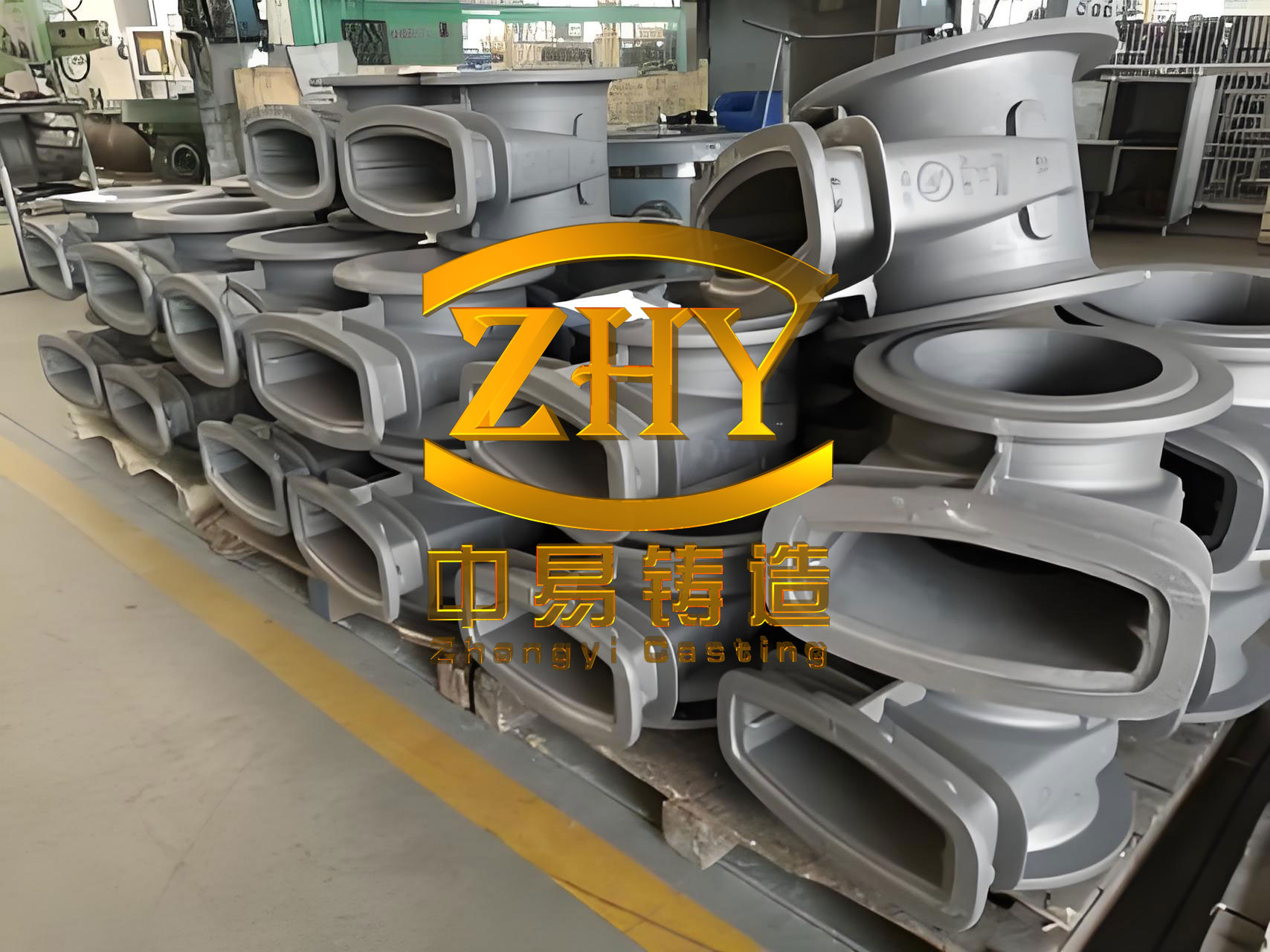
To assess the casting’s manufacturability, we analyzed its geometry using 3D modeling. The table below summarizes key parameters of this grey iron casting:
| Parameter | Value |
|---|---|
| Outline Dimensions | 1095 mm × 910 mm × 380 mm |
| Net Weight | 566 kg |
| Average Wall Thickness | 25 mm |
| Minimum Wall Thickness | 20 mm |
| Maximum Wall Thickness | 153 mm |
| Material | HT250 Grey Iron |
Our casting process employs furan resin self-hardening sand for mold and core making, with alcohol-based graphite coating applied to surfaces. Grey iron castings like HT250 exhibit favorable casting properties due to graphite expansion during solidification, which aids in compensating for shrinkage. However, careful design is still required to prevent defects in thick sections. We adopted a single-casting-per-mold approach for small-batch production, using sand gravity casting. The pouring position was selected to place major machining surfaces downward and larger planar surfaces upward, facilitating riser placement. A curved parting surface was implemented to minimize the number of cores, simplifying the process. Only two sand cores were designed: one for the front bearing housing and another for the oil injection channel and adjacent housing.
The gating system is a critical element in producing sound grey iron castings. We designed a closed bottom-pouring system to ensure smooth filling, reduce turbulence, and minimize oxidation. The cross-sectional area ratio was set as follows:
$$ \sum A_{\text{sprue}} : \sum A_{\text{runner}} : \sum A_{\text{ingate}} = 1.4 : 1.2 : 1 $$
To determine the pouring time, we used an empirical formula for grey iron castings:
$$ t = k \cdot \sqrt[3]{G_{\text{casting}} \cdot \delta} $$
Where \( t \) is the pouring time in seconds, \( G_{\text{casting}} \) is the net weight of the casting in kg (573 kg after adjustments), \( \delta \) is the main wall thickness in mm (20 mm), and \( k \) is a coefficient typically around 0.8 for similar grey iron castings. Calculating precisely:
$$ t = 0.8 \cdot \sqrt[3]{573 \times 20} \approx 35 \text{ s} $$
Thus, the pouring time was set to 35 seconds, with a pouring temperature of 1350°C. The gating dimensions were calculated using the choke area method. The total choke area \( \sum A_{\text{choke}} \) was found to be 26.4 cm². With 8 ingates, each ingate area is approximately 3.3 cm². The sprue area is 37 cm², and the total runner area is 32 cm² (two runners). Details are provided in the table below:
| Gating Component | Number | Cross-Sectional Area (cm²) | Dimensions (mm) |
|---|---|---|---|
| Sprue | 1 | 37 | Diameter: ~68.7 (circular) |
| Runner | 2 | 16 each (total 32) | Trapezoidal: top 40, bottom 30, height 35 |
| Ingate | 8 | 3.3 each (total 26.4) | Trapezoidal: top 30, bottom 20, height 15 |
To optimize the process, we utilized ProCAST 2021 numerical simulation software. The mesh generation resulted in 1,138,332 volume elements. Initial conditions included a pouring temperature of 1350°C, pouring time of 35 s, and material properties for HT250 grey iron and resin sand. Heat transfer coefficients were set as: 1000 W/(m²·K) between sand and casting, 1000 W/(m²·K) between sand and chills, and 2000 W/(m²·K) between casting and chills. Cooling was assumed to be in still air.
First, we simulated the “bare” casting with only the gating system. The filling process showed smooth metal flow without significant turbulence or air entrapment, completing in about 35 seconds. However, defect analysis revealed severe issues in thick sections. Surface depression was observed on the top thick area (153 mm wall) and an elliptical boss, indicating inadequate feeding. Shrinkage porosity defects were concentrated in hot spots, as shown in the simulation results. This underscores the need for risers and chills in such grey iron castings.
Based on these results, we designed a riser system to promote directional solidification. Using the modulus method and empirical ratios, we placed seven risers: one open top necking-down riser, two insulation risers, and four vent risers. The open riser was positioned on the elliptical boss, while insulation risers were placed on the thickest section. Their dimensions are summarized below:
| Riser Type | Quantity | Dimensions (mm) | Purpose |
|---|---|---|---|
| Open Top Necking-down | 1 | Height: 200, Top Diameter: 120, Neck: 60 | Feed elliptical boss |
| Insulation Riser | 2 | Height: 180, Diameter: 100 | Feed thickest section |
| Vent Riser | 4 | Height: 50, Diameter: 30 | Release air and gases |
Simulation after adding risers showed a reduction in shrinkage defects, but residual porosity persisted in areas like circular bosses, window regions, and the central thick section. To address this, we introduced external chills to accelerate cooling in these hot spots. Five chills were designed: one shaped chill for the thickest area, two shaped chills for window zones, and two cylindrical chills for circular bosses. Their specifications are as follows:
| Chill Type | Quantity | Dimensions (mm) | Placement |
|---|---|---|---|
| Shaped Chill (1#) | 1 | Thickness: 150, Contoured to part | Central thick section |
| Shaped Chill (2#) | 2 | Thickness: 150, Contoured to windows | Square and circular windows |
| Cylindrical Chill | 2 | Diameter: 50, Thickness: 20 | Bottom of circular bosses |
With risers and chills integrated, the final casting process was simulated again. The results demonstrated complete elimination of shrinkage porosity defects in the grey iron casting. The solidification process followed a directional pattern: areas farthest from risers solidified first, followed by the open riser region, and finally the insulation risers, ensuring that shrinkage was confined to the risers. The total solidification time was reduced, enhancing the density of the casting. The process yield, calculated as the ratio of casting weight to total poured weight (including gating and risers), reached 85%, which is efficient for grey iron castings.
The success of this design hinges on the synergistic use of risers and chills. The risers provide feeding to compensate for liquid and solidification shrinkage, while chills modify the temperature gradient to control solidification sequence. For grey iron castings like HT250, the inherent graphite expansion offers some self-feeding, but it must be supplemented with external feeding in thick sections. Our design ensures that thermal gradients are optimized, minimizing defect formation.
In conclusion, we have developed a comprehensive casting process for the upper half of a front bearing seat made from grey iron. Key aspects include a curved parting surface to simplify molds, a closed bottom-pouring gating system with calculated dimensions, and a combination of risers and chills to achieve directional solidification. Numerical simulation played a vital role in iteratively optimizing the design, allowing us to predict and eliminate defects before physical production. This approach not only ensures high-quality grey iron castings but also reduces development time and cost. The methodology can be extended to other complex grey iron castings, contributing to advancements in casting technology for heavy machinery components. Future work could explore the effects of varying alloy compositions or cooling rates on the microstructure and properties of such grey iron castings.
Throughout this study, the term “grey iron castings” has been emphasized to highlight the material’s significance in industrial applications. The design principles discussed here—such as proper gating ratios, riser placement based on modulus calculations, and chill usage for thermal management—are broadly applicable to grey iron castings of similar complexity. By leveraging simulation tools, foundries can enhance their capability to produce defect-free grey iron castings consistently, meeting the demanding standards of modern equipment manufacturing.