
In my extensive practice with grey iron castings produced in green sand molds, the design of risers is a critical aspect that directly influences casting quality, yield, and economic efficiency. Based on the balanced solidification theory and the principle of limited feeding, I have developed and refined a systematic approach to riser selection and design. This methodology emphasizes adaptability, practical application, and optimization for various structural characteristics and weights of grey iron castings. The goal is to achieve sound castings with minimal defects while maximizing the process yield, which is essential for both high-volume production and small-batch runs. The following sections detail this comprehensive framework, incorporating theoretical foundations, selection criteria, design calculations, and illustrative examples, all aimed at enhancing the reliability and cost-effectiveness of producing grey iron castings.
The foundation of my riser design philosophy is the balanced solidification theory. This theory posits that for grey iron castings, the graphitization expansion during solidification can partially compensate for the shrinkage, thereby reducing the external feeding demand. Consequently, risers need not provide full compensation but rather a controlled, limited feed to balance the solidification process. The feeding requirement is not constant; it varies with the casting’s geometry, wall thickness, and the presence of thermal junctions. For thin-walled, uniform-section grey iron castings, the expansion effect is relatively significant, often allowing for the elimination of dedicated risers or the use of pouring gates for feeding. In contrast, grey iron castings with isolated heavy sections or pronounced thermal hotspots require stronger feeding, necessitating risers with high feeding efficiency. The key is to assess the “feeding strength” category for each grey iron casting: weak feeding for large, bulky sections where expansion utilization is high, and strong feeding for smaller castings or those with concentrated shrinkage tendencies.
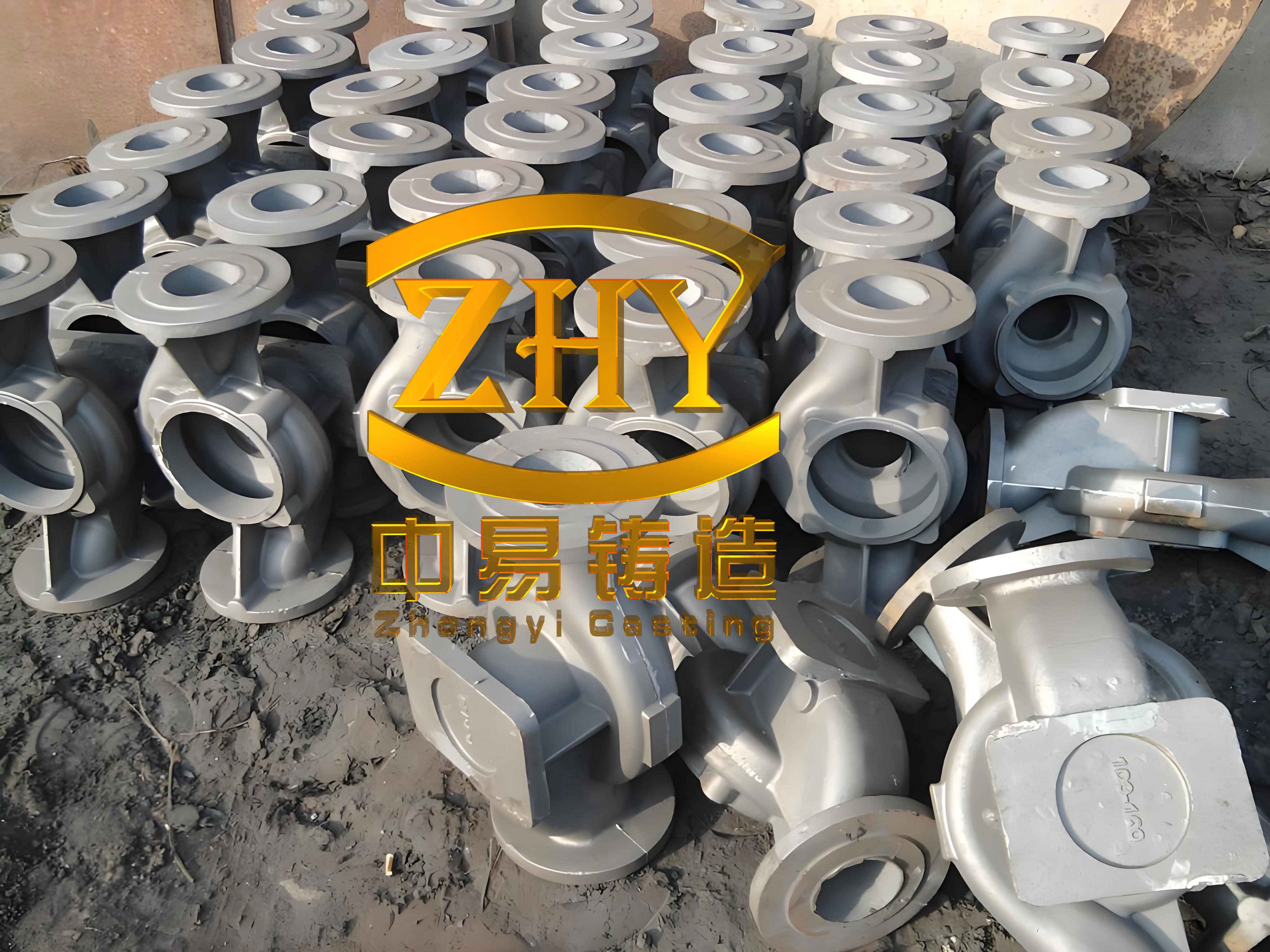
The first step in the methodology is selecting the appropriate type of riser. This decision is based on several sequential judgments concerning the specific grey iron casting. First, one must determine if a riser is necessary for feeding. As mentioned, thin-walled, uniform grey iron castings may not need a separate feeding riser; an atmospheric riser for venting might suffice, or the gating system can be enlarged to act as a feeder. For grey iron castings with local hot spots, a dedicated, efficient feeding riser is essential. Second, the feasibility of using a blind (or dark) riser versus an open riser is evaluated. Blind risers are generally preferred over open risers due to better thermal efficiency and reduced slag inclusion. They can be used when the entire grey iron casting is located in the drag or middle mold parts. If part of the casting is in the cope, an open riser must be employed. Therefore, the parting line selection should consider riser placement. For single-piece or small-batch grey iron castings, multi-part molding can sometimes be justified to allow for optimal blind riser use.
Third, the choice between hot risers and cold risers is made. Hot risers, which are connected to the mold cavity with a relatively large neck to maintain liquid metal longer, offer the most economical feeding for suitable grey iron castings. For green sand molds, I recommend prioritizing hot risers for grey iron castings weighing less than 200 kg and with a height under 200 mm. Beyond these limits, cold risers, which have a narrower neck to promote earlier freezing and separation, are more appropriate. Finally, the specific riser geometry is chosen based on the primary need of the grey iron casting. For strong feeding requirements within the hot riser range, the pressed-edge hot riser is often the best choice. Compared to side-feeding risers, the pressed-edge design offers smoother filling, better feeding efficiency, and economic advantages in pattern making, molding, and cleaning. Its shape can be adjusted, and one riser can feed multiple grey iron castings, improving yield. For plate-like grey iron castings with large upward-facing surfaces, cold flash risers or ear risers are preferred for their ability to handle cold metal, slag, and gas while providing some feeding. Atmospheric risers are used for grey iron castings with no feeding requirement but needing venting and acting as cooling ribs.
For open risers where feeding is needed, the duck-bill wedge riser is advantageous. Compared to a top necked-down riser, its distinctive slit-like neck provides excellent adaptive feeding capability, preventing “back-sucking” and making removal easier. These selection criteria ensure that the riser type aligns with the functional demands of the grey iron casting, whether it’s feeding, slag trapping, venting, or a combination thereof.
The core of the design process is determining the riser dimensions. I employ a simplified yet effective method based on the “hot spot circle diameter” of the casting section needing feeding. The riser size is derived by multiplying this thermal node diameter by a predetermined riser coefficient ($K_r$). The relationship is expressed as:
$$ D_r = K_r \cdot T_c $$
where $D_r$ is the riser diameter (or the inscribed circle diameter for non-circular risers), and $T_c$ is the hot spot circle diameter of the grey iron casting. The riser coefficient $K_r$ is not a single value but varies based on the riser type, the feeding strength required, and the casting characteristics. The following table summarizes the recommended riser coefficient ranges for various riser types used in green sand grey iron castings.
| Riser Category | Riser Type | Riser Coefficient $K_r$ Range | Primary Application for Grey Iron Castings |
|---|---|---|---|
| Blind / Hot Riser | Pressed-Edge Riser | 1.2 – 1.5 | Strong feeding for local hot spots. |
| Side-Feeding (Ear) Riser | 1.3 – 1.6 | General feeding, good slag trapping. | |
| Flash Riser | 1.4 – 1.7 | Plate castings, emphasis on slag/cold metal overflow. | |
| Blind / Cold Riser | Pressed-Edge Riser | 1.0 – 1.3 | Feeding for larger/heavier sections. |
| Side-Feeding (Ear) Riser | 1.1 – 1.4 | Feeding and overflow for bulkier castings. | |
| Flash Riser | 1.2 – 1.5 | Large upward faces, strong overflow function. | |
| Open / Cold Riser | Top Necked-Down Riser | 1.1 – 1.4 | Open feeding where blind risers are impossible. |
| Duck-Bill Wedge Riser | 1.0 – 1.3 | Open feeding with adaptive neck, prevents back-suck. | |
| Open / Atmospheric | Atmospheric Riser | 0.8 – 1.0 | Venting only, no feeding requirement. |
Notes on the table: For bulky grey iron castings (weak feeding), the lower limit of the coefficient range is selected. For grey iron castings with local hot spots in thin walls (strong feeding), the upper limit is chosen. The riser height ($H_r$) is typically related to its diameter. A common rule is $H_r = (1.2 \text{ to } 1.5) D_r$ for feeding risers, ensuring adequate feed metal volume. The riser neck dimensions are critical. For cold risers, the total neck cross-sectional area ($A_n$) should be greater than or equal to the cross-sectional area of the ingate ($A_g$) to promote effective overflow of cold metal and slag: $A_n \geq A_g$. A larger $A_n/A_g$ ratio improves overflow efficiency. For hot risers, the neck is designed to freeze after the casting section but before the riser itself to ensure directional solidification.
The volume of the riser must satisfy the feeding demand of the grey iron casting, accounting for the compensation from graphitization. The required riser volume $V_r$ can be estimated using the feeding demand volume $V_f$ and the riser feeding efficiency $\eta_r$:
$$ V_r = \frac{V_f}{\eta_r} $$
The feeding demand volume $V_f$ depends on the casting’s volumetric shrinkage ($\varepsilon_v$, typically 1-3% for grey iron, lower for high-carbon equivalents) and the volume of the feeding zone $V_c$: $V_f = \varepsilon_v \cdot V_c$. However, due to expansion, the effective $V_f$ is often lower. The feeding efficiency $\eta_r$ varies with riser type and molding conditions; for example, a well-designed pressed-edge hot riser on a grey iron casting can have an efficiency ($\eta_r$) of 15-25%. Combining these, a practical check is to ensure the riser’s modulus ($M_r = V_r / A_r$, where $A_r$ is riser surface area) is greater than the modulus of the casting section it feeds ($M_c$): $M_r > M_c$. According to Chvorinov’s rule, solidification time $t$ is proportional to the square of the modulus: $t = k \cdot M^2$, where $k$ is a mold constant. Therefore, ensuring $M_r > M_c$ guarantees the riser solidifies later, enabling feeding.
To illustrate the design process, let’s consider two concrete examples of grey iron castings. First, a heavy block-like grey iron casting (weak feeding category) with a hot spot circle diameter $T_c = 80$ mm, weight approximately 150 kg. The material is grade HT250. A pressed-edge hot riser is selected. From the table, for a hot pressed-edge riser on a bulky grey iron casting, we choose the lower coefficient $K_r = 1.2$. Thus, the riser diameter is $D_r = K_r \cdot T_c = 1.2 \times 80 = 96$ mm. We round to a standard pattern size of 100 mm. The riser height is set as $H_r = 1.3 \times D_r = 130$ mm. The neck thickness for a hot pressed-edge riser is typically 0.6 to 0.8 times the casting wall thickness at the junction, with a very short length to act as a “press edge” slit. This design provides adequate feeding while maintaining a high process yield for the grey iron casting.
Second, consider a plate-shaped grey iron casting (slider block) with an upward-facing large surface, weight 40 kg, material HT200. The primary need is to trap cold metal and slag, with feeding as a secondary concern. A cold flash riser is chosen. The thermal node diameter $T_c$ is 50 mm. For a cold flash riser, the coefficient is selected from the middle of the range, $K_r = 1.35$. Therefore, $D_r = 1.35 \times 50 = 67.5$ mm, rounded to 70 mm. The flash riser has a specific geometry: a bottom flash height ($H_f$) that is about 0.2-0.3 times $D_r$, say 15 mm. The riser body height $H_r$ can be 1.5 times $D_r$ (105 mm). The neck area is designed to be generous for overflow. This configuration effectively collects cold, slag-laden metal that arrives first during pouring, significantly improving the surface quality of the grey iron casting.
A practical challenge in using pressed-edge risers, especially without dedicated pattern plates, is the accurate positioning of the riser on the mold to ensure the precise slit width (the “press edge” dimension). An incorrect gap can severely impair feeding. To address this, I have devised a simple positioning plate system. The plate is pre-set in the drag mold, aligning with the grey iron casting pattern. When molding the cope, the riser pattern aligns with this plate. After molding, the positioning plate is removed, and its cavity is filled with molding sand. The plate can be reused for similar grey iron castings within a size range. The assembly relationship between the positioning plate, the grey iron casting, and the riser is crucial. Two types of positioning plates (Type A and Type B) are recommended, with key dimensions provided in the table below. Dowel pins can be made of wood, bamboo, or metal.
| Parameter | Symbol | Type A Positioning Plate | Type B Positioning Plate | Relation to Riser/Casting |
|---|---|---|---|---|
| Plate Thickness | $T_p$ | 10 – 15 mm | 15 – 20 mm | Sufficient for rigidity. |
| Alignment Hole Diameter | $D_h$ | 8 – 12 mm | 10 – 15 mm | Fits dowel pin size. |
| Plate Width | $W_p$ | 1.5 $D_r$ | 1.8 $D_r$ | Ensures stable support. |
| Plate Length | $L_p$ | $D_r + 2T_c$ | $D_r + 3T_c$ | Covers riser-casting junction. |
| Edge Clearance | $C_e$ | 2 – 5 mm | 3 – 6 mm | Prevents sand crush. |
The use of this positioning system guarantees the correct press-edge gap, typically designed to be 2-4 mm for hot pressed-edge risers on medium-sized grey iron castings. This consistency directly translates to reliable feeding performance and defect-free grey iron castings.
The effectiveness of this riser design methodology, particularly the application of side-feeding (ear) risers based on balanced solidification, is demonstrated in a production case involving coupling castings. These grey iron castings are critical components for large pump systems, requiring defect-free machining. Initial trials with top massive risers and later with pressed-edge risers resulted in high scrap rates (15-20%) and low process yields (60-65%). Defects included slag inclusions and shrinkage at the flange roots. By redesigning the process using a conformal ear riser placed at the thermal junction of the flange, the feeding was localized and efficient. The ear riser design leverages the “riser by the side” principle, where the riser is attached to the side of the hot spot, promoting directional solidification towards it while allowing graphitization expansion to act within the casting body. For a coupling weighing 85 kg with a flange thermal diameter of 90 mm, an ear riser with $K_r=1.4$ was chosen, giving $D_r=126$ mm (rounded to 130 mm). The riser height was 160 mm. The neck was designed to freeze after the flange. The result was a dramatic reduction in scrap rate to below 3% and an increase in process yield to over 78%. All machined grey iron castings met quality standards, validating the approach.
This case underscores several key formulas in action. The modulus of the flange section $M_c$ was calculated from its dimensions. The riser modulus $M_r$ was designed to be larger: $M_r \approx 1.2 M_c$. The solidification time ratio, derived from Chvorinov’s rule, confirmed the riser would remain liquid longer: $t_r / t_c = (M_r / M_c)^2 > 1$. Furthermore, the feeding demand volume $V_f$ was estimated considering a net shrinkage of 1.5% after allowing for expansion, and the riser volume $V_r$ provided ample feed metal with its efficiency factor. The success hinged on correctly classifying this grey iron casting as needing moderate feeding and selecting the optimal riser type and size.
In conclusion, the systematic application of balanced solidification theory and limited feeding principles to riser design for green sand grey iron castings offers substantial benefits. By carefully selecting riser types based on casting geometry and needs, and by using the hot spot circle method with appropriate coefficients, designers can reliably produce sound grey iron castings. The incorporation of practical tools like positioning plates enhances consistency. The economic impact is significant: higher process yields directly reduce melting costs and improve productivity, while fewer defects lower scrap and rework expenses. This methodology is scalable and adaptable, suitable for both automated high-volume foundries and jobbing shops producing varied grey iron castings. Continuous refinement through practice, coupled with a deep understanding of the solidification behavior of grey iron, remains the cornerstone of advancing riser design technology for grey iron castings. The ultimate aim is to achieve the optimal balance between quality assurance and cost-effectiveness in every grey iron casting produced.