
The production of high-integrity castings, particularly for critical components in demanding applications, presents significant challenges in gray iron casting. Defects such as shrinkage porosity and oxide inclusions can severely compromise mechanical properties, pressure tightness, and fatigue life. This article details a comprehensive study on the optimization of a complex gray iron rotor bracket casting process. We employed advanced numerical simulation software to predict defect formation, analyze their root causes, and iteratively develop an effective gating and feeding system. The focus is on the synergistic use of chills and risers to achieve directional solidification and the implementation of bottom gating to minimize turbulence, ultimately yielding a sound casting.
Introduction to Gray Iron Casting and Simulation
Gray iron casting is a fundamental manufacturing process for producing components with excellent damping capacity, good machinability, and favorable thermal conductivity. However, the presence of graphite flakes, which confer these properties, also influences the solidification behavior. Unlike steels, gray iron experiences a volumetric expansion during the eutectic reaction due to graphite precipitation, which can compensate for the shrinkage of the austenite phase. This phenomenon, known as “graphitic expansion,” can be harnessed to achieve a more “directional” or “balanced” solidification, reducing the reliance on massive risers. The key challenge lies in controlling the solidification sequence to ensure this expansion effectively feeds the remaining liquid, preventing the formation of internal shrinkage porosity (micro-shrinkage).
Numerical simulation has become an indispensable tool in modern foundry engineering for gray iron casting optimization. It allows for the visualization of filling patterns, temperature fields, and solidification sequences before any metal is poured. The governing equations for fluid flow, heat transfer, and solidification in such simulations are based on the fundamental laws of conservation. The continuity and momentum equations (Navier-Stokes) for fluid flow are often solved using methods like the SIMPLE algorithm, while the energy equation accounts for the latent heat release during phase change. A critical model for gray iron casting simulation is the treatment of the eutectic reaction and the associated expansion. Sophisticated software packages implement constitutive equations to approximate this behavior, such as a pressure-dependent shrinkage model. The general energy conservation equation considering phase change is given by:
$$
\rho C_p \frac{\partial T}{\partial t} + \rho C_p \mathbf{u} \cdot \nabla T = \nabla \cdot (k \nabla T) – \rho L \frac{\partial f_s}{\partial t}
$$
where \( \rho \) is density, \( C_p \) is specific heat, \( T \) is temperature, \( t \) is time, \( \mathbf{u} \) is velocity vector, \( k \) is thermal conductivity, \( L \) is latent heat, and \( f_s \) is solid fraction.
For defect prediction, criteria like the Niyama criterion are widely used to identify regions prone to shrinkage porosity. The Niyama criterion, \( Ny \), is defined as:
$$
Ny = \frac{G}{\sqrt{R}}
$$
where \( G \) is the temperature gradient at the solidus front (°C/m) and \( R \) is the cooling rate (°C/s). Regions where \( Ny \) falls below a critical threshold are flagged as potential shrinkage sites. This study leverages these simulation capabilities to diagnose and rectify defects in a critical rotor bracket gray iron casting.
Casting Specifications and Initial Process Design
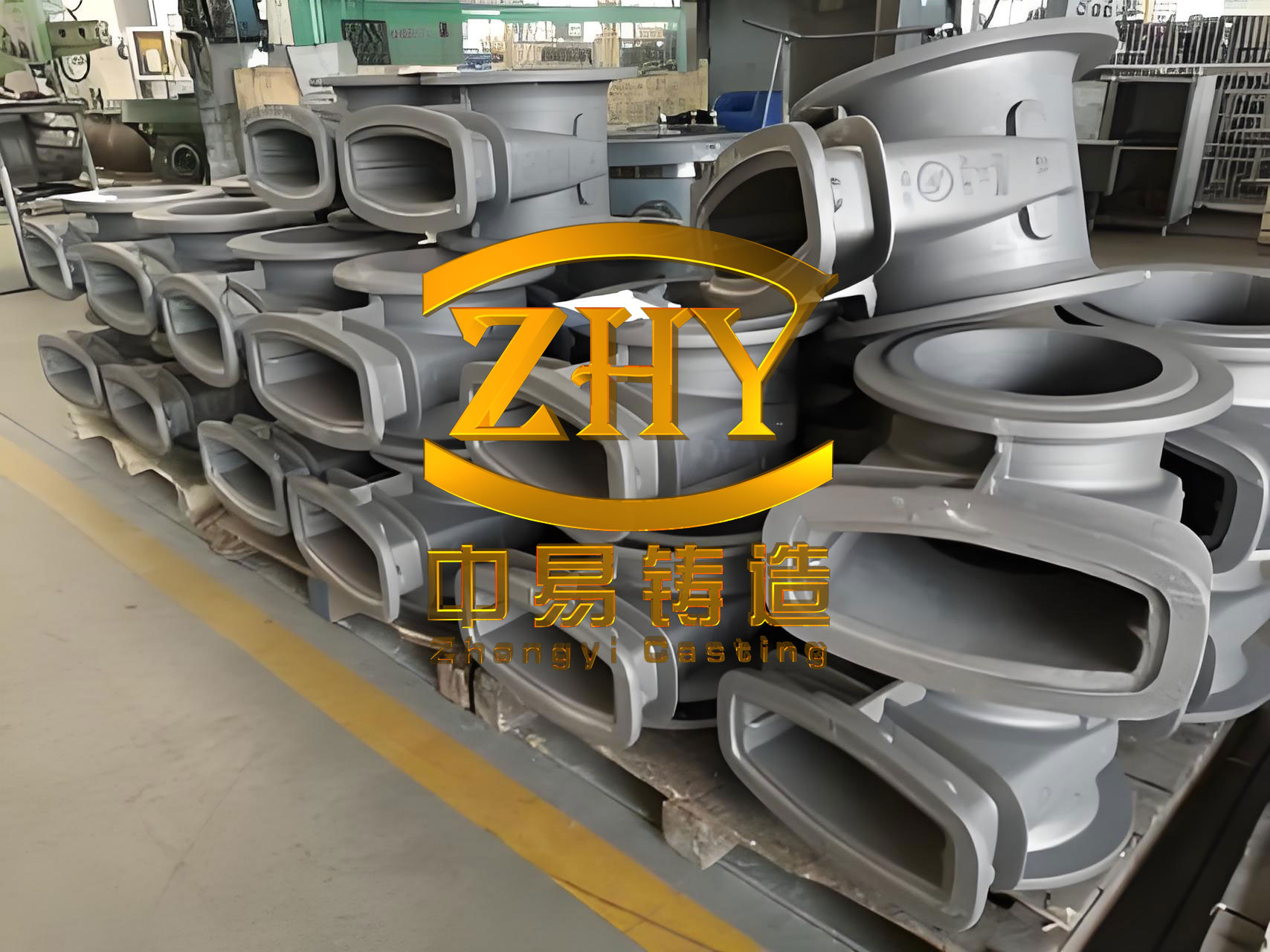
The subject of this study is a compressor rotor bracket, a high-speed rotating component requiring exceptional balance, pressure tightness, and freedom from defects. The casting, with major dimensions of 1223 mm x 1223 mm x 381 mm and a weight of 725 kg, was specified in grade HT300 gray iron. The chemical composition and key thermophysical properties are summarized in Table 1.
| Parameter | Value / Composition (wt.%) | Remarks |
|---|---|---|
| Major Dimensions | 1223 x 1223 x 381 mm | – |
| Weight | 725 kg | – |
| Carbon (C) | 2.96% | – |
| Silicon (Si) | 1.85% | – |
| Manganese (Mn) | 0.67% | – |
| Liquidus Temperature | 1235 °C | Used in simulation |
| Solidus Temperature | 1084 °C | Used in simulation |
| Pouring Temperature | 1360-1370 °C | Process parameter |
The initial production scheme for this gray iron casting employed a top-gating system with a “choke-pour” principle (initially pressurized followed by an open system). The gating system consisted of a sprue, a runner, and ingates. Chills were placed in selected thick sections of the casting in an attempt to control local solidification. The cross-sectional area ratios of the initial gating system are detailed in Table 2.
| Gating Element | Cross-sectional Area (mm²) | Ratio (Relative to Sprue) |
|---|---|---|
| Sprue | 2,826 | 1.0 |
| Runner | 7,200 | ~2.5 |
| Ingates | 7,200 | ~2.5 |
Initial Production Scheme and Defect Analysis via Simulation
Production using the initial scheme revealed significant shrinkage porosity in three critical locations: inside a machined bore (Defect 1) and within two other thick-walled sections accessible via drilled holes (Defects 2 & 3). To understand the root cause, a full numerical simulation of the filling and solidification process was conducted. The model used quartz sand as the mold material with an initial temperature of 25°C. The interfacial heat transfer coefficient between the gray iron casting and the mold was set to 0.42 J/(cm²·s·°C).
The simulation of the solidification sequence vividly illustrated the problem. For Defect 1, the simulation showed an isolated liquid pool forming in the heavy section adjacent to the bore during the late stages of solidification. This isolated region, cut off from a feeding source, inevitably led to shrinkage formation. The Niyama criterion analysis confirmed this, indicating a high-risk zone with a low \( G/\sqrt{R} \) value precisely at the defect location.
Similarly, for Defect 2 and Defect 3, the solidification sequence plots displayed isolated liquid zones. The analysis using the Residual Liquid Modulus criterion further corroborated the risk of shrinkage in these regions. The initial placement of chills was insufficient to alter the thermal geometry and establish a proper feeding path. Furthermore, the simulation of the filling process highlighted a secondary issue inherent to the top-gating design: severe oxide formation. The high velocity and turbulent impact of the metal stream as it fell from the sprue into the mold cavity caused significant air entrainment and oxidation of the iron, leading to potential slag inclusions in the final gray iron casting. This can be conceptually related to the kinetic energy of the stream:
$$
E_{kinetic} = \frac{1}{2} \dot{m} v^2
$$
where \( \dot{m} \) is the mass flow rate and \( v \) is the impact velocity. A high \( v \), as in top-pouring, maximizes splash and turbulence.
Process Optimization and Iterative Simulation
Based on the simulation diagnosis, an iterative optimization process was undertaken. The first revision (Optimization Step 1) focused on the shrinkage defects. An exothermic riser was added near Defect 1. Additional chills of specific dimensions (e.g., 90mm x 50mm x 40mm) were placed adjacent to Defect 2 and Defect 3. Simulation of this revised scheme showed improvement for Defects 2 and 3, as the chills effectively accelerated cooling, reducing the size of the thermal hotspots. However, the simulation revealed that the exothermic riser for Defect 1 had failed. Instead of providing feed metal, it acted as a massive thermal insulator, creating a new, even larger hotspot and failing to promote directional solidification towards itself. Subsequent production trials confirmed this; Defect 1 persisted, and a new shrinkage zone (Defect 4) was identified radiographically in an adjacent thick section.
A second, more comprehensive revision (Optimization Step 2) was formulated, addressing both feeding and filling issues. The flawed exothermic riser at Defect 1 was removed. The strategy shifted to a combination of a conventional riser placed on a nearby flange and a strategically sized chill on the opposite side of the problematic thick section. This created a controlled thermal gradient, pushing the solidification front towards the riser. For the new Defect 4 area, a similar combination of a chill and a conventional riser was applied.
Most importantly, the entire gating philosophy was changed. The turbulent top-gating system was replaced with a bottom-fill system using four ceramic tubes (Ø35 mm each). This ensured that metal entered the mold cavity smoothly from the bottom, rising with minimal turbulence and oxidation. The comparative effects of these changes are summarized in Table 3.
| Defect Location | Initial Scheme Issue (Simulation) | Optimization Step 1 | Optimization Step 2 (Final) | Result |
|---|---|---|---|---|
| Defect 1 (Bore) | Isolated liquid pool, Niyama risk. | Added exothermic riser (ineffective). | Removed exothermic riser. Added conventional riser on flange + chill. | Defect eliminated. Directional solidification achieved. |
| Defect 2 & 3 | Isolated liquid, high residual modulus. | Added specific chills. | Chill design refined. | Defects eliminated. |
| Defect 4 (New) | N/A (Created by Step 1 riser). | N/A | Added chill + conventional riser. | Defect eliminated. |
| Oxide Inclusions | Severe turbulence in top gating. | Unchanged. | Gating changed to bottom-fill via ceramic tubes. | Oxide formation minimized. |
The simulation of the final scheme confirmed its success. The solidification sequence plots showed no isolated liquid pools; instead, a progressive solidification front moved from the chilled areas towards the strategically placed risers. The Niyama criterion and other defect indices showed no high-risk zones in the critical sections of the gray iron casting. The filling analysis confirmed a quiescent mold fill with dramatically reduced oxide formation potential.
Theoretical Basis for the Optimized Gray Iron Casting Strategy
The success of the final optimization hinges on two key principles applied to gray iron casting: controlled directional solidification via thermal management and minimization of turbulent filling.
1. Synergistic Use of Chills and Risers (Thermal Management): The goal is to create a controlled temperature gradient, \( G \), that directs solidification from remote areas towards a riser. A chill, with its high thermal diffusivity \( \alpha \) (where \( \alpha = k / \rho C_p \)), rapidly extracts heat, effectively increasing the local cooling rate \( R \) and shifting the solidus isotherm. This action can eliminate a thermal hotspot or create a “starting point” for solidification. A riser is then placed to feed the section that solidifies last. For gray iron casting, the riser does not need to be as large as for white solidification alloys because it primarily feeds the austenitic shrinkage, while the graphitic expansion feeds itself internally. The combined effect can be conceptualized by modifying the solidification time equation locally. The solidification time \( t_s \) according to Chvorinov’s rule is proportional to the square of the volume-to-area ratio (modulus \( M \)):
$$
t_s \propto M^n = \left( \frac{V}{A} \right)^n
$$
where \( n \) is a constant (~2 for simple shapes). A chill effectively reduces the local modulus \( M \) by increasing the effective cooling area \( A \), thereby reducing \( t_s \) and making that region solidify earlier. The riser, having a larger modulus \( M_{riser} > M_{casting} \), solidifies last, fulfilling its feeding role.
2. Bottom Gating for Laminar Fill: The switch from top to bottom gating fundamentally changes the fluid dynamics. The metal velocity \( v \) at the ingate is determined by the hydrostatic head \( h \):
$$
v \approx \mu \sqrt{2 g h}
$$
where \( \mu \) is a friction factor and \( g \) is gravity. In a bottom-fill system with ceramic tubes, the head \( h \) is the height from the metal level in the pouring basin to the ingate level, which is relatively constant and low compared to the free-fall height in top-pouring. This results in a lower, controlled ingate velocity. The Reynolds number \( Re = \rho v D / \mu \) (where \( D \) is hydraulic diameter, \( \mu \) is dynamic viscosity) remains lower, promoting laminar or less turbulent flow, which drastically reduces air entrainment and oxide film formation. This is critical for the quality of the gray iron casting, especially for pressure-tight components.
Conclusion
This detailed investigation demonstrates the powerful synergy between numerical simulation and practical foundry engineering for optimizing complex gray iron casting processes. The initial production scheme, plagued by shrinkage porosity and oxide inclusion risks, was successfully diagnosed through simulation, which accurately identified isolated liquid zones and turbulent filling. The iterative optimization process yielded a final, robust solution based on two pillars: First, the strategic combination of chills and conventional risers to manage thermal gradients and promote a controlled directional solidification sequence, effectively feeding the solidifying gray iron casting by leveraging both riser feeding and internal graphitic expansion. Second, the implementation of a bottom-fill gating system using ceramic tubes to ensure a quiescent, non-turbulent fill, thereby virtually eliminating the formation of oxide slag inclusions. The final simulation results correlated perfectly with the sound castings produced, validating the methodology. This approach provides a generalizable framework for tackling defect-related challenges in the production of high-performance gray iron casting components, reducing development time, scrap rates, and ensuring component reliability.