
In the realm of diesel engine manufacturing, the engine block stands as one of the most critical components, where its quality is paramount to ensuring normal engine operation. With the evolution of marine diesel engines and market demands, there is an escalating requirement for enhanced performance in engine blocks. These blocks must not only exhibit high tensile strength but also possess excellent vibration damping properties. In recent years, our team has developed several large engine blocks using high-grade gray iron, which offers superior damping performance compared to ductile iron. However, we observed that high-grade gray iron casting tends to have a pronounced susceptibility to shrinkage porosity, thereby increasing the complexity of the casting process. This article delves into our investigation of shrinkage defects in a specific large gray iron casting, analyzing the root causes and outlining optimized strategies that led to a significant improvement in quality.
The engine block in question is fabricated from HT300 gray iron, a material known for its high strength and wear resistance in gray iron casting applications. The rough casting dimensions are 4,060 mm in length, 1,672 mm in width, and 1,250 mm in height, with an approximate weight of 12 tons, making it the largest high-grade gray iron casting we have undertaken. The wall thickness varies significantly, with a primary wall thickness of 15 mm and a maximum thickness of 170 mm, leading to substantial transitions and complex internal geometries due to integrated functionalities. The structural complexity of such a gray iron casting poses inherent challenges in achieving soundness, particularly in avoiding shrinkage defects.
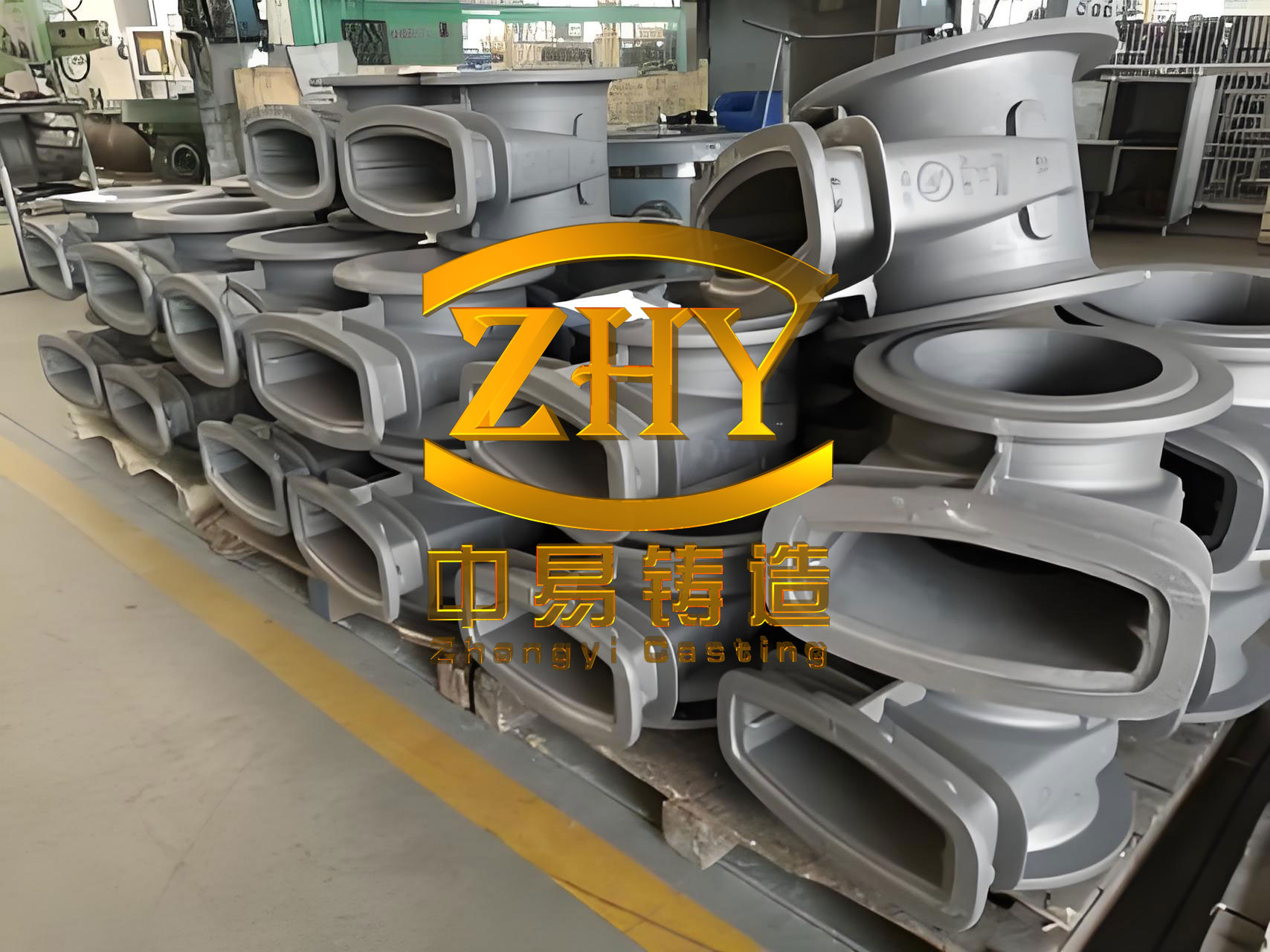
Technically, the engine block requires attached test bars of φ50 mm on the main bearing walls, with a tensile strength of no less than 254 MPa. The bulk hardness must range between 200 HB and 240 HB. Additionally, the water jacket must withstand a hydrostatic pressure test of 1 MPa for 30 minutes without any leakage or sweating, and the main oil passage is also mandated to be free from seepage. Crucially, the casting must be devoid of any crack-like defects. These stringent specifications underscore the importance of meticulous process control in gray iron casting. To summarize the key technical requirements, we present the following table:
| Parameter | Specification |
|---|---|
| Material | HT300 Gray Iron |
| Rough Dimensions | 4,060 mm × 1,672 mm × 1,250 mm |
| Weight | ~12,000 kg |
| Minimum Tensile Strength (Test Bar) | ≥254 MPa |
| Bulk Hardness | 200 HB – 240 HB |
| Water Jacket Pressure Test | 1 MPa for 30 min (no leakage) |
| Main Oil Passage Integrity | No leakage permitted |
| Defect Allowance | No cracks or major shrinkage |
Initially, the production process employed a bottom gating system coupled with top risers, a common approach for heavy-section gray iron casting. Chills were strategically placed at critical areas such as the bearing cap regions and cylinder bores to promote directional solidification. The molding was conducted using alkaline phenolic resin no-bake sand with manual molding, and all cores were produced using metal tooling. To mitigate gas entrapment on the upper plane of the horizontally poured casting, the pouring temperature was set between 1,390°C and 1,400°C. However, upon machining the first three units produced under this original process, severe shrinkage porosity was discovered on the exhaust side and within the main oil passage, rendering the blocks non-conforming. This outcome highlighted the persistent challenge of shrinkage in high-grade gray iron casting.
Shrinkage porosity in gray iron casting typically manifests as dispersed micro-porosity within the thermal centers of a casting. When machined, these areas reveal clusters of tiny holes that increase in size and density toward the center of the shrinkage zone. The fundamental cause lies in the inadequate compensation for liquid and solidification shrinkage during the cooling process. For our engine block, the main oil passage, being a massive thermal mass, was particularly prone. Although insulating risers were placed above it, their location at the top of the casting, far from the ingates, meant the iron there was relatively cooler, diminishing their effectiveness as feeders. In some cases, the risers might even solidify before the oil passage section. Furthermore, the design of the chills in that area was suboptimal; their dimensions were insufficient to create a pronounced chilling effect that could induce simultaneous solidification around the thermal node.
The exhaust side cavity, with its intricate network of reinforcing ribs, presented significant variations in wall thickness, creating localized hot spots. Since the casting was bottom-gated, this cavity was the furthest region from the ingates, receiving the least thermal feed during the later stages of solidification. Consequently, these thick sections lacked sufficient liquid metal replenishment, leading to shrinkage porosity. Additionally, the relatively high pouring temperature exacerbated the liquid contraction tendency of the iron, increasing the risk of shrinkage if the feeding system was not robust. To quantify the shrinkage tendency, we can consider the volumetric shrinkage during solidification, which can be approximated by:
$$ \Delta V_s = \beta_s \cdot V_0 $$
where $\Delta V_s$ is the solidification shrinkage volume, $\beta_s$ is the solidification shrinkage coefficient (typically around 4-6% for gray iron casting), and $V_0$ is the initial liquid volume. The feeding demand must at least match this $\Delta V_s$ to prevent porosity.
Our corrective actions focused on three pillars: optimizing chill design, enhancing riser efficiency, and refining melt chemistry. First, for the main oil passage, we redesigned the chills to be conformal to the junction between the oil passage and cylinder wall. We also increased their thickness based on the thermal modulus of the section, thereby amplifying the chilling effect and promoting a more uniform solidification front. The principle here is to increase the chilling power, which accelerates heat extraction. The chilling power can be related to the chill’s volume and thermal diffusivity. We aimed for a chill volume ratio relative to the hot spot volume to ensure rapid heat dissipation. A simplified model for the solidification time of a section with a chill can be expressed as:
$$ t_s \propto \frac{V^2}{A \cdot k} $$
where $t_s$ is solidification time, $V$ is volume of the hot spot, $A$ is the surface area in contact with the chill, and $k$ is a factor incorporating thermal properties. By increasing chill thickness (effectively increasing A and modifying k), we reduce $t_s$ locally, aligning it with thinner sections.
Second, for the exhaust side cavity, we replaced the existing risers with more efficient insulating risers and added an additional chill between two risers. This combination serves a dual purpose: the risers provide feeding metal, while the chill modifies the temperature gradient, enhancing the risers’ feeding range and effectiveness. The feeding efficiency of a riser can be estimated by:
$$ \eta_r = \frac{V_f}{V_s} \times 100\% $$
where $\eta_r$ is the riser efficiency, $V_f$ is the volume of feed metal actually used to compensate shrinkage, and $V_s$ is the total shrinkage volume in the feeding zone. Optimizing riser size and placement aims to maximize $\eta_r$.
Third, we adjusted the melt composition toward the higher end of the carbon equivalent (CE) range. A higher CE improves fluidity and promotes graphite precipitation during solidification, which counteracts shrinkage due to the expansion associated with graphite formation. We also controlled sulfur content at the lower limit, as sulfur can hinder graphite formation. The pouring temperature was lowered to 1,370°C–1,380°C to reduce liquid contraction. The carbon equivalent for gray iron casting is calculated as:
$$ CE = \%C + \frac{1}{3}(\%Si + \%P) $$
We targeted a CE near the upper specification to enhance graphitization potential. Additionally, we enforced stricter foundry practices, ensuring proper sand compaction during molding to increase mold rigidity, which is crucial to harness the graphite expansion pressure for self-feeding. If the mold wall moves due to low rigidity, the expansion effect is lost, exacerbating shrinkage. The following table summarizes the key process changes implemented:
| Aspect | Original Process | Optimized Process |
|---|---|---|
| Chill Design for Oil Passage | Standard chills, moderate thickness | Conformal chills, increased thickness |
| Exhaust Side Feeding | Basic risers | Insulating risers + interstitial chill |
| Carbon Equivalent (CE) | Mid-range control | Controlled at upper limit |
| Sulfur Content | Standard range | Lower limit control |
| Pouring Temperature | 1,390°C – 1,400°C | 1,370°C – 1,380°C |
| Mold Rigidity | Standard compaction | Enhanced vibration compaction |
To validate these improvements, we produced a batch of 40 engine blocks using the revised gray iron casting process. Upon machining, all critical areas—the main oil passage and the exhaust side face—were found to be free from shrinkage porosity. Non-destructive testing, including hydrostatic pressure tests and ultrasonic inspection, confirmed the integrity of each casting. All blocks met the assembly requirements, enabling successful small-batch production. This outcome demonstrates the efficacy of our integrated approach to mitigating shrinkage in high-grade gray iron casting.
The success of this project underscores several fundamental principles in gray iron casting. Firstly, the balance between chilling and feeding is critical for heavy-section castings. Chills must be designed with sufficient mass and contact area to effectively control solidification rates in hot spots. Secondly, riser design must account for thermal gradients and feeding distances; insulating risers can be highly beneficial when placed in optimal locations with adequate thermal support. Thirdly, melt chemistry plays a pivotal role. Maximizing carbon equivalent within specifications enhances graphitization, which inherently reduces shrinkage through expansion. The graphitization expansion pressure can be conceptually related to the volume change due to graphite precipitation, partially offsetting the metallic contraction. We can express the net volume change during solidification of gray iron as:
$$ \Delta V_{net} = \Delta V_{metal} + \Delta V_{graphite} $$
where $\Delta V_{metal}$ is negative (shrinkage) and $\Delta V_{graphite}$ is positive (expansion). By promoting graphite formation (via higher CE), we increase $\Delta V_{graphite}$, thereby reducing the magnitude of $\Delta V_{net}$ or even making it positive, which aids in self-feeding.
Moreover, process control in the foundry, such as maintaining mold rigidity, is often an overlooked but vital factor. A rigid mold confines the casting, allowing the internal graphite expansion pressure to compensate for shrinkage micro-porosity. If the mold yields, this beneficial effect is dissipated. Therefore, for high-grade gray iron casting, a holistic view encompassing pattern design, gating and feeding, melt treatment, and sand system performance is essential.
In conclusion, addressing shrinkage defects in large, high-grade gray iron casting requires a multifaceted strategy. Through systematic analysis and optimization of chilling, feeding, and compositional parameters, we successfully eliminated shrinkage porosity in a challenging engine block casting. The key takeaway is that shrinkage in gray iron casting is not merely a feeding issue but a interplay of thermal management, metallurgical factors, and process execution. Future work may involve advanced simulation tools to predict shrinkage hotspots more accurately and optimize chill and riser layouts digitally before physical trials. Nonetheless, the principles established here—enhanced chilling, efficient insulated feeding, controlled high carbon equivalent, and robust mold integrity—provide a reliable framework for producing sound high-performance gray iron castings. As demands for lighter and stronger components grow, mastering these aspects of gray iron casting will remain crucial for the foundry industry.
To further illustrate the relationship between process variables and shrinkage tendency in gray iron casting, we can consider a simplified empirical model. The shrinkage susceptibility index (SSI) might be expressed as a function of several factors:
$$ SSI = f(CE, T_{pour}, M_t, R_e, C_q) $$
where $CE$ is carbon equivalent, $T_{pour}$ is pouring temperature, $M_t$ is modulus of thermal section (volume/surface area), $R_e$ is riser efficiency, and $C_q$ is chill quality factor. Minimizing SSI involves increasing CE (within limits), lowering $T_{pour}$ appropriately, reducing $M_t$ via chills, increasing $R_e$, and improving $C_q$. Our optimization effectively addressed each term: we increased CE, decreased $T_{pour}$, reduced effective $M_t$ with better chills, and enhanced $R_e$ with improved risers. This systematic reduction in SSI correlates with the observed elimination of defects.
In practice, for every new gray iron casting project, we now conduct a thorough thermal analysis to identify potential hot spots and design chills and risers accordingly. We also emphasize the importance of maintaining consistent melt quality, monitoring not only CE but also trace elements that might affect graphite morphology. The table below outlines a recommended checklist for preventing shrinkage in high-grade gray iron casting:
| Category | Specific Action | Desired Outcome |
|---|---|---|
| Design & Pattern | Identify hot spots via modulus calculation | Target chilling/feeding areas early |
| Gating & Feeding | Use bottom gating with top risers; optimize riser size/location using feeding distance rules | Ensure adequate liquid feed to last-solidifying zones |
| Chill Design | Employ conformal chills of sufficient mass; consider chill materials (iron, copper) | Promote uniform solidification; eliminate isolated hot spots |
| Melt Chemistry | Control CE at upper limit (e.g., 4.0-4.2 for HT300); minimize S and other carbides stabilizers | Maximize graphitization expansion; improve fluidity |
| Pouring Practice | Maintain moderate pouring temperature (e.g., 1,370-1,380°C for heavy sections) | Reduce liquid contraction; avoid gas entrapment |
| Mold/Core Making | Ensure high sand compaction and rigidity; use quality binders | Harness graphite expansion pressure; prevent mold wall movement |
| Process Monitoring | Implement real-time temperature monitoring; conduct periodic sand property tests | Consistent process conditions; early detection of deviations |
This comprehensive approach has proven effective not only for the specific engine block but also for other complex gray iron castings we have since undertaken. The lessons learned reinforce that gray iron casting, while a mature technology, continually demands refinement and adaptation to meet evolving performance criteria. By integrating theoretical principles with practical foundry expertise, we can consistently produce high-integrity gray iron castings that satisfy the most demanding applications. The journey from defect analysis to successful production underscores the dynamic and problem-solving nature of modern foundry engineering, particularly in the realm of high-grade gray iron casting.