
In the realm of heavy-duty engine manufacturing, the production of critical structural components via gray iron casting presents significant technical challenges. As a foundry engineer involved in the development of strategic powertrain systems, I have directly overseen the process refinement for a large-scale front-end housing—a quintessential complex box-type gray iron casting. This component, characterized by its intricate internal passages and demanding service requirements, epitomizes the precision required in modern high-grade gray iron casting. The journey from initial prototype failures to a reliable production process underscores the iterative nature of foundry engineering, where simulation and empirical analysis converge to solve multifaceted defects. This comprehensive account details our methodological approach to identifying and rectifying critical issues such as cracking, core failure, and blowholes, which plagued the early production attempts of this HT300-grade gray iron casting.
The component in question is a front-end housing for a series of diesel engines. Its external envelope measures approximately 1800 mm × 1100 mm × 990 mm, with a rough casting weight nearing 2000 kg. The design features a complex internal cavity constructed from over 40 individually shaped sand cores, forming three distinct layers of water jackets and oil galleries. Wall thicknesses vary dramatically, from a nominal 11 mm at critical sections to localized heavy mass areas up to 60 mm thick. The material specification, a high-strength gray iron HT300, is notoriously sensitive to composition variations, making its metallurgical control a foundational aspect of quality assurance. Furthermore, the casting must withstand post-machining hydrostatic pressure tests, imposing stringent demands on its internal soundness and structural integrity. Every step in the gray iron casting process for this part had to be meticulously planned and validated.
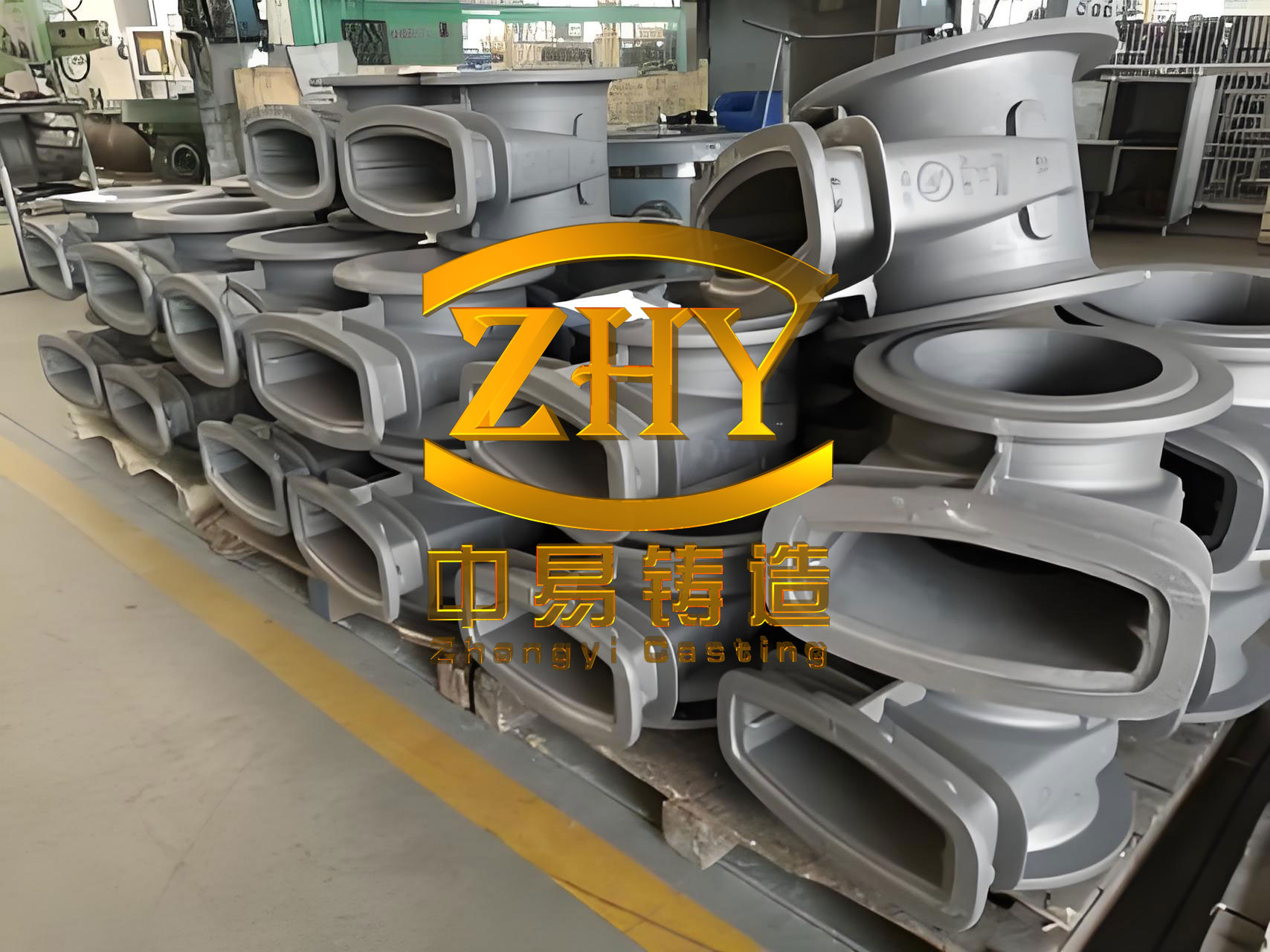
Our initial production setup utilized alkaline phenolic resin no-bake sand for molding and relied on manual core-making techniques. The gating system was a conventional bottom-filling, top-riser design. While this approach leveraged existing foundry capabilities, the trial production phase revealed several persistent and catastrophic defects that threatened the viability of the entire gray iron casting project. The most prominent issues were: 1) cracks appearing at the internal corners of the charge air cooler cavity after shakeout, 2) core fractures leading to missing wall sections (effectively core shift), and 3) severe blowhole defects, particularly on the top casting surface and beneath large core assemblies. The prevalence of gas-related defects was especially alarming, as they directly compromise pressure tightness—a key functional requirement for this gray iron casting.
The systematic resolution of these defects began with a root-cause analysis, supported by both theoretical principles and advanced simulation tools. The following sections decompose each problem, our investigative process, and the implemented solutions that ultimately transformed the yield and quality of this high-grade gray iron casting.
Analysis and Mitigation of Casting Cracks
Cracking in gray iron casting typically arises when the thermally induced tensile stresses during cooling exceed the material’s strength at elevated temperatures. These stresses, known as casting stresses ($\sigma_c$), are fundamentally linked to hindered contraction. They can be conceptualized through a simplified relation accounting for thermal strain and mechanical restraint:
$$
\sigma_c = E(T) \cdot \alpha \cdot \Delta T \cdot R
$$
where $E(T)$ is the temperature-dependent modulus of elasticity of gray iron, $\alpha$ is the coefficient of thermal expansion, $\Delta T$ is the temperature drop over the critical cooling range, and $R$ is a restraint factor (0 ≤ R ≤ 1) representing the degree to which the mold or core impedes free contraction. For the cracked corner, analysis indicated an acute design fillet radius, creating a natural stress concentration zone. Coupled with the massive, rigid sand core occupying the internal cavity, the restraint factor $R$ was exceptionally high, leading to localized stress exceeding the hot strength of the HT300 iron.
Our countermeasures were twofold, targeting both the casting geometry and the core behavior. First, we modified the core boxes to include printed or attached wax patterns that provided additional metal buildup (padding) at the critical interior corners. This effectively increased the fillet radius in the final gray iron casting, reducing the stress concentration factor ($K_t$). The improvement can be summarized by comparing the theoretical stress concentration for different geometries. For a sharp re-entrant corner, $K_t$ can approach very high values, whereas for a rounded fillet, it is significantly lower:
$$
K_t \approx 1 + 2\sqrt{\frac{t}{r}}
$$
where $t$ is a characteristic wall thickness and $r$ is the fillet radius. Increasing $r$ directly reduces $K_t$ and thus the peak stress.
Second, to address the high core restraint, we engineered a method to enhance core collapsibility. The large core was hollowed out by strategically placing high-diameter ceramic tubes during core shooting, wound tightly with removable通气绳 (vent ropes). After core curing, the ropes were extracted, leaving behind a network of voids within the core mass. This drastically reduced the core’s effective modulus during the cooling phase, lowering the restraint factor $R$ in the stress equation. The success of this intervention was immediate and complete, eliminating the cracking defect in all subsequent gray iron casting pours.
| Defect Feature | Primary Root Cause | Governing Principle/Parameter | Corrective Action | Impact on Gray Iron Casting Quality |
|---|---|---|---|---|
| Corner Cracks | High thermal stress due to sharp geometry and rigid core restraint. | Stress Concentration Factor ($K_t$), Restraint Factor ($R$), Casting Stress ($\sigma_c$). | 1. Increase fillet radius via core box modification. 2. Create hollow core structure using ceramic tubes and removable ropes. |
Complete elimination of cracking. Improved structural integrity of the gray iron casting. |
Resolution of Core Fracture and Shifting
Core fracture, leading to misplaced walls or “missing metal,” is a dimensional defect stemming from inadequate core strength or poor support within the mold. In this complex gray iron casting, an “L”-shaped core was identified as particularly vulnerable. Its center of gravity was offset, and it lacked positive location in the bend region, making it susceptible to bending moments and buoyant forces during metal filling. The buoyancy force ($F_b$) acting on a core can be approximated by:
$$
F_b = V_{core} \cdot (\rho_{metal} – \rho_{core}) \cdot g
$$
where $V_{core}$ is the volume of core submerged, $\rho_{metal}$ is the density of molten iron, $\rho_{core}$ is the effective density of the sand core, and $g$ is gravity. While the core’s weight provides some resistance, its strength must withstand the combined effects of $F_b$ and the dynamic pressure of the flowing metal.
The original core design used a two-part core iron (reinforcement) that was disconnected at the corner for ease of removal. This created a structural weak point. Our solution was to redesign the core iron into an interlocking system. The two segments were joined using a precision-machined steel socket or “locator block” at the critical corner. This block transferred loads effectively, turning two weak cantilevers into a single rigid, reinforced structure. After casting and shakeout, the block could be detached and the core iron segments withdrawn for reuse. Concurrently, we optimized the resin curing cycle to ensure full polymerization and core strength development. These changes rendered the core robust enough to resist the forces inherent in the gray iron casting process, completely eradicating fractures and the associated wall-thickness defects.
| Parameter | Original State | Improved State | Remarks |
|---|---|---|---|
| Core Bending Strength at Corner | Low (discontinuous reinforcement) | High (continuous, interlocked reinforcement) | Prevents fracture under metallostatic and dynamic pressure. |
| Core Positioning Stability | Poor (reliant on gravity/friction at corner) | Excellent (positive mechanical linkage via locator block) | Eliminates core shift in gray iron casting. |
| Core Collapsibility (for large cores) | Poor (solid, high restraint) | Good (hollowed structure) | Reduces hot tearing/cracking risk, as previously discussed. |
Comprehensive Strategy Against Blowhole Defects
Blowholes were the most pervasive and detrimental defect encountered in this gray iron casting project. These were identified as primarily invasive blowholes, caused by gases from the mold or core penetrating the solidifying metal skin. The genesis of such defects lies in the gas generation rate ($\dot{G}$) from the bonded sand, the permeability of the sand ($k$), the pressure at the metal-sand interface ($P_{int}$), and the metal’s solidification kinetics.
The potential for gas invasion exists when the gas pressure at the interface exceeds the metallostatic pressure ($P_m$) plus the pressure required to nucleate a bubble in the liquid ($P_n$), often simplified as the liquid metal head pressure. The condition for invasion is:
$$
P_{int} > P_m + P_n \quad \text{where} \quad P_m = \rho_{metal} \cdot g \cdot h
$$
with $h$ being the height of metal above the point in question. The gas pressure $P_{int}$ builds up if the gas evolution rate is high and the venting path is restricted. Two major contributors were pinpointed in our initial process: excessive gas from the resin-bonded sand with inadequate venting, and a gating system that promoted turbulent entrainment of air.
1. Core and Mold Venting Overhaul: The original method used soft fiber ropes embedded in cores as vent channels. During core compaction, these ropes were often crushed, severely reducing their flow area and permeability. We replaced them entirely with flexible metallic tubes. These tubes, resistant to compaction, provided a consistent, open pathway from the core interior to the core print. During mold assembly, additional metallic tubes were connected from the core prints to the exterior of the mold, creating a dedicated, low-resistance exhaust route for gases evolved during the gray iron casting pour. This ensured $P_{int}$ remained below the critical invasion threshold. The improvement in effective venting can be modeled by considering the gas flow rate $Q$ through a channel, given by the Hagen-Poiseuille equation for laminar flow in a rough approximation:
$$
Q \propto \frac{\pi d^4 \Delta P}{128 \mu L}
$$
where $d$ is the tube diameter, $\Delta P$ is the pressure differential, $\mu$ is the gas viscosity, and $L$ is the tube length. The fourth-power dependence on diameter $d$ highlights why a non-collapsible metallic tube (maintaining its full $d$) is vastly superior to a crushed rope (where $d$ approaches zero).
2. Gating System Redesign via Simulation: Initial MAGMA software simulations of the filling process revealed a flawed flow pattern. The original bottom-gating system was unbalanced, with most metal entering through the first few ingates, causing splashing and vortexing in the mold cavity. The simulation clearly showed reverse flow into the last ingates, indicative of an unfilled system and severe air entrainment. Turbulent flow entrains air, which then gets trapped as the metal solidifies. The kinetic energy of the stream at the ingate is a key factor, related to the pouring height $H$:
$$
v_{ingate} \approx \sqrt{2gH}
$$
A high velocity leads to turbulence. Our redesigned system adopted a “bottom-filling fountain” approach with an extended runner that acted as a flow distributor and slag trap. The new design principles focused on reducing the initial entry velocity and maintaining a more consistent, tranquil rise of metal in the cavity. Subsequent MAGMA simulations confirmed the improvement: the initial metal stream was slower, the runner filled more progressively, and tracer particle studies showed that the first metal remained confined to the gating system, minimizing early front turbulence that could encapsulate air in the gray iron casting.
The synergy of these two major interventions—superior venting and laminar filling—produced a dramatic reduction in blowhole defects. The quality of the top surface and areas under large cores improved to meet the stringent inspection standards.
| Aspect | Initial Process (Problematic) | Optimized Process (Solution) | Key Physics Parameter Affected |
|---|---|---|---|
| Core Venting | Crushable fiber vent ropes, often blocked. | Rigid metallic tubes ensuring open channel to mold exterior. | Gas flow rate $Q$, Interface pressure $P_{int}$. Maintains $P_{int} < P_m + P_n$. |
| Gating Design | Unbalanced bottom gate, causing splashing & reverse flow. | Balanced “fountain” bottom gating with elongated runner for tranquil fill. | Ingate velocity $v_{ingate}$, Reynolds Number (Re). Promotes laminar fill, minimizes air entrainment. |
| Filling Pattern | Turbulent, air entraining. | Laminar, progressive cavity fill from bottom-up. | Reduces volume of entrapped air ($V_{air}$) in gray iron casting. |
Integrative Role of Simulation in Gray Iron Casting Optimization
The use of MAGMA simulation software was instrumental in moving from qualitative guesses to quantitative insights, particularly for the gating-related defects. Beyond visualizing filling, the software can calculate thermal gradients, solidification sequences, and even stress development. For a high-grade gray iron casting like this front-end housing, predicting the solidification pattern is crucial to avoid shrinkage porosity, which can be interrelated with gas defects. The fundamental heat transfer during solidification is governed by the Fourier equation:
$$
\rho c_p \frac{\partial T}{\partial t} = \nabla \cdot (k \nabla T) + \dot{q}_{latent}
$$
where $\rho$ is density, $c_p$ is specific heat, $k$ is thermal conductivity, $T$ is temperature, $t$ is time, and $\dot{q}_{latent}$ is the latent heat release rate due to phase change. Simulation helps ensure directional solidification towards the feeders (risers), minimizing internal shrinkage. While our primary focus was on cracks and blowholes, a robust solidification profile is a prerequisite for sound gray iron casting. The simulation validated that our modified gating and chilling practice did not create new thermal hotspots prone to shrinkage.
Production Verification and Concluding Insights
Implementing the full suite of improvements—enlarged fillets, hollowed cores, interlocking core irons, metallic tube venting, and a redesigned laminar gating system—resulted in a transformative leap in quality. The scrap rate for the front-end housing gray iron casting dropped precipitously. Post-machining hydrostatic tests confirmed the internal soundness and pressure tightness of the castings, allowing them to meet all stringent engine assembly requirements.
This case study reinforces several universal principles in complex gray iron casting production. First, the design of the casting and its cores must be cooperative; foundry engineers must have input on geometric details like fillet radii to mitigate stress concentration. Second, core engineering is not just about shape replication but encompasses strength, positioning, collapsibility, and venting as integrated design goals. The choice of venting medium is critical—non-collapsible, reliable channels are essential for managing the substantial gas evolution from chemical-bonded sands in gray iron casting. Third, the gating system is a hydraulic circuit that must be designed for flow balance and minimal turbulence; reliance on tradition without computational verification can lead to pervasive defects like blowholes. Finally, a high-grade gray iron casting like HT300 demands a holistic view where metallurgical control, sand technology, and process engineering are inextricably linked.
The success of this project highlights that advancing gray iron casting technology, especially for critical, heavy-section components, requires a blend of empirical craftsmanship, theoretical understanding of materials and fluids, and the powerful predictive capabilities of modern simulation software. It is through such a multifaceted approach that the foundry industry continues to push the boundaries of what is possible with gray iron casting, achieving higher performance, reliability, and complexity in components that power modern machinery.