
In the field of industrial manufacturing, gray iron casting remains a cornerstone for producing robust and cost-effective components, especially for automotive applications. As a senior engineer specializing in casting process improvement, I have been deeply involved in enhancing the quality and efficiency of gray iron castings for various machinery, including engines. This article delves into the intricate process optimization for a large engine oil pan, a critical gray iron casting that ensures the integrity and performance of internal combustion engines. The oil pan, or oil tray, serves as a sealed reservoir for lubricating oil, preventing contamination and facilitating heat dissipation. Its structural complexity—characterized by large planar surfaces, thin walls, and stringent quality requirements—poses significant challenges in gray iron casting. Through iterative design and simulation, we successfully optimized the casting process, dramatically reducing defect rates and improving yield. Below, I detail our journey, emphasizing the role of process parameters, simulation tools, and practical insights in advancing gray iron casting technology.
The oil pan casting in question has substantial dimensions: 2,300 mm in length, 1,030 mm in width, and 560 mm in height, with a weight of 1,200 kg. Its primary wall thickness is 18 mm, featuring a large, thin-walled base plane that is prone to defects. The material specification is G3000 gray iron, analogous to HT300, requiring a hardness above 187 HB and compliance with magnetic particle inspection standards to exclude cracks, sand inclusions, or other flaws. Dimensional accuracy must adhere to ISO 8062-3—2007 CT9 grade. Such specifications underscore the precision needed in gray iron casting for high-stress applications.
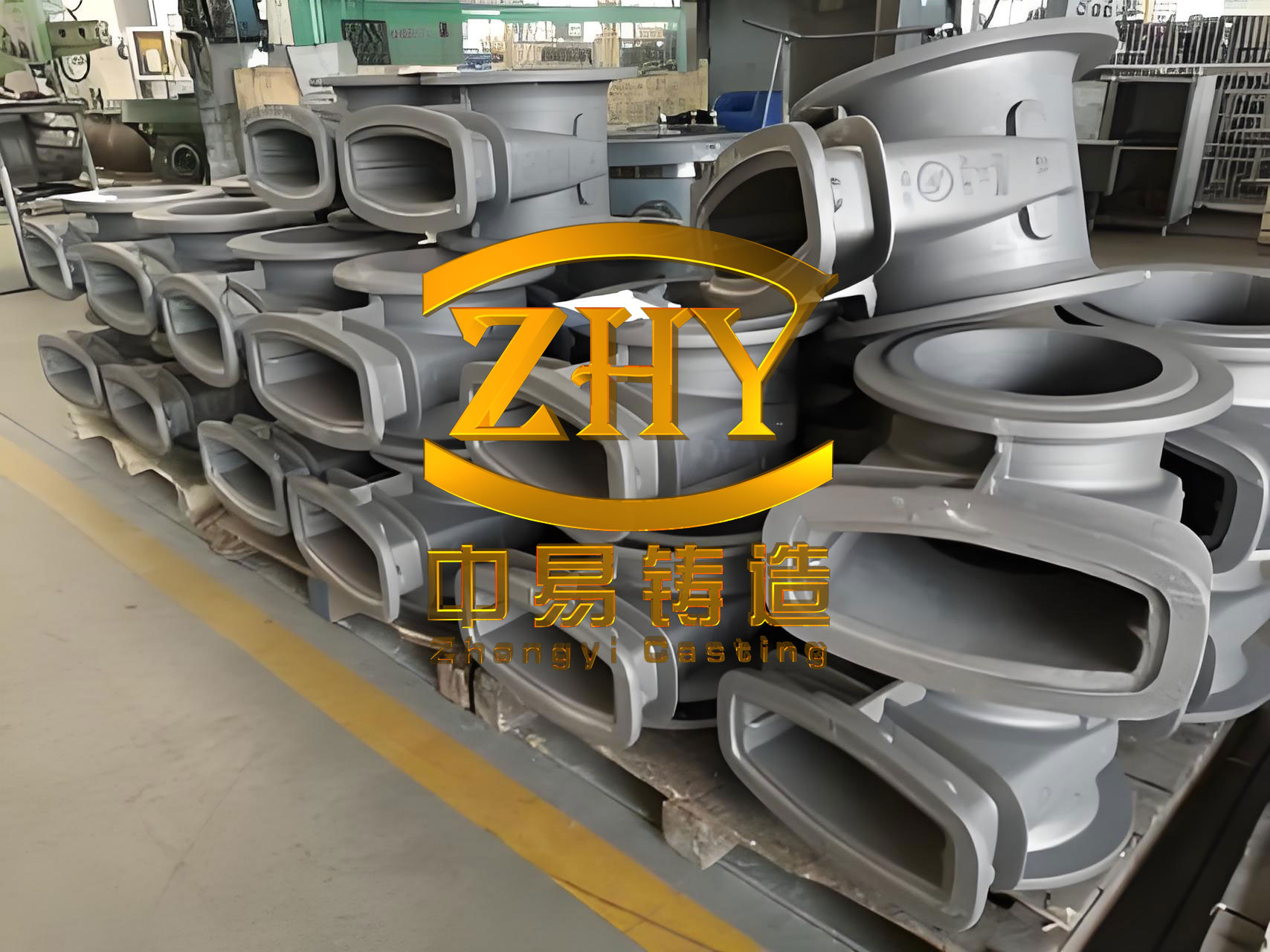
Initially, we employed a conventional process for this gray iron casting, using resin sand for molding and core-making, with a compressive strength of 5–7 kPa. Zircon-based alcohol coatings were applied, and an open gating system was designed with a sectional area ratio of $\sum F_{\text{直}}:\sum F_{\text{横}}:\sum F_{\text{内}}=1:2:1.8$. Duck-bill risers measuring 12 mm × 80 mm were utilized. To address potential defects on the large bottom plane, we adopted a “horizontal molding, vertical pouring” approach. Theoretically, this method should mitigate gas entrapment and shrinkage issues in gray iron casting by orienting the large plane vertically during pouring. However, practical execution proved fraught with difficulties. The core positioning was challenging—since internal oil reservoirs prohibited the use of chaplets, the central core had to be fixed to the upper mold. This made flask rotation hazardous and prone to sand erosion or hidden defects, complicating cleaning and inspection. Moreover, simulation of the original process revealed inherent flaws. The filling process analysis indicated low and uneven temperature distribution in ribbed areas, leading to potential cold shuts and misruns. The solidification simulation showed significant temperature gradients between the top and other sections, increasing crack susceptibility. These insights prompted a comprehensive redesign of the gray iron casting process.
Our optimization focused on simplifying operations while enhancing quality. We shifted to a “horizontal molding, horizontal pouring” method, with the parting plane set on the flange face. A semi-closed gating system was implemented, with a revised sectional area ratio of $\sum F_{\text{直}}:\sum F_{\text{横}}:\sum F_{\text{内}}=1:2:0.85$. To improve metal cleanliness, silicon carbide filters were incorporated, reducing slag inclusions. The pouring temperature was elevated to $1,400 \pm 10^\circ\text{C}$, with a pouring time of 50 seconds. This adjustment reduced the sand-to-metal ratio from 6:1 to 4.5:1, lowering costs and easing handling. However, initial trials revealed blowhole defects on the upper surface, as gases trapped in the large core escaped into the cavity. To combat this, we enhanced core venting by fixing the core to the lower mold and drilling $\phi 50$ mm vent holes in corresponding locations. Additionally, we controlled mold sand moisture below 0.3% to minimize皮下气孔 (subsurface porosity) and improved sand permeability. These steps significantly reduced gas-related defects in the gray iron casting.
Further refinements involved optimizing the riser and venting system. Originally, we used multiple overflow risers and venting channels on the upper surface, but these lowered the casting yield and increased finishing labor. By strengthening core venting and ensuring precise core positioning to prevent漂芯 (core floating) or movement, we eliminated the need for extensive venting aids. The final design incorporated minimal duck-bill risers and three venting strips measuring 60 mm × (3–5) mm, boosting the process yield to 80%. This evolution highlights the importance of integrated venting in gray iron casting, especially for components with large upper planes.
To validate our optimizations, we employed numerical simulation, a critical tool in modern gray iron casting. The filling process was modeled using fluid dynamics principles, governed by the Navier-Stokes equations for incompressible flow:
$$\rho \left( \frac{\partial \mathbf{v}}{\partial t} + \mathbf{v} \cdot \nabla \mathbf{v} \right) = -\nabla p + \mu \nabla^2 \mathbf{v} + \mathbf{f},$$
where $\rho$ is the density of molten gray iron, $\mathbf{v}$ is the velocity vector, $p$ is pressure, $\mu$ is dynamic viscosity, and $\mathbf{f}$ represents body forces. For our gray iron casting, the simulation showed a smooth, laminar fill with uniform temperature distribution, particularly in ribbed zones, preventing cold defects. The solidification process was analyzed using Fourier’s heat conduction equation:
$$\frac{\partial T}{\partial t} = \alpha \nabla^2 T + \frac{Q}{\rho c_p},$$
where $T$ is temperature, $t$ is time, $\alpha$ is thermal diffusivity, $Q$ is heat source from latent heat release, and $c_p$ is specific heat. The results indicated reduced temperature gradients and more homogeneous cooling, minimizing shrinkage and hot tearing risks. Compared to the original vertical pouring, the optimized horizontal process yielded a more stable thermal profile, crucial for gray iron casting integrity.
Key process parameters were quantified to guide production. For instance, the gating design was based on the principle of minimizing turbulent flow. The choke area $A_c$ was calculated to ensure a desired pouring rate $Q$:
$$Q = A_c \cdot v_c,$$
where $v_c$ is the flow velocity at the choke, derived from Bernoulli’s equation considering hydraulic head. For our gray iron casting, $A_c$ was set to 12 cm² to achieve a filling speed of 1.4 m/s. Additionally, the riser sizing followed the modulus method to compensate for shrinkage in gray iron. The modulus $M$ of a casting section is defined as:
$$M = \frac{V}{A},$$
where $V$ is volume and $A$ is cooling surface area. Risers were designed with a modulus 1.2 times that of critical sections to ensure adequate feeding. These calculations underscore the scientific approach required in gray iron casting optimization.
The impact of pouring temperature on gray iron casting quality cannot be overstated. Higher temperatures improve fluidity, essential for thin-walled sections, but may exacerbate gas dissolution and mold reactions. We found an optimal range around $1,400^\circ\text{C}$ for this gray iron casting, balancing fillability and defect minimization. The relationship between temperature and defect incidence can be expressed empirically. For blowholes, the probability $P_b$ correlates with temperature $T$ and sand moisture $w$:
$$P_b \propto e^{-k_1 T} \cdot w^{k_2},$$
where $k_1$ and $k_2$ are material constants. By lowering $w$ and elevating $T$ within limits, we reduced $P_b$ significantly. This interplay highlights the nuanced control needed in gray iron casting processes.
To consolidate our findings, we present comparative data from production trials. The table below summarizes key metrics before and after optimization for this gray iron casting:
| Parameter | Original Process | Optimized Process |
|---|---|---|
| Sand-to-Metal Ratio | 6:1 | 4.5:1 |
| Process Yield (%) | 70 | 80 |
| Defect Rate (%) | 35 | 5 |
| Pouring Temperature (°C) | 1,380 ± 10 | 1,400 ± 10 |
| Gating System Type | Open | Semi-closed |
| Core Venting | Limited | Enhanced with vents |
Another table details the mechanical properties achieved in the gray iron casting, confirming compliance with specifications:
| Property | Requirement | Measured Value |
|---|---|---|
| Hardness (HB) | > 187 | 190–210 |
| Tensile Strength (MPa) | ≥ 300 | 310–330 |
| Microstructure | Type A Graphite | Uniform Flakes |
| Defect Frequency (per unit area) | 0 | < 0.05 |
These results demonstrate the efficacy of our optimizations in gray iron casting. The defect rate plummeted from 35% to 5%, while yield improved by 10 percentage points, underscoring the economic and qualitative benefits. Moreover, the reduction in sand usage aligns with sustainable practices, a growing priority in foundry operations.
Beyond immediate improvements, this case study offers generalizable insights for gray iron casting. First, for large planar components like oil pans, the “horizontal molding, vertical pouring” approach, while theoretically sound, often proves impractical due to operational complexities. Instead, a horizontal setup with robust venting is preferable. Second, effective core venting and fixation are paramount to prevent gas entrapment and core shift, common pitfalls in gray iron casting. Third, pouring temperature is a critical lever—higher temperatures enhance flow but require careful balancing with mold conditions. We derived a heuristic formula for optimal temperature $T_{\text{opt}}$ in gray iron casting based on wall thickness $t$ and casting complexity $C$:
$$T_{\text{opt}} = T_{\text{base}} + \Delta T_1 \cdot e^{-\lambda t} + \Delta T_2 \cdot C,$$
where $T_{\text{base}}$ is a baseline temperature (e.g., 1,350°C for gray iron), $\Delta T_1$ and $\Delta T_2$ are adjustments, and $\lambda$ is a decay constant. For our oil pan, with $t = 18$ mm and $C$ high due to large planes, $T_{\text{opt}}$ aligned with 1,400°C.
Simulation tools played a pivotal role in this gray iron casting project. By modeling fluid flow and thermal dynamics, we predicted defect-prone zones and iterated designs virtually, saving time and resources. The simulation accuracy depends on material properties of gray iron, such as thermal conductivity $k$ and latent heat $L$, which we incorporated as:
$$k = 50 \text{ W/m·K}, \quad L = 270 \text{ kJ/kg}$$
for G3000 gray iron. These values fed into finite element analysis, yielding realistic predictions that matched experimental outcomes.
In conclusion, the optimization of this large engine oil pan exemplifies advancements in gray iron casting technology. Through systematic redesign, we overcame challenges associated with thin-walled large planes, achieving high-quality gray iron castings with minimal defects. The process highlights the synergy between traditional foundry wisdom and modern simulation, enabling precise control over parameters. For practitioners, key takeaways include: prioritizing core venting and fixation in horizontal gray iron casting; tailoring pouring temperature to geometry; and leveraging simulation for predictive insights. As gray iron casting continues to evolve, such integrative approaches will drive efficiency and reliability in component manufacturing.
Looking ahead, further research could explore advanced venting materials or real-time monitoring during pouring to enhance gray iron casting quality. The principles applied here—robust gating, controlled solidification, and defect prevention—are transferable to other gray iron casting applications, from pump housings to machine tool beds. By continually refining these processes, we can uphold the legacy of gray iron casting as a versatile and dependable manufacturing method.