
In my extensive experience within the foundry industry, the production of tall, intricate gray iron castings presents a formidable set of challenges. The shift from conventional green sand molding to the Evaporative Pattern Casting (EPC) process is often driven by the need for superior dimensional accuracy and the ability to form complex internal geometries that are otherwise impossible. However, this transition is not without its significant hurdles. Specifically, defects such as severe folds (wrinkle skin), slag inclusions, shrinkage porosity, and gas holes frequently manifest, leading to catastrophic failures during machining or pressure testing. The economic impact is severe, with initial yield rates plunging below 50%. This article synthesizes my first-hand analysis and systematic solutions developed to overcome these obstacles, transforming the production reliability for such demanding gray iron castings.
The component in question is a representative example of these challenges: a substantial gray iron casting standing 720 mm tall with intricate features and a critical nominal wall thickness of 12 mm. Its complexity and height make it a prime candidate for the EPC process, yet also amplify the risks. When produced using a vertically-poured EPC setup with EPS (Expandable Polystyrene) patterns, a triad of persistent defects emerged. First, large horizontal planes exhibited severe carbonaceous folds or wrinkles. Subsequent machining on these surfaces would reveal underlying slag-like carbon deposits, carbon-flake shrinkage cavities, or pinholes. Second, machining operations on various bore features would encounter thread peel-offs, gas holes, or sand inclusions, rendering the entire casting scrap. Third, even after successful machining, internal shrinkage or gas porosity often led to leakage during hydrostatic pressure testing at 3 MPa. These issues, whether occurring in isolation or combination, created a persistent bottleneck.
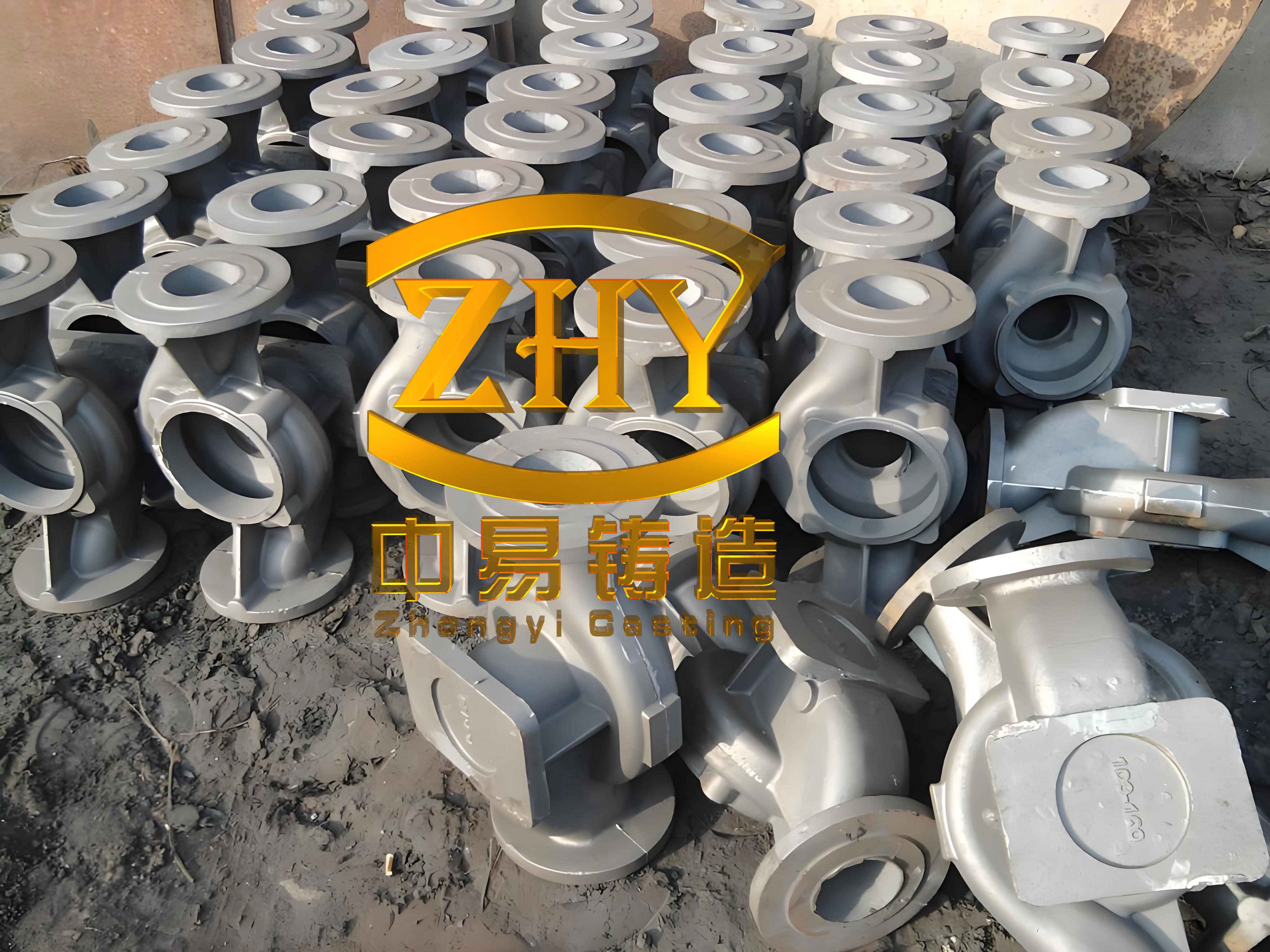
The journey to resolve these issues began with a root-cause analysis focusing on four interconnected pillars: gating design, thermal dynamics, process atmosphere, and pattern integrity. Each pillar directly influences the formation of defects in gray iron castings.
Deep Dive into Defect Genesis and Governing Principles
The EPC process is a delicate balance between the advancing liquid metal front and the rapidly decomposing foam pattern. For gray iron castings, the high carbon content interacts uniquely with the pyrolysis products of EPS. The primary defects observed are not random but stem from specific thermodynamic and hydrodynamic conditions.
1. Carbonaceous Folds and Slag Defects: These defects on large upper surfaces are predominantly a result of incomplete pattern degradation. When molten iron at lower temperatures (1350-1420°C) encounters the EPS, it undergoes pyrolysis—thermal decomposition in the absence of sufficient oxygen. This process yields liquid styrene, which further cracks into solid, lustrous carbon and hydrogen gas. This carbon can deposit on the advancing metal front or become entrapped at the metal-mold interface. The governing reaction can be simplified as:
$$ (C_8H_8)_n \ (EPS) \ \xrightarrow[\text{Pyrolysis}]{\Delta} \ nC_{(s)} + 4nH_{2(g)} + \text{other hydrocarbons} $$
The amount of residual carbon, $C_{res}$, is a function of pouring temperature $T_p$, local heat flux $q$, and available oxygen. A lower $T_p$ and a slower fill time increase the likelihood of carbon deposition.
2. Gas and Shrinkage Porosity: Porosity in these gray iron castings is a complex interplay of gas evolution and solidification shrinkage. The total gas volume, $V_{gas}$, generated from the pattern is substantial and must be evacuated through the coating. If the venting capacity is exceeded or if gas is trapped by the metal stream, gas porosity forms. Simultaneously, gray iron exhibits significant solidification shrinkage (approx. 1-2% in volume). The volumetric shrinkage demand, $V_{shrink}$, must be met by liquid feed metal. Inadequate feeding leads to shrinkage porosity, often found in conjunction with carbon deposits. The total cavity volume $V_{cavity}$ can be approximated as:
$$ V_{cavity} \approx V_{gas} + V_{shrink} – V_{escape} $$
where $V_{escape}$ is the volume of gas successfully evacuated through the coating under vacuum.
3. Sand Inclusions and Surface Defects: These occur when the fragile refractory coating is eroded by the turbulent metal stream, carrying sand or coating fragments into the casting. This is highly dependent on the fluid velocity $v$ and the coating’s hot strength $S_c$.
The following table summarizes the primary defects, their common locations, and immediate consequences for gray iron castings:
| Defect Type | Typical Location | Direct Consequence | Detected During |
|---|---|---|---|
| Carbonaceous Folds/Wrinkles | Large horizontal top surfaces | Slag layers, carbon pockets, poor surface finish | Visual inspection, machining |
| Subsurface Shrinkage/Carbon Flakes | Beneath large planes, heavy sections | Leak paths, reduced mechanical strength | Machining, pressure test |
| Gas Holes & Blows | Near cope areas, behind metal front | Porous structure, leak paths | Machining, X-ray, pressure test |
| Sand Inclusions | Along internal passages, bore surfaces | Machining tool damage, thread failure | Machining |
Systematic Analysis of Contributing Factors
The root causes are multifaceted and interactive. My analysis identified the following as the key levers influencing the quality of tall, complex gray iron castings in EPC:
Gating System Design:
The initial vertical setup, whether top- or bottom-gated, created inherent problems. A bottom-gating system leads to a large temperature gradient from bottom to top. While it promotes calm filling, the upper sections of the casting, especially large flat areas, are filled with cooler metal that has lost much of its superheat. This cooler metal is less capable of fully gasifying the EPS pattern, leading to increased carbon deposition and folds. Conversely, a top-gating system introduces metal with high kinetic energy, which can erode the coating and cause sand inclusions in critical bore areas. The fast initial drop also traps pattern decomposition gases, creating blows and gas holes. An ideal stepped or intermediate gating system was practically difficult to implement reliably for these tall gray iron castings.
Pouring Temperature and Velocity:
Pouring temperature ($T_p$) is arguably the most critical parameter. In the problematic range of 1350-1420°C, the heat transfer to the EPS is sufficient for pyrolysis but not for complete gasification. This regime maximizes the production of the heavy, liquid styrene intermediate and its subsequent cracking into solid carbon. The pouring velocity ($v_p$) is equally crucial. A slow pour gives the pattern more time to pyrolyze in contact with the metal, increasing residual carbon. A rapid pour can outrun the decomposition front, but if uncontrolled, leads to turbulence.
Applied Vacuum (Negative Pressure):
Vacuum serves multiple purposes: it stabilizes the mold, draws decomposition products through the coating, and influences the pouring velocity. A higher vacuum (e.g., > 40 kPa) increases the pressure differential, pulling metal into the mold faster. It also lowers the partial pressure of oxygen in the mold cavity, suppressing the exothermic combustion of EPS and promoting endothermic pyrolysis. While combustion produces large volumes of gas quickly ($C_8H_8 + 10O_2 \rightarrow 8CO_2 + 4H_2O$), pyrolysis produces less total gas but more solid carbon. However, excessive vacuum can induce turbulent flow, entrapping gases before they can be evacuated, paradoxically creating gas holes.
Pattern Density and Integrity:
The bulk density ($\rho_{EPS}$) of the foam pattern directly controls the mass of material to be decomposed per unit volume. A higher density ($>$0.025 g/cm³) means more polymer to break down, generating more gas and more potential carbon residue. A lower density (<0.018 g/cm³) often uses larger bead size, resulting in a rough surface texture with deep interbead crevices. These crevices can hold coating material, which is easily scoured away during pouring, leading to sand defects in the final gray iron castings. Furthermore, moisture absorption or the use of high-volume organic adhesives introduces additional sources of gas.
The table below correlates these process factors with the specific defects they promote in gray iron castings:
| Process Factor | Inappropriate Condition | Primary Defect(s) Promoted | Mechanism |
|---|---|---|---|
| Gating Design | Bottom-pour only | Carbon folds on top surfaces | Cold metal at top, poor pattern degradation |
| Gating Design | Top-pour only | Sand holes, gas blows in bores | Turbulence, gas entrapment, coating erosion |
| Pouring Temperature ($T_p$) | Too low (1350-1420°C) | Carbon folds, slag inclusions | Promotes pyrolysis to solid carbon |
| Pouring Velocity ($v_p$) | Too slow | Carbon folds, misruns | Extended metal-pattern contact time |
| Applied Vacuum ($P_v$) | Too low (<25 kPa) | Mold collapse, poor venting | Insufficient force to evacuate gases & liquids |
| Applied Vacuum ($P_v$) | Too high (>40 kPa) | Turbulence-induced gas holes | Excessive fill speed entraps gases |
| Pattern Density ($\rho_{EPS}$) | Too high | Gas porosity, carbon defects | Excessive mass to decompose |
| Pattern Density ($\rho_{EPS}$) | Too low / Rough surface | Sand inclusions, poor finish | Coating trapped in crevices, eroded easily |
A Comprehensive and Integrated Solution Strategy
Addressing these defects required a holistic, multi-pronged approach. Isolated changes yielded marginal improvements, but a synchronized optimization of all parameters was the key to success. The following strategies were implemented to robustly produce high-integrity gray iron castings.
1. Redesign of the Gating and Feeding System:
The gating philosophy was completely overhauled to create a more thermally balanced and hydraulically controlled fill.
- Intermediate, Pressurized Gating: We adopted a closed, pressurized gating system with ingates located in the lower-middle height of the casting. This positioned the metal entry points closer to the thermal center of the main casting body, ensuring hotter metal reached the critical midsection and upper features compared to a pure bottom-gate. The pressurized system (ratio: $\Sigma A_{sprue} < \Sigma A_{runner} < \Sigma A_{ingate}$) promotes a rapid, non-aspirating fill and minimizes air entrainment. Maintaining a full pouring basin throughout the pour was mandatory.
- Strategic Use of a Blind Riser/Skimming Bob: A small, blind riser was placed at the junction of the sprue and runner, acting as a highly effective slag trap. The first, often oxide-laden metal and the initial flow containing the most concentrated pattern decomposition products are diverted into this chamber. It also provides a minor but useful source of liquid for feed metal to combat shrinkage in adjacent sections of the gray iron casting.
- Hollow Sprue Design: The volume of foam in the gating system is substantial. By constructing the main sprue as a hollow EPS cylinder (or using low-density filler), the total mass of decomposable material in the system was drastically reduced. This directly lowered the total gas load, $V_{gas}$, that needed to be managed.
- In-Gate Filters: Ceramic foam filters were placed in the in-gates. These filters not only trap any remaining coarse inclusions but, more importantly, transform a turbulent metal stream into a laminar one as it enters the mold cavity, drastically reducing coating erosion potential.
2. Optimization of Thermal and Dynamic Parameters:
This involved precise control over the heat and momentum of the liquid metal.
- Elevated Pouring Temperature: The target pouring temperature was raised significantly to 1470±10°C. This high superheat provides ample sensible heat to drive the EPS pattern towards complete gasification rather than pyrolysis, minimizing the formation of liquid styrene and solid carbon. The relationship is not linear, but the improvement in surface quality of the gray iron castings above 1450°C was dramatic.
- Controlled Pouring Profile: A “slow-fast-slow” pouring technique was standardized. The initial slow pour allows the sprue to fill and the reaction at the metal front to begin without splashing. The main pour is then executed as rapidly as possible to maintain a hot, rising metal front that gasifies the pattern efficiently. The final stage is slowed to prevent over-pressurization and turbulence at the end of fill.
The required superheat, $\Delta T_{sh}$, to achieve a desired fill time $t_f$ without carbon defects can be conceptually related to the pattern’s heat of decomposition, $\Delta H_{dec}$:
$$ \rho_{iron} \cdot C_{p,iron} \cdot \Delta T_{sh} \cdot V_{casting} \propto \rho_{EPS} \cdot \Delta H_{dec} \cdot V_{pattern} / t_f $$
where a higher $\Delta T_{sh}$ allows for a shorter $t_f$ for a given pattern mass.
3. Precise Control of Process Atmosphere and Pattern Quality:
- Optimal Vacuum Level: Through experimentation, the ideal applied vacuum was set at 32.5±2.5 kPa. This level provided sufficient force to swiftly evacuate decomposition gases through the coating ($V_{escape}$) without causing turbulent breakthrough. It also supported the mold rigidity adequately for these tall gray iron castings. The vacuum was maintained for several minutes after pouring to ensure gases were removed during solidification.
- Tight Pattern Density Control: The target pre-expanded bead density was locked at 0.020±0.002 g/cm³. This represents a compromise minimizing both gas generation and surface roughness. Crucially, this specification was enforced not just for the casting pattern but also for all gating system components.
- Coating Management: Coating thickness was controlled to a maximum of 1.5 mm. A thicker coating increases hot strength but reduces gas permeability. The selected coating and application process ensured adequate permeability for gas evacuation while maintaining enough erosion resistance to survive the now-laminar metal flow. Complete, baked dryness of the coating was verified before molding.
The synergy between vacuum $P_v$, coating permeability $k$, and gas generation rate $\dot{V}_{gas}$ determines back-pressure at the metal front. Darcy’s law gives an approximation for the flow of gases through the coating:
$$ \dot{V}_{gas, escape} \approx \frac{k \cdot A \cdot (P_{int} – P_v)}{\mu \cdot L} $$
where $P_{int}$ is the interfacial pressure at the decomposition front, $A$ is the interfacial area, $\mu$ is gas viscosity, and $L$ is coating thickness. Optimizing $k$, $L$, and $P_v$ maximizes $\dot{V}_{gas, escape}$ to keep $P_{int}$ low and prevent gas entrapment in the gray iron castings.
4. Rigorous Control of Ancillary Processes:
- Pattern Drying and Adhesive Use: EPS patterns were stored in a controlled, low-humidity environment to prevent moisture absorption. Low-fume, minimal-adhesive assembly techniques were employed to reduce volatile organic contributions to the gas load.
- Metallurgical Adjustments: While not a direct process fix, the carbon equivalent (CE) of the iron was lowered slightly within specification limits. A lower CE reduces the total graphite expansion during solidification, slightly increasing the net shrinkage demand but also reducing the overall volume of gas (from both pattern and mold reaction) that the iron can absorb, making the process more stable.
The following table summarizes the optimized process window established for producing these complex gray iron castings:
| Process Parameter | Target Specification | Primary Function |
|---|---|---|
| Pouring Temperature | 1470 ± 10 °C | Maximize pattern gasification, minimize carbon |
| Pouring Profile | Slow-Fast-Slow sequence | Control fill turbulence & thermal front |
| Applied Vacuum | 32.5 ± 2.5 kPa | Evacuate gases without causing turbulence |
| Pattern Density (EPS) | 0.020 ± 0.002 g/cm³ | Balance gas load and surface finish |
| Coating Thickness | ≤ 1.5 mm (dry) | Ensure permeability and sufficient strength |
| Gating Type | Closed, mid-height, with filter & slag trap | Thermal balance, laminar fill, inclusion control |
Integrated Application and Validated Results
Implementing this constellation of improvements was not sequential but concurrent. The redesigned gating system with its hollow sprue, filter, and slag trap was coupled with patterns of rigorously controlled density. Every mold was coated to the specified thickness and thoroughly dried. The furnace schedule was adjusted to reliably deliver iron at 1470°C, and the pouring crew was trained on the critical slow-fast-slow technique. The vacuum system was calibrated to hold steady at the 32-35 kPa range.
The transformation was significant. The severe carbon folds on the large flat surfaces were virtually eliminated. Any minor surface irregularities that remained were well within the machining allowance. The incidence of sand holes and gas blows in the critical bore areas dropped precipitously. Most importantly, the internal soundness of the gray iron castings improved dramatically, as evidenced by a drastic reduction in leakage during the 3 MPa hydrostatic pressure tests.
The quantitative outcome was a sustained increase in the overall foundry yield for these challenging components from less than 50% to a stable 85% or higher. This represented not just a reduction in scrap cost, but also a major gain in production predictability, scheduling reliability, and customer confidence for these high-performance gray iron castings.
The table below contrasts the key outcomes before and after the integrated optimization:
| Performance Metric | Initial State (Before Optimization) | Optimized State (After Implementation) |
|---|---|---|
| Overall Process Yield | < 50% | > 85% |
| Major Carbon Fold Defects | Frequent (>70% of casts) | Rare (<5%) |
| Bore Machining Rejects (Holes/Sand) | High (>40%) | Low (<8%) |
| Pressure Test Failure Rate (3 MPa) | Very High (>60% of machined parts) | Very Low (<10% of machined parts) |
| Process Consistency | Unpredictable, high variability | Stable, repeatable |
In conclusion, the successful production of tall, complex gray iron castings via the EPC process hinges on recognizing the process as a tightly coupled system. Defects like folds, porosity, and inclusions are not independent failures but symptoms of imbalances in thermal input, hydrodynamic flow, gas management, and pattern quality. By systematically analyzing these interactions and implementing a coordinated set of corrections—centered on aggressive pouring temperatures, intelligently designed gating, precise vacuum and pattern control, and unwavering procedural discipline—it is possible to achieve robust, high-yield production. The lessons learned extend beyond this specific component; they form a fundamental framework for tackling a wide range of challenging geometries in gray iron castings using evaporative pattern techniques. The core principle is that controlling the transformation of the pattern from a solid polymer to a gaseous state, and managing the byproducts of that transformation, is the key to unlocking the full potential of the EPC process for high-quality gray iron castings.