
In my experience at a foundry specializing in automotive components, I have been deeply involved in the production of exhaust pipes for export markets, particularly Japan. These gray iron castings, with a material specification equivalent to FC200 (similar to HT200), presented significant challenges due to internal defects such as gas holes and peeling, which often emerged only during late-stage machining. This not only escalated production costs but also delayed deliveries. Over a six-month period, the comprehensive rejection rate soared to 53.54%, prompting a thorough analysis and optimization of the casting process. Through systematic improvements, we achieved a robust and efficient production method, ultimately reducing the defect rate to 3.62% and ensuring high-quality outputs. This article details the journey from problem identification to solution implementation, emphasizing the critical aspects of designing and refining processes for gray iron castings.
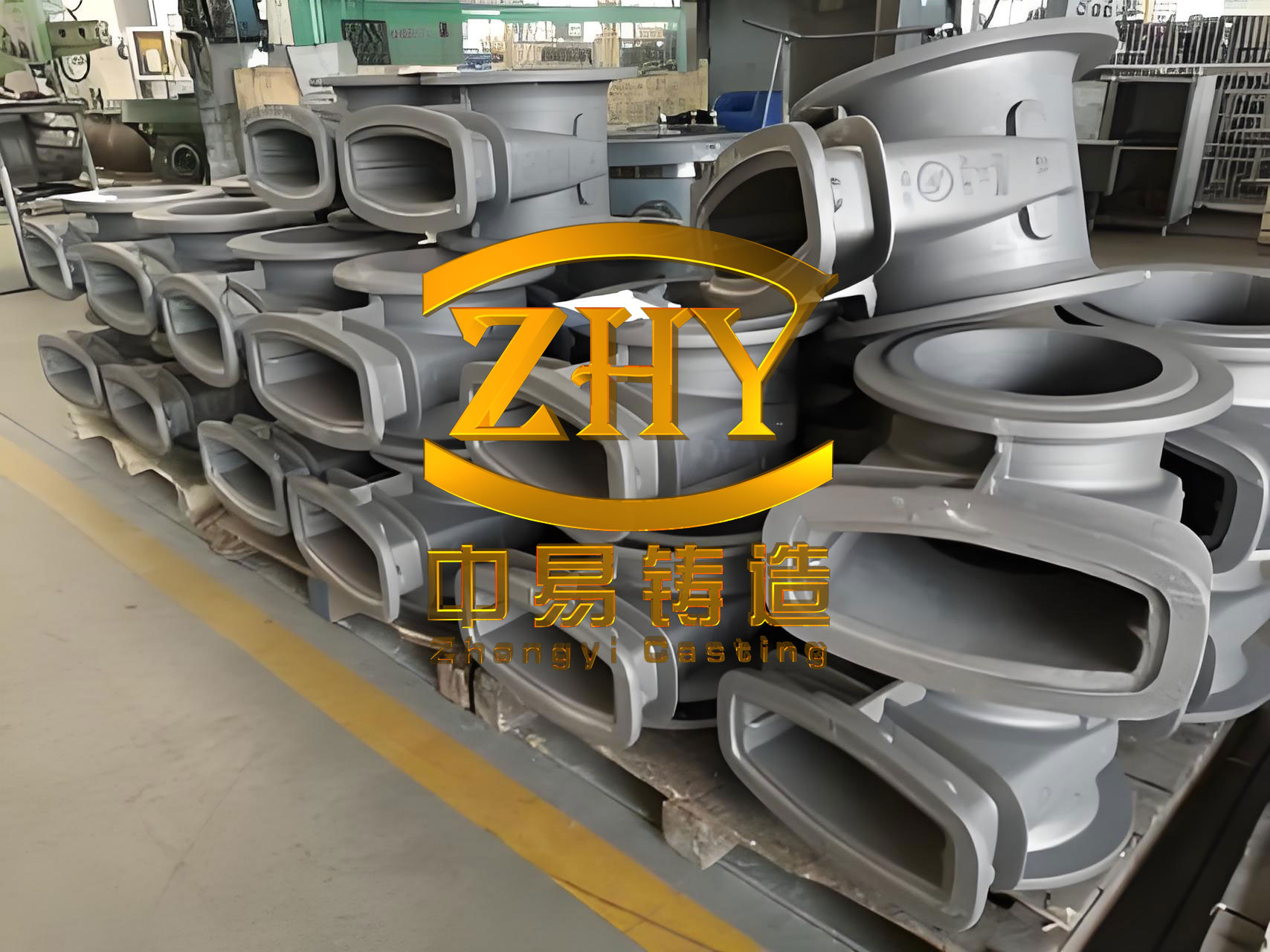
The exhaust pipe casting, as a representative example of complex thin-walled gray iron castings, features a curved tubular structure with a total length of 487 mm, a wall thickness of 5 mm, and a weight of 3.1 kg. Key characteristics include isolated hot spots at bolt formations and an extended open slot section measuring 32 mm × 38 mm × 304 mm. The U-shaped open slot, in particular, posed a risk of deformation during solidification, necessitating additional support ribs in the initial design. These geometric complexities make the production of such gray iron castings highly sensitive to process parameters, where minor deviations can lead to major defects. Understanding the interplay between geometry, material properties, and process dynamics is essential for successful manufacturing of gray iron castings.
| Parameter | Value | Description |
|---|---|---|
| Material | FC200 (Gray Iron) | Equivalent to HT200, with typical composition for automotive applications. |
| Weight | 3.1 kg | Single casting weight, influencing gating and riser design. |
| Total Length | 487 mm | Overall dimension, affecting mold layout and cooling patterns. |
| Wall Thickness | 5 mm | Uniform thin wall, prone to cold shuts and misruns if not properly filled. |
| Critical Feature | U-shaped Open Slot | 32 mm × 38 mm × 304 mm, requiring anti-deformation measures. |
| Hot Spots | Bolt Formations | Isolated thicker sections, potential sites for shrinkage and gas entrapment. |
Initially, the casting process was designed for production on a KOYO molding line, with a pattern layout of four castings per mold, all placed in the drag half to facilitate core setting and inspection. The gating system featured four ingates on one side of each casting to ensure rapid filling and avoid cold shuts, with a calculated total mold weight of 27 kg. Melting was conducted in 2 t/h medium-frequency induction furnaces, with a charge ratio controlled to a Si/C ratio of 0.75 and a eutectic degree between 0.93 and 0.94. Adhering to the principle of “high-temperature melting, low-temperature pouring,” the tapping temperature was set at 1,440–1,450°C, followed by slag removal and inoculation with 75SiFe during pouring. However, despite these measures, defects persisted, primarily gas holes and peeling at the top of the flange disk in the tubular section. Analysis revealed that the original use of hot risers, intended for feeding, inadvertently trapped gases at the highest points, where declining pouring temperatures prevented their escape, leading to rejection. This highlighted the need for a more nuanced approach in designing processes for gray iron castings.
| Aspect | Original Setting | Associated Defect | Root Cause |
|---|---|---|---|
| Gating System | Four ingates per casting, side gating | Turbulence, gas entrapment | Multiple streams causing chaotic flow and oxide formation. |
| Riser Type | Hot riser at flange top | Gas holes, peeling | Gas accumulation at high point with poor venting. |
| Pouring Temperature | ~1,440°C start, decreasing over pours | Cold shuts, gas retention | Insufficient fluidity in later molds to purge gases. |
| Mold Layout | 4 castings/mold, all in drag | Deformation of open slot | Inadequate support during solidification. |
| Pouring Time Control | Not strictly monitored | Variable quality | Inconsistent filling leading to thermal gradients. |
To address these issues, we employed casting simulation software to analyze the filling pattern. The simulation clearly showed that the multiple ingates induced turbulent flow, which exacerbated gas entrainment and oxidation within the mold cavity. The molten metal, particularly in the upper layers, tended to converge toward the highest point—the flange disk top—where gases became trapped beneath a solidified skin due to lower temperatures. This insight guided our redesign efforts. We modified the gating system by eliminating the ingate directly connected to the flange and reducing the number of ingates to three, ensuring a more directional flow from thinner walls toward thicker sections. The hot riser was replaced with a cold riser, and the riser neck was relocated to the side of the flange, connected via an inclined pad that facilitated gas venting into the riser. This design promotes a smoother filling sequence and better venting for gray iron castings. Additionally, we implemented strict control over pouring time to maintain consistent temperatures across all molds, crucial for the integrity of gray iron castings.
The governing equations for fluid flow and heat transfer in casting processes underscore the importance of controlled filling. The filling time can be approximated by:
$$ t_f = \frac{V_{cavity}}{Q_{pour}} $$
where \( t_f \) is the filling time (s), \( V_{cavity} \) is the volume of the mold cavity (m³), and \( Q_{pour} \) is the volumetric flow rate (m³/s). For gray iron castings, minimizing \( t_f \) reduces heat loss but must balance against turbulence. The Reynolds number (\( Re \)) indicates flow regime:
$$ Re = \frac{\rho v D}{\mu} $$
with \( \rho \) as density (kg/m³), \( v \) as velocity (m/s), \( D \) as characteristic diameter (m), and \( \mu \) as dynamic viscosity (Pa·s). Keeping \( Re \) below critical thresholds (typically < 2,000 for laminar flow) is vital to avoid gas entrainment. Furthermore, the solidification time (\( t_s \)) for gray iron castings can be estimated using Chvorinov’s rule:
$$ t_s = k \left( \frac{V}{A} \right)^n $$
where \( k \) is a mold constant, \( V \) is casting volume, \( A \) is surface area, and \( n \) is an exponent (often ~2). For thin-walled sections like our exhaust pipe, \( V/A \) is small, leading to rapid solidification that can trap gases if not vented properly. Our redesigned riser system enhances venting by providing a low-pressure path, described by the ideal gas law applied to entrapped air:
$$ P V = n R T $$
where \( P \) is pressure, \( V \) is gas volume, \( n \) is moles, \( R \) is the gas constant, and \( T \) is temperature. By maintaining a riser as a vent, pressure buildup is mitigated, reducing gas hole formation in gray iron castings.
| Parameter | Improved Setting | Rationale | Impact on Gray Iron Castings |
|---|---|---|---|
| Ingate Number | 3 per casting (one removed near flange) | Reduce turbulence, promote directional flow | Less oxide formation, lower gas entrapment. |
| Riser Design | Cold riser with side neck and inclined pad | Vent gases effectively, avoid hot spots | Eliminates gas holes at high points. |
| Pouring Temperature Control | Strict monitoring to ensure ~1,400°C end pour | Maintain fluidity for gas expulsion | Consistent filling, fewer cold shuts. |
| Pouring Time | Fixed at 8-10 seconds per mold | Optimize thermal gradients | Uniform cooling, reduced stresses. |
| Mold Support | Retained auxiliary ribs for open slot | Prevent deformation during solidification | Dimensional accuracy post-heat treatment. |
| Inoculation Practice | Instantaneous with 75SiFe during pour | Enhance graphite formation, improve mechanicals | Better tensile strength and hardness in gray iron castings. |
Implementing these changes required meticulous adjustment of our production line. We recalculated the gating dimensions to ensure balanced flow, using the principle of continuity:
$$ A_i v_i = \text{constant} $$
where \( A_i \) is the cross-sectional area of each ingate and \( v_i \) is the flow velocity. For gray iron castings, we aimed for a choke at the sprue base to control velocity. The modified layout, as shown in process diagrams, positioned the riser to act as a sink for gases while minimizing thermal contraction issues. We also tightened control over melting chemistry, targeting a eutectic composition to enhance fluidity and reduce shrinkage tendencies in gray iron castings. The carbon equivalent (CE) was monitored closely:
$$ CE = \%C + \frac{1}{3}(\%Si + \%P) $$
For FC200 gray iron castings, CE was maintained around 4.2-4.3 to ensure proper graphitization and minimize undercooling. Post-improvement, we conducted extensive inspections, including dimensional checks with go/no-go gauges for the open slot, metallographic analysis, and mechanical testing. The results confirmed that the optimized process yielded gray iron castings free from peeling and gas holes, with tensile strengths exceeding 240 MPa and hardness within specified ranges.
| Metric | Before Improvement (6-Month Avg) | After Improvement (3-Month Avg) | Improvement Percentage |
|---|---|---|---|
| Rejection Rate | 53.54% | 3.62% | 93.2% reduction |
| Major Defects | Gas holes, peeling (flange top) | None detected | 100% elimination |
| Dimensional Accuracy | Variable, often out of spec for open slot | Consistent, within tolerance | Near-perfect compliance |
| Tensile Strength | ~220 MPa (fluctuating) | 240 MPa (stable) | 9% increase |
| Production Lead Time | Delayed due to rework | On schedule | Timely delivery achieved |
| Cost Impact | High scrap and rework costs | Minimal scrap, lower cost per piece | Significant cost savings |
The success of this project underscores the importance of iterative design and validation in foundry operations. For gray iron castings, particularly complex thin-walled components like exhaust pipes, a holistic approach integrating simulation, process control, and metallurgical knowledge is indispensable. Key lessons include the necessity of minimizing turbulent flow through streamlined gating, the effectiveness of cold risers for venting in gray iron castings, and the critical role of consistent pouring parameters. Moreover, the experience reinforced that gray iron castings, while forgiving in some aspects, demand precision in handling gases and thermal dynamics to achieve defect-free outputs. Future work could explore advanced simulation models incorporating gas dissolution kinetics or real-time monitoring systems to further optimize the production of gray iron castings.
In conclusion, through systematic analysis and targeted modifications, we transformed a problematic production process into a reliable one for manufacturing high-quality gray iron castings. The journey from a 53.54% rejection rate to 3.62% exemplifies how empirical insights combined with engineering principles can resolve persistent issues in foundries. The optimized process not only enhanced product quality but also boosted operational efficiency, demonstrating that continuous improvement is vital for competitiveness in producing gray iron castings. As the automotive industry evolves, such methodologies will remain essential for meeting stringent specifications and sustainability goals, ensuring that gray iron castings continue to serve critical applications with reliability and precision.