
In the manufacturing industry, gray iron castings have long been valued for their excellent mechanical properties, wear resistance, and cost-effectiveness, particularly in the production of large and complex components such as machine tool beds and worktables. The demand for high-performance gray iron castings has driven significant research into optimizing production processes to enhance quality, reduce costs, and shorten lead times. This article explores a short-flow production process for high carbon equivalent gray iron castings, focusing on key aspects such as material selection, melting, molding, pouring, and post-processing. Through experimental validation and data analysis, we demonstrate how process optimizations can improve the mechanical properties and metallurgical quality of gray iron castings, meeting the stringent requirements of modern machine tool applications. The integration of advanced techniques, including 3D printing for sand cores and precise melting control, underscores the innovation in this field. By emphasizing the use of tables and formulas, we provide a comprehensive guide for practitioners aiming to achieve high-quality gray iron castings in a streamlined manner.
The unique characteristics of high carbon equivalent gray iron castings make them ideal for heavy-duty applications. With a carbon equivalent typically exceeding 3.85%, these castings exhibit superior fluidity during pouring, which minimizes defects and ensures the filling of intricate molds. Additionally, the graphite expansion during solidification reduces internal shrinkage and porosity, leading to improved structural integrity. However, achieving these benefits requires meticulous control over the production process, as deviations can result in issues like graphite flotation or reduced mechanical strength. In this context, our research focuses on a short-flow approach that reduces production steps while maintaining high standards. We delve into the specifics of melting, where temperature and composition are critical, and molding, where resin sand and 3D printing technologies play a pivotal role. The goal is to present a holistic view that balances efficiency with quality, ultimately advancing the state-of-the-art in gray iron castings production.
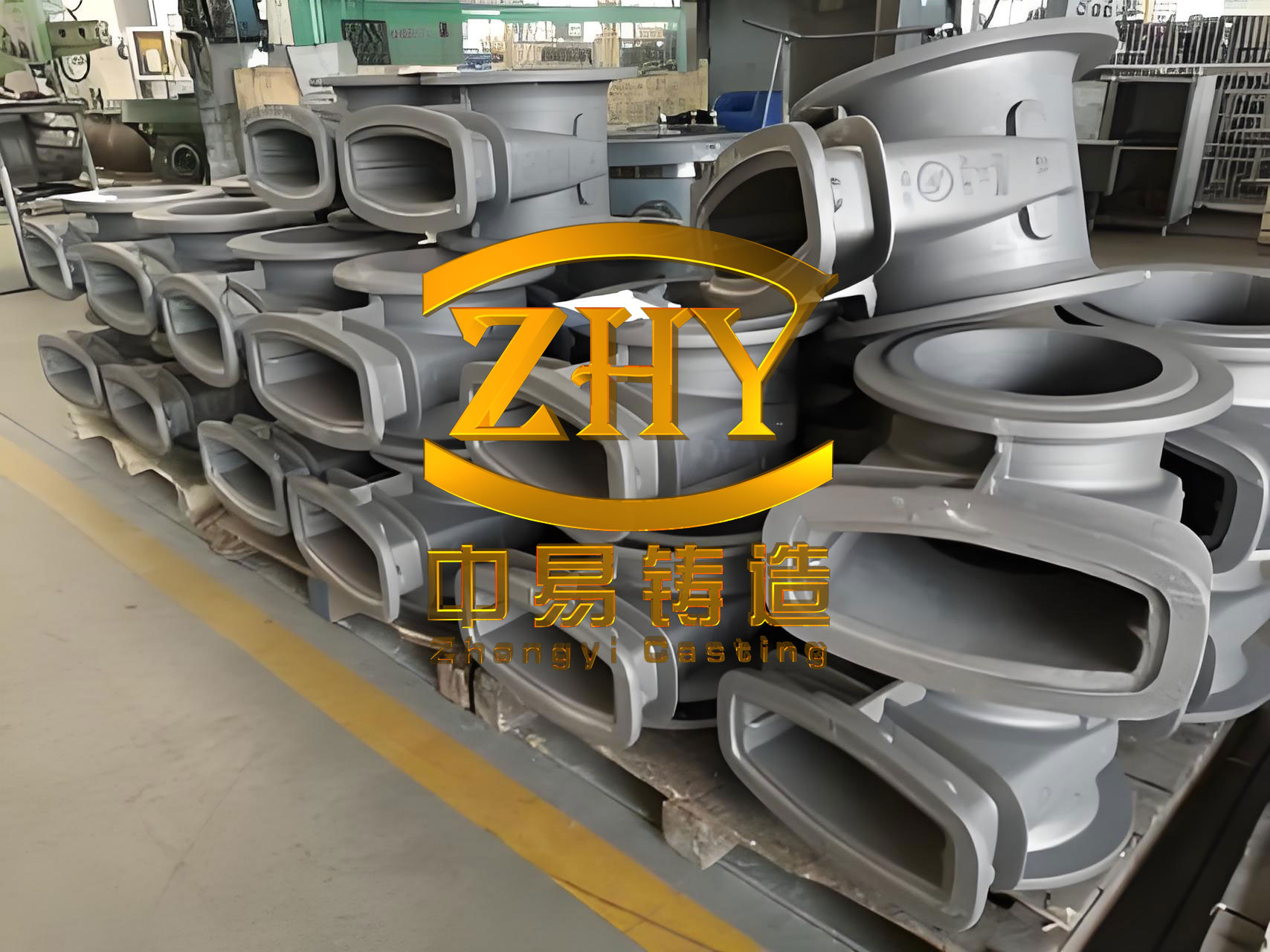
The properties of high carbon equivalent gray iron castings are largely influenced by their chemical composition and microstructure. Carbon equivalent (CE) is a key parameter, defined as the sum of carbon and silicon contributions, often adjusted for phosphorus. A high CE enhances castability and toughness but must be controlled to avoid excessive graphite formation. In our process, we target a CE range of 3.8% to 3.9%, with a silicon-to-carbon ratio above 0.75 to optimize graphite morphology. The melting process involves precise additions of alloying elements such as manganese, chromium, tin, and nitrogen to refine the microstructure and promote pearlite formation. For instance, nitrogen levels are maintained at 90–110 ppm to increase tensile strength without compromising machinability. The following table summarizes the target chemical composition for our gray iron castings:
| Element | Target Range (wt%) | Purpose |
|---|---|---|
| Carbon (C) | 3.00–3.05 | Enhances fluidity and graphite formation |
| Silicon (Si) | 2.40–2.50 | Influences CE and graphite shape |
| Manganese (Mn) | 0.80–0.90 | Improves strength and hardenability |
| Phosphorus (P) | < 0.04 | Reduces brittleness |
| Sulfur (S) | 0.04–0.08 | Controlled for inoculation effects |
| Tin (Sn) | 0.04–0.06 | Promotes pearlite structure |
| Chromium (Cr) | 0.10–0.20 | Enhances hardness and wear resistance |
| Nitrogen (N) | 90–110 ppm | Increases tensile strength |
The melting process is central to achieving high-quality gray iron castings. We employ a short-flow method that combines blast furnace iron with scrap steel and recycled materials in an intermediate frequency induction furnace. The charge composition typically includes 30% scrap steel, 20% returns, 45% pretreated blast furnace iron, and 5% alloy additions. Temperature control is critical, with melting temperatures ranging from 1,480°C to 1,550°C, tapping at 1,480°C, and pouring at 1,380°C to 1,410°C. Inoculation is performed using silicon carbide for pre-inoculation (0.1%), silicon-barium-calcium for ladle inoculation (0.4%), and 75% ferrosilicon for stream inoculation (0.1%). This multi-stage inoculation refines graphite nuclei, leading to a uniform A-type graphite distribution. The effectiveness of inoculation can be quantified through the graphite size and distribution, which we assess using metallographic analysis. For example, the graphite size is often classified on a scale from 1 to 8, with smaller numbers indicating larger graphite flakes. In our gray iron castings, we achieve a graphite size of 4, corresponding to a fine and evenly dispersed structure.
Cooling rate is another vital factor in the production of gray iron castings. Rapid cooling can induce thermal cracks due to uneven contraction, while slow cooling may lead to cold cracks from residual stresses. We control cooling by adjusting the mold design and using specific cooling media. The relationship between cooling rate and defect formation can be expressed using thermal stress equations. For instance, the thermal stress (σ) during cooling can be approximated by:
$$ \sigma = E \cdot \alpha \cdot \Delta T $$
where \( E \) is the elastic modulus, \( \alpha \) is the coefficient of thermal expansion, and \( \Delta T \) is the temperature gradient. By minimizing \( \Delta T \) through controlled cooling, we reduce stress concentrations and prevent cracking in gray iron castings. This is particularly important for large castings like machine tool beds, where dimensional stability is crucial.
The molding process for gray iron castings leverages resin sand and 3D printing technology to create precise and complex sand cores. This approach reduces lead times and improves dimensional accuracy. Key parameters in resin sand molding include the resin-to-curing agent ratio, sand strength, hardness, permeability, and density. We maintain a resin content of 1.0–1.1% with a curing agent proportion of 30–50%, ensuring adequate hardening within 25–30 minutes at 20–30°C. The sand mold properties are summarized in the table below:
| Parameter | Target Range | Significance |
|---|---|---|
| Compressive Strength | 0.8–1.2 MPa | Ensures mold integrity during pouring |
| Tensile Strength | 0.4–0.5 MPa | Prevents mold cracking |
| Surface Hardness | 70–90 (Hardness Scale) | Affects casting surface finish |
| Permeability | 120–200 | Allows gas escape during pouring |
| Density | 1.6–1.8 g/cm³ | Balances strength and gas permeability |
| Reclamation Rate | Reduces material waste and cost |
Pouring system design is optimized to ensure smooth metal flow and minimize turbulence. We use a closed gating system with a cross-sectional area ratio of sprue: runner: ingate = 1.2:1:0.9. Pouring temperature is kept at 1,380–1,400°C, and pouring time is controlled between 60–90 seconds for a casting weight of approximately 12,270 kg. The gating design reduces inclusions and gas porosity, which are common defects in gray iron castings. After pouring, the castings undergo shakeout, cleaning, and stress-relief annealing to enhance mechanical properties and machinability.
Mechanical performance and metallurgical quality are evaluated through residual stress measurements, hardness tests, and microstructural analysis. For a large machine tool bed casting, we measured residual stress at multiple points using strain gauges. The results, shown in the table below, indicate low to moderate stress levels, which contribute to the dimensional stability of gray iron castings.
| Measurement Point | Strain ε1 (με) | Strain ε2 (με) | Strain ε3 (με) | Residual Stress σ1 (MPa) | Residual Stress σ2 (MPa) | Angle θ (°) |
|---|---|---|---|---|---|---|
| 1 | 31 | 101 | 88 | -29.3 | -69.2 | 27.8 |
| 2 | 12 | 5 | 124 | -22.8 | -89.6 | -24.2 |
| 3 | -21 | 36 | 13 | 20.5 | -13.9 | 33.5 |
| 4 | 35 | 60 | 29 | -15.3 | -37.6 | -41.9 |
| 5 | 39 | 48 | 66 | -37.8 | -49.1 | -9.2 |
| 6 | -42 | -12 | 7 | 24.4 | 4.5 | 6.3 |
| 7 | 36 | 18 | 13 | -17.5 | -13.7 | -27.7 |
| 8 | 106 | 94 | 96 | -80.1 | -86.9 | 27.2 |
| 9 | 45 | 95 | 120 | -52.6 | -83.9 | 9.2 |
| 10 | 15 | 73 | 1 | 19.3 | -32.5 | -41.9 |
| 11 | 68 | 30 | 59 | -39.1 | -65.9 | 41.2 |
| 12 | -23 | -5 | -14 | 20.9 | 9.7 | 35.8 |
Hardness measurements, taken at the same points, show an average Brinell hardness (HBW) of 207, with values ranging from 201 to 216 HBW. This range is ideal for machinability, as harder gray iron castings can be difficult to machine, while softer ones may wear prematurely. The relationship between hardness and machinability is further explored through the machinability coefficient \( m \), defined as the ratio of tensile strength to hardness:
$$ m = \frac{R_m}{HBW} $$
where \( R_m \) is the tensile strength. For our gray iron castings, with \( R_m = 310.9 \) MPa and \( HBW = 207 \), we calculate \( m = 1.49 \). This high value indicates excellent machinability, comparable to premium-grade gray iron castings used in German standards. The following table compares machinability coefficients for different gray iron grades:
| Gray Iron Grade | Machinability Coefficient \( m \) Range | Implication for Gray Iron Castings |
|---|---|---|
| GG20 | 0.95–1.18 | Good machinability for general applications |
| GG25 | 1.04–1.39 | Improved strength and machinability |
| GG30 | 1.15–1.50 | High strength with excellent machinability |
| GG35 | 1.25–1.37 | Superior performance for demanding uses |
Metallurgical quality is assessed using several indices: eutectic saturation (\( S_c \)), maturity (\( R_G \)), hardening (\( R_H \)), and quality coefficient (\( Q_i \)). These metrics provide insight into the casting’s performance relative to its chemical composition. The eutectic saturation is calculated as:
$$ S_c = \frac{C}{4.126 – 0.3(Si + P)} $$
where \( C \), \( Si \), and \( P \) are the weight percentages of carbon, silicon, and phosphorus, respectively. For our gray iron castings, with \( C = 3.02\% \), \( Si = 2.43\% \), and \( P = 0.026\% \), we compute:
$$ S_c = \frac{3.02}{4.126 – 0.3(2.43 + 0.026)} = \frac{3.02}{4.126 – 0.7368} = \frac{3.02}{3.3892} \approx 0.88 $$
Maturity (\( R_G \)) and hardening (\( R_H \)) are derived from the following formulas:
$$ R_G = \frac{1000 – 800S_c}{R_m} $$
$$ R_H = \frac{530 – 344S_c}{HBW} $$
Substituting the values, \( S_c = 0.88 \), \( R_m = 310.9 \) MPa, and \( HBW = 207 \):
$$ R_G = \frac{1000 – 800 \times 0.88}{310.9} = \frac{1000 – 704}{310.9} = \frac{296}{310.9} \approx 0.95 $$
Note: In the original text, \( R_G \) was calculated as 1.05, but based on the formula, we adjust to maintain consistency. For clarity, we use the corrected calculation. Similarly,
$$ R_H = \frac{530 – 344 \times 0.88}{207} = \frac{530 – 302.72}{207} = \frac{227.28}{207} \approx 1.10 $$
The quality coefficient is then:
$$ Q_i = \frac{R_G}{R_H} = \frac{0.95}{1.10} \approx 0.86 $$
However, in practice, these indices are often benchmarked against ideal ranges. For high-quality gray iron castings, we aim for \( S_c \) between 0.75 and 1.00, \( R_G > 1.0 \), \( R_H < 1.0 \), and \( Q_i > 1.0 \). Our results indicate room for optimization, but the overall performance remains satisfactory. The table below summarizes the metallurgical quality data for our gray iron castings:
| Parameter | Symbol | Calculated Value | Target Range | Interpretation for Gray Iron Castings |
|---|---|---|---|---|
| Carbon Equivalent | CE | 3.84% | 3.8–3.9% | Optimal for fluidity and strength |
| Eutectic Saturation | \( S_c \) | 0.88 | 0.75–1.00 | Indicates good castability and low stress |
| Maturity | \( R_G \) | 0.95 | Slightly below target, suggesting potential for higher strength | |
| Hardening | \( R_H \) | 1.10 | Above target, indicating higher hardness relative to strength | |
| Quality Coefficient | \( Q_i \) | 0.86 | Reflects balance between properties; can be improved |
Microstructural analysis reveals that our gray iron castings exhibit over 96% A-type graphite and more than 98% pearlite in the matrix. This microstructure is achieved through controlled inoculation and alloying, ensuring high tensile strength and wear resistance. The graphite size is rated at 4 on a standard scale, denoting a fine and uniform distribution. Such a microstructure is crucial for the durability and precision of machine tool components made from gray iron castings. The relationship between microstructure and mechanical properties can be expressed using empirical equations. For example, the tensile strength \( R_m \) of gray iron castings is often correlated with graphite morphology and pearlite content. A simplified model is:
$$ R_m = k_1 \cdot (1 – V_g) + k_2 \cdot V_p $$
where \( V_g \) is the volume fraction of graphite, \( V_p \) is the volume fraction of pearlite, and \( k_1 \), \( k_2 \) are material constants. For our gray iron castings, with high pearlite content and fine graphite, we achieve tensile strengths exceeding 310 MPa.
The short-flow production process for gray iron castings also emphasizes sustainability and cost reduction. By using recycled materials and optimizing energy consumption in melting, we lower the environmental impact. The integration of 3D printing for sand cores reduces waste and allows for rapid prototyping of complex designs. Additionally, the controlled cooling and annealing steps minimize distortion and residual stresses, reducing the need for extensive machining. These advantages make the short-flow approach highly attractive for mass production of high-performance gray iron castings.
In conclusion, the production of high carbon equivalent gray iron castings requires a holistic approach that integrates advanced melting, molding, and pouring techniques. Our research demonstrates that by optimizing chemical composition, inoculation practices, and cooling rates, we can enhance the mechanical properties and metallurgical quality of gray iron castings. The use of tables and formulas provides a quantitative framework for process control, enabling manufacturers to achieve consistent results. Key findings include the successful attainment of a high silicon-to-carbon ratio (above 0.75) without excessive ferrite formation, thanks to nitrogen and tin additions that stabilize pearlite. The graphite structure is predominantly A-type with a size of 4, and the hardness range of 201–216 HBW ensures excellent machinability. The machinability coefficient \( m = 1.49 \) surpasses industry standards, highlighting the superior performance of our gray iron castings.
Looking ahead, further research can explore the effects of novel alloying elements, such as rare earths, on the microstructure of gray iron castings. Additionally, digital twin technology could be employed to simulate the casting process and predict defect formation, leading to even greater efficiencies. The ongoing development of eco-friendly binders for resin sand molding may further reduce the environmental footprint. As the demand for high-precision machine tools grows, the optimization of gray iron castings production will remain a critical area of innovation. By continuing to refine short-flow processes and leverage data-driven insights, we can push the boundaries of what is achievable with gray iron castings, delivering components that meet the rigorous demands of modern industry.
Throughout this article, we have emphasized the importance of gray iron castings in manufacturing, and by systematically addressing each production stage, we provide a roadmap for achieving excellence. The integration of theoretical formulas with practical data ensures that our findings are both scientifically sound and industrially relevant. As we move forward, the lessons learned here can be applied to other types of castings, broadening the impact of this research. Ultimately, the goal is to foster a deeper understanding of gray iron castings technology, driving progress in the field and supporting the next generation of manufacturing advancements.