
In my experience with manufacturing gray iron castings, particularly for components like pump bodies, I have frequently encountered a critical issue: the pearlite content in the surface layer of the castings is significantly lower than in the core. This discrepancy adversely affects the reliability and service life of the castings, as reduced pearlite content diminishes tensile strength, reduces effective wall thickness, and can initiate fracture points. The standard requirement for pearlite content in gray iron castings, such as HT250 grade, is typically above 90%. However, in my production runs, the surface layer (approximately 1-2 mm thick) often exhibits only 70-80% pearlite, while the core achieves 90-98%. This problem is not merely cosmetic; it fundamentally compromises the mechanical integrity of the castings.
The microstructure of gray iron castings is a complex interplay of graphite morphology and metallic matrix. Pearlite, a lamellar structure of ferrite and cementite, provides strength and hardness. Graphite, in its various forms, influences both the mechanical properties and the formation of pearlite. I have observed that while a uniform distribution of Type A graphite generally correlates with high pearlite content, the presence of undercooled graphite types like D and E often leads to lower pearlite. Interestingly, even when Type A graphite predominates (exceeding 50%), pearlite content can still fall below 90%. This indicates that graphite morphology alone does not wholly dictate pearlite quantity. Therefore, addressing this issue requires a dual approach: improving graphite morphology and stabilizing the pearlite phase during solidification and cooling.
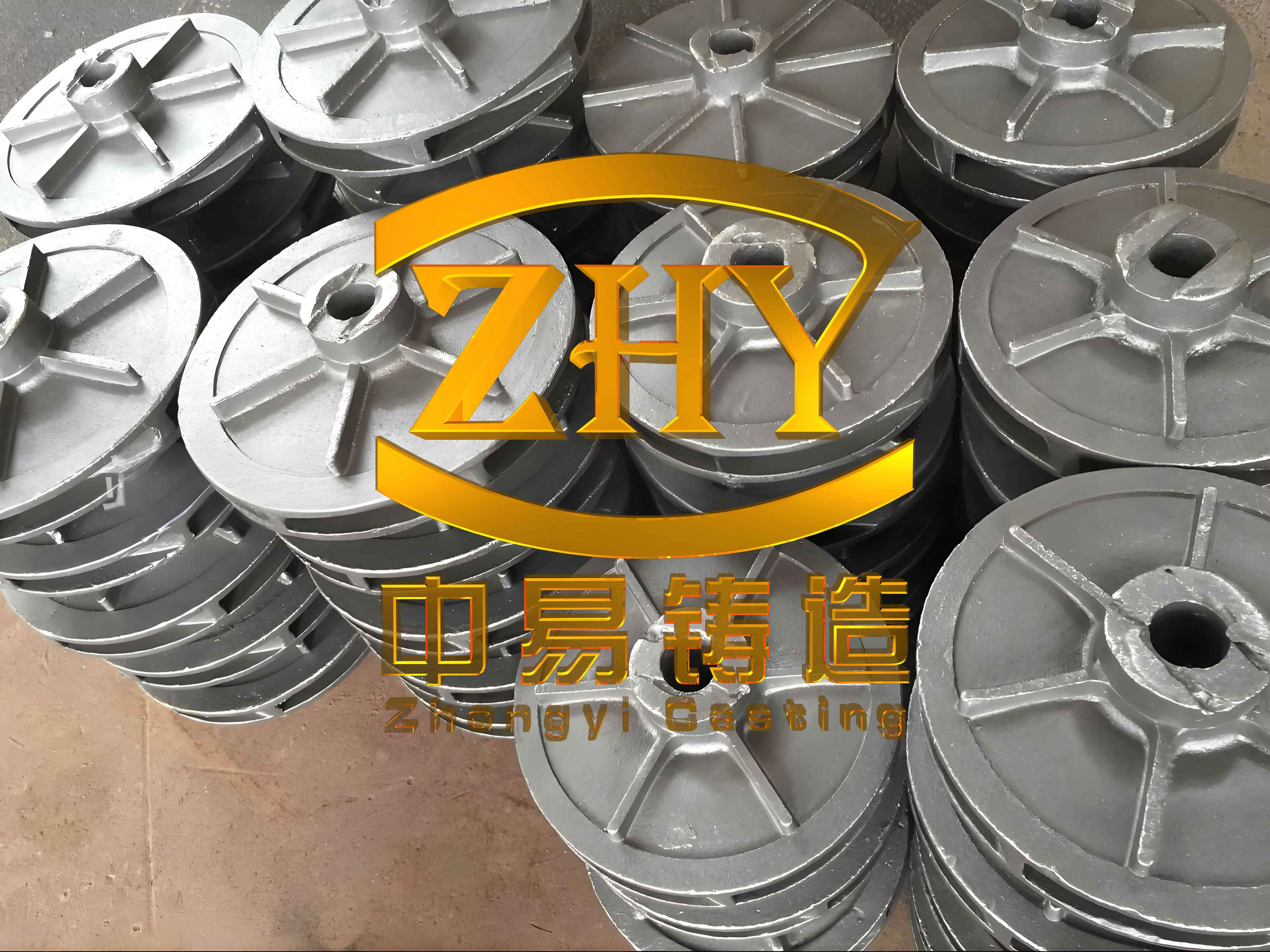
The production of these gray iron castings involved a wet sand casting process using an automated molding line. Melting was conducted in a 1-ton medium-frequency induction furnace. To systematically investigate and solve the low surface pearlite issue, I designed and implemented a series of process improvements, focusing on three key parameters: the silicon-to-carbon ratio (Si/C), inoculation practice, and alloying with tin (Sn). All trials maintained a consistent carbon equivalent (CE) around 4.0%, a pouring temperature between 1480-1520°C, and mold sand moisture controlled at 3.2-3.5%. After pouring, the castings were allowed to cool in the mold. For each batch, the first casting was selected for sampling. Test specimens for hardness, metallography, and tensile strength were taken from identical locations to ensure comparability.
The primary factors influencing pearlite formation in the surface layer of gray iron castings are related to the high cooling rate at the mold-metal interface. This rapid cooling creates a large undercooling, which significantly alters nucleation and growth kinetics. For graphite formation, the critical nucleus size decreases with increasing undercooling, leading to a higher number of effective nucleation sites. This often results in the precipitation of numerous fine graphite particles, characteristic of D-type or E-type undercooled graphite. During the subsequent eutectoid transformation, the abundance of these finely dispersed graphite particles provides ample sites for carbon atoms from the austenite to deposit. This facilitates the formation of ferrite around the graphite, thereby depleting the carbon available for pearlite formation and resulting in a matrix rich in ferrite and poor in pearlite. The relationship between undercooling (ΔT) and critical nucleus radius (r*) can be expressed as:
$$ r^* = \frac{2\gamma}{\Delta G_v} $$
where $\gamma$ is the interfacial energy and $\Delta G_v$ is the volume free energy change, which is a function of undercooling. Higher undercooling increases $\Delta G_v$, reducing $r^*$ and promoting a finer, more numerous graphite structure detrimental to pearlite.
My first intervention targeted the Si/C ratio. Silicon is a potent graphitizer, but in the high-undercooling environment of the casting surface, an excess of silicon relative to carbon can exacerbate the formation of undesirable graphite forms. By reducing the Si/C ratio from approximately 0.70 to around 0.55 while keeping the carbon equivalent constant, I effectively increased the absolute carbon content. Higher carbon availability promotes the development of longer, more interconnected Type A graphite flakes rather than the isolated, fine undercooled graphite. Type A graphite is less numerous and more uniformly distributed, which reduces the number of preferential sites for carbon deposition during the eutectoid reaction, thereby favoring the simultaneous formation of ferrite and cementite as pearlite. The carbon equivalent is calculated as:
$$ CE = \%C + \frac{1}{3}(\%Si + \%P) $$
In all trials, CE was maintained at ~4.0%. The adjustment of Si/C is thus a refinement within this constraint to optimize graphite structure specifically for the surface layer conditions.
The second measure involved enhancing the inoculation treatment. Inoculation is crucial for controlling graphite nucleation. I shifted from a single inoculation at tap (0.4% Ca-Ba-Zr inoculant) to a dual inoculation process: 0.3% at tap plus an additional 0.1% during pouring via a stream inoculation method. This strengthened inoculation reduces the effective undercooling by providing more heterogeneous nucleation sites for graphite. This encourages graphite to precipitate earlier and grow as longer, well-formed flakes (Type A), again suppressing the formation of undercooled graphite. The effectiveness of inoculation can be related to the number of nuclei (N) formed, which is a function of inoculant addition rate and undercooling:
$$ N \propto I_0 \cdot \exp\left(-\frac{Q}{k_B T}\right) $$
where $I_0$ is related to inoculant potency, $Q$ is an activation energy, $k_B$ is Boltzmann’s constant, and $T$ is temperature. Enhanced inoculation increases $I_0$, leading to more nuclei at a given undercooling, promoting Type A graphite.
The third and perhaps most direct intervention was the alloying addition of tin (Sn). Tin is a well-known pearlite stabilizer in gray iron. It strongly inhibits the formation of ferrite by segregating at the austenite/ferrite interface during the eutectoid transformation, thereby promoting the formation of pearlite. I added approximately 0.06% Sn to the ladle at tap. It is critical to keep Sn additions below 0.10% to avoid the precipitation of brittle iron-tin compounds at grain boundaries, which can severely reduce impact toughness. The effect of Sn on shifting the eutectoid transformation temperature can be conceptualized. It increases the temperature range for pearlite formation, making it the favored transformation product even under moderately fast cooling conditions experienced at the surface.
To quantitatively assess the impact of these process modifications, I conducted a series of trials and compiled the results. The table below summarizes the chemical composition, process parameters, and resulting properties for key experimental conditions. The data clearly demonstrates the progression from the initial problematic state to the improved condition.
| Trial Condition | Carbon Content, w% | Silicon Content, w% | Si/C Ratio | Tin Content, w% | Inoculation Steps | Type A Graphite, % | Graphite Length Grade | Surface Pearlite, % | Core Pearlite, % | Tensile Strength, MPa | Hardness, HB |
|---|---|---|---|---|---|---|---|---|---|---|---|
| Baseline (High Si/C) | 3.26 | 2.29 | 0.70 | 0 | 1 | <50 | – | 70-80 | >90 | 223 | 207 |
| Low Si/C Only | 3.30 | 1.81 | 0.55 | 0 | 1 | <50 | – | 70-80 | >90 | 245 | 217 |
| Low Si/C + Enhanced Inoculation | 3.32 | 1.87 | 0.56 | 0 | 2 | <70 | 6 | 75-85 | >90 | 235 | 213 |
| Low Si/C + Enhanced Inoculation + Sn | 3.29 | 1.85 | 0.56 | 0.062 | 2 | >70 | 5 | >90 | >90 | 265 | 214 |
The results are illuminating. The baseline condition with a high Si/C ratio of 0.70 yielded less than 50% Type A graphite and a surface pearlite content of only 70-80%. Merely lowering the Si/C ratio to 0.55 (Trial 2) improved tensile strength slightly but did not significantly increase surface pearlite content. The graphite morphology remained unfavorable. Introducing enhanced inoculation (Trial 3) alongside a low Si/C ratio showed some improvement in graphite structure (more Type A, longer flakes) and a marginal increase in surface pearlite to 75-85%. However, the target of 90% was still not met. The definitive solution emerged when tin was added in conjunction with low Si/C and dual inoculation (Trial 4). This combination successfully pushed the surface pearlite content above 90%, increased the proportion of Type A graphite to over 70%, and delivered the highest tensile strength of 265 MPa. The hardness values remained relatively consistent, indicating that the improvement came primarily from microstructural refinement rather than just increased carbide formation.
The synergy between these factors is key. Lowering the Si/C ratio in these gray iron castings creates a chemical environment conducive to the growth of favorable graphite. Enhanced inoculation ensures that this potential is realized by providing ample nuclei, reducing undercooling, and promoting Type A graphite formation from the outset. However, in the severe thermal gradient at the surface, these measures alone may be insufficient to fully counteract the ferrite-promoting effect of the fine graphite-austenite interface area. Tin acts as a powerful “insurance” at the eutectoid stage. It segregates to the transformation front, impeding the diffusion-controlled growth of ferrite and effectively raising the minimum cooling rate at which pearlite can form. This ensures that even in the rapidly cooled surface layer of the gray iron castings, the matrix transforms predominantly to pearlite.
The role of tin can be further elaborated through its effect on the eutectoid reaction kinetics. The growth rate of ferrite ($v_f$) and pearlite ($v_p$) can be modeled. Tin, as a solute, reduces the diffusivity of carbon in austenite ($D_C^\gamma$) and increases the energy required for ferrite nucleation. A simplified expression for the growth rate of a pearlite colony involves carbon diffusion:
$$ v_p \propto D_C^\gamma \cdot \frac{\Delta T}{S_0} $$
where $\Delta T$ is the undercooling below the eutectoid temperature and $S_0$ is the interlamellar spacing. While Sn may slightly reduce $D_C^\gamma$, its primary effect is to thermodynamically stabilize pearlite by lowering the free energy of the pearlite structure relative to ferrite + graphite, effectively increasing the driving force $\Delta G$ for pearlite formation at a given temperature. This shifts the TTT (Time-Temperature-Transformation) diagram for the gray iron castings, extending the “nose” for pearlite to shorter times, making it the unavoidable transformation product under typical casting cooling conditions.
It is worth noting that other alloying elements like copper (Cu) and chromium (Cr) are also used to promote pearlite in gray iron castings. Based on literature and experience, additions of 0.30-0.50% Cu and 0.25-0.35% Cr can be effective. However, Cr above 0.35% increases the risk of carbide formation and shrinkage porosity. In this specific case, Sn was chosen for its potent effect at very low addition levels and its relative ease of addition and control in the foundry environment for producing high-quality gray iron castings.
The improvement in graphite morphology is equally critical. The transition from undercooled to Type A graphite reduces the total graphite-matrix interfacial area per unit volume. This interface acts as a preferred site for carbon deposition during the eutectoid reaction, leading to ferrite halos. By having fewer, larger graphite flakes, the interfacial area is minimized. The surface area to volume ratio for graphite can be approximated. For spherical particles of radius $r$, the surface area per unit volume is $3/r$. For flake graphite, the ratio is even larger for a given volume if the flakes are thin. Type A graphite, being longer and thicker than D-type, has a lower specific surface area, thus reducing the number of ferrite nucleation sites. This, combined with the pearlite-stabilizing effect of Sn, creates a double barrier against ferrite formation in the surface layer.
In practice, controlling the mold sand properties is also essential, as moisture content affects the cooling rate and gas evolution at the metal-mold interface. For these gray iron castings, maintaining consistent sand moisture (3.2-3.5%) was part of the standardized process to ensure that the observed effects were solely due to the metal treatment changes. Variability in sand properties could reintroduce excessive cooling rates or gas pressures that might destabilize pearlite, underscoring the need for holistic process control in manufacturing reliable gray iron castings.
To generalize the findings, I propose a conceptual model for achieving high surface pearlite content in gray iron castings. The key is to manage both the solidification (graphite formation) and solid-state transformation (eutectoid reaction) stages. The following equation summarizes the target function for maximizing surface pearlite ($P_s$):
$$ P_s = f(G_A, \Delta T_{eff}, [Sn]) $$
where $G_A$ is the volume fraction of Type A graphite, $\Delta T_{eff}$ is the effective undercooling during eutectoid transformation (which we aim to minimize for pearlite by alloying), and $[Sn]$ is the tin concentration. $G_A$ itself is a function of Si/C ratio and inoculation potency. The process improvements directly optimize these variables: lowering Si/C and enhancing inoculation increase $G_A$; adding Sn decreases the critical $\Delta T_{eff}$ at which pearlite forms.
In conclusion, the problem of low pearlite content in the surface of gray iron castings is a significant challenge that can compromise component performance. Through systematic investigation, I found that a multifaceted approach is necessary for a robust solution. Isolated adjustments, such as only modifying the Si/C ratio or only enhancing inoculation, yielded incomplete improvements. The synergistic combination of reducing the Si/C ratio to approximately 0.55, implementing a dual inoculation practice, and adding a small but critical amount of tin (around 0.06%) proved to be highly effective. This integrated strategy successfully improved the graphite morphology towards Type A and, most importantly, stabilized the pearlite phase during the eutectoid transformation, ensuring that the surface layer of the gray iron castings achieved a pearlite content exceeding 90%. This resulted in enhanced tensile strength without adversely affecting hardness, thereby improving the overall reliability and service life of the castings. The principles derived from this study—balancing graphite formation controls with targeted pearlite stabilization—are broadly applicable to enhancing the quality and consistency of gray iron castings across various applications where surface integrity is paramount.