
In the realm of sand casting, a widely utilized manufacturing process for producing metal components, surface defects such as scab formation on the upper surfaces of castings remain a persistent challenge. As an engineer deeply involved in foundry practices, I have observed that scab defects, characterized by the entrapment of sand layers within the casting surface, predominantly occur in green sand molds during the pouring of high-temperature molten metal. This article delves into the intricate formation mechanism of scab, drawing upon mechanical principles to explain why large castings are particularly susceptible, and how factors like thermal-wet tensile strength and original moisture content influence this defect. The core argument is that the mechanical essence of scab lies in the buckling instability of a thin plate under compressive stress. Through detailed analyses, formulas, and tables, we will explore the dynamics of sand casting that lead to scab, emphasizing the critical role of process parameters in mitigating such issues.
Sand casting involves creating a mold from compacted sand, often bonded with clay and water, into which molten metal is poured. The upper surfaces of castings, especially those with large, flat areas, are prone to scab due to thermal interactions between the hot metal and the mold. During pouring, the sand mold’s surface layer is subjected to intense radiative heat, causing rapid heating and expansion. Concurrently, moisture within the sand migrates inward, forming a weak zone known as the saturated moisture condensation region. This combination of thermal expansion and weakened internal strength sets the stage for scab formation. In sand casting, understanding this phenomenon is crucial for improving product quality and reducing waste.
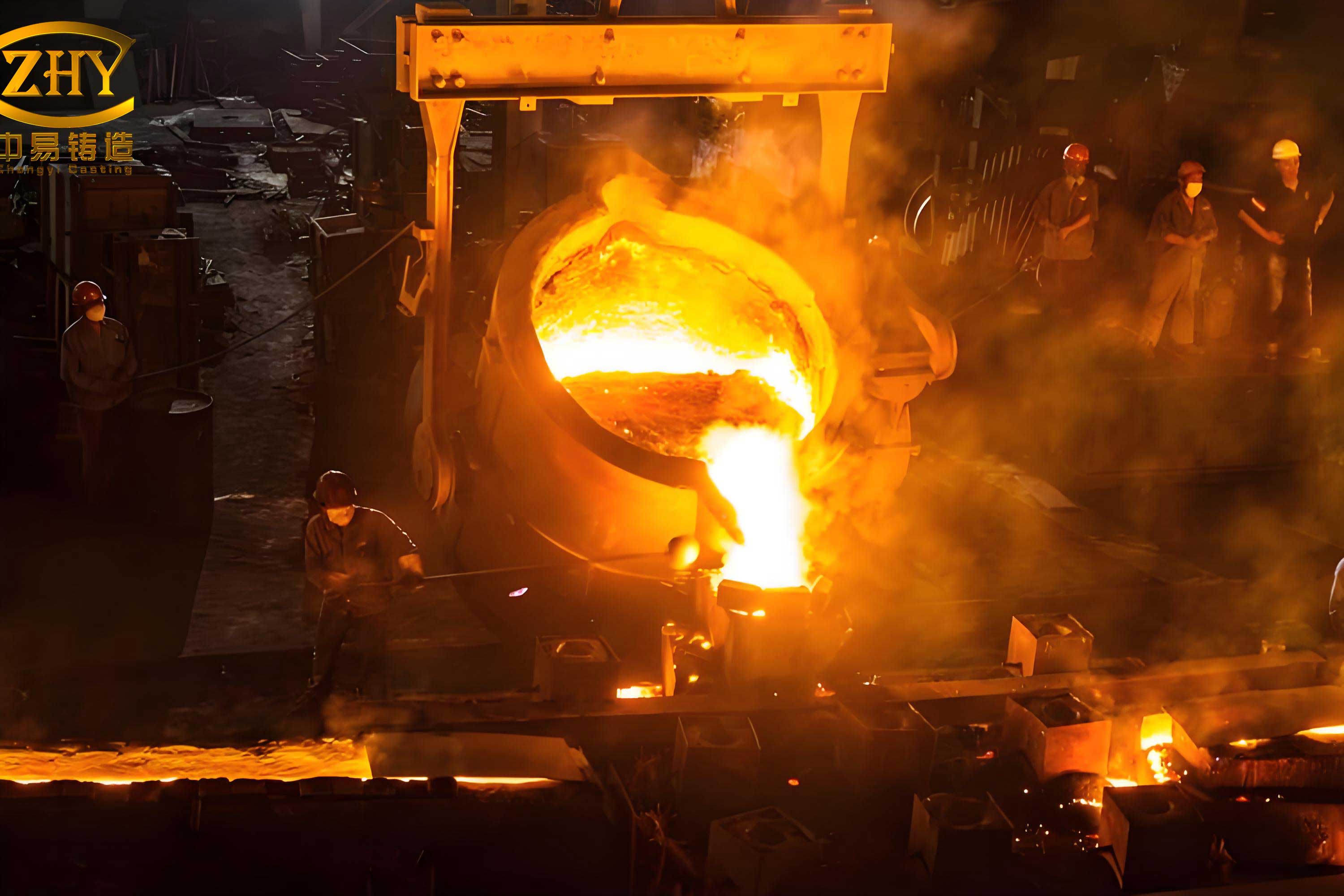
The formation process of scab in sand casting begins with the heating of the mold surface. As molten metal is poured, the sand’s surface layer, typically a few millimeters thick, experiences a temperature gradient. The outer layer dries out and becomes a dry sand layer, while the inner region retains moisture, creating a saturated zone with low strength. The dry layer expands due to thermal effects, but this expansion is constrained by the surrounding mold walls, leading to the development of compressive thermal stresses. If these stresses exceed a critical threshold, the dry layer buckles, akin to a thin plate under compression. This buckling causes the layer to arch upward, and if the deformation is sufficient, it can separate from the weak saturated zone, resulting in cracks and eventual sand inclusion into the casting. This mechanism is fundamental to sand casting defects and requires thorough analysis.
To quantify this, let’s consider the dry sand layer as a thin plate subjected to biaxial compressive stresses. In sand casting, the plate dimensions correspond to the casting’s upper surface area, with thickness denoted as \(c\). The critical compressive stress for buckling, based on elastic theory, is given by:
$$(\sigma_x)_c = \frac{\pi^2 E c^2 (m^2 + a^2/b^2)}{12(1-\mu) a^2 (m^2 + \alpha a^2/b^2)}$$
where:
- \(E\) is the elastic modulus of the dry sand layer,
- \(c\) is the thickness of the dry layer,
- \(\mu\) is Poisson’s ratio for the sand,
- \(a\) and \(b\) are the length and width of the casting surface, respectively,
- \(m\) is the number of half-waves in the buckling mode, dependent on the aspect ratio \(a/b\),
- \(\alpha\) is the ratio of stresses in the x and y directions.
This formula highlights that the critical stress is inversely proportional to the square of the casting dimensions. Thus, in sand casting, larger castings with extensive flat surfaces have significantly lower critical stresses, making them more prone to scab. For instance, if \(a\) and \(b\) double, the critical stress reduces by a factor of four, explaining why big castings in sand casting often exhibit scab defects. Additionally, the thickness \(c\) plays a pivotal role; as \(c\) decreases, the critical stress drops sharply, which is influenced by the original moisture content of the sand, as we’ll discuss later.
The buckling phenomenon can be further analyzed through energy principles. When the dry layer buckles, it releases stored elastic energy from compression, leading to deformation. The deflection or arching of the layer, denoted as \(\delta\), relates to the uncompensated expansion strain \(\epsilon\). In sand casting, if \(\delta\) exceeds the elongation capacity of the saturated zone, separation occurs. The outer surface of the buckled layer experiences tensile stress, which can cause cracking if it surpasses the sand’s tensile strength. This tensile stress \(\sigma_t\) can be approximated as:
$$\sigma_t = \frac{E \delta^2}{c^2}$$
where a larger \(\delta\) indicates more severe buckling. Therefore, in sand casting, controlling parameters that affect \(\delta\), such as thermal expansion and mold constraints, is essential to prevent scab.
Now, let’s examine the factors influencing scab formation in sand casting through a detailed table. This table summarizes key variables and their effects, based on empirical observations and theoretical models.
| Factor | Effect on Scab Formation | Mechanism | Typical Range in Sand Casting |
|---|---|---|---|
| Original Moisture Content | Increases susceptibility | Reduces dry layer thickness \(c\) and thermal-wet tensile strength | 3-5% for green sand |
| Thermal-Wet Tensile Strength | Decreases susceptibility | Enhances resistance to buckling by providing lateral support | 1-5 kPa for typical sands |
| Casting Size (a, b) | Increases susceptibility for large areas | Lowers critical compressive stress \((\sigma_x)_c\) | Varies widely; >0.5 m² high risk |
| Dry Layer Thickness (c) | Decreases susceptibility if thicker | Raises \((\sigma_x)_c\) proportional to \(c^2\) | 2-10 mm, depending on heating |
| Aspect Ratio (a/b) | Can cause multiple scabs if high | Affects buckling mode \(m\) and stress distribution | 1-10; >6 may lead to multiple instabilities |
| Sand Type (e.g., bentonite) | Decreases susceptibility with sodium-based | Improves thermal-wet tensile strength and cohesion | Calcium or sodium bentonite blends |
| Pouring Temperature | Increases susceptibility if too high | Accelerates heating and expansion rates | 1300-1500°C for iron castings |
From this table, it’s evident that sand casting parameters must be carefully optimized to minimize scab. For example, original moisture content is critical; higher moisture leads to earlier formation of the saturated zone, thinning the dry layer and reducing \(c\). This not only lowers the critical stress but also diminishes the thermal-wet tensile strength of the saturated region, exacerbating scab risk. In sand casting, controlling moisture within a narrow range is often a practical challenge, but essential for quality assurance.
The role of thermal-wet tensile strength deserves elaboration. In sand casting, this property represents the sand’s resistance to tensile forces under heated, moist conditions. It acts as a lateral restraining force on the dry layer, analogous to a blank holder in sheet metal forming that prevents wrinkling. The thermal-wet tensile stress \(\sigma_{tw}\) generates a bending moment that counteracts the buckling induced by compressive stresses. Thus, the effective critical stress for scab formation becomes:
$$(\sigma_x)_{c,eff} = (\sigma_x)_c + \frac{\sigma_{tw} \cdot f(c)}{k}$$
where \(f(c)\) is a function of thickness, and \(k\) is a constant related to geometry. Even a small \(\sigma_{tw}\) can significantly raise the buckling threshold, which is why in sand casting, additives like sodium bentonite are used to enhance this property. Sodium bentonite, compared to calcium bentonite, offers higher thermal-wet tensile strength due to better water retention and swelling capacity, making it preferred in sand casting for defect-prone applications.
To illustrate the impact of casting geometry, consider a rectangular casting surface with length \(a\) and width \(b\). The buckling mode number \(m\) depends on \(a/b\): for \(a/b \leq 2\), \(m=1\); for \(2 < a/b \leq 6\), \(m=2\); for \(6 < a/b \leq 12\), \(m=3\). This implies that in sand casting, elongated castings with high aspect ratios may experience multiple buckling waves, leading to several scab spots along the surface. For instance, if \(a/b = 8\), \(m=3\), meaning the dry layer could buckle into three half-waves, potentially causing multiple separations and scabs. This phenomenon explains why some sand casting products exhibit repetitive defect patterns.
Another aspect is the influence of mold constraints. In sand casting, the dry layer’s expansion is resisted not only by the saturated zone but also by the mold walls. The resistance forces include compressive stress from the sides and shear stress along the interfaces. However, as derived from force balance, the dominant resistance comes from the mold walls, given the low shear strength of the saturated zone (around 1 kPa). The force equilibrium can be expressed as:
$$F = E \epsilon L c = p_2 + p_3$$
where \(F\) is the thermal expansion force, \(L\) is a characteristic length, \(p_2\) is the lateral compressive force, and \(p_3\) is the shear force from the walls. Since \(p_2\) and \(p_3\) are much larger than the saturated zone’s resistance, the buckling is primarily driven by the compression from the constraints. This underscores the importance of mold design in sand casting; techniques like using chamfers or steps on large surfaces can effectively reduce the effective dimension \(a\) or \(b\), thereby increasing the critical stress and preventing scab.
Let’s delve deeper into the mathematical modeling of scab in sand casting. The dry layer’s behavior can be analyzed using plate theory. Assuming a simply supported rectangular plate under uniform biaxial compression, the buckling equation is:
$$D \nabla^4 w + \sigma_x \frac{\partial^2 w}{\partial x^2} + \sigma_y \frac{\partial^2 w}{\partial y^2} = 0$$
where \(D = \frac{E c^3}{12(1-\mu^2)}\) is the flexural rigidity, \(w\) is the deflection, and \(\sigma_x\), \(\sigma_y\) are the compressive stresses. For sand casting applications, we often assume \(\sigma_y = \alpha \sigma_x\), with \(\alpha\) depending on the constraint conditions. Solving this eigenvalue problem yields the critical stress formula provided earlier. This theoretical framework allows us to simulate scab formation in sand casting by inputting material properties and dimensions.
In practice, sand casting involves variable thermal profiles. The temperature distribution in the mold affects both the dry layer thickness and the thermal strain. We can model the temperature \(T\) as a function of depth \(z\) and time \(t\) using the heat conduction equation:
$$\frac{\partial T}{\partial t} = \kappa \frac{\partial^2 T}{\partial z^2}$$
where \(\kappa\) is the thermal diffusivity of the sand. Solving this with boundary conditions (e.g., surface temperature equal to molten metal temperature) gives \(T(z,t)\), from which we can estimate the dry layer thickness \(c\) as the depth where moisture evaporates. In sand casting, this thickness typically ranges from 2 to 10 mm, depending on pouring speed and sand composition. A simple empirical relation is \(c \propto \sqrt{t}\), but moisture content alters this significantly.
The original moisture content \(M_0\) directly impacts \(c\). Higher \(M_0\) causes more rapid moisture migration, leading to a thinner dry layer. Experimental data in sand casting show that for every 1% increase in \(M_0\), \(c\) decreases by approximately 0.5 mm under standard pouring conditions. This reduces the critical stress quadratically, as per the formula. Moreover, \(M_0\) affects the thermal-wet tensile strength \(\sigma_{tw}\), which often follows a negative correlation: \(\sigma_{tw} = A – B \cdot M_0\), where \(A\) and \(B\) are constants specific to the sand mix. Thus, in sand casting, maintaining optimal moisture is a double-edged sword—too low, and the sand may lack moldability; too high, and scab risk escalates.
To mitigate scab in sand casting, several strategies are employed based on this mechanistic understanding. One common approach is inclined pouring, where the mold is tilted to reduce the effective horizontal surface area exposed to heat. This effectively decreases \(a\) or \(b\) in the buckling formula, raising the critical stress. Another method is to incorporate grooves or ribs on the pattern, which break up large surfaces into smaller segments, altering the buckling modes. In sand casting, these design modifications are cost-effective and widely adopted.
Additionally, improving the sand mix is crucial. Using sodium bentonite instead of calcium bentonite, as mentioned, boosts thermal-wet tensile strength. The activation of calcium bentonite with sodium carbonate also helps. The table below compares typical properties of different sand mixes relevant to sand casting.
| Sand Mix Type | Thermal-Wet Tensile Strength (kPa) | Optimal Moisture Content (%) | Dry Layer Thickness (mm) at 5% Moisture | Scab Susceptibility Rating |
|---|---|---|---|---|
| Calcium Bentonite Base | 1.2 – 2.0 | 3.5 – 4.5 | 3.0 | High |
| Sodium Bentonite Base | 3.0 – 5.0 | 4.0 – 5.0 | 4.5 | Low |
| Activated Calcium Bentonite | 2.5 – 4.0 | 3.8 – 4.8 | 4.0 | Medium |
| High Clay Content Mix | 2.0 – 3.5 | 4.5 – 5.5 | 5.0 | Medium-Low |
This table underscores that in sand casting, selecting the right sand mix can dramatically reduce scab occurrences. Sodium bentonite-based mixes, despite higher cost, offer superior performance, especially for large castings. Furthermore, controlling compactness and uniformity of the mold through proper ramming in sand casting ensures consistent dry layer formation, minimizing local weak spots that could initiate buckling.
The concept of critical temperature also plays a role. In sand casting, if the surface temperature exceeds a certain threshold, the sand may undergo sintering or glass transition, altering its mechanical properties. From the thermal expansion curve, beyond a critical temperature \(t_{crit}\), thermal strain surpasses expansion, reducing the uncompensated strain \(\epsilon\) and thus the compressive stress. This implies that very high pouring temperatures might not always increase scab risk, but in practice, for typical sand casting alloys, temperatures are below this threshold, making expansion dominant. Monitoring temperature profiles in sand casting through simulations or sensors can help optimize pouring parameters.
For concave or convex casting surfaces, the mechanics differ. In sand casting, a convex surface (like a dome) subjects the dry layer to additional lateral compressive components that aid stability, as the curvature generates a restoring force. Conversely, a concave surface (like a dish) introduces tensile components that promote buckling. This is why in sand casting, concave designs are more prone to scab. The modified critical stress for a curved surface can be expressed as:
$$(\sigma_x)_{c,curve} = (\sigma_x)_c \pm \frac{E c}{R}$$
where \(R\) is the radius of curvature (positive for convex, negative for concave). The plus sign applies to convex surfaces, increasing critical stress, and the minus sign to concave surfaces, decreasing it. Thus, in sand casting, designing with convex contours where possible can mitigate scab.
Another factor is the duration of metal pressure. In sand casting, the molten metal exerts pressure on the mold, which can suppress buckling if applied uniformly. However, during the initial pouring stage, pressure may not be fully developed, allowing buckling to initiate. The timing of stress development versus pressure application is critical. Analytical models incorporating time-dependent pressure \(P(t)\) show that the effective compressive stress becomes \(\sigma_{eff} = \sigma_{thermal} – P(t)\). If \(P(t)\) rises quickly, it can counteract the thermal stress, preventing scab. In sand casting, fast pouring rates are often recommended to hasten pressure buildup, though this must be balanced against turbulence and erosion risks.
Let’s consider a numerical example to solidify these concepts. Suppose a sand casting of a flat plate with dimensions \(a = 1.0 \, \text{m}\), \(b = 0.5 \, \text{m}\), so aspect ratio \(a/b = 2\). Assume dry layer properties: \(E = 50 \, \text{MPa}\), \(\mu = 0.3\), \(c = 0.005 \, \text{m}\). For \(m=1\) and \(\alpha=1\) (equal biaxial stress), the critical stress is:
$$(\sigma_x)_c = \frac{\pi^2 \times 50 \times 10^6 \times (0.005)^2 \times (1^2 + 2^2)}{12(1-0.3) \times (1.0)^2 \times (1^2 + 1 \times 2^2)}$$
Calculating stepwise:
- Numerator: \(\pi^2 \approx 9.87\), so \(9.87 \times 50 \times 10^6 = 493.5 \times 10^6\).
- \((0.005)^2 = 25 \times 10^{-6}\), so product: \(493.5 \times 10^6 \times 25 \times 10^{-6} = 12,337.5\).
- \(1^2 + 2^2 = 5\), so \(12,337.5 \times 5 = 61,687.5\).
- Denominator: \(12 \times (1-0.3) = 12 \times 0.7 = 8.4\).
- \(a^2 = 1\), so \(8.4 \times 1 = 8.4\).
- \(1^2 + 1 \times 2^2 = 1 + 4 = 5\), so \(8.4 \times 5 = 42\).
- Thus, \((\sigma_x)_c = 61,687.5 / 42 \approx 1,469 \, \text{kPa} = 1.47 \, \text{MPa}\).
In sand casting, typical thermal stresses can range from 0.5 to 3 MPa, so this value is within a risky zone. If moisture increases, reducing \(c\) to 0.003 m, the critical stress drops to approximately \(0.53 \, \text{MPa}\) (since it scales with \(c^2\)), making scab highly likely. This example illustrates why meticulous control in sand casting is vital.
Beyond theory, practical observations in sand casting reinforce these principles. Foundries often report that scab defects peak during humid conditions when sand moisture is harder to control, or when casting large, flat parts like engine blocks or panels. Preventive measures include using facing sands with higher refractory properties, reducing cycle times to minimize heat exposure, and applying mold washes that enhance surface strength. In sand casting, these practices are integral to quality management systems.
In conclusion, the formation of scab in sand casting is a complex interplay of thermal, mechanical, and material factors. The core mechanism is the buckling instability of the dry sand layer under compressive thermal stresses, influenced by casting geometry, sand properties, and process parameters. Key takeaways for sand casting practitioners are:
- Large castings with big upper surfaces are inherently prone to scab due to low critical buckling stresses.
- Original moisture content must be minimized to maintain dry layer thickness and thermal-wet tensile strength.
- Enhancing sand mixes with sodium bentonite or additives improves resistance to scab.
- Design modifications like inclined pouring or surface patterning can effectively prevent defects.
- Understanding the buckling dynamics allows for predictive modeling and optimization in sand casting operations.
As sand casting continues to evolve with advancements in simulation and material science, a deeper grasp of scab formation will lead to more robust processes. By integrating theoretical insights with practical adjustments, foundries can significantly reduce scrap rates and enhance the reliability of sand casting for diverse industrial applications. This mechanistic perspective not only addresses scab but also informs broader defect prevention strategies in the versatile world of sand casting.