
In modern manufacturing, the integration of additive manufacturing, commonly known as 3D printing, with traditional processes like sand casting has opened new avenues for efficiency and innovation. As a researcher focused on advancing foundry techniques, I have explored the use of 3D printing to create patterns for sand casting, specifically targeting complex components such as blower impellers. This study delves into how 3D printing can replace wooden patterns, addressing issues like long lead times, high costs, and material limitations in sand casting. Through this first-person account, I will detail the process from digital modeling to final casting, emphasizing the role of sand casting in achieving precise and economical results. The goal is to demonstrate that 3D printed patterns can revolutionize sand casting by simplifying workflows, reducing waste, and enabling the production of intricate designs that are challenging with conventional methods.
Sand casting is one of the oldest and most versatile metal-forming processes, where molten metal is poured into a sand mold to create a part. Its flexibility makes it ideal for a wide range of applications, from automotive components to industrial machinery. However, traditional sand casting often relies on wooden patterns, which are labor-intensive to produce, prone to damage, and limited in complexity. In my work, I aimed to overcome these drawbacks by leveraging 3D printing technology. By using fused deposition modeling (FDM) to fabricate patterns directly from digital designs, I sought to streamline the sand casting process, making it more adaptable to custom or low-volume production. This approach aligns with the growing trend toward digital manufacturing, where sand casting benefits from rapid prototyping and reduced material usage.
The core of my investigation centered on a blower impeller, a component with curved blades and thin sections that pose challenges for traditional pattern-making. I began by creating a three-dimensional digital model using NX10.0 software, based on engineering drawings. The model accounted for key factors in sand casting, such as shrinkage and draft angles. For the aluminum alloy ZL301 used in this study, the linear shrinkage rate was set at 1.3%, which influences the final dimensions in sand casting. The shrinkage can be expressed mathematically as: $$ S = \frac{L_m – L_c}{L_c} \times 100\% $$ where \( S \) is the shrinkage percentage, \( L_m \) is the pattern dimension, and \( L_c \) is the casting dimension. This formula ensured accuracy in the sand casting process, as proper compensation is crucial to avoid defects.
After modeling, I exported the design to STL format and prepared it for 3D printing using Cura software. The printer employed was an UP box model, utilizing FDM technology with polylactic acid (PLA) filament. FDM is well-suited for sand casting patterns due to its affordability and ease of maintenance, though other methods like selective laser sintering (SLS) or binder jetting can also be applied in sand casting for direct mold production. I formulated two printing strategies to optimize quality and efficiency for the sand casting pattern, as summarized in Table 1. These strategies varied in layer height, print speed, and support structures, all critical for achieving a smooth surface finish that benefits sand casting by reducing mold preparation time.
| Parameter | Strategy 1 | Strategy 2 |
|---|---|---|
| Layer Height (mm) | 0.2 | 0.1 |
| Wall Thickness (mm) | 0.8 | 0.8 |
| Print Speed (mm/s) | 50 | 40 |
| Nozzle Temperature (°C) | 210 | 210 |
| Support Type | Everywhere | Everywhere |
| Build Plate Adhesion | Raft | Brim |
| Print Time | 3 hours 58 minutes | 6 hours 59 minutes |
| Material Used (g) | 36 | 32 |
From this comparison, Strategy 1 proved more time-efficient with minimal compromise on quality, making it preferable for sand casting applications where rapid pattern production is key. The printed impeller pattern exhibited fine details, including the blade curvatures and draft angles, essential for successful sand casting. The FDM process generated little waste, aligning with the sustainable goals of modern sand casting practices. To quantify the material efficiency, I used the formula: $$ \eta = \frac{M_p}{M_t} \times 100\% $$ where \( \eta \) is the material utilization rate, \( M_p \) is the mass of the printed pattern, and \( M_t \) is the total material fed into the printer. For Strategy 1, \( \eta \) approached 98%, far exceeding traditional wood machining rates, which often fall below 50% due to subtractive methods. This high efficiency is a significant advantage for sand casting, as it reduces raw material costs and environmental impact.
With the 3D printed pattern ready, I proceeded to the sand casting phase. The pattern was used to create both the cope and drag halves of the sand mold. In sand casting, the mold is typically made from silica sand mixed with binders, but here, I relied on conventional green sand for its accessibility and cost-effectiveness. The process involved placing the pattern in the drag box, ramming sand around it, and then repeating for the cope. A parting line was established at the impeller’s back face, as determined during digital design. To ensure proper metal flow in sand casting, I designed a top-gating system, which is suitable for thin-walled parts like the impeller. The gating ratio can be expressed as: $$ R_g = \frac{A_c}{A_p} $$ where \( R_g \) is the gating ratio, \( A_c \) is the cross-sectional area of the choke, and \( A_p \) is the total area of the ingates. For this sand casting setup, a ratio of 1:2:1 was maintained to minimize turbulence and defects.
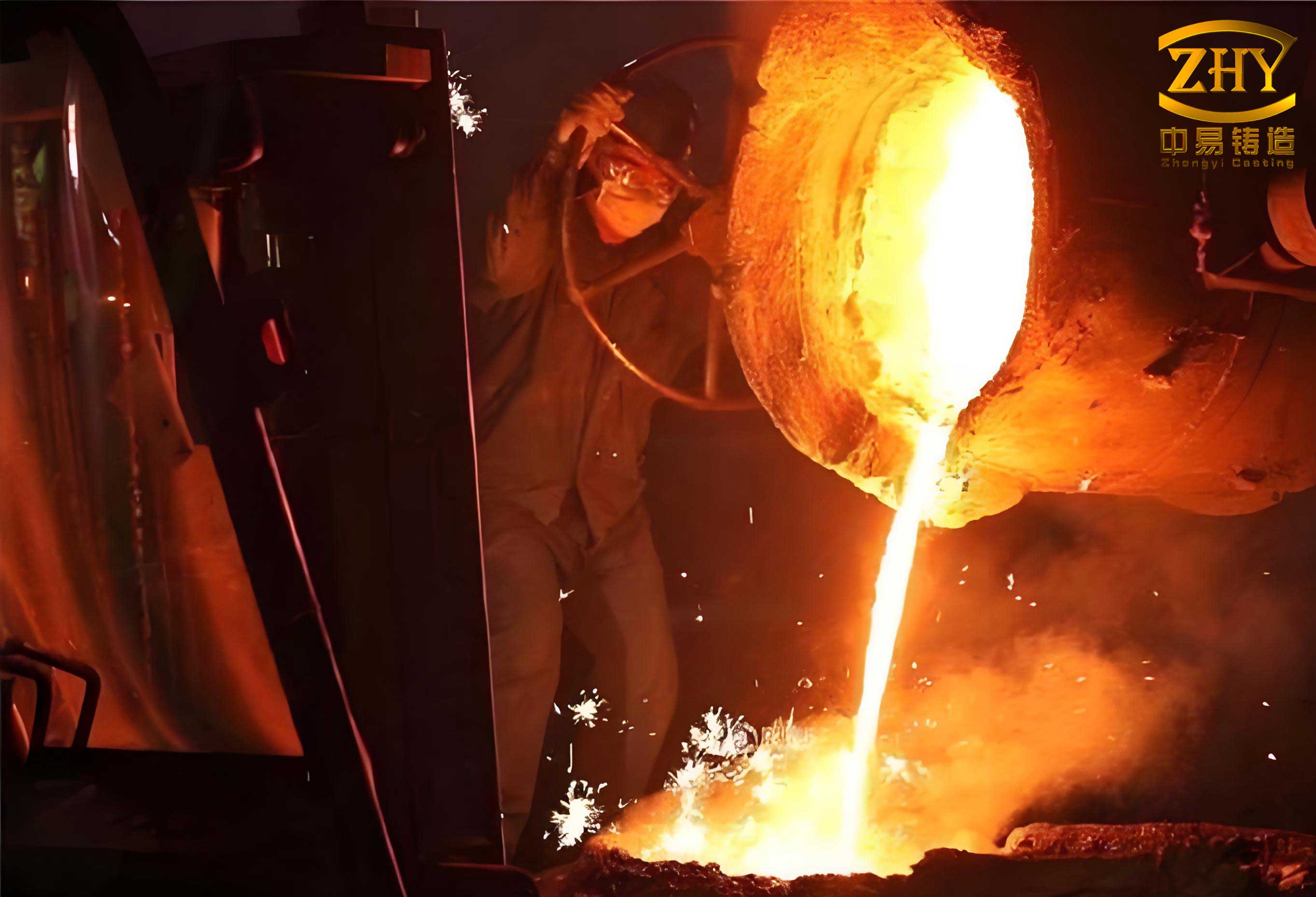
The image above illustrates a typical sand casting setup, highlighting the mold assembly and pouring process. In my experiment, after mold preparation, I poured molten ZL301 aluminum alloy at approximately 755°C, as recommended for sand casting this material. The alloy’s properties, such as fluidity and shrinkage, are critical in sand casting to avoid issues like cold shuts or porosity. The fluidity length \( F \) can be modeled using: $$ F = k \cdot \sqrt{T – T_s} $$ where \( k \) is a material constant, \( T \) is the pouring temperature, and \( T_s \) is the solidus temperature. For ZL301, \( F \) is around 325 mm at 700°C, ensuring adequate filling in sand casting for thin sections. After cooling, the mold was broken away, and the casting was cleaned, resulting in a precise impeller that met dimensional tolerances and surface requirements for sand casting.
To evaluate the effectiveness of 3D printed patterns in sand casting, I compared them with traditional wooden patterns across multiple metrics. Table 2 provides a detailed analysis, focusing on aspects like material utilization, production time, and cost—all vital for optimizing sand casting operations. This comparison underscores how 3D printing enhances sand casting by addressing common bottlenecks.
| Aspect | 3D Printed Pattern | Traditional Wooden Pattern |
|---|---|---|
| Material Utilization Rate | 98% (minimal waste from supports) | 46% (high waste from machining) |
| Production Time | 5 hours (1h modeling + 4h printing) | 32 hours (including programming and machining) |
| Cost Breakdown | PLA material: $3.6; Printing service: $50; Total: $53.6 | Wood: $100; Fixtures: $500; Machining: $1000; Total: $1600 |
| Pattern Durability | High (resistant to moisture and wear) | Low (prone to cracking and deformation) |
| Complexity Handling | Excellent (can produce intricate geometries) | Limited (requires multiple setups and tools) |
The data clearly shows that 3D printed patterns offer substantial benefits for sand casting, particularly in reducing lead times and costs. The production time for sand casting patterns was cut by over 80%, while costs dropped by more than 30 times. This economic advantage makes sand casting more accessible for prototyping or small batches, where traditional patterns are often prohibitive. Moreover, the durability of PLA patterns ensures they can be reused multiple times in sand casting without degradation, unlike wooden patterns that may warp in humid conditions. From a technical perspective, the surface finish of 3D printed patterns contributes to better mold quality in sand casting, reducing the need for post-processing on cast parts.
Beyond the impeller case, I explored broader applications of 3D printing in sand casting. For instance, direct sand printing technologies, such as binder jetting, enable the creation of molds without physical patterns, further accelerating the sand casting workflow. The bond strength in such processes can be described by: $$ \sigma_b = \frac{F}{A} $$ where \( \sigma_b \) is the bonding strength, \( F \) is the force required to break the bond, and \( A \) is the cross-sectional area. In sand casting, this strength determines mold integrity during pouring. Additionally, metal powders used in SLS for direct mold printing, though costly, offer high strength for sand casting applications involving high-temperature alloys. The choice of method depends on factors like part complexity and production volume, but sand casting consistently benefits from these additive techniques.
In my analysis, I also considered the environmental impact of integrating 3D printing with sand casting. Traditional sand casting often generates significant waste from pattern making and mold cleaning, but 3D printing minimizes this through near-net-shape production. The energy consumption per part can be approximated using: $$ E = P \cdot t + E_m $$ where \( E \) is the total energy, \( P \) is the printer power, \( t \) is the print time, and \( E_m \) is the energy for material production. For sand casting, this translates to lower overall resource use, aligning with sustainable manufacturing goals. Furthermore, the ability to recycle sand in sand casting complements the waste reduction from 3D printed patterns, creating a more eco-friendly cycle.
The success of this project highlights several key trends in sand casting. First, digitalization allows for rapid iteration; design changes can be implemented quickly in the pattern, reducing downtime in sand casting. Second, the customization potential is vast—3D printing enables unique geometries that are impractical with wooden patterns, expanding the scope of sand casting for artistic or specialized components. Finally, cost-effectiveness improves, especially for low-volume runs, making sand casting competitive with other processes like investment casting or die casting. As 3D printing technology advances, with faster speeds and new materials, its synergy with sand casting will likely deepen, driving innovation in foundries worldwide.
Looking ahead, I envision a future where sand casting is fully integrated with additive manufacturing, from patternless mold printing to hybrid processes. Research directions might include developing composite filaments for patterns that enhance sand casting performance or optimizing print parameters for different sand casting alloys. The formula for thermal expansion mismatch, for example, could guide material selection: $$ \Delta L = L \cdot \alpha \cdot \Delta T $$ where \( \Delta L \) is the length change, \( L \) is the initial length, \( \alpha \) is the coefficient of thermal expansion, and \( \Delta T \) is the temperature change. This is crucial in sand casting to prevent cracking during solidification. By continuing to explore these intersections, sand casting can evolve into a more agile and precise method, meeting the demands of industries like aerospace and automotive.
In conclusion, my study demonstrates that 3D printed patterns are a viable and superior alternative to wooden patterns in sand casting, offering significant advantages in efficiency, cost, and quality. The blower impeller case serves as a practical example of how additive manufacturing can transform traditional sand casting, enabling the production of complex parts with reduced lead times and material waste. As I reflect on this work, it is clear that sand casting remains a cornerstone of metal fabrication, and its integration with 3D printing paves the way for a more innovative and sustainable future. By embracing these technologies, manufacturers can enhance their sand casting capabilities, catering to diverse needs while maintaining economic and environmental balance.