
In my extensive experience with foundry processes, the production of hollow spherical components from non-ferrous metals, such as aluminum and brass alloys, presents unique challenges that demand meticulous attention to detail in sand casting methodologies. These components, including spherical sprinkler heads, high-pressure equalizing rings, and large decorative metal balls, are typically characterized by high-quality requirements—after machining or polishing, their surfaces must be free from defects like gas pores, shrinkage cavities, and inclusions—and are often produced in small batches or as single pieces. While specialized casting techniques might offer precision, they are cost-prohibitive for such low-volume applications, whereas conventional sand casting can struggle to ensure quality. Through years of practice, I have developed and refined a sand casting approach that effectively addresses these issues, particularly for hollow spheres with diameters around 400 mm. This article delves into the entire process, from defect analysis to production execution, emphasizing the critical role of sand casting in achieving successful outcomes.
The foundation of any reliable sand casting process lies in understanding and mitigating potential defects. For hollow spheres, common issues include shrinkage depressions in thick sections where feeders cannot provide adequate compensation, gas porosity due to inadequate degassing or excessive mold moisture, micro-shrinkage or porosity inherent to the alloy’s solidification behavior, and inclusions from entrapped oxides or secondary oxidation. Specifically, in thin-walled sections (≤10 mm), inclusions may not fully float to the surface before the metal solidifies, becoming trapped within the casting and revealed after machining. To quantify the risk of gas porosity, I often consider a relationship involving mold moisture and metal temperature: $$ P_g = k \cdot e^{-\frac{E_a}{RT}} \cdot \frac{H_m}{H_c} $$ where \( P_g \) is the probability of gas pore formation, \( k \) is a constant, \( E_a \) is the activation energy for gas evolution, \( R \) is the gas constant, \( T \) is the molten metal temperature, \( H_m \) is the mold moisture content, and \( H_c \) is a critical moisture threshold. This highlights the importance of controlling sand moisture in sand casting. A summary of common defects and their causes in sand casting hollow spheres is provided in Table 1.
| Defect Type | Primary Causes | Impact on Casting | Mitigation in Sand Casting |
|---|---|---|---|
| Shrinkage Depression | Inadequate feeding in thick sections, improper solidification sequence. | Localized surface concavity, potential weakness. | Modify design to uniform wall thickness, use of chills or feeders. |
| Gas Porosity | High mold moisture, insufficient degassing of melt, low permeability of sand. | Subsurface or surface pores, reduced mechanical integrity. | Control sand moisture, implement effective degassing, optimize sand grain distribution. |
| Micro-shrinkage/ Porosity | Alloy solidification characteristics, poor feeding. | Dispersed tiny voids, affecting machinability and polishability. | Select alloys with narrow freezing ranges, enhance directional solidification. |
| Inclusions (Oxides, Slag) | Turbulent pouring, oxidation during melting and transfer. | Embedded foreign particles, surface defects after machining. | Use of slag traps, calm gating systems, proper melt treatment. |
Addressing these defects begins with material and structural adjustments. I have found that selecting an aluminum-silicon eutectic-type alloy, such as ZL108, is advantageous for sand casting hollow spheres. This alloy promotes directional solidification, reducing the tendency for micro-shrinkage, and offers good machinability and polishability. Structurally, modifying internal features like thick bosses to align with the shell wall thickness (e.g., converting them to annular rings with central bolt hole bosses not exceeding φ30 mm) eliminates hotspots that cause shrinkage. This optimization is crucial in sand casting to ensure uniform cooling. The benefits of alloy selection can be expressed through the solidification time parameter: $$ t_s = \frac{V}{A} \cdot \frac{\rho L}{h(T_m – T_0)} $$ where \( t_s \) is the solidification time, \( V \) is the volume, \( A \) is the surface area, \( \rho \) is density, \( L \) is latent heat, \( h \) is the heat transfer coefficient, \( T_m \) is the melting point, and \( T_0 \) is the mold temperature. Eutectic alloys often have favorable \( V/A \) ratios for thin-walled sand castings.
The core of the process is the casting process design. For a hollow sphere, key sand casting parameters include parting at the maximum diameter, using a suspended core, a shrinkage allowance of 1.5%, and machining allowances of 3 mm on sides and bottom, with 7 mm on upper planar surfaces to allow for defect removal. Additionally, I incorporate a technological pad on the upper hemisphere, with a maximum thickness of at least 20 mm, to act as a reservoir for inclusions and oxides. Three evenly spaced φ40 mm feeders (risers) are placed on top to promote directional solidification and facilitate inclusion flotation. The gating system features a φ35 mm sprue, 60 mm × 8 mm ingates, and a slag trap in the runner. The gating ratio can be optimized using: $$ A_s : A_r : A_i = 1 : 1.2 : 1.5 $$ where \( A_s \), \( A_r \), and \( A_i \) are the cross-sectional areas of the sprue, runner, and ingates, respectively, ensuring smooth metal flow in sand casting. A comprehensive table of process design parameters is shown in Table 2.
| Parameter Category | Specific Value/Description | Rationale in Sand Casting |
|---|---|---|
| Parting Line | At maximum diameter (equatorial plane). | Simplifies mold assembly and core placement. |
| Shrinkage Allowance | 1.5% | Accommodates thermal contraction of aluminum alloy. |
| Machining Allowance | 3 mm (sides/bottom), 7 mm (top surfaces). | Extra on top for defect removal; ensures clean finish. |
| Technological Pad | Min. 20 mm thick on upper hemisphere. | Collects inclusions, improves feeding. |
| Feeders (Risers) | Three φ40 mm, evenly spaced on top. | Enhances directional solidification, reduces porosity. |
| Gating System | φ35 mm sprue, 60×8 mm ingate, slag trap. | Controls fill rate, minimizes turbulence and slag entry. |
| Core Design | Suspended, with venting and reinforcement. | Ensures internal cavity integrity and proper positioning. |
Moving to the production phase, the sand casting process involves meticulous mold and core making, melting, and pouring. Cores are produced using CO2-hardened sodium silicate sand, coated with a quick-drying refractory coating to improve surface finish. To enhance venting, I incorporate carbonaceous materials like coke within the core, and secure it with threaded steel rods for suspension. Mold sand must have controlled moisture content to prevent gas evolution; I typically aim for moisture levels below 4-5% for green sand or use dry sand methods. Pattern molding is employed for accuracy. Mold halves are aligned with pins to prevent core misalignment—a critical step in sand casting to ensure dimensional consistency.
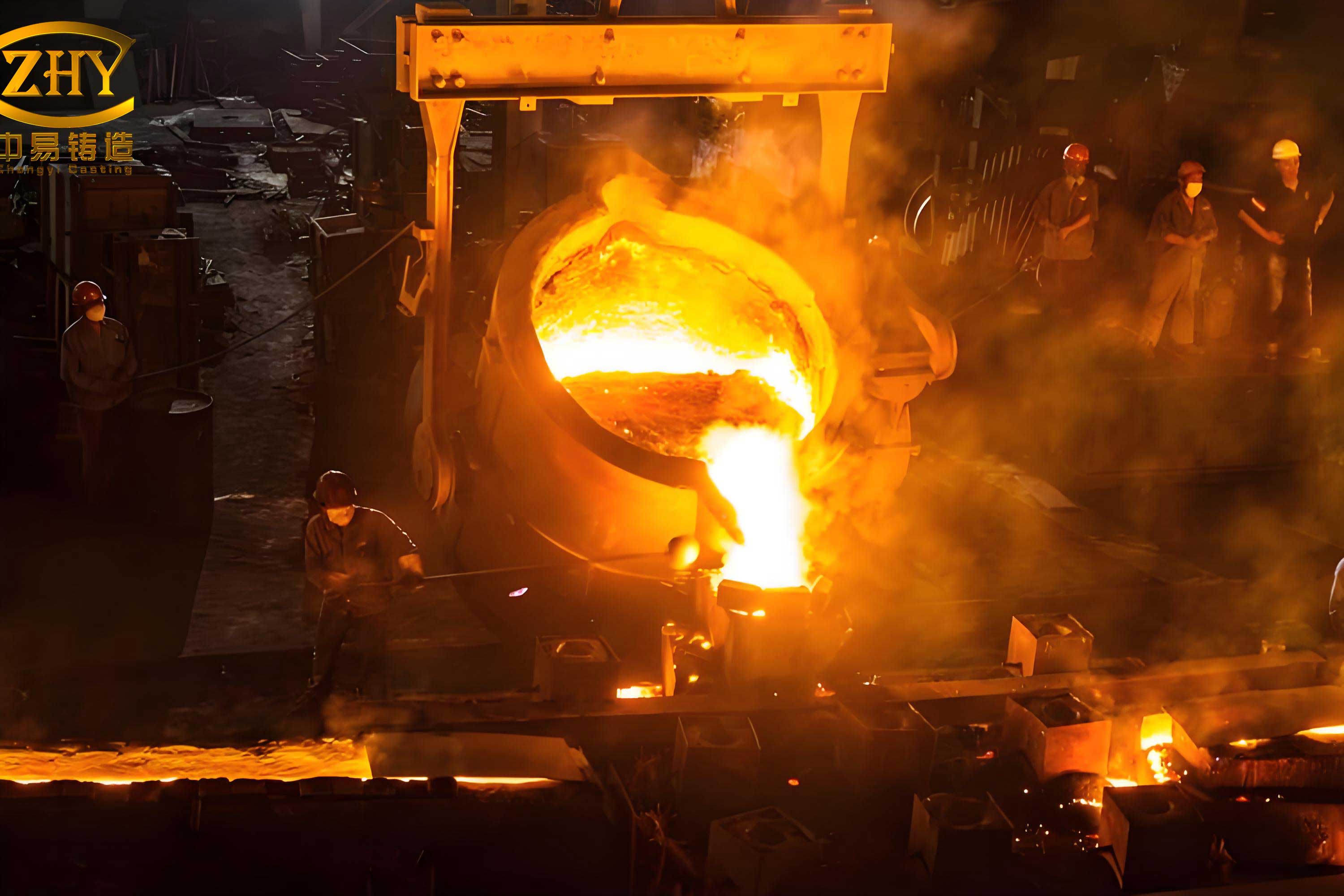
Melting and melt treatment are paramount. For aluminum alloys, I conduct rigorous degassing using hexachloroethane (C2Cl6) or modern alternatives, followed by modification (e.g., with sodium or strontium) to refine the eutectic structure. The degassing efficiency can be modeled as: $$ C_t = C_0 \cdot e^{-kt} $$ where \( C_t \) is the gas concentration at time \( t \), \( C_0 \) is the initial concentration, and \( k \) is the degassing rate constant, dependent on the purging agent and stirring intensity. After treatment, the melt is allowed to settle for sufficient time to let inclusions float out. Pouring temperature is maintained at 700–720°C for aluminum; a slightly higher temperature aids inclusion flotation but must be balanced against increased oxidation and shrinkage. The heat transfer during solidification in sand casting can be described by Fourier’s law: $$ q = -k \frac{dT}{dx} $$ where \( q \) is the heat flux, \( k \) is the thermal conductivity of the sand, and \( \frac{dT}{dx} \) is the temperature gradient, which is optimized through mold design. Key production parameters are summarized in Table 3.
| Process Step | Parameters/Controls | Impact on Sand Casting Quality |
|---|---|---|
| Core Making | CO2-sodium silicate sand, coke vents, coating, reinforcement rods. | Ensures core stability, venting, and smooth cavity surface. |
| Mold Making | Controlled sand moisture (<5%), pattern molding, precise alignment. | Prevents gas porosity, ensures dimensional accuracy. |
| Melting & Degassing | Degassing with C2Cl6, modification, settling time ≥15 min. | Reduces gas content and inclusions, improves metallurgical quality. |
| Pouring | Temperature 700–720°C, calm transfer, slag skimming. | Minimizes turbulence-related defects, promotes inclusion flotation. |
| Solidification | Directional via feeders, mold insulation/chilling as needed. | Reduces shrinkage defects, enhances mechanical properties. |
Through this integrated sand casting approach, I have successfully produced qualified aluminum alloy hollow spheres, such as the φ400 mm example, and extended the methodology to other non-ferrous metals like brass. For instance, a φ200 mm brass sprinkler ball was cast successfully in one attempt, demonstrating the versatility of the sand casting process when properly engineered. The success hinges on a holistic view: from alloy selection and design modification to precise process control. The economic viability of sand casting for low-volume, high-quality components is thus achievable without resorting to expensive specialized methods.
In conclusion, sand casting remains a powerful and adaptable technique for manufacturing non-ferrous metal hollow spheres, provided that defects are systematically addressed through material science, process design, and production rigor. The use of technological pads, optimized feeders, controlled gating, and stringent melt treatment are all essential elements in the sand casting recipe. Future advancements may involve simulation software to predict solidification patterns, but the fundamental principles outlined here—rooted in hands-on experience—will continue to underpin successful sand casting operations. By embracing these strategies, foundries can consistently produce defect-free spherical castings that meet stringent aesthetic and functional demands, reaffirming the enduring relevance of sand casting in modern manufacturing.