
In the development of high-power diesel engines, the production of large and complex aluminum alloy castings, such as scavenge pump bodies and impellers, presents significant challenges. These components are critical for engine performance, requiring high integrity, pressure tightness, and balanced operation. Traditional sand casting methods often struggle with defects like porosity, inclusions, shrinkage, and cracks, especially for bulky parts. This article, based on my firsthand experience in tackling these issues, details the innovative sand casting process enhanced by pressure crystallization. Over several years of trial and improvement, we developed a comprehensive approach that integrates advanced melting, gating system design, and pressurized solidification to achieve superior quality in large aluminum alloy sand castings.
The core of our work revolves around sand casting, a versatile and economical method for producing large components. However, aluminum alloys’ susceptibility to gas absorption, oxidation, and shrinkage demands meticulous control. We focused on optimizing every stage—from melting and mold preparation to pouring and solidification—while introducing pressure crystallization to mitigate defects. The following sections elaborate on the工艺, equipment design, and problem-solving strategies, supported by data, tables, and formulas. Throughout, sand casting remains the foundational process, repeatedly emphasized for its adaptability and cost-effectiveness in manufacturing large-scale parts.
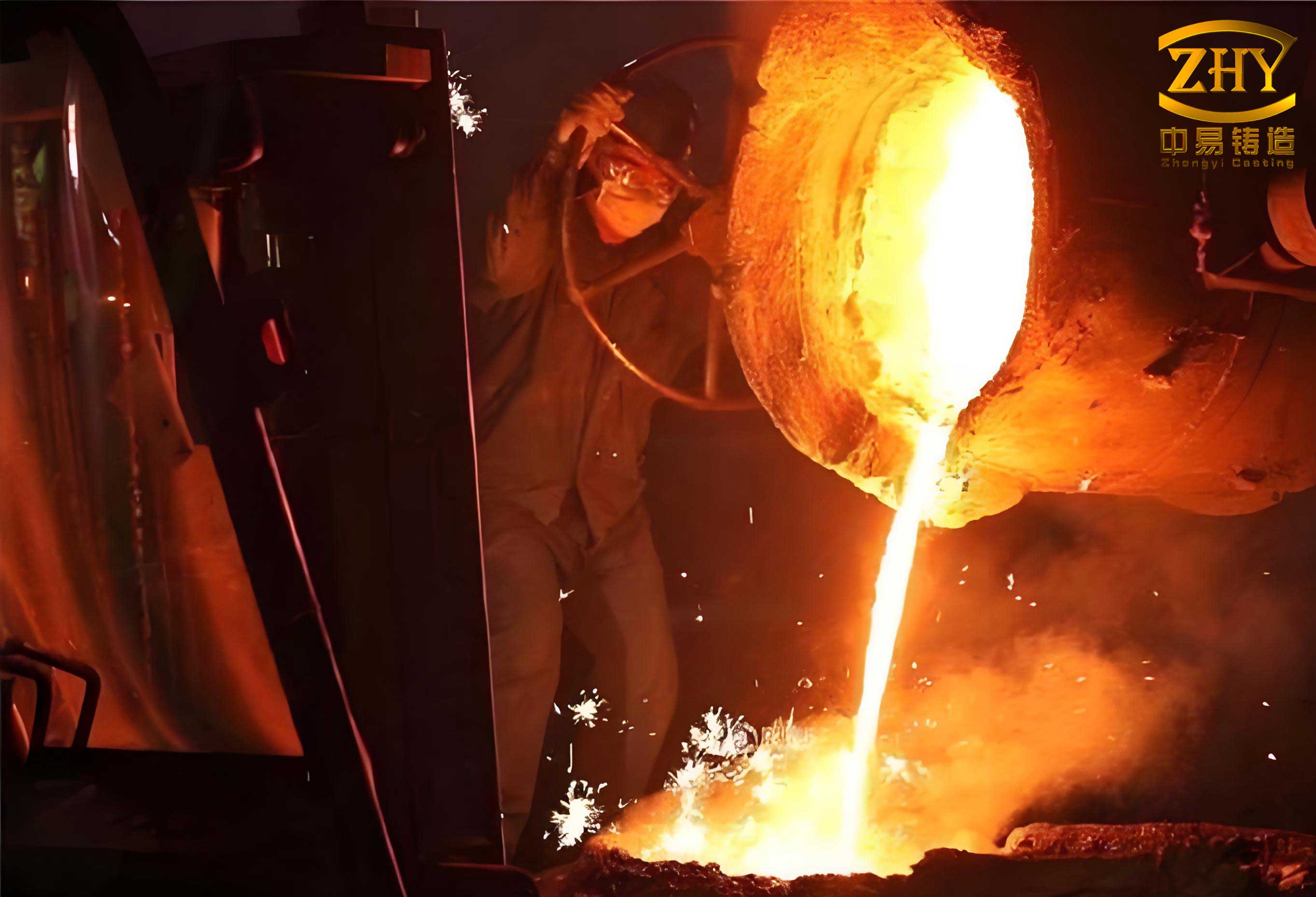
Our journey began with addressing the melting process, a crucial step in sand casting aluminum alloys. Initially, we used simple crucible furnaces with coke heating, which led to uncontrolled temperatures, prolonged melting times, and severe oxidation. These issues resulted in excessive gas pickup and slag formation, compromising casting quality. To overcome this, we designed a semi-gas radiant flame furnace, capable of melting 500 kg of aluminum alloy in a single charge. This furnace minimizes direct flame contact with the metal, ensuring more uniform heating and reducing gas absorption. The key dimensions for optimal performance include a crucible-to-wall distance of 150–200 mm and a bottom clearance of 50–100 mm, with tangential flame entry to promote efficient heat transfer. Melting temperature is controlled at 720–740°C, balancing fluidity and minimal oxidation.
Refinement of the molten metal is essential in sand casting to eliminate dissolved gases and inclusions. We experimented with three methods: using hexachloroethane (C2Cl6) alone, combining C2Cl6 with nitrogen bubbling, and employing sodium fluoaluminate (Na3AlF6). The table below summarizes their effects on mechanical properties, based on our trials:
| Refinement Method | Processing Temperature (°C) | Tensile Strength (kg/cm²) | Elongation (%) | Hardness (HB) |
|---|---|---|---|---|
| C2Cl6 Alone | 700–720 | 18–20 | 2–3 | 60–65 |
| C2Cl6 + N2 Bubbling | 720–740 | 20–22 | 3–4 | 65–70 |
| Na3AlF6 (Pressed) | 730–750 | 22–24 | 4–5 | 70–75 |
The combined C2Cl6 and nitrogen method proved most effective, with nitrogen introduced at 0.5–1.0 kg/cm² for 5–10 minutes after degassing. This approach significantly reduces porosity and improves mechanical properties, crucial for high-integrity sand castings. The gas solubility in aluminum alloys under pressure follows Sieverts’ law, expressed as:
$$S = k \sqrt{P}$$
where \(S\) is the gas solubility (e.g., hydrogen), \(k\) is a temperature-dependent constant, and \(P\) is the pressure. This principle underpins our pressure crystallization technique, where increased pressure during solidification suppresses gas pore formation.
Next, the sand casting mold design and gating system are pivotal. We employ ordinary clay-bonded sand molds, dried twice to ensure strength and low moisture. Initially, we used bottom-pouring “shower” gates and stepped gates, but these led to turbulence, oxide entrapment, and shrinkage defects. After extensive trials, we adopted a bottom-gating system with a slit-type filter gate, which promotes laminar flow and effective slag removal. The gating ratio is optimized as:
Pouring cup area : Filter effective area : Runner area : Inlet gate area = 1 : 0.8 : 1.2 : 1.5
This open system minimizes velocity and oxidation. The pouring speed is calculated using the formula:
$$v = \frac{G}{\rho \cdot A \cdot t}$$
where \(v\) is the flow velocity, \(G\) is the weight of metal poured, \(\rho\) is the density, \(A\) is the minimum cross-sectional area of the gating system, and \(t\) is the pouring time. For a pump body weighing 180 kg (including risers), with \(A = 20 \, \text{cm}^2\) and average pressure head \(H = 40 \, \text{cm}\), the pouring time is approximately 30 seconds, ensuring smooth filling in sand casting molds. The slit gate shape was modified from tapered-in to tapered-out, reducing turbulence and gas entrainment, as illustrated in flow simulations.
A critical innovation in our sand casting process is pressure crystallization, where castings solidify under elevated pressure to enhance density and reduce porosity. We designed a pressure vessel specifically for large sand castings, featuring a unique “misaligned-tooth” lid structure that minimizes internal volume for rapid pressurization. The vessel has an internal diameter of 1500 mm and length of 2000 mm, accommodating sand molds up to 1200 × 1000 × 800 mm. The lid design ensures quick sealing with a rotational movement of about 30°, and a specialized rubber gasket with a sharp-edge profile provides pressure-activated sealing at up to 8 kg/cm². The stress analysis of the lid teeth, simplified as cantilever beams, confirms safety under pressure:
Bending stress: \(\sigma_b = \frac{M}{W}\), where \(M = F \cdot l\) and \(W = \frac{b \cdot h^2}{6}\).
Shear stress: \(\tau = \frac{F}{A_s}\).
For a lid pressure of 8 kg/cm², the total force is 14,000 kg, distributed across 24 teeth. Calculations yield \(\sigma_b \approx 5.2 \, \text{kg/mm}^2\) and \(\tau \approx 1.8 \, \text{kg/mm}^2\), well below the allowable stresses for cast steel (10 kg/mm² for tension, 8 kg/mm² for shear). This robust design enables efficient pressure application within 10 seconds after pouring, a key requirement for effective sand casting under pressure.
The pressure crystallization setup includes a storage tank to supply compressed air. To balance economy and performance, we use a 0.5 m³ tank pre-pressurized to 12 kg/cm², connected to the main vessel via 50 mm diameter pipes. The required airflow rate is derived from gas dynamics:
$$Q = \frac{V_{\text{eff}} \cdot (P_{\text{target}} – P_{\text{initial}})}{t_{\text{fill}}}$$
where \(V_{\text{eff}}\) is the effective volume of the pressure vessel minus mold volume (about 0.8 m³), \(P_{\text{target}} = 8 \, \text{kg/cm}^2\), \(P_{\text{initial}} = 1 \, \text{atm}\), and \(t_{\text{fill}} = 10 \, \text{s}\). This demands a flow area \(A_{\text{pipe}} \approx 0.002 \, \text{m}^2\), met by our pipe design. Integrating this with existing plant air systems reduces operational complexity, making pressure-enhanced sand casting feasible for regular production.
In implementing pressure crystallization, we refined the sand casting工艺 parameters. Pouring temperature is elevated to 700–720°C, about 20°C higher than conventional sand casting, to compensate for rapid cooling in the pressure vessel. After pouring, the vessel is sealed within 2 minutes, and pressure is ramped to 8 kg/cm² within 10 seconds, maintained for 15–20 minutes until solidification. Riser design is modified: riser height increased from 150 mm to 200 mm, and insulating sleeves made of coal powder, sawdust, and clay are applied to delay solidification, improving feeding. The table below compares key parameters before and after pressure crystallization:
| Parameter | Conventional Sand Casting | Pressure Crystallization Sand Casting |
|---|---|---|
| Pouring Temperature (°C) | 680–700 | 700–720 |
| Pressure During Solidification (kg/cm²) | Atmospheric (1) | 8 |
| Riser Volume (as % of Casting) | 15% | 20% |
| Solidification Time (minutes) | 10–15 | 15–20 |
| Typical Porosity Level | Grade 3–4 | Grade 1–2 |
Defect analysis revealed that shrinkage and cracks were initially prevalent in pressure-crystallized sand castings. Shrinkage occurred due to insufficient feeding, addressed by enlarging risers and using insulation. Cracks at riser roots stemmed from sharp corners and delayed pressurization; we added fillets and ensured pressure application within 2 minutes post-pour. The relationship between pressure and porosity grade is empirically established through tests on small sand cast specimens:
$$P_{\text{grade}} = a \cdot e^{-b \cdot P} + c$$
where \(P_{\text{grade}}\) is the porosity grade (lower is better), \(P\) is the applied pressure, and \(a\), \(b\), \(c\) are constants. At 8 kg/cm², porosity consistently reaches Grade 1, as shown in metallographic comparisons where gas pores are virtually absent.
The quality improvements from pressure crystallization in sand casting are stark. For scavenge pump bodies, water pressure test leakage rates dropped from 30% to under 5%. Mechanical properties enhanced: tensile strength increased by 10–15%, and hardness by 5–10 HB. Impeller balance improved, with unbalance reduced below 5 g·cm. The table summarizes quality metrics for sand cast components before and after implementation:
| Component | Casting Method | Porosity (pores/cm²) | Pore Diameter (mm) | Water Test Pass Rate |
|---|---|---|---|---|
| Pump Body | Conventional Sand Casting | 8–12 | 0.5–1.0 | 70% |
| Pump Body | Pressure Crystallization Sand Casting | 1–3 | 0.1–0.3 | 95% |
| Impeller | Conventional Sand Casting | 6–10 | 0.3–0.8 | 75% |
| Impeller | Pressure Crystallization Sand Casting | 0–2 | 0.1–0.2 | 98% |
Another aspect is the integration of copper shafts into aluminum impellers via sand casting. We achieved reliable bonding by preheating shafts to 150°C, sandblasting for cleanliness, and adjusting pouring temperature to 710–730°C. A surrounding blind riser ensures directional solidification toward the shaft, preventing detachment. This hybrid sand casting approach meets the stringent requirements for dynamic balance and overspeed testing.
Throughout this work, sand casting has been the backbone, proving its versatility when augmented with advanced techniques. The pressure crystallization method, in particular, transforms traditional sand casting into a high-performance process for large aluminum alloys. Economic considerations favor sand casting due to low tooling costs and adaptability to complex geometries, and with pressure enhancement, it rivals more expensive methods like investment or die casting for critical parts.
Looking forward, further optimizations in sand casting are possible. For instance, automated pressure control systems could fine-tune solidification profiles, and advanced binders in sand molds might reduce drying times. Computational fluid dynamics (CFD) simulations can refine gating designs to minimize turbulence. The formula for feeding distance in sand castings under pressure could be explored:
$$L_f = k \cdot \sqrt{T_m – T_s} \cdot \frac{P}{\rho g}$$
where \(L_f\) is the feeding distance, \(k\) is a material constant, \(T_m\) and \(T_s\) are melting and solidus temperatures, \(P\) is pressure, \(\rho\) is density, and \(g\) is gravity. Such models would enhance predictive capabilities in sand casting.
In conclusion, our experience demonstrates that large aluminum alloy components can be successfully produced via sand casting with integrated pressure crystallization. This approach resolves common defects like porosity and shrinkage, yielding high-integrity castings suitable for demanding applications. The misaligned-tooth pressure vessel design offers operational efficiency, while process refinements ensure reliability. Sand casting, when empowered by pressure, becomes a robust and economical solution, underscoring its enduring relevance in manufacturing. Continued innovation in sand casting will further push the boundaries of quality and size for aluminum alloy parts.