
The relentless pace of global economic development has precipitated a sharp decline in traditional energy reserves, making the quest for sustainable and renewable energy sources an urgent global imperative. Within this critical context, wind power has emerged as a prominent and widely adopted clean energy solution. Wind power generation offers a dual advantage: it effectively mitigates energy crises while simultaneously delivering significant economic benefits. Consequently, the wind power industry is experiencing vigorous growth and heightened focus. The core components of a wind turbine include the rotor, gearbox, base, and bearing housing. The rotor itself comprises blades and a hub. The hub is a critical component, tasked with bearing the complex forces and multi-axial moments generated during blade rotation. This results in an exceptionally intricate and demanding stress state, underscoring the hub’s pivotal role in the entire wind power system. Due to its complex geometry, significant wall thickness variations, and stringent quality requirements—mandating freedom from defects such as shrinkage porosity, cracks, gas holes, and slag inclusions as verified by UT and MT inspections—the manufacturing of large hubs presents considerable challenges. Furthermore, domestic research on riserless casting technology remains limited. Therefore, investigating the riserless sand casting process for hubs holds substantial practical application value.
The conventional materials for hubs are typically QT400-18 and QT350-22 ductile iron. However, QT500-14 grade ductile iron offers superior advantages, including more uniform tensile strength and hardness, as well as better machinability. Achieving the QT500-14 grade, however, often necessitates the addition of substantial alloying elements and the execution of stringent nodulizing and inoculation practices, which are less commonly applied domestically and increase production costs. This study first established a production process based on solid solution strengthening via a high-silicon, low-carbon composition, through comparative trials with high-carbon low-silicon and low-carbon high-silicon melts. Subsequently, it focuses on the design of a riserless sand casting process for a 3.5 MW large wind power hub made of QT500-14. The design was analyzed and optimized using MAGMASOFT simulation software to study the temperature field distribution during solidification and predict casting defects. The optimized process was successfully implemented in production, yielding a hub that meets all technical specifications. The findings of this research provide valuable insights for the manufacturing of large-scale wind power hubs.
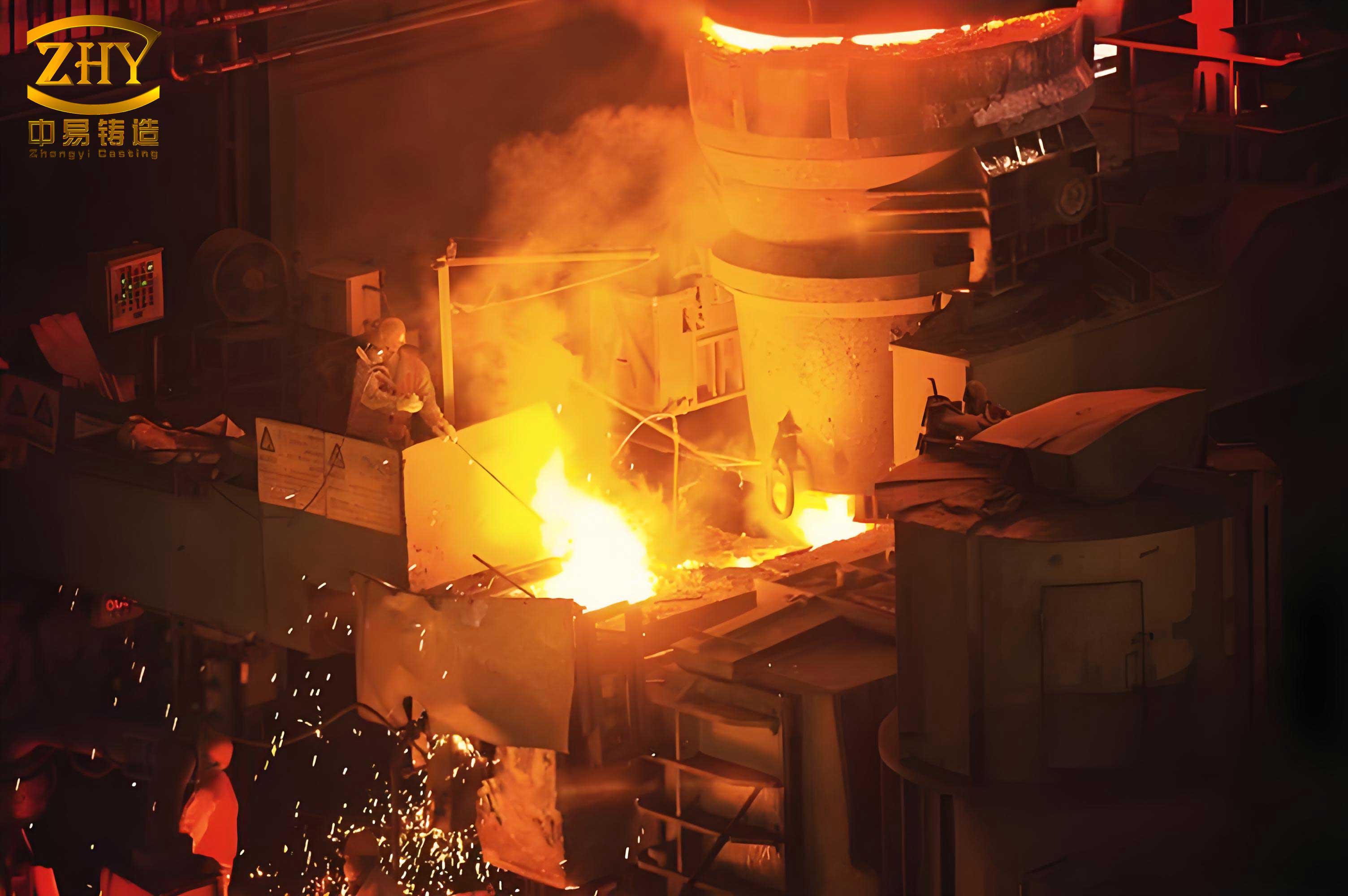
The hub under investigation features a roughly spherical shell contour with complex structures around the blade mounting holes and the main shaft bore. Its overall envelope dimensions are approximately 3500 mm × 3000 mm × 3200 mm, with a nominal wall thickness ranging from 60 mm to 80 mm. However, the maximum wall thickness reaches 350 mm at certain locations. The finished casting net weight is about 18,000 kg. The material specification, QT500-14, requires a minimum tensile strength of 500 MPa and a minimum elongation of 14%. Prior to casting process design, a foundational study on the material was conducted. Melts with two different compositions—high-carbon low-silicon and low-carbon high-silicon—were prepared in medium-frequency induction furnaces. After optimized nodulizing and inoculation treatments, samples were poured and analyzed. To ensure high nodularity and ideal graphite morphology, high-quality pig iron and scrap steel were used. The final material chosen for the hub was the optimized low-carbon high-silicon ductile iron.
The design of any casting process must reconcile theoretical principles with practical production constraints. The primary goal is to ensure the feasibility of the process scheme while minimizing the complexity of mold-making operations. For this large hub, the process design encompassed the gating and risering system, molding method, and the application of chills and padding. A core principle was to align the design with the solidification characteristics of the material to prevent defects in the casting body.
Ductile iron exhibits a mushy or pasty mode of solidification. A wide mushy zone, where liquid and solid coexist, exists across the casting section, leading to narrow feeding channels. Crucially, graphite begins to precipitate early during solidification. The precipitation of graphite, which has a lower specific volume than austenite, leads to a volumetric expansion known as graphite expansion. This inherent expansion can be harnessed to compensate for the liquid and solidification shrinkage of the iron, provided the mold is sufficiently rigid to contain the pressure. The fundamental principle for riserless sand casting can be expressed by considering volume changes:
$$ V_{shrinkage} = \beta \cdot V_{casting} $$
where $\beta$ is the total volumetric shrinkage coefficient (encompassing liquid and solidification shrinkage).
$$ V_{expansion} = \alpha \cdot V_{casting} $$
where $\alpha$ is the volumetric expansion coefficient due to graphite precipitation.
For successful riserless casting, the mold must be rigid enough to force the expansion to compensate for shrinkage:
$$ V_{expansion} \ge V_{shrinkage} \quad \text{and} \quad P_{mold} > P_{metal} $$
where $P_{mold}$ is the mold wall pressure capacity and $P_{metal}$ is the internal pressure from the expanding metal. Control of the carbon equivalent (CE), mold rigidity, and sand strength is essential. Additionally, a low pouring temperature combined with fast filling reduces the liquid shrinkage volume. Strategic placement of external chills on thick sections promotes directional solidification towards these chills or achieves a more simultaneous solidification pattern. Therefore, this study employed a riserless sand casting approach, leveraging the graphite expansion characteristic of ductile iron within a rigid sand mold.
The design and placement of chills are critical for controlling the solidification sequence. Chills, typically made of steel or cast iron, are placed at thermal centers (hot spots) to accelerate cooling, thereby equalizing cooling rates across the casting. Analysis of the hub geometry identified the thermal centers at the periphery of the blade mounting holes and the adjacent raised pads. These areas are highly susceptible to shrinkage defects and coarse grain structure. To address this, contoured chills matching the blade hole profile were placed, and rectangular block chills of appropriate size were used on the raised pads to promote rapid solidification.
To prevent slag inclusion defects, which can occur due to incomplete slag floatation from lower-temperature iron or sand erosion, the height of the three upper raised pads on the hub was intentionally increased. This provided a reservoir for slag collection and buoyancy-driven separation from the sound metal. The thick face connecting to the main shaft was oriented downward in the mold. Following the principles of smooth, high-flow-rate, and rapid mold filling to prevent defects around critical areas, a bottom-gating system was adopted. The parting plane was selected perpendicular to the main shaft axis, passing through the common center of the inner and outer spherical surfaces. This greatly simplified pattern and core box construction and facilitated molding operations. An open gating system was designed with a cross-sectional area ratio to minimize turbulent impingement: $F_{ingate} : F_{runner} : F_{sprue} = 3 : 1.2 : 1$.
The molding was performed using a manual, two-part flask sand casting process. The mold material was furan resin-bonded sand. The molds and cores were coated with 3-4 layers of alcohol-based graphite paint. Crucial alignment marks were created during ramming to ensure precise core assembly and prevent mismatch. Ceramic tubes were used for the ingates to maintain their position and shape. The final pouring temperature was controlled between 1280°C and 1300°C, with a total metal weight of 23,000 kg. Based on this comprehensive analysis, the final 3D model of the hub casting process was established.
| Boundary Condition | Interface | Value / Material | Initial Condition |
|---|---|---|---|
| Heat Transfer Coefficient | Casting-Chill | 1500 W/m²K | Casting: 1300°C Sand Mold: 20°C Chill: 20°C |
| Heat Transfer Coefficient | Casting-Sand Mold | 700 W/m²K | |
| Material Property | Casting / Sand / Chill | GJS500 (QT500-14) / Furan Sand / Steel |
The 3D models of the casting, molds, cores, and chills were converted to STL files and imported into MAGMASOFT software for numerical simulation. The domain was discretized using a finite difference method mesh comprising approximately 15 million cells. The key material properties and boundary conditions applied in the simulation are summarized in Table 1. The simulation aimed to analyze the solidification sequence, temperature gradients, and predict the formation of shrinkage porosity and macro-shrinkage.
The analysis of the solidification temperature field is paramount. Given the significant variation in wall thickness, sections without chills would solidify much slower, creating ideal conditions for defect formation. The placement of chills creates end-cooling zones, increasing the local temperature gradient and promoting a more uniform solidification front. The simulation results for the temperature field at key solidification fractions are shown in the analysis. At the start of solidification (assuming instantaneous filling), the regions in contact with chills show an immediate temperature drop, confirming their active cooling role. As solidification progresses, heat is conducted away through the mold and chills. The final temperature field demonstrates that a nearly simultaneous solidification was achieved across the complex geometry, validating the strategic placement and sizing of the chills in this sand casting process. This approach effectively mitigated the issues arising from disparate cooling rates due to wall thickness variations.
The prediction of shrinkage cavities is based on tracking the liquid fraction and feeding paths during solidification. The simulation results indicated the absence of any macroscopic shrinkage cavity within the main body of the hub casting. Minor shrinkage was predicted only in the heightened sections of the three upper pads, which were designed as sacrificial slag collectors. This isolated shrinkage does not compromise the integrity of the functional part of the casting. Notably, the morphology of the predicted shrinkage in these pads was not the typical concave “V” or “U” shape but rather a “center-high, periphery-low” profile. This is a direct simulation artifact of the graphite expansion process, where the internal pressure from expansion causes the still-soft metal in the final liquid pool to bulge upwards against the constraint of the rigid sand mold.
For the prediction of dispersed micro-shrinkage (porosity), the Niyama criterion is a widely accepted and effective method. It considers not only the thermal gradient ($G$) and solidification time but also, indirectly, the pressure drop in the interdendritic liquid feeding. The criterion is given by:
$$ N_y = \frac{G}{\sqrt{\dot{T}}} $$
where $G$ is the temperature gradient (K/m) and $\dot{T}$ is the cooling rate (K/s). Regions where $N_y$ falls below a critical threshold are prone to shrinkage porosity. The simulation results, applying this criterion, showed no significant shrinkage porosity in the hub body. Similar to the macro-shrinkage prediction, potential porosity was confined to the sacrificial pad areas. These results provided strong numerical evidence for the合理性 of the designed riserless sand casting process.
| Defect Type | Simulation Prediction Location | Actual Casting Inspection Result | Assessment |
|---|---|---|---|
| Macro-Shrinkage | Only in sacrificial pad extensions | None in hub body; pads removed during machining | Excellent Correlation |
| Micro-Shrinkage (Porosity) | Only in sacrificial pad extensions | Ultrasonic testing (UT) passed per GB/T25390-2010 standard | Excellent Correlation |
The optimized sand casting process was executed in production. A two-ladle pouring practice was employed to achieve the desired “low-temperature, fast-pour” condition, further minimizing liquid shrinkage and aiding the self-feeding mechanism. After pouring, the casting was allowed to cool under controlled conditions within the mold. Following shakeout, the casting underwent a standard annealing heat treatment for ferritization to achieve the required ductility. After heat treatment, the casting was cleaned, fettled, and subjected to shot blasting. The resulting hub casting was inspected via 100% ultrasonic testing according to the stringent standard for wind turbine castings. The testing confirmed sound internal quality with no rejectable defects. Coupons attached to the casting were used for mechanical property testing. The results surpassed the QT500-14 specifications: nodularity >90%, graphite size grade 6, tensile strength 520 MPa, yield strength 403 MPa, elongation 18%, and hardness 193 HB.
| Property | Unit | QT500-14 Requirement | Actual Result |
|---|---|---|---|
| Tensile Strength (Rm) | MPa | ≥ 500 | 520 |
| Yield Strength (Rp0.2) | MPa | – | 403 |
| Elongation (A) | % | ≥ 14 | 18 |
| Hardness | HB | – | 193 |
| Nodularity | % | ≥ 80 (Typical specification) | >90 |
This study successfully demonstrates the application of integrated process design and numerical simulation for the production of a critical, large-scale component. The use of MAGMASOFT software provided an efficient and accurate virtual prototyping platform, significantly reducing the traditional trial-and-error costs and shortening the development cycle for this complex sand casting. By combining the principles of riserless casting (exploiting graphite expansion), low-temperature fast pouring, and strategic use of chills within a rigid sand mold system, the production of a large, geometrically complex wind power hub with demanding wall thickness variations was accomplished. The casting met all performance and non-destructive testing requirements. The developed QT500-14 material process and the optimized riserless sand casting工艺 have been validated and can be solidified for batch production. Future work could explore further optimization of chill design using simulation-driven topology optimization and investigate the effects of varying sand properties on mold rigidity for riserless sand casting applications of even larger components.