
The pursuit of enhanced surface quality in sand casting, particularly for demanding alloys, remains a central challenge in foundry engineering. Our research focused on addressing the persistent issue of burn-on and surface roughness in high manganese steel (HMS) castings produced via sand casting. HMS, renowned for its exceptional work-hardening capability and impact resistance under severe service conditions, is widely used in mining, cement machinery, and railway components. Its production volume in steel casting is second only to carbon steel. However, the conventional sand casting practice for HMS, which typically employs sodium silicate-bonded sand molds often coated with zircon- or magnesia-based paints, frequently results in defective surfaces. Zircon flour, being weakly acidic, reacts with the basic HMS melt, leading to severe burn-on, especially at hot spots or in heavy-section castings. While chemically inert magnesia flour does not react, its non-sintering nature results in a porous coating layer that fails to prevent metal oxide penetration, yielding castings with a rough, peppered surface finish. To overcome these limitations in the sand casting process, we undertook the development of a novel, cost-effective alcohol-based foundry coating utilizing forsterite olivine as the primary refractory aggregate, designed specifically for sintering and spontaneous peeling.
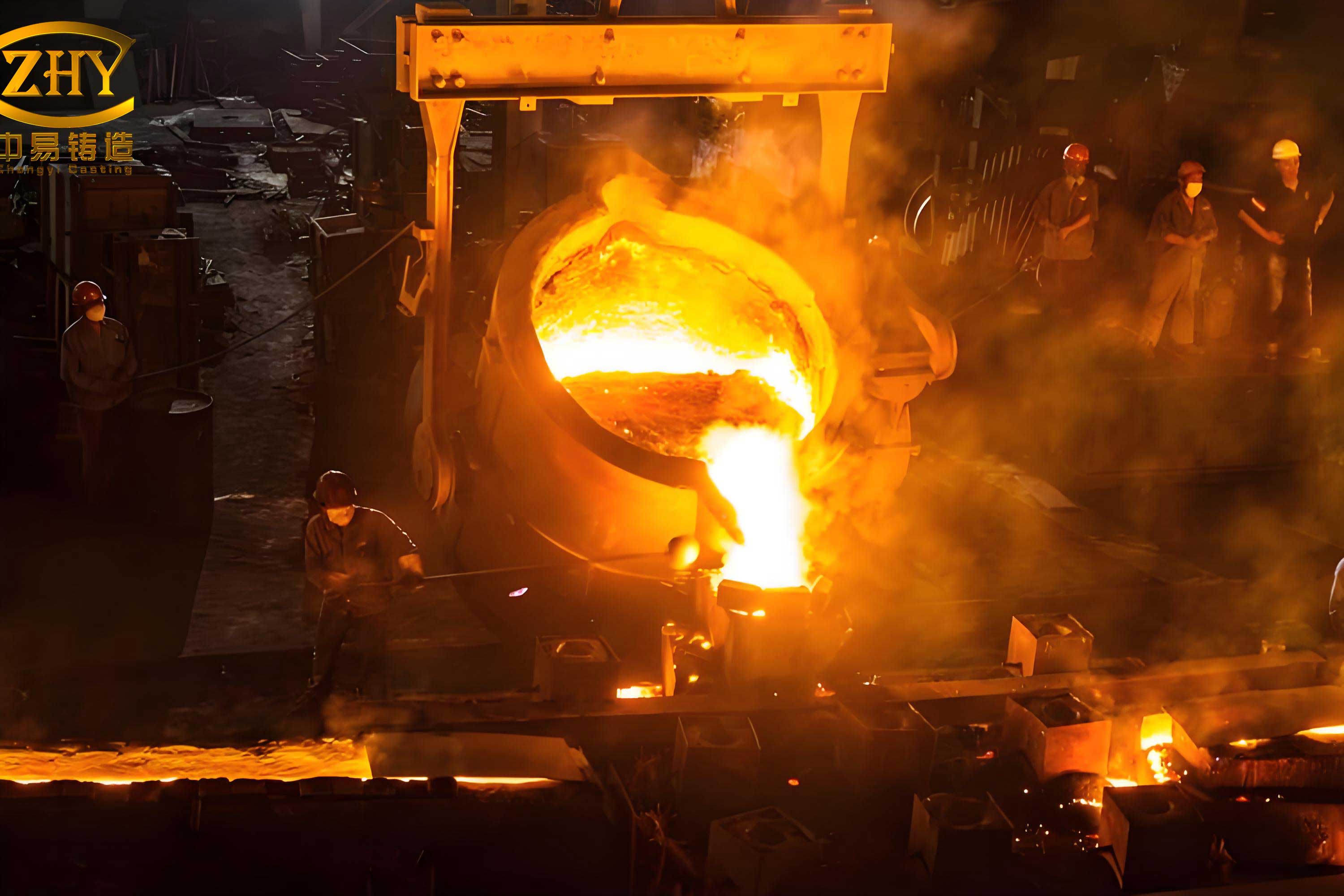
The efficacy of any coating in sand casting is fundamentally dictated by the properties of its refractory skeleton. We selected forsterite-rich olivine sand as the principal aggregate. Olivine is a solid solution mineral of forsterite (Mg₂SiO₄) and fayalite (Fe₂SiO₄). Its key advantages for sand casting include a low sintering point, absence of polymorphic transformations upon heating, slow and uniform thermal expansion, and a low coefficient of thermal expansion. The material used had a density of approximately 3.17 g/cm³, a Mohs hardness of 6-7, and a refractoriness of 1690-1710°C. Its chemical composition is detailed in Table 1, confirming its high magnesia content which provides basic character compatible with HMS melts.
| Component | SiO₂ | MgO | Fe₂O₃ | Al₂O₃ | CaO | K₂O + Na₂O | Cr₂O₃ | LOI |
|---|---|---|---|---|---|---|---|---|
| Content (wt.%) | 39-40 | 47-49 | 7-9 | 1.0-4.0 | 0.5 | 0.01-0.03 | 0.00-0.01 | 0.5-1.0 |
The binder system was carefully engineered for dual functionality: providing green strength for handling and high-temperature integrity during metal pouring in sand casting. A phenolic resin (Type 2123) served as the ambient-temperature binder, readily soluble in alcohol. Trials indicated that exceeding 1.5 wt.% addition caused severe bubbling during torch-drying, deteriorating the coating’s surface. Therefore, its content was capped at 1.5%. To enhance the coating’s resistance to wash erosion by the molten steel stream, a high-temperature inorganic binder (designated Binder A), a phosphate-based compound, was incorporated. Upon heating, it polymerizes into a network that encapsulates the refractory particles, boosting the hot strength of the sintered layer.
Suspension stability is critical for homogeneous application in sand casting. We employed a dual-suspension agent system. Polyvinyl butyral (PVB) acts as both a suspending agent and a secondary ambient binder. It dissolves in alcohol to form a viscous solution, significantly increasing the coating’s yield value and thixotropy. Its addition was limited to below 0.5% to prevent the formation of a continuous film that could trap gases during ignition, causing blistering. The primary suspending agent was lithium-modified bentonite. Derived from calcium bentonite via cation exchange with lithium salts, it exhibits excellent swelling and thickening capacity in ethanol, functioning also as a high-temperature binder. Its content was optimized to not exceed 3.5% to avoid coating cracking upon drying.
Given the low density of alcohol solvents, the suspension network from PVB and Li-bentonite alone was insufficient. A specific polymeric additive with active functional groups was introduced. This additive adsorbs onto the clay platelets, reinforcing the three-dimensional gel structure, thereby dramatically improving suspension stability and rheological control. Industrial ethanol (content >95%, density ~0.793 g/cm³) was chosen as the solvent for its favorable combustion properties and cost-effectiveness.
Through systematic orthogonal experimentation, the optimal formulation for this sand casting coating was determined, as summarized in Table 2.
| Material | Olivine Flour | Li-Bentonite | Phenolic Resin | PVB | Binder A | Additive | Ethanol |
|---|---|---|---|---|---|---|---|
| Content | 100 | 2.5 – 3.5 | 1.0 – 1.5 | 0.2 – 0.5 | 0.7 – 1.0 | Appropriate amount | Appropriate amount |
The preparation protocol is crucial for achieving a homogeneous dispersion essential for consistent performance in sand casting. The process is as follows:
- The lithium-modified bentonite is first ball-milled with a small amount of soft water for about 5 minutes to form a uniform clay paste.
- The olivine flour, along with pre-dissolved PVB in part of the ethanol, the phenolic resin solution, the polymeric additive, and Binder A are added to the mill.
- This mixture is milled for 1 to 1.5 hours to ensure complete wetting and de-agglomeration of all solid components.
- The remaining ethanol is added, and milling continues for a further 15-20 minutes to achieve final homogenization before discharge.
This procedure ensures the effective development of the suspension structure and binder distribution.
The coating’s performance was rigorously characterized. Its thixotropic behavior, vital for brush or dip application in sand casting without sagging on vertical surfaces, was evaluated using a rotational viscometer. The apparent viscosity decreased significantly under constant shear, demonstrating excellent shear-thinning. The thixotropy index, calculated from viscosity values at different resting times, was approximately 70%, indicating a strong but reversible internal structure.
A detailed rheological study using a coaxial cylinder viscometer revealed the coating to be a pseudoplastic fluid with a distinct yield point. The flow curve showed a pronounced hysteresis loop, characteristic of highly thixotropic behavior. The shear stress ($\tau$) versus shear rate ($\dot{\gamma}$) data (Table 3) was fitted to the Herschel-Bulkley model:
$$
\tau = \tau_0 + K \dot{\gamma}^n
$$
where $\tau_0$ is the yield stress, $K$ is the consistency index, and $n$ is the flow index. Regression analysis of the data yielded the following constitutive equation for this sand casting coating:
$$
\tau \approx 55 + 21\dot{\gamma}^{0.21}
$$
Here, $\tau$ and $\tau_0$ are in $10^{-1}$ Pa. The low flow index ($n << 1$) confirms high pseudoplasticity (strong shear-thinning), while the measurable yield stress ($\tau_0$) explains its non-drip behavior. This rheological profile is ideal for sand casting applications: it appears viscous at rest for suspension stability, thins readily under the shear of brushing for easy application, and recovers quickly once applied to prevent run-off.
| Shear Rate, $\dot{\gamma}$ (s⁻¹) | Shear Stress (Ascending), $\tau_{asc}$ (10⁻¹ Pa) | Shear Stress (Descending), $\tau_{desc}$ (10⁻¹ Pa) |
|---|---|---|
| 0 | 5.5* | – |
| 147.6 | 70.5 | 30.5 |
| 204.3 | 77.5 | 46.1 |
| 266.1 | 83.2 | 61.8 |
| 355.0 | 90.2 | 70.2 |
| 464.2 | 95.7 | 78.5 |
| 587.2 | 103.5 | 93.0 |
| *Yield stress ($\tau_0$) extrapolated from ascending curve. | ||
Other key properties make this coating suitable for sand casting: pH of 7.5 (neutral), density of ~1.42 g/cm³, Ford cup viscosity of 8 seconds, solid content of ~60%, 24-hour suspension stability >90%, low gas evolution (<20 ml/g), and excellent thermal shock resistance (no cracking after 1000°C for 2 minutes).
The anti-burn-on mechanism of this olivine-based coating in HMS sand casting can be explained by a sintering-oxidation theory. Typical pouring temperatures for HMS range from 1360°C to 1380°C. The fayalite (Fe₂SiO₄) component within the olivine has a melting point around 1205°C, giving the aggregate a sintering range of 1250–1350°C. Upon contact with the hot steel, the fayalite at the coating surface oxidizes:
$$
2Fe_2SiO_4 + O_2 \rightarrow 2Fe_2O_3 + 2SiO_2
$$
The iron oxide (Fe₂O₃/Fe₃O₄) forms a viscous, glassy phase that fills inter-particle voids, promoting sintering and creating a dense, impervious barrier against metal penetration. Simultaneously, the highly oxidizable HMS melt reacts at the interface, further contributing to an oxide layer. The volume change associated with the crystallization of these oxides, coupled with the exceptionally high thermal contraction of HMS upon solidification, generates significant interfacial shear stresses. This stress, exceeding the bond strength of the sintered but separable coating layer, causes it to spontaneously peel away from the casting, revealing a clean, smooth surface. The sintering kinetics can be conceptually related to temperature by an Arrhenius-type relationship, where the degree of sintering increases exponentially with temperature above a critical point $T_s$ (the sintering onset temperature):
$$
S(T) \propto A \exp\left(-\frac{E_a}{R(T – T_s)}\right) \quad \text{for} \quad T > T_s
$$
where $S(T)$ is the sintered density or strength, $A$ is a pre-exponential factor, $E_a$ is the effective activation energy for sintering, $R$ is the gas constant, and $T$ is the absolute temperature.
The coating was successfully trialed in production sand casting environments at several foundries manufacturing HMS components like jaw plates, liner plates, grates, and railway crossings (weighing up to 730 kg). It was applied on various sand casting mold types, including CO₂-hardened sodium silicate-bonded limestone and quartz sand molds, as well as dried molds. Feedback was consistently positive: the coating was easy to stir and apply, showed excellent sag resistance on vertical faces, and dried without blistering. Post-casting, the sintered coating shell (exhibiting a dark purple-black color) detached easily from the castings, which displayed clean, smooth surfaces with sharp contours, significantly reducing cleaning effort.
In conclusion, this research demonstrates the successful development of a specialized alcohol-based coating for the sand casting of high manganese steel. The olivine-based formulation exhibits optimal rheology for application, excellent stability, and forms a sintered, self-peeling barrier that effectively prevents metal penetration. The resulting improvement in surface finish directly enhances the quality and reduces the finishing cost of sand cast HMS components. Furthermore, by utilizing low-cost olivine flour and lithium-modified bentonite instead of expensive zircon or organic bentonite, this coating provides a significant economic advantage, making it a highly viable and beneficial solution for industrial sand casting operations.