
In my extensive experience within the heavy machinery manufacturing sector, the production of hydraulic support sockets through sand casting processes, particularly using water glass-bonded sand, presents significant technical challenges. These components are paramount for mining safety, and their integrity directly impacts operational reliability. The prevalent use of sand casting, accounting for a substantial majority of cast component production, necessitates a deep understanding of its inherent complexities. Water glass sand offers excellent flowability and rapid hardening, but its poor collapsibility and the substantial shrinkage of the low-carbon alloy steel ZG30Cr06 used for sockets create a predisposition towards defects like shrinkage cavities, gas pores, and burn-on. This article, from my firsthand perspective, delves into a detailed analysis of these defects, their root causes, and presents comprehensive, data-driven prevention strategies, emphasizing the continuous evolution of sand casting technology.
The fundamental principle of sand casting involves creating a mold cavity within a sand aggregate bonded by a suitable agent. In our operations, sodium silicate (water glass) is the primary binder. The quality of the final sand casting is governed by a multitude of interrelated factors: the properties of the sand and binder, the design of the gating and feeding system, the melting and pouring practices, and the solidification dynamics. Defects arise when the equilibrium between these factors is disrupted. A systematic approach to understanding these failures is the first step towards mitigation.
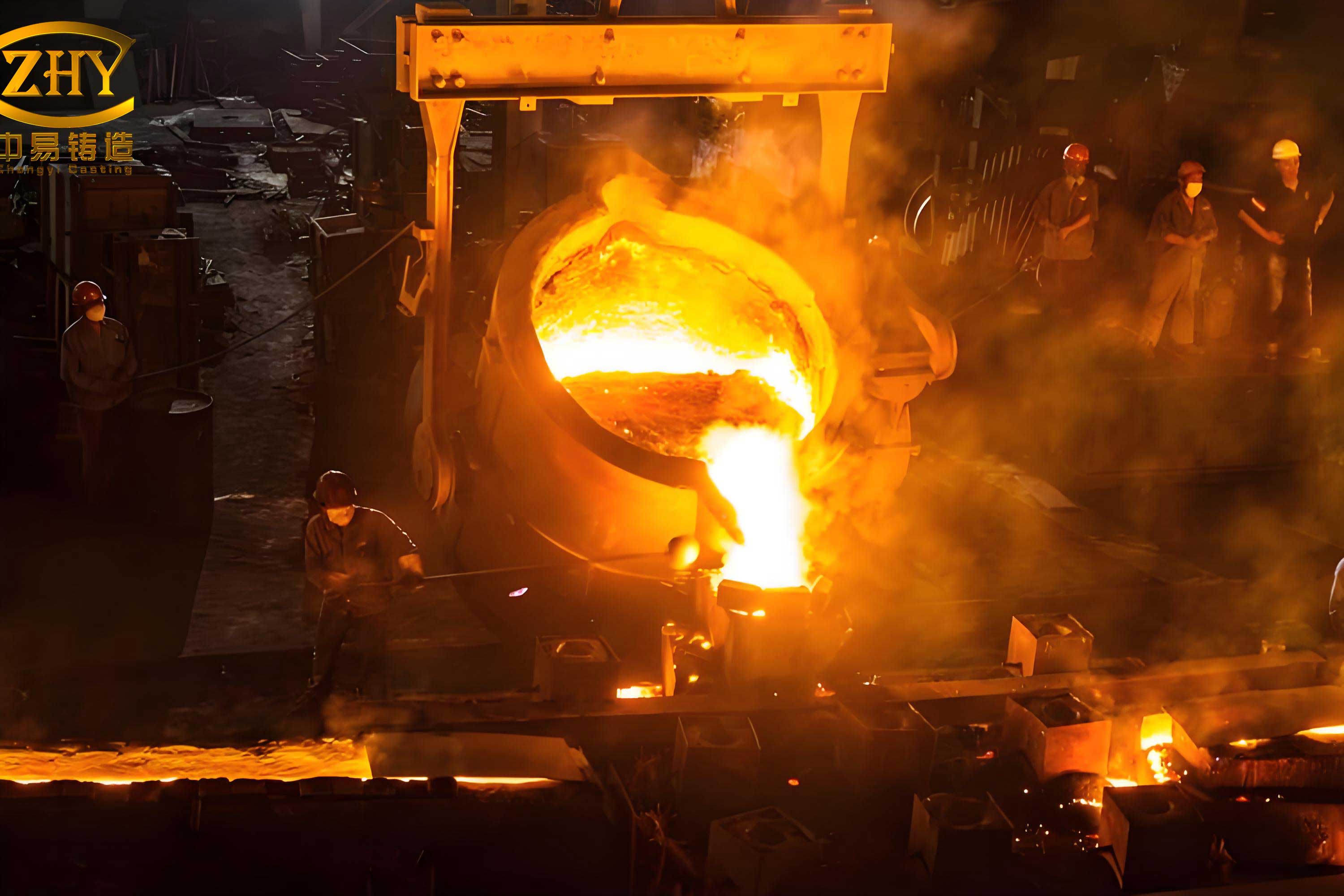
Shrinkage cavities are among the most critical defects in sand casting of heavy-section steel components like support sockets. These are macroscopic voids that form in the final freezing locations, such as hot spots and junction areas, due to inadequate liquid metal feed during solidification. The irregular shape and rough, oxidized interior surfaces are characteristic. In the socket’s cross-rib region, the shrinkage defect severely compromises the load-bearing cross-section. The primary driving force is the volumetric contraction of the metal during the liquid-to-solid phase change and subsequent solid-state cooling. The total shrinkage ε can be conceptually represented as the sum of liquid contraction, solidification contraction, and solid contraction:
$$ \varepsilon_{total} = \varepsilon_{liquid} + \varepsilon_{solidification} + \varepsilon_{solid} $$
For the ZG30Cr06 alloy, the solidification shrinkage is particularly significant. The formation of a shrinkage cavity requires that a region becomes isolated from the liquid feed source (the riser) before solidification is complete. This is often described by Chvorinov’s Rule, where the solidification time t is proportional to the square of the volume-to-surface area ratio (modulus):
$$ t = k \cdot \left( \frac{V}{A} \right)^2 $$
Where ‘k’ is the mold constant. Areas with a high modulus (like the rib junctions) solidify last. If the riser, designed to have a higher modulus than the casting hot spot, fails to remain liquid long enough, a shrinkage cavity forms in the casting. The causes can be tabulated as follows:
| Cause Category | Specific Factors in Sand Casting | Effect on Shrinkage |
|---|---|---|
| Feeding System Design | Insufficient riser size/number; blocked feeding paths; incorrect riser neck design. | Reduces available liquid metal for补缩 (feeding). |
| Pouring Parameters | Excessively high pouring temperature; improper pouring rate. | Increases total liquid contraction and gas absorption. |
| Mold/Metal Interaction | Poor riser insulation; early riser surface solidification. | Causes “reverse feeding” (casting feeds riser). |
| Alloy Characteristics | High solidification shrinkage range of ZG30Cr06; gas content in melt. | Inherent tendency for cavity formation. |
To prevent shrinkage cavities in sand casting, the strategy must focus on promoting directional solidification towards the riser. This involves computational simulation to optimize riser design, often using modulus-based calculations. The use of exothermic or insulating riser sleeves in sand casting dramatically improves feeding efficiency by maintaining thermal gradient. Furthermore, the practice of “hot topping” – adding molten metal to the riser after pouring and covering it with exothermic material – is crucial. The gating system should be designed to establish thermal gradients, and pouring temperature must be carefully controlled within an optimal window, typically following the principle of “high temperature melting, low temperature pouring” to minimize total contraction volume.
Gas porosity is another pervasive issue in sand casting, manifesting as spherical or elongated smooth-walled cavities within the casting section. These pores can be classified based on origin. Precipitated gas pores result from the decreased solubility of gases like hydrogen and nitrogen in the steel during cooling. The solubility of diatomic gases in liquid steel follows Sieverts’ law:
$$ S = k_s \cdot \sqrt{P} $$
Where S is solubility, k_s is the equilibrium constant, and P is the partial pressure of the gas. Upon solidification, solubility drops sharply, forcing gas out of solution to form numerous fine, dispersed pores. Invaded gas pores originate from the mold itself. The intense heat from the molten metal causes moisture evaporation and breakdown of the water glass binder, generating large volumes of gas. If the mold permeability is insufficient or venting is inadequate, this gas can be forced into the solidifying metal, creating larger, irregular pores often located near the mold surface or in core pockets. The following table contrasts these two major types of gas porosity in sand casting:
| Porosity Type | Formation Mechanism | Typical Morphology | Primary Source in Sand Casting |
|---|---|---|---|
| Precipitated (Microporosity) | Decreasing gas solubility during solidification. | Small, round, widely dispersed throughout matrix. | Humidity in charge materials; wet ladles; insufficient deoxidation. |
| Invaded (Macroporosity) | Mold/core gases penetrating metal surface. | Larger, elongated, often near surface or in cores. | High moisture/clay in sand; low permeability; inadequate venting; high pouring rate. |
Prevention of gas porosity in sand casting requires a multi-front approach. For precipitated pores, strict control over charge material dryness and pre-heating of all tools is essential. Effective deoxidation practice is critical; aluminum is a powerful deoxidizer, and its addition must be carefully timed and quantified to remove oxygen without creating excessive oxides that could act as pore nucleation sites. For the sand casting mold, selecting sands with appropriate grain size and distribution to ensure high intrinsic permeability is key. The water glass addition must be optimized (typically below 8% by weight) to balance strength and gas generation. Adequate venting through strategic placement of vents and permeable core prints is non-negotiable. Furthermore, controlling the pouring speed to ensure laminar filling minimizes air entrapment in the mold cavity. A gating system design that reduces turbulence is vital for high-quality sand casting.
Burn-on or metal penetration is a surface defect unique to sand casting processes, where a layer of metal and sand grains becomes fused to the casting surface. This occurs when molten metal or its oxides infiltrate the pores between sand grains under metallostatic and dynamic pressure. The penetration depth δ can be approximated by considering the metal pressure (P), surface tension (σ), contact angle (θ), and pore radius (r), often related through a modified version of the Washburn equation for capillary flow:
$$ \delta \propto \sqrt{ \frac{r \cdot \sigma \cdot \cos\theta \cdot t}{4 \eta} } $$
Where t is time and η is viscosity. High pouring temperature, low sand refractoriness, and low mold hardness exacerbate this phenomenon. The causes are summarized below:
| Contributing Factor | Effect in Sand Casting Process |
|---|---|
| Low Mold/Sand Hardness | Increases effective pore radius, facilitating metal infiltration. |
| High Pouring Temperature | Lowers metal viscosity, increases fluidity and thermal attack on sand. |
| Inadequate Sand Refractoriness | Sand grains sinter or melt, losing structural integrity. |
| Poor Mold/Core Finish | Loose sand on mold surface is easily incorporated into metal. |
To prevent burn-on in sand casting, the first line of defense is using sands with high refractoriness, such as silica sands with low impurity levels. The water glass content must be controlled to avoid excessive low-melting-point phases. Increasing mold compaction uniformity and surface hardness reduces the effective pore size. The application of refractory coatings (e.g., zirconia-based washes) creates a physical barrier between the metal and the sand mold. Finally, optimizing pouring parameters—specifically reducing pouring temperature to the lower feasible limit for the given casting geometry—significantly decreases the thermal and chemical driving force for penetration. Every step in the sand casting process, from sand preparation to mold closing, must aim to produce a dense, stable mold surface.
The integration of modern technology into traditional sand casting practices is transformative. Computer-aided design (CAD) and simulation software allow for virtual prototyping of the entire sand casting process. Solidification and fluid flow simulations can predict hot spots, shrinkage risks, and potential gas entrapment zones before a single mold is made. This enables precise optimization of riser placement, gating design, and cooling conditions. Advanced binder systems, including modified water glasses and organic alternatives, are being developed to improve collapsibility while maintaining strength. Automated sand mixing and molding lines ensure consistent mold quality, a critical factor in defect reduction for high-volume sand casting production. Real-time process monitoring of pouring temperature and speed further enhances control. The future of sand casting lies in this synergy between empirical knowledge and digital precision, moving towards a defect-averse manufacturing paradigm.
In conclusion, mastering the sand casting process for critical components like hydraulic support sockets requires a holistic understanding of material science, fluid dynamics, and heat transfer. The analysis of defects such as shrinkage cavities, gas porosity, and burn-on reveals their multi-factorial origins, intertwined with every stage of the sand casting operation. The preventive measures are equally comprehensive, spanning from meticulous metallurgical control and optimized sand preparation to intelligent feeding system design and strict process discipline. The incorporation of computational tools and advanced materials is steadily elevating the capabilities of sand casting, ensuring higher integrity, reliability, and quality of cast components. As practitioners in this field, our goal is to relentlessly pursue the refinement of the sand casting process, transforming empirical insights into predictable, repeatable, and superior manufacturing outcomes.