
In the evolving landscape of manufacturing, the traditional paradigm of mass production is increasingly being challenged by the need for adaptability and responsiveness to dynamic market demands. As an engineer deeply involved in the process design, guidance, and quality management of steel and iron castings production, I have witnessed firsthand the limitations of rigid, specialized production lines. This article, from my professional perspective, delves into the imperative and methodologies for infusing flexibility into specialized sand casting production systems. Sand casting, as a foundational manufacturing process, must evolve to accommodate diverse product varieties and batch sizes while maintaining efficiency and quality. The journey toward flexible sand casting operations is not merely a technical upgrade but a strategic necessity for survival and growth in competitive markets.
The core of modern manufacturing lies in balancing efficiency with adaptability. Specialized production lines in sand casting are designed for high-volume output of specific product types, leveraging dedicated equipment and optimized processes to achieve economies of scale. However, this approach often falters when faced with fluctuations in demand or the need to produce multiple product types. Flexible production, in contrast, emphasizes the ability to switch between different products or production volumes with minimal downtime and cost. For sand casting foundries, embracing flexibility means enhancing the “quality” flexibility—the range of products that can be manufactured—and “time” flexibility—the speed of transition between products. This dual focus enables foundries to respond swiftly to customer needs, reduce lead times, and improve resource utilization, ultimately fostering resilience against market volatility.
| Aspect | Specialized Production | Flexible Production |
|---|---|---|
| Primary Focus | High-volume, single-product output | Multi-variety, small-to-medium batch output |
| Equipment | Dedicated, purpose-built machinery | Adaptable or modular systems with quick-change capabilities |
| Process Stability | Highly stable for specific products | Dynamically adjustable to different product requirements |
| Market Responsiveness | Low; vulnerable to demand shifts | High; can adapt to changing customer needs |
| Resource Utilization | May lead to idle resources during downturns | Optimizes use of equipment and materials across products |
| Cost Structure | Lower per-unit cost at high volumes | Balanced cost efficiency across variable volumes |
The necessity for flexible improvement in specialized sand casting lines stems from several market-driven factors. Firstly, the saturation of traditional casting markets, such as railway components, has led to erratic demand patterns, necessitating diversification into new product segments like high-speed rail parts, wind turbine components, or nuclear energy castings. These new segments often involve castings with varying weights—from as light as 10 kg to over 5,000 kg—and stringent quality requirements that specialized lines may not inherently support. Secondly, the shift from production-oriented to demand-oriented markets compels foundries to offer customization and rapid delivery. Without flexibility, sand casting operations risk obsolescence, as they cannot efficiently produce the diverse, high-quality castings required by modern industries. Thus, transforming specialized sand casting lines into flexible systems is crucial for leveraging existing investments while expanding capabilities.
When undertaking flexible improvements, certain principles must guide the process to ensure viability and sustainability. Firstly, modifications should integrate seamlessly with existing equipment and facilities to avoid redundant investments and disruption. For instance, retrofitting a sand mixing system to handle multiple binder types is more cost-effective than installing entirely new lines. Secondly, improvements must align with environmental goals, such as reducing energy consumption, resource use, and pollutant emissions, thereby promoting green sand casting practices. Thirdly, advancements should possess a degree of forward-looking innovation, enabling the production line to meet current needs while accommodating future product developments. These principles ensure that flexible transformation in sand casting is both practical and progressive, fostering long-term competitiveness.
To illustrate the application of these principles, let us consider the flexible improvements implemented across key process stages in a sand casting production line originally designed for railway bolster and side frame components. The line comprised dedicated units for molding, melting, and cleaning, but through targeted modifications, it was transformed to handle a wide range of casting types and sizes. The following sections detail these improvements, supported by technical analyses and quantitative assessments.
Molding and Core-Making Flexibility
The molding section initially relied on ester-cured sodium silicate sand for high-volume production. To accommodate diverse products, such as ductile iron castings weighing 3–5 tons, which require furan resin sand for dimensional accuracy and surface finish, the sand mixing system was upgraded. A dual-function mixing system was developed by integrating additional storage tanks and liquid delivery systems into the existing continuous mixer. This allowed the same mixer to handle both ester-cured sodium silicate sand and furan resin sand, with programmable control for swift switching. The key to maintaining sand quality was implementing an automatic temperature control device that adjusts hardener ratios based on ambient conditions, ensuring consistent curing behavior. The flexibility can be modeled by the mixing efficiency equation: $$ \eta_m = \frac{Q_{output}}{Q_{input}} \times 100\% $$ where $\eta_m$ represents mixing efficiency, $Q_{output}$ is the volume of properly mixed sand, and $Q_{input}$ is the total input materials. This modification enabled the sand casting line to produce both steel and iron castings without compromising stability or speed.
For smaller castings (e.g., 10–50 kg), standard small molding plates were designed and mounted onto universal molding plates using locating pins. This approach allowed multiple small-pattern plates to be fixed simultaneously, enabling batch production of varied small parts on the same line. The versatility is summarized in Table 2, highlighting the adaptability gains.
| Improvement Area | Technical Modification | Flexibility Gain |
|---|---|---|
| Sand Mixing System | Added furan resin sand capability to existing mixer | Enabled production of both steel and iron sand castings |
| Small Casting Production | Implemented small plate mounting on universal plates | Allowed multi-variety small-part sand casting with quick changeovers |
| Core-Making for Complex Cores | Adopted in-box squeeze locking core-making process | Improved internal cavity accuracy and reduced defects in sand castings |
| Core-Machine Versatility | Modified shot sleeve and blowing plates for multi-core production | Expanded range of sodium silicate sand cores producible |
| Automated Core Setting | Deployed robotic systems with adaptable grippers | Enhanced precision and stability in core placement for sand castings |
Complex cores for high-end sand castings, which previously required manual making, were transitioned to an in-box squeeze locking process. This method, inspired by core shooting principles, involves filling sand into half-boxes, then using an automatic core assembler to squeeze and lock the cores via pins before hardening. The process reduces core joint lines and improves wall thickness consistency, critical for defect minimization. The core integrity can be expressed as: $$ I_c = \frac{F_{lock}}{A_{joint}} $$ where $I_c$ is core integrity index, $F_{lock}$ is the locking force, and $A_{joint}$ is the joint area. Higher integrity correlates with fewer sand inclusion defects in final sand castings.
Additionally, horizontal core shooting machines originally limited to specific cores were retrofitted with interchangeable shot sleeves, blowing plates, and shooting plates to produce various sodium silicate sand cores. This expanded the core-making flexibility without major capital expenditure. For automated core setting, robots were introduced to handle complex cores, replacing manual operations. By equipping robots with customizable grippers and programming them for different core geometries, the sand casting line achieved consistent, high-precision core placement, reducing human error and enhancing repeatability. The robotic efficiency in sand casting can be quantified by the cycle time reduction: $$ \Delta t = t_{manual} – t_{robot} $$ where $\Delta t$ is the time saved per cycle, contributing to overall productivity gains.
Melting and Pouring Adaptations
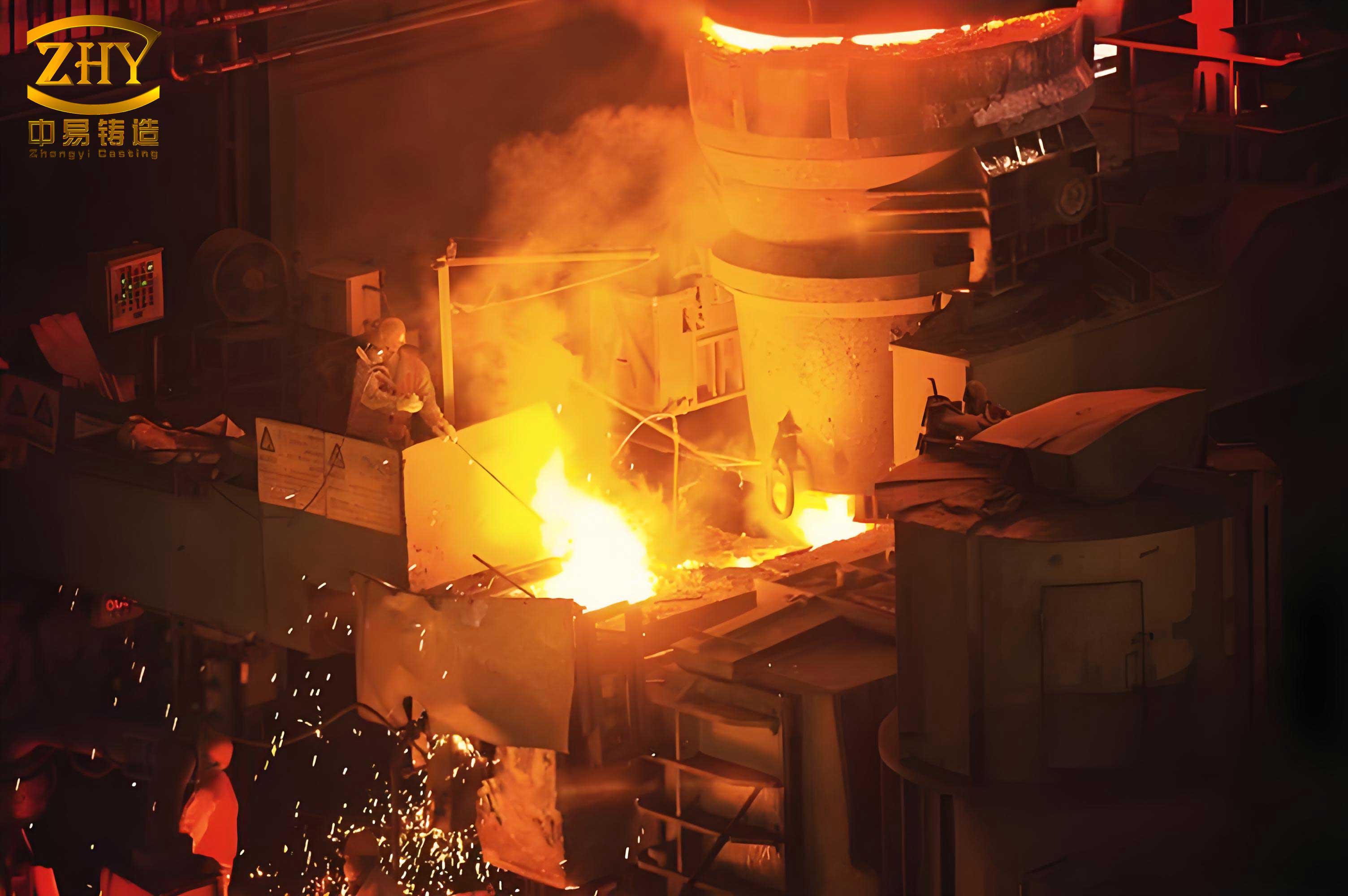
The melting section featured a 30-ton EBT electric arc furnace and ladle refining station, designed for large steel castings. To accommodate smaller castings with lower weight requirements, improvements focused on temperature management during pouring. By refining ladle lining practices, optimizing argon stirring during refining, controlling slag volume, and using ladle covers, the temperature drop rate during pouring was reduced from 0.9°C per minute to below 0.5°C per minute. This extended the viable pouring time to over 80 minutes per ladle, enabling the pouring of small sand castings alongside larger ones from the same heat. The temperature decay can be modeled as: $$ T(t) = T_0 – k \cdot t $$ where $T(t)$ is the temperature at time $t$, $T_0$ is the initial temperature, and $k$ is the decay coefficient (improved from 0.9 to 0.5°C/min).
For pouring large castings requiring simultaneous two-end pouring, a rail-based pouring machine was developed to replace the manual alignment of pouring basins with ladle nozzles. This machine moves along tracks parallel to the pouring line, allowing precise positioning with minimal crane movement. The height-adjustable rollers on the machine accommodate different molding flask heights, making it versatile for various sand casting products. This innovation halved the pouring time and improved temperature control for late-stage pours, mitigating defects like cold shuts or misruns. The pouring efficiency improvement is summarized in Table 3, demonstrating the impact on sand casting quality.
| Improvement | Technical Detail | Impact on Sand Casting Flexibility |
|---|---|---|
| Temperature Control | Enhanced ladle practices to reduce cooling rate | Enabled pouring of small and large sand castings from same ladle |
| Pouring Mechanism | Introduced rail-based pouring machine with height adjustment | Facilitated quick, precise pouring for diverse sand casting sizes |
| Batch Compatibility | Paired small and large castings in same heat | Optimized material use and extended pouring window for sand castings |
The synergy between melting and pouring adaptations ensures that the sand casting line can handle a broad spectrum of casting weights and geometries, from lightweight precision parts to heavy-section components, all while maintaining metallurgical quality.
Cleaning and Heat Treatment Modularity
The cleaning segment included shakeout units, hydroblasting machines, continuous heat treatment lines, shot blasting, non-destructive testing, and painting systems. To achieve flexibility, heat treatment processes were modularized. Continuous heat treatment lines, originally fitted with dedicated fixtures for specific products, were adapted with master-slave combination fixtures and multi-hook fixtures. These fixtures allow quick changeovers for different sand casting products by swapping slave components, and they enable batch treatment of mixed-size castings. The multi-hook design distributes load stress, enhancing fixture lifespan and safety. The thermal uniformity achieved in such systems can be expressed by the heat treatment efficacy parameter: $$ E_{ht} = \frac{T_{uniform}}{T_{deviation}} $$ where $E_{ht}$ is efficacy, $T_{uniform}$ is the temperature uniformity, and $T_{deviation}$ is the maximum deviation. Higher efficacy leads to more consistent mechanical properties and microstructures in sand castings.
Moreover, the integration of automated handling and scheduling ensured that castings from the same melt could be heat-treated together, promoting consistency. The flexibility in cleaning operations is further enhanced by adjustable shot blasting parameters and adaptable non-destructive testing setups for different casting geometries. These modifications allow the sand casting line to process everything from small, intricate castings to massive ones without bottlenecks. The overall equipment effectiveness (OEE) for the cleaning section can be calculated as: $$ OEE = A \times P \times Q $$ where $A$ is availability, $P$ is performance efficiency, and $Q$ is quality rate. Post-improvement, OEE increased due to reduced changeover times and fewer defects in sand castings.
Quantitative Outcomes and Future Directions
The cumulative effect of these flexible improvements is profound. The sand casting production line now accommodates casting weights from 10 kg to over 5,000 kg, with the ability to switch between steel and iron sand castings seamlessly. Product variety has expanded to include high-speed rail components, wind energy parts, and other premium castings, all produced with high dimensional accuracy and surface quality. Key performance indicators, such as changeover time, defect rate, and energy consumption per ton of casting, have shown significant improvement. For instance, the changeover time between different sand casting products was reduced by up to 60%, while defect rates decreased by approximately 30% due to enhanced process control.
Economically, the flexible transformation has enabled better asset utilization, reducing idle time and capitalizing on diverse market opportunities. The sand casting line’s adaptability has also future-proofed the operation against market fluctuations, ensuring sustainability. Looking ahead, further enhancements could involve integrating IoT sensors for real-time monitoring of sand properties, leveraging AI for predictive maintenance, and exploring additive manufacturing for rapid pattern and core box production. These advancements will continue to push the boundaries of what is possible in flexible sand casting, driving innovation in foundry operations worldwide.
In conclusion, the journey from a specialized to a flexible sand casting production line is both a technical and strategic endeavor. By retrofitting key processes—molding, melting, and cleaning—with adaptable technologies, foundries can achieve remarkable resilience and competitiveness. The principles of integration, sustainability, and innovation guide this transformation, ensuring that sand casting remains a vital and dynamic manufacturing process. As markets evolve, the ability to produce diverse, high-quality sand castings efficiently will be paramount, and flexible production lines stand as a testament to the industry’s capacity for adaptation and excellence.