
In my extensive experience within the foundry industry, the development of a reliable and cost-effective casting process for high-integrity components like rear axle housings presents a fascinating and complex challenge. Among the various manufacturing routes, sand castings remain a cornerstone, particularly during the crucial stages of prototyping and process qualification. The inherent flexibility, material cost-effectiveness, and adaptability of sand castings make them an indispensable tool for engineers. This article details a first-person account of the journey from initial concept to a mature production process for a low-carbon steel rear axle housing, specifically the JT6120 model, utilizing manual sand castings. I will explore the theoretical calculations, practical hurdles encountered during trial production, and the systematic optimizations that led to a robust and economically viable process.
The component in question is a rear axle housing for a large passenger coach chassis. This part is subjected to severe and complex loading conditions in service, including significant bending moments, torsional stresses, and impact loads. Consequently, the final casting must possess high strength and stiffness. An equally critical requirement is pressure tightness, as the housing contains lubricating oil. Any leakage is unacceptable. The material specification is ZG35, a cast low-carbon steel with a nominal yield strength. The as-cast weight is approximately 184 kg. The key technical requirements are stringent: the casting must be free from surface and internal defects such as shrinkage cavities, porosity, slag inclusions, and cracks. Furthermore, after machining, the housing must withstand a hydrostatic pressure test of 0.5 MPa without any seepage.
The geometry of the housing is that of a thin-walled, elongated box structure with significant variations in wall thickness. Its overall envelope dimensions are 1442 mm in length, 393 mm in width, and 148 mm in height. The primary wall thickness is around 50 mm. However, the design features two large, annular mounting flanges at the top and bottom. The ring-shaped plane on the top flange, located between diameters of Φ308 mm and Φ424 mm, has a nominal wall thickness of only 13 mm. With machining allowances and a necessary process pad (a “chill” or “padding” added to the pattern to control solidification) totaling 21 mm, this region represents a classic “T-section” or “plate-to-rod” junction, creating a significant thermal mass or hot spot. Calculating the modulus (a measure of a section’s solidification time, defined as volume divided by cooling surface area) for this hot spot is crucial for designing an effective feeding system. For this junction, the calculated modulus, M, was:
$$ M_{top} = \frac{V}{A} \approx 2.76 \text{ cm} $$
Similarly, the corresponding annular plane on the bottom flange, with a base thickness of 14 mm and a total thickness of 25 mm after allowances, has a smaller but still critical modulus:
$$ M_{bottom} \approx 1.25 \text{ cm} $$
The end flanges themselves also constitute hot spots with a modulus of approximately 1.7 cm. This disparity in moduli—from thin walls to thick junctions—within a single, long casting makes achieving soundness throughout a primary difficulty in the casting process design for such sand castings.
Initial Casting Process Design and Rationale
Leveraging the adaptability of sand castings, the initial process was designed based on fundamental foundry engineering principles: directional solidification and the modulus method for feeder (riser) design. The goal was to ensure liquid metal feed paths remain open to compensate for volumetric shrinkage until the critical sections solidify.
Pattern Equipment and Molding
Existing tooling was utilized for efficiency. A flask size of 2100 mm x 1500 mm was selected, with a cope height of 500 mm and a drag height of 400 mm, allowing for two castings to be produced per mold. Sodium silicate (water glass)-bonded sand, cured by CO₂ or ester hardening, was chosen for the mold due to its good strength, collapsibility, and environmental benefits compared to some organic binders.
The internal cavity of the housing, which is widest in the center and tapers towards the ends, was formed by a single large core. The core’s behavior was identified as a potential risk factor. If the core lacked sufficient collapsibility (the ability to yield as the casting contracts during cooling), it could mechanically restrain the contracting metal, leading to hot tearing or distortion. To mitigate this, the initial plan was to use a resin-bonded core sand (likely phenolic urethane cold box or a similar process) known for good strength and breakdown properties. Zircon-based refractory coating was specified to improve the core surface finish and resist metal penetration. Furthermore, explicit instructions were given to incorporate “yield holes” or hollow sections within the core to enhance its compressibility.
Pouring Position and Gating System
The casting orientation in the mold is paramount. The bottom annular flange was positioned in the drag (lower half of the mold). This places this critical, pressure-bearing surface in a zone less prone to slag or dross entrapment and allows for easier feeding if needed. Conversely, the top annular flange, with its larger thermal modulus (M=2.76 cm), was positioned in the cope. This strategic placement facilitates the attachment of top feeders directly over this major hot spot to effectively draw liquid metal from the feeder during solidification.
The gating system was designed to fill the mold smoothly and rapidly to prevent mist runs or cold shuts, while minimizing turbulence and oxide formation. Using standard hydraulic principles and empirical data for steel castings, the choke area was calculated. The system comprised a top-pouring sprue, a runner bar, and multiple ingates. The calculated cross-sectional areas were:
| Component | Dimensions (mm) | Total Cross-Sectional Area (cm²) |
|---|---|---|
| Sprue (Downsprue) | Ø70 | $$ A_{sprue} = \pi \times (3.5)^2 \approx 38.5 $$ |
| Runner (Cross Gate) | 48 x 56 x 55 (Trapezoidal) | $$ A_{runner} \approx 28.6 $$ |
| Ingates | 30 x 35 x 40 (Multiple) | $$ \Sigma A_{ingate} \approx 26.0 $$ |
The area ratios were designed as: $$ \Sigma A_{sprue} : \Sigma A_{runner} : \Sigma A_{ingate} = 1 : 0.74 : 0.68 $$. This represents a slightly pressurized system, intended to help keep slag and oxides in the runner and promote a non-turbulent fill.
Feeding and Chilling Strategy
Following the modulus method, the feeding system was designed to establish a clear thermal gradient, promoting solidification from the extremities and thinner sections back toward the feeders. Eight feeders (risers) were placed over the identified hot spots: the two end flanges and the thick junctions on the top and bottom. The required feeder volume $$ V_{feed} $$ for a steel casting can be estimated based on the feeding demand of the hot spot it serves and the feeder efficiency. For a cylindrical side feeder, a common rule of thumb for steel is that its modulus must be about 1.2 times that of the casting section it feeds:
$$ M_{feed} \ge 1.2 \times M_{cast} $$
Simultaneously, to accelerate solidification in certain thicker sections of the drag and to control the solidification sequence, ten external chills (made of cast iron or steel) were placed against the mold wall in strategic locations. The combination of feeders and chills aimed to achieve a controlled directional solidification pattern. The initial process yield (weight of sound casting vs. total metal poured) was calculated at a modest 55%, indicating significant metal was dedicated to the gating and feeding systems. A linear shrinkage allowance of 1.3% was applied for the length, and 2.0% for other dimensions, accounting for the constraints of the box-like structure.
Trial Production and Emergent Defects
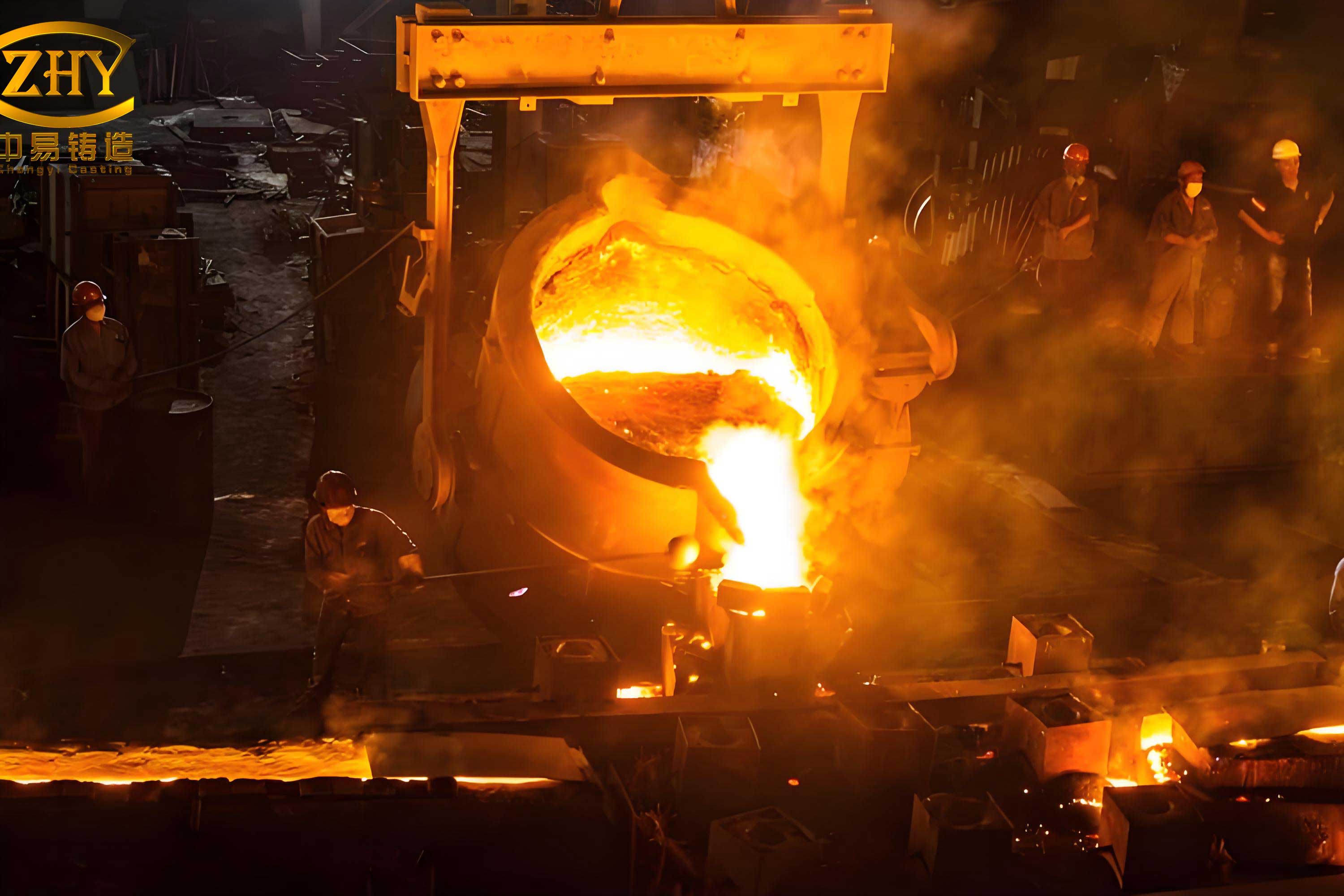
The metal was melted in a 600 kg medium-frequency induction furnace. Standard deoxidation practice was employed using aluminum and rare-earth silicide additions in the ladle. The molds were poured using a 6-ton bottom-pour ladle, which provides a cleaner metal stream compared to lip-pour ladles. A single “topping up” pour was performed to compensate for liquid shrinkage in the feeders. The key process parameters were: pouring temperature range of 1540-1560°C, a fill time mandated to be over 20 seconds to ensure calm filling, and a minimum shakeout time of 10 hours to allow the casting to cool below its transformation temperature and gain sufficient strength.
Upon shakeout, cleaning, and preliminary machining, several critical defects were observed, demanding a thorough investigation and process revision. This phase perfectly illustrates the iterative, empirical nature of perfecting sand castings processes. The defects were:
- Shrinkage Porosity at Feeder Necks: The four side feeders attached to the thick junctions showed shrinkage porosity (spongy, dendritic structure) at their points of attachment to the casting body. This indicated the feeders themselves had solidified before the hot spot they were intended to feed, failing in their primary function.
- Hot Tears (Cracks) in the Internal Cavity: Cracks were found in the internal walls of the housing, particularly near stiffening ribs or “pull ribs” designed into the core. Some castings also exhibited cracks on the surface of the critical bottom annular flange.
- Burn-on/Penetration at End Flanges: The sand at the end flanges was severely fused to the metal surface, making cleaning extremely difficult and damaging the surface finish.
Root Cause Analysis and Systematic Process Optimization
The beauty of manual sand castings in this development phase is the relative ease and low cost of modifying pattern equipment and process layouts. Each defect was analyzed, and targeted corrective actions were implemented.
Solving Shrinkage Porosity: From Side to Top Feeders, Then to Padding
The porosity at the side feeder necks was a classic design flaw. While side feeders are often convenient, in this case, the thermal connection (the “neck”) was insufficient to keep the feeder liquid long enough. The feeder acted as an additional heat source, enlarging the effective hot spot, rather than a reservoir. The immediate solution was to replace the four blind side feeders with four blind top feeders positioned directly over the hot spots. This creates the shortest possible feeding distance and a direct thermal gradient. A trial with top feeders produced sound castings with no neck shrinkage.
However, for volume production, this solution introduced new drawbacks: it required four additional core prints and cores to form the feeder cavities, increased cutting and grinding labor for feeder removal, and placed the feeder contact point on a machined surface, complicating cleanup. Therefore, a more elegant solution was sought. The principle of directional solidification was revisited: could the required thermal mass be temporarily increased using a “padding” or “chill” added to the pattern (a sacrificial mass of metal) to draw the shrinkage zone away from the final part geometry and into the padding, which would later be machined off? Analysis confirmed the local geometry allowed for this. A carefully designed pad was added to the pattern in these regions. The subsequent castings were sound, with all shrinkage confined to the pad area, which was completely removed during machining. This was an optimal solution, improving quality without adding production complexity.
Eliminating Hot Tears: Core Collapsibility is Key
The cracks were metallurgically confirmed as hot tears, occurring in the brittle temperature range just after solidification is complete but before the casting has gained significant strength. The contributing factors are high thermal stress and strain concentration, exacerbated by mechanical restraint. Despite the presence of design ribs and external chills, cracks persisted. Observation of the production floor revealed inconsistent implementation of the core “yield hole” instruction. Cores with large, properly placed yield holes produced crack-free castings; those with small or missing holes resulted in cracks.
This was a clear indication that the core’s resistance to deformation was the root cause. The resin sand, while good, did not offer sufficient early collapsibility under the thermal load of the solidifying steel. The solution was twofold: First, switch to a core sand with superior hot collapsibility. A linseed oil or similar organic-bonded core sand was selected for its ability to burn out and yield readily upon heating. Second, the process control was tightened. A mandatory core design with specific, sizable yield holes was enforced, ensuring the sand thickness around these holes (the “sand backing”) did not exceed 35 mm to guarantee easy compression.
For the isolated cracks on the bottom flange, a different approach was needed. These were likely due to tensile stresses developing during cooling. A simple yet effective remedy was employed: adding a small, continuous “anti-cracking rib” or “serpentine chill” on the pattern around the Φ310 mm region on the drag side. This rib, which is later machined off, acts as a cooling fin, locally increasing the cooling rate and strengthening the region during the vulnerable phase, thus preventing tear initiation.
Addressing Metal Penetration: Refractory Coating and Sand Density
The burn-on at the end flanges suggested a combination of high local metal temperature and insufficient sand refractoriness or density in those areas. The solution involved improving the mold surface integrity. The application of the zircon wash was made more stringent, ensuring a thicker, fully dried coating. Furthermore, attention was paid to ramming density in these complex, deep pocket areas of the mold to eliminate any low-density zones where metal could penetrate.
Results of the Optimized Sand Casting Process
The implementation of these optimized parameters transformed the process. The revised setup is summarized below:
| Process Aspect | Initial Design | Optimized Design | Reason for Change |
|---|---|---|---|
| Core Sand | Resin-Bonded Sand | Oil-Bonded Sand (e.g., Linseed) | Superior hot collapsibility to prevent hot tears. |
| Core Feature | Yield holes (inconsistent) | Mandatory, large yield holes with <35mm sand backing | Ensure consistent, positive mechanical yield. |
| Feeder for Top Junctions | Blind Side Feeder | Pattern Padding / Chill | Draws shrinkage into machining allowance; eliminates neck porosity & simplifies cleaning. |
| Bottom Flange Cracking | None | Addition of a Continuous Anti-Crack Rib | Increases local cooling rate & strength during vulnerable solidification phase. |
| Mold Surface Prep | Standard Zircon Wash | Enhanced, Thicker Zircon Wash Application | Prevents metal penetration and burn-on. |
| Process Yield | ~55% | ~75% | Elimination of large side feeders and optimized feeding. |
The outcome was highly successful. Over 500 castings were produced with the optimized process. Every casting was sound, free from shrinkage, porosity, and cracks after machining. All units passed the 0.5 MPa hydrostatic pressure test without a single leak. A significant economic benefit was also realized: the optimized feeding system reduced the required poured weight per casting by approximately 40 kg, boosting the process yield from 55% to 75%. This represents a substantial saving in raw material and melting energy for every piece produced.
Conclusions and the Enduring Value of Sand Castings
This detailed case study underscores the powerful role of traditional sand castings in modern manufacturing, especially for the development and validation of processes for demanding components. The journey from theoretical design to a stable production process for the JT6120 axle housing was iterative and driven by empirical observation and analysis. The initial process, designed using sound engineering principles, served as a necessary starting point but required refinement based on real-world casting behavior.
The key lessons reinforce fundamental foundry truths: Feeding system design must be validated, not just calculated; core behavior is often the critical factor in stress-related defects; and process control consistency is non-negotiable. The ability to quickly and inexpensively modify wooden or resin pattern equipment, adjust core boxes, and experiment with chills and padding is a unique advantage of the sand castings method during the development phase.
While advanced processes like investment casting or permanent mold casting offer benefits for high-volume production, they lack the flexibility and low upfront cost for such iterative development. Therefore, sand castings, with its readily available and inexpensive molding materials, simple mold-making techniques, and adaptability to any production volume—from single prototypes to mass production—remains an essential and foundational craft. It is both an art, honed by experience, and a science, guided by principles of metallurgy and heat transfer. This project stands as a testament to the fact that a well-engineered and optimized sand casting process is more than capable of producing high-integrity, complex steel components that meet the most stringent performance criteria.