
In modern foundry practices, the selection of pouring temperature is a critical parameter that directly influences the quality, microstructure, and mechanical properties of cast components. While sand castings have been the traditional method for centuries, lost foam casting has emerged as an innovative technique, offering advantages such as reduced machining and complex geometry capabilities. However, a key challenge in lost foam casting is determining the appropriate pouring temperature relative to conventional sand castings. Historically, this has been based on empirical experience, which is often unreliable. As a researcher in the field, I aim to establish a theoretical framework to calculate the required temperature increase in lost foam casting over sand castings, ensuring scientific rigor and practical applicability.
The fundamental difference between lost foam casting and sand castings lies in the presence of a vaporizable foam pattern in the former. During pouring, the molten metal replaces the foam, which decomposes and gasifies, absorbing significant heat. This additional heat loss necessitates a higher pouring temperature to maintain proper fluidity and avoid defects like cold shuts or incomplete filling. In sand castings, the mold is inert, and no such endothermic reaction occurs, allowing for lower pouring temperatures. Therefore, quantifying this temperature increase is essential for optimizing the process.
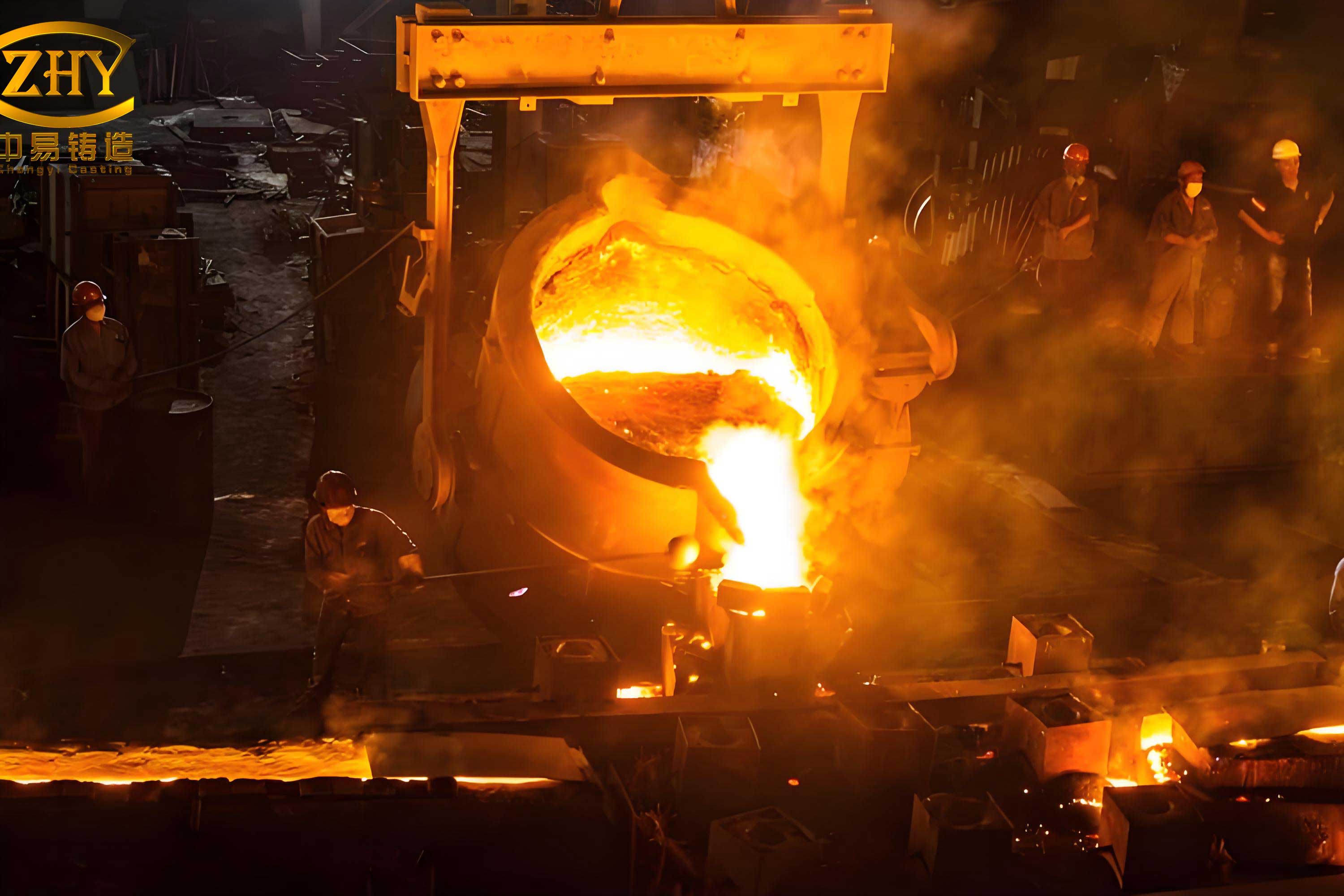
To derive a mathematical model, let us consider the energy balance during pouring. Assume the mold volume is $V_{\text{mold}}$ (in m³), and the foam pattern within it undergoes decomposition, vaporization, and heating. The total heat required to gasify a unit mass of foam is denoted as $q_{\text{foam}}$ (in kJ/kg), which varies with temperature. For a given foam mass $m_{\text{foam}}$, the total heat absorbed $Q_{\text{absorbed}}$ is:
$$ Q_{\text{absorbed}} = m_{\text{foam}} \cdot q_{\text{foam}} $$
Here, $q_{\text{foam}}$ comprises three components: the decomposition heat $q_{\text{decomp}}$, the vaporization heat $q_{\text{vap}}$, and the sensible heat $q_{\text{sens}}$ required to raise the foam from ambient temperature to its vaporization point (including any phase changes). Thus:
$$ q_{\text{foam}} = q_{\text{decomp}} + q_{\text{vap}} + q_{\text{sens}} $$
Simultaneously, the molten metal, with mass $m_{\text{metal}}$ (including gates and risers), loses heat as it cools. If the metal has a specific heat capacity $c_{\text{metal}}$ (in kJ/(kg·K)), the heat released by the metal for a temperature drop $\Delta T$ is:
$$ Q_{\text{released}} = m_{\text{metal}} \cdot c_{\text{metal}} \cdot \Delta T $$
By energy conservation, the heat absorbed by the foam equals the heat released by the metal, assuming adiabatic conditions. Therefore:
$$ m_{\text{metal}} \cdot c_{\text{metal}} \cdot \Delta T = m_{\text{foam}} \cdot q_{\text{foam}} $$
Rearranging, the required temperature increase $\Delta T$ for lost foam casting compared to sand castings is:
$$ \Delta T = \frac{m_{\text{foam}}}{m_{\text{metal}}} \cdot \frac{q_{\text{foam}}}{c_{\text{metal}}} $$
In practice, the foam and metal often occupy similar mold volumes, so the mass ratio can be expressed in terms of densities. Let $\rho_{\text{foam}}$ be the foam density (in kg/m³) and $\rho_{\text{metal}}$ the metal density (in kg/m³). Then, $m_{\text{foam}} = V_{\text{mold}} \cdot \rho_{\text{foam}}$ and $m_{\text{metal}} = V_{\text{mold}} \cdot \rho_{\text{metal}}$, leading to:
$$ \Delta T = \frac{\rho_{\text{foam}}}{\rho_{\text{metal}}} \cdot \frac{q_{\text{foam}}}{c_{\text{metal}}} $$
This formula provides a general criterion for determining the pouring temperature increment. It highlights that $\Delta T$ depends on the foam density, metal density, foam’s thermal properties, and metal’s specific heat. For sand castings, where $\rho_{\text{foam}} = 0$, $\Delta T = 0$, confirming no additional temperature is needed.
To illustrate, let us compute $\Delta T$ for common alloys. The following table summarizes typical values for expanded polystyrene (EPS) foam and two metals: cast iron and aluminum alloy. These values are derived from experimental data and literature, acknowledging that variations exist based on specific compositions and process conditions.
| Parameter | Symbol | EPS Foam | Cast Iron | Aluminum Alloy |
|---|---|---|---|---|
| Density (kg/m³) | $\rho$ | 25 | 7200 | 2700 |
| Specific Heat (kJ/(kg·K)) | $c_{\text{metal}}$ | — | 0.46 | 0.88 |
| Decomposition Heat (kJ/kg) | $q_{\text{decomp}}$ | 347,000 | — | — |
| Vaporization Heat (kJ/kg) | $q_{\text{vap}}$ | 50,400 | — | — |
| Sensible Heat (kJ/kg) | $q_{\text{sens}}$ | 418,000 | — | — |
| Total Foam Heat (kJ/kg) | $q_{\text{foam}}$ | 815,400 | — | — |
Using these values, we can calculate $\Delta T$ for each metal. For cast iron:
$$ \Delta T_{\text{iron}} = \frac{25}{7200} \cdot \frac{815,400}{0.46} \approx \frac{25}{7200} \cdot 1,772,608.7 \approx 6.15 \, \text{K} $$
For aluminum alloy:
$$ \Delta T_{\text{al}} = \frac{25}{2700} \cdot \frac{815,400}{0.88} \approx \frac{25}{2700} \cdot 926,590.9 \approx 8.58 \, \text{K} $$
These calculations suggest that, theoretically, the pouring temperature in lost foam casting should be increased by approximately 6–9°C compared to sand castings, depending on the alloy. However, this is a simplified model assuming uniform heat absorption and ideal conditions. In reality, the foam decomposition is non-uniform, and part of the metal may not interact directly with the foam, necessitating adjustments.
Moreover, the interaction between metal and foam during pouring is dynamic. The initial metal stream must penetrate the foam pattern, often leading to localized cooling and gas generation. Thus, practical applications may require a higher $\Delta T$ than calculated. To mitigate this, foundries can employ techniques like overflow chambers or cold shot traps in the gating system to capture cooler, contaminated metal, allowing subsequent metal to retain higher temperature and cleanliness. This approach can reduce the need for excessive temperature increases.
Another critical factor is the influence of vacuum in lost foam casting. Unlike conventional sand castings, lost foam processes often use vacuum assistance to remove gases and stabilize the mold. Vacuum enhances heat transfer by promoting gas expansion and cooling within the sand, accelerating solidification. For thin-walled castings, this rapid cooling can be detrimental, requiring a higher pouring temperature to ensure complete filling. Conversely, for thick-walled castings, the thermal mass is large, and once the foam and adjacent coatings are consumed, the dry sand under vacuum acts as an insulator, slowing cooling compared to sand castings. Hence, for thick sections, the pouring temperature can be lower than the theoretical $\Delta T$.
To generalize, let us consider the following table comparing recommended pouring temperature adjustments for different casting scenarios, relative to sand castings.
| Casting Type | Alloy | Theoretical $\Delta T$ (°C) | Practical Adjustment | Final $\Delta T$ Range (°C) |
|---|---|---|---|---|
| Thin-Walled | Cast Iron | 6.2 | Increase by 20–30% | 7.5–8.0 |
| Thin-Walled | Aluminum Alloy | 8.6 | Increase by 20–30% | 10.3–11.2 |
| Thick-Walled | Cast Iron | 6.2 | Decrease by 10–20% | 5.0–5.6 |
| Thick-Walled | Aluminum Alloy | 8.6 | Decrease by 10–20% | 6.9–7.7 |
The adjustments account for factors like sand type, coating conductivity, and alloy fluidity. For instance, silica sand in sand castings has a higher thermal conductivity than dry sand under vacuum in lost foam casting, affecting heat dissipation rates. Therefore, when transitioning from sand castings to lost foam casting, engineers must consider these nuances to optimize pouring temperature.
Expanding the analysis, the energy balance equation can be refined to include transient effects. Let $T_{\text{pour, LF}}$ be the pouring temperature for lost foam casting and $T_{\text{pour, sand}}$ for sand castings. The difference $\Delta T = T_{\text{pour, LF}} – T_{\text{pour, sand}}$ must compensate for both foam heat absorption and altered cooling dynamics. A more comprehensive model incorporates the heat transfer coefficient $h$ (in W/(m²·K)) of the mold interface. For sand castings, $h_{\text{sand}}$ is relatively high due to direct contact, while for lost foam, $h_{\text{LF}}$ varies with vacuum level and coating thickness. The effective temperature increase can be expressed as:
$$ \Delta T_{\text{effective}} = \Delta T + \frac{h_{\text{sand}} – h_{\text{LF}}}{\rho_{\text{metal}} \cdot c_{\text{metal}} \cdot V_{\text{casting}}} \cdot \int_{0}^{t_{\text{solid}}} (T_{\text{metal}} – T_{\text{mold}}) \, dt $$
where $V_{\text{casting}}$ is the casting volume, $t_{\text{solid}}$ is the solidification time, and $T_{\text{metal}}$ and $T_{\text{mold}}$ are temperature functions. This integral accounts for differential cooling rates, but for simplicity, empirical corrections are often applied.
In practice, many foundries rely on rules of thumb for sand castings, such as pouring temperatures based on section thickness and alloy type. For lost foam casting, these rules must be modified. Below is a comparative table for typical pouring temperatures in sand castings versus lost foam casting for common alloys, assuming medium wall thickness (10–20 mm).
| Alloy | Sand Castings Pouring Temperature (°C) | Lost Foam Casting Pouring Temperature (°C) | $\Delta T$ (°C) |
|---|---|---|---|
| Gray Cast Iron | 1350–1400 | 1360–1410 | 10–15 |
| Ductile Iron | 1300–1350 | 1315–1365 | 15–20 |
| Aluminum A356 | 700–750 | 710–760 | 10–15 |
| Copper Alloy | 1100–1150 | 1115–1165 | 15–20 |
These values align with the theoretical calculations when practical adjustments are included. Notably, for sand castings, the pouring temperature is optimized to minimize defects like shrinkage and gas porosity, while in lost foam casting, the focus shifts to overcoming foam-related heat loss. Therefore, when designing gating systems for lost foam casting, it is crucial to account for this temperature increase to ensure smooth metal flow and proper feeding, akin to principles used in sand castings.
Furthermore, the decomposition products of the foam can influence the casting environment. In sand castings, the mold atmosphere is relatively inert, but in lost foam casting, gases from foam decomposition may cause turbulence or pressure changes. This necessitates higher superheat to maintain metal fluidity despite gas interactions. The heat requirement $q_{\text{foam}}$ can be modeled as a function of temperature $T$, as decomposition kinetics vary. A polynomial approximation is:
$$ q_{\text{foam}}(T) = a + bT + cT^2 $$
where $a$, $b$, and $c$ are material constants. Integrating this into the energy balance yields a nonlinear equation for $\Delta T$, solvable numerically. However, for most industrial applications, using average $q_{\text{foam}}$ values suffices.
To enhance accuracy, statistical methods like design of experiments (DOE) can correlate pouring temperature with casting quality in both sand castings and lost foam casting. Factors such as foam density, coating thickness, vacuum pressure, and metal composition are varied, and response surfaces generated to predict optimal $\Delta T$. This data-driven approach complements theoretical models, especially for complex geometries where heat transfer is non-uniform.
In summary, the pouring temperature in lost foam casting should be higher than in sand castings due to endothermic foam decomposition. The theoretical increase $\Delta T$ is given by:
$$ \Delta T = \frac{\rho_{\text{foam}}}{\rho_{\text{metal}}} \cdot \frac{q_{\text{foam}}}{c_{\text{metal}}} $$
For typical EPS foam and metals like cast iron or aluminum, $\Delta T$ ranges from 6 to 9°C. However, practical considerations—such as gating design, wall thickness, vacuum effects, and coating properties—necessitate adjustments. Thin-walled castings require a higher $\Delta T$ to counteract rapid cooling, while thick-walled castings may use a lower $\Delta T$ due to insulating effects. This framework provides a reliable criterion for foundries transitioning from sand castings to lost foam casting, ensuring scientific precision over empirical guesswork. Future work could explore dynamic simulation models to refine these predictions further, but the present analysis offers a robust foundation for optimizing pouring temperatures in lost foam casting relative to traditional sand castings.