
In my extensive experience within the heavy machinery manufacturing sector, the production of critical components like hydraulic support sockets presents a continuous challenge. These sockets, typically produced as steel sand castings, bear immense loads and are fundamental to operational safety. The prevalence of water glass (sodium silicate) as a binder in our sand casting processes offers advantages like good flowability and rapid hardening, but it also introduces specific challenges, particularly regarding defect formation in complex, high-integrity sand castings. The pursuit of defect-free sand castings is not merely a quality goal but a safety imperative. This analysis, drawn from firsthand observation and process refinement, delves into the common defects encountered in these specific sand castings, their root causes, and the systematic preventive measures we have implemented.
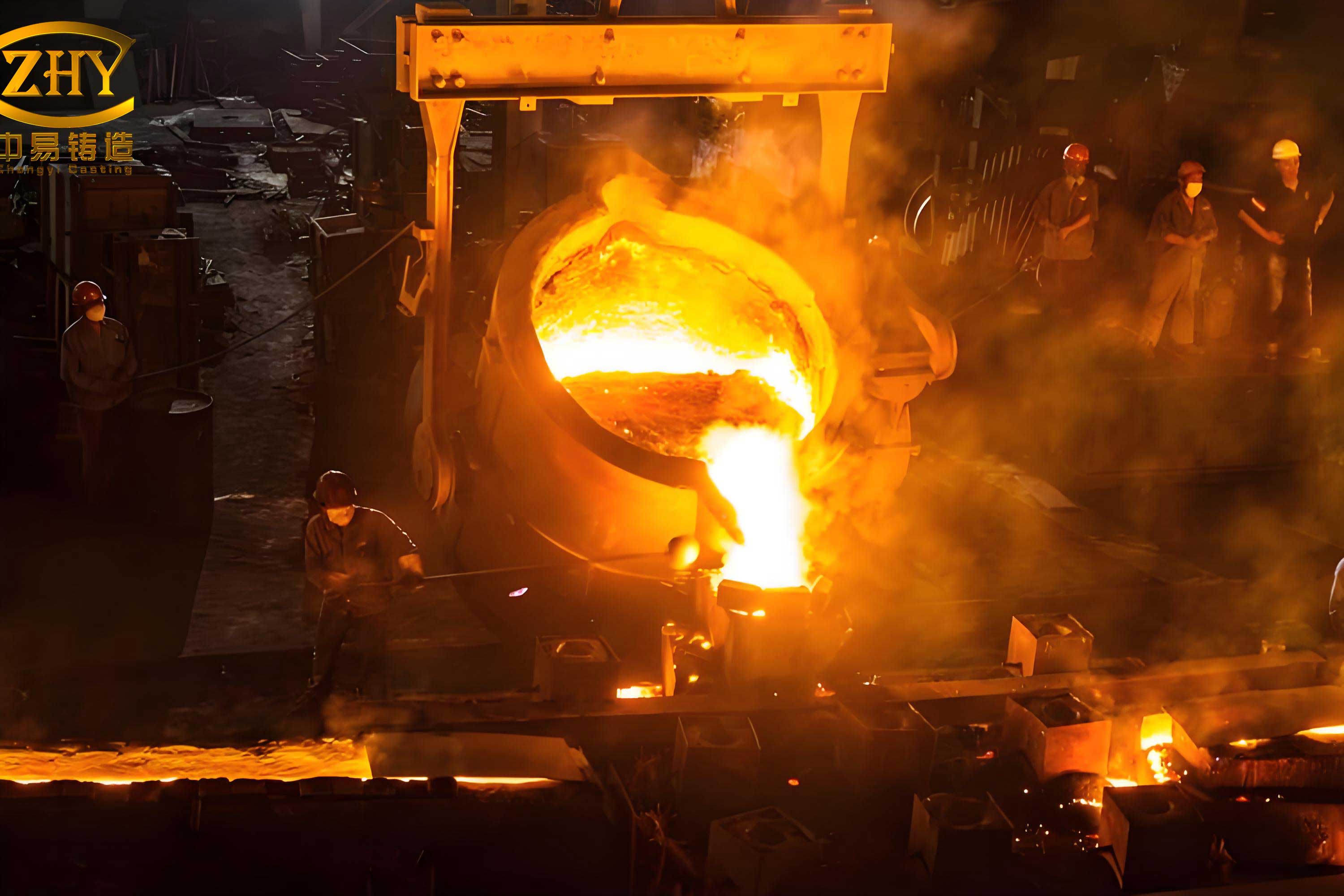
The journey of producing high-quality sand castings begins with understanding the intricate dance between molten metal and the sand mold. Defects are essentially the physical record of where this interaction faltered. For sand castings like the support socket, three primary adversaries are shrinkage porosity, gas porosity, and metal penetration (burn-on/roughness). Each has a distinct genesis, often interlinked with core process parameters.
1. Shrinkage Porosity: The Challenge of Solidification Feeding
Shrinkage defects in sand castings are cavities that form due to inadequate liquid metal feed to compensate for volumetric contraction during solidification. In our socket sand castings, these often manifest at thermal centers or hot spots, such as junction points of reinforcing ribs, appearing as irregular, dendritic cavities with rough surfaces. This defect critically reduces the load-bearing cross-section and acts as a stress concentrator.
The formation is fundamentally described by the solidification shrinkage, which is a characteristic of the alloy. For typical casting steels, the total volumetric shrinkage from pouring temperature to room temperature can be significant, often broken down as:
$$ \epsilon_{total} = \epsilon_{liquid} + \epsilon_{solidification} + \epsilon_{solid} $$
Where $\epsilon_{liquid}$ is the contraction of the superheated liquid, $\epsilon_{solidification}$ is the contraction during the liquid-to-solid phase change (typically ~3-4% for carbon steels), and $\epsilon_{solid}$ is the thermal contraction of the solid down to room temperature. The critical period for defect formation is during $\epsilon_{solidification}$.
The key to preventing shrinkage in sand castings is ensuring a continuous feed path of liquid metal from a reservoir (the riser) to the solidifying region until the entire casting is solid. This is governed by Chvorinov’s rule and the concept of feeding distance. The solidification time $t$ for a simple shape is approximated by:
$$ t = k \left( \frac{V}{A} \right)^n $$
where $V$ is volume, $A$ is surface area, $n$ is often taken as 2, and $k$ is the mold constant, heavily influenced by the properties of the sand mold material. For water glass sand, the high thermal stability and low collapsibility can sometimes increase $k$, affecting the solidification gradient necessary for directional solidification.
The primary factors leading to shrinkage in our socket sand castings and their mitigation are summarized below:
| Contributing Factor | Mechanism | Preventive Measure |
|---|---|---|
| Inadequate Riser Design | Riser volume/height insufficient to provide adequate metallostatic pressure and feed metal. Riser solidifies before the hot spot. | Use modulus method or simulation to design risers. Employ insulating/exothermic riser sleeves to delay solidification. Implement feeder neck design to ensure proper connection and isolation. |
| Poor Solidification Gradient | Sand casting geometry creates isolated hot spots with no feed path. Water glass sand’s low collapsibility can restrict natural contraction. | Optimize casting layout to promote directional solidification towards risers. Use chills (external or internal) to accelerate cooling at strategic locations, creating a defined thermal gradient. |
| High Pouring Temperature | Increases total liquid shrinkage and can widen the mushy zone, making feeding more difficult and increasing gas dissolution. | Adhere to “high temperature melting, low temperature pouring” principle. Determine and strictly control the optimal pouring temperature range for the specific sand casting geometry. |
| Alloy Characteristics | Certain alloys have wide freezing ranges, leading to pasty/mushy solidification, which impedes interdendritic feeding. | Enhance liquid metal quality through effective refining and degassing. Final deoxidation with aluminum must be controlled to avoid excessive oxide formation that can block feed paths. |
A critical practical step we enforce is the proper management of the riser during pouring. Once the metal reaches the riser neck, the pouring rate is reduced, and the riser is filled progressively. Maintaining a liquid top on the riser using exothermic or insulating toppings is crucial, as is the practice of “rodding” the riser to break any early solidified skin and enhance feeding efficiency under atmospheric pressure.
2. Gas Porosity: The Intrusion of Unwanted Phases
Gas porosity remains one of the most pervasive issues in sand castings. These spherical or elongated cavities with smooth, bright walls can be subsurface or surface-breaking, severely reducing fatigue life and pressure tightness. In sand castings produced with water glass-bonded molds, we typically confront two main types: precipitation (micro) porosity and inclusion (macro) porosity.
Precipitation Porosity arises from gases (primarily Hydrogen, Nitrogen, Oxygen) dissolved in the molten metal during melting. Upon solidification, their solubility drops precipitously. The solubility of hydrogen in liquid iron, for example, follows Sievert’s law:
$$ [H] = K_H \sqrt{p_{H_2}} $$
where $[H]$ is the dissolved concentration, $K_H$ is the temperature-dependent equilibrium constant, and $p_{H_2}$ is the partial pressure of hydrogen at the melt surface. During cooling and solidification, $K_H$ decreases, leading to supersaturation and bubble nucleation. The critical pressure for pore nucleation is given by:
$$ P_{crit} = P_{atm} + \rho g h + \frac{2\gamma}{r} $$
where $\rho g h$ is the metallostatic pressure and $\frac{2\gamma}{r}$ is the pressure due to surface tension $\gamma$ for a bubble of radius $r$. Tiny bubbles formed in the viscous mushy zone cannot float out, resulting in finely dispersed microporosity throughout the sand casting.
Inclusion (Blowhole) Porosity is caused by gases generated from the mold/core itself. Water glass sand, when contacted by hot metal, releases large volumes of gas from residual moisture, crystallization water, and decomposition of organic additives. If the mold permeability is insufficient or venting is inadequate, this gas can penetrate the solidifying metal skin, forming larger, often subsurface cavities. The rate of gas generation and the pressure buildup in the mold cavity are critical factors.
The following table contrasts the sources and controls for these gas-related defects in sand castings:
| Porosity Type | Primary Source | Key Preventive Strategies |
|---|---|---|
| Precipitation (Micro) | • Moist/rusty charge materials • Wet/unpreheated ladles/tools • Inadequate melt deoxidation & degassing • High pouring temperature |
• Use clean, dry charge materials and preheated tools (>200°C). • Implement effective furnace degassing (Argon purging, vacuum if available). • Controlled final deoxidation (Aluminum, CalciumSilicon). • Allow sufficient “killing” time in ladle for bubbles to float out. |
| Inclusion (Macro / Blowhole) | • High moisture/low permeability of sand mold. • Inadequate mold/core venting. • Excessive binder (water glass) content. • Turbulent mold filling entrapping air. |
• Optimize sand composition: control water glass addition (typically 4-6%), use coarser base sand for better permeability. • Ensure thorough and adequate mold venting using vent rods/channels, especially in deep pockets. • Apply mold/coating coatings to create a barrier and improve surface finish. • Design gating system for laminar, non-turbulent filling (e.g., tapered sprue, well-designed runner/gate system). |
From a practical standpoint, the control of gas porosity in sand castings is a multi-stage battle. It starts at the melt shop with rigorous charge control and ladle treatment, extends to the foundry floor with strict control over sand properties and mold venting practices, and culminates in a controlled, smooth pouring process.
3. Metal Penetration and Burn-On: When Sand and Metal Fuse
This defect, often called rough surface or burn-on, occurs when molten metal or metal oxides infiltrate the voids between sand grains to a significant depth, forming a tenacious, hard layer that is difficult to remove. It severely impacts the surface finish of sand castings and complicates subsequent machining and welding operations.
The mechanism is primarily one of capillary penetration. For infiltration to occur, the metallostatic pressure must overcome the opposing capillary pressure. The penetration depth $h$ can be modeled over time $t$ by:
$$ h = \sqrt{\frac{\gamma_{lv} \cos \theta \cdot D_p \cdot t}{4 \eta}} $$
where $\gamma_{lv}$ is the liquid metal surface tension, $\theta$ is the contact angle between metal and sand, $D_p$ is the average pore diameter (related to sand grain size and packing), and $\eta$ is the metal viscosity. High pouring temperature decreases $\eta$ and often modifies $\theta$, promoting penetration. Low mold strength or high porosity (large $D_p$) also facilitates it.
In water glass sand castings, a related phenomenon is chemical burn-on, where silicates in the binder react with iron oxides from the metal to form low-melting-point fayalite (Fe$_2$SiO$_4$) slags, which then wick into the sand matrix. The prevention strategy is therefore two-pronged: physical and chemical.
| Contributing Factor | Effect on Penetration | Preventive Measure |
|---|---|---|
| Low Mold Hardness/High Permeability | Creates large, interconnected pores offering easy paths for metal infiltration. | Achieve uniform, high mold compaction. Optimize sand distribution and ramming. Use appropriate sand grain distribution to reduce average pore size. |
| High Pouring Temperature | Lowers metal viscosity and increases thermal attack on sand, degrading its refractoriness. | Pour at the lowest temperature consistent with complete mold filling and good fluidity for the specific sand casting. |
| Inadequate Mold Coating | Lacks a refractory barrier between metal and sand grains. | Apply a consistent, high-refractoriness zircon- or alumina-based mold wash and ensure it is properly dried/cured before closing the mold. |
| Sand Composition | Sand with low inherent refractoriness or high binder content is more prone to chemical reaction and sintering. | Use high-purity silica sand with low clay content. Minimize water glass addition to the necessary minimum for adequate bond strength. Consider additives like iron oxide or coal dust to create a reducing atmosphere at the mold/metal interface. |
| Mold Cleanliness | Loose sand grains in the mold cavity become incorporated into the casting surface. | Thoroughly blow out the mold cavity with dry air before closing and pouring. |
4. Integrated Process Control: A Systems Approach to Quality Sand Castings
Defect prevention in sand castings cannot be achieved by addressing isolated parameters. It requires an integrated view of the entire process chain, from pattern design to finished heat treatment. Modern foundry practice leverages technology to move from empirical correction to predictive control.
Simulation-Driven Design: Casting simulation software is indispensable. It allows us to visualize mold filling, predict solidification patterns, identify probable hot spots for shrinkage, and assess temperature gradients before a single pound of sand is mixed. This enables virtual optimization of the gating and risering system for each unique sand casting geometry, drastically reducing the trial-and-error cost.
Process Parameter Monitoring & Data Analytics: Key parameters must be monitored and logged: sand properties (compactability, strength, moisture, LOI), melt chemistry and temperature, pouring temperature and speed, mold coating thickness. Statistical Process Control (SPC) charts for these variables help identify trends that precede defect outbreaks, enabling proactive intervention.
Material Science Advancements: The development of improved sand binders, including modified water glass systems with better breakdown properties, and high-performance mold coatings, directly addresses the core weaknesses of traditional materials. The exploration of alternative sands like chromite or zircon for critical facing layers can elevate the surface quality of demanding sand castings.
Lean Foundry Practices: Standardized work instructions, visual controls for mold venting and coating application, and a culture of root-cause problem-solving are the human and organizational foundations that ensure technological solutions are consistently applied. Every team member must understand their role in the “wall of quality” that protects the integrity of the final sand casting.
5. Conclusion: The Path to Robust Sand Castings
The production of flawless, high-duty sand castings, such as hydraulic support sockets, is a complex interplay of physics, chemistry, and engineering. Defects like shrinkage porosity, gas holes, and metal penetration are not random failures but direct consequences of specific process deviations. Through a deep understanding of the underlying mechanisms—solidification dynamics, gas solubility laws, and capillary penetration physics—we can transition from reactive troubleshooting to proactive process design.
The preventive measures outlined, from optimized riser design and rigorous melt treatment to controlled sand molding and intelligent pouring practices, form a comprehensive defense system. However, the future of defect-free sand castings lies in the integration of these traditional wisdoms with modern tools: predictive simulation, real-time process monitoring, and advanced materials. By embracing this holistic, technology-augmented approach, we can consistently produce sand castings that meet the most stringent mechanical and safety standards, ensuring the reliability of the critical machinery they constitute. The goal is a state of controlled predictability, where the quality of every sand casting is a guaranteed outcome of a precisely managed and thoroughly understood process.