
In my research, I encountered the significant challenge of producing a large, intricate stainless steel impeller for a pharmaceutical application. This component, characterized by its substantial diameter, numerous thin-walled, twisted blades, and demanding service conditions requiring high rotational speed and corrosion resistance, presented obstacles that conventional singular casting methods struggled to overcome. The pursuit of a reliable, cost-effective domestic production process led to the investigation and development of a compound molding technology, synergistically combining the strengths of precision investment casting and conventional sand castings.
The core problem lay in the impeller’s dichotomous geometry: a complex blade assembly requiring excellent surface finish and dimensional accuracy, and a relatively simple but bulky hub/spoke structure requiring effective feeding to prevent shrinkage defects. Traditional sand castings alone could not reliably reproduce the fine blade details and tight tolerances. Conversely, creating the entire impeller, including its massive thermal sections, as a monolithic investment casting was prohibitively expensive and posed challenges in shell strength and feeding control. The logical solution was a hybrid approach, where the geometrically demanding blade ring was produced via investment casting to form a precise shell, while the hub and spokes were formed using robust sand castings. These two mold components would then be assembled to create a complete compound mold cavity.
The fundamental theory applied here leverages the complementary advantages of each process. Investment casting provides superior surface finish (often reaching Ra 1.6-3.2 μm) and dimensional precision for complex shapes, as the mold is formed directly around a sacrificial wax pattern. The relationship between pattern material shrinkage and final casting dimension can be expressed as:
$$ D_{casting} = D_{pattern} \cdot (1 + S_{pattern} + S_{metal}) $$
where $D_{casting}$ is the final casting dimension, $D_{pattern}$ is the pattern dimension, $S_{pattern}$ is the linear shrinkage of the pattern material (e.g., 0.75%), and $S_{metal}$ is the linear shrinkage of the metal alloy. For the ZG1Cr18Ni9Ti stainless steel used, the total linear contraction can approach 2.2-2.6%.
Conversely, sand castings offer great flexibility in size, economical production of larger parts, and the ability to incorporate large, efficient feeding systems. The feeding requirement is governed by the modulus principle, where the solidification time $t_f$ is proportional to the square of the volume-to-surface area ratio (modulus, $M$):
$$ t_f \propto M^2 = \left(\frac{V}{A}\right)^2 $$
To prevent shrinkage porosity, the modulus of the riser $M_r$ must be greater than that of the casting section it feeds $M_c$, and the riser must provide sufficient liquid metal volume to compensate for the solidification contraction $\varepsilon$:
$$ V_r \geq \frac{V_c \cdot \varepsilon}{(\eta – \varepsilon)} $$
where $V_r$ is the riser volume, $V_c$ is the casting volume fed, $\varepsilon$ is the volumetric shrinkage (approximately 6% for this alloy), and $\eta$ is the riser efficiency. This principle was critical for designing the risers in the sand-cast hub section.
| Feature | Challenges for Singular Method | Advantages of Compound Method |
|---|---|---|
| Complex Blades (54 twisted, thin-walled) | Sand Casting: Difficulty in core making/assembly, poor surface finish, dimensional inaccuracy. Investment Casting: Very large ceramic shell for entire part, risk of shell cracking/failure, high cost. |
Investment-cast shell ensures precise blade geometry, excellent surface finish, and accurate blade positioning. |
| Bulky Hub & Spokes (Thermal Mass) | Sand Casting: Effective feeding possible with large risers. Investment Casting: Difficulty in placing sufficiently large ceramic-compatible feeders, high shell material cost for bulk. |
Sand castings allow for the economical creation of large-volume mold sections and the integration of robust, high-efficiency riser systems for soundness. |
| Overall Cost & Feasibility | Sand Casting: Lower tooling cost but high finishing cost and scrap risk. Investment Casting: Extremely high pattern and shell material cost for full part, potential for low yield. |
Optimizes cost by applying each process only where its benefits are indispensable, improving overall yield and economy. |
Based on this analysis, the compound process was defined. The impeller was conceptually divided at the inner diameter of the blade ring. The outer blade segment would be produced as an investment shell. The inner hub/spoke section, along with the mold cavity to accommodate the investment shell, would be produced via conventional sand castings. The final assembly would be a top-poured mold with risers positioned on the sand-cast sections.
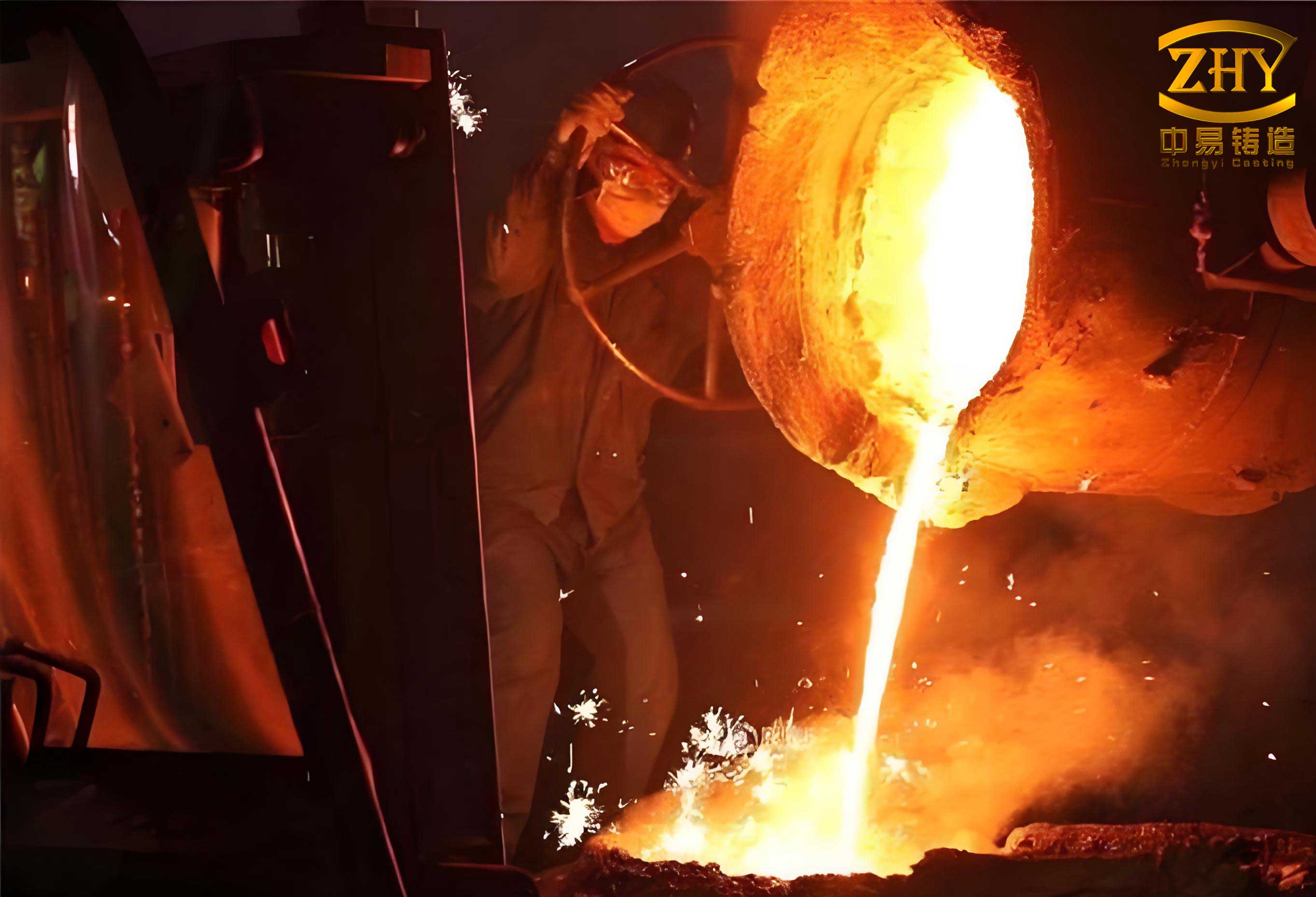
The figure above provides a visual representation of the sand castings process principle, which forms the foundational half of our compound mold strategy for creating the impeller’s core structure.
Process Design and Engineering
The success of this compound methodology hinged on meticulous design at every stage, from pattern making to mold assembly.
Investment Casting of the Blade Shell
1. Pattern Assembly: Given the blade count and precision required, a dedicated welding fixture was engineered. This fixture consisted of alignment rings and clamping mechanisms to hold individual wax blade patterns in their exact spatial orientation relative to a central hub fixture, ensuring the pitch and angular relationships were maintained within the specified 1° and 3 mm chord length tolerance. The assembly shrinkage was pre-compensated in the metal die used to produce the wax patterns.
2. Shell Building: To achieve a balance of cost, strength, and surface quality, a hybrid ethyl silicate (ES)-water glass (WG) binder system was adopted for the ceramic shell. The primary coats used ES binder with fine zircon flour for superior surface reproduction, while subsequent backup coats used WG binder with coarse silica sand for cost-effective build-up and strength. The shell build-up process can be summarized by the sequential coat application:
$$ Shell_{total} = \sum_{i=1}^{n}(Primer_{ES} + Backup_{WG})_i $$
Typically, 1-2 ES primer coats followed by 5-7 WG backup coats were applied to achieve the necessary thickness and green strength.
3. Shell Reinforcement & Firing: Due to the large, ring-like geometry of the blade shell, it was susceptible to distortion during handling and dewaxing. A reinforcement system was devised. A water glass-sand jacket, approximately 100mm thick, was built around the shell. Steel reinforcement bars with lifting lugs were embedded within this jacket, creating a rigid, transportable unit. This reinforced shell was then dewaxed using high-pressure steam and fired at 850°C to burn out residuals and develop final ceramic strength.
Sand Casting of the Hub/Spoke Mold
The sand castings for the hub and the cavity to receive the investment shell were produced as a single mold. A full wooden pattern included the impeller’s hub, spokes, and the negative space for the blade shell.
1. Molding Material: For the mold faces in contact with the molten stainless steel, a CO2-hardened water glass chromite sand was used. Chromite sand’s high chilling power and low reactivity with stainless steel helped produce a clean casting surface. The molding mixture’s composition was critical:
$$ M_{sand} = [Chromite Sand]_{100\%} + [Water Glass]_{3-4\%} + [Moisture]_{<2\%} $$
The backing mold was made with standard silica sand. The surfaces were coated with a zircon-based refractory paint to further enhance finish.
2. Gating and Risering Design: This was paramount for the soundness of the sand castings sections. Using the modulus method, risers were designed for the hub and the rim (where the spokes meet the blade ring). The hub acted as a major thermal center. Its modulus $M_c$ was calculated from its volume and surface area. A riser with a larger modulus $M_r$ was designed:
$$ M_r = 1.2 \times M_c $$
A standard elliptical top riser was selected. Its dimensions were derived from foundry manuals correlating modulus to riser geometry. Similarly, three risers were placed on the rim sections. The gating system was integrated into the hub riser, adopting a top-pouring approach to minimize oxide formation and promote directional solidification towards the risers. The filling time $t_{fill}$ was estimated using Bernoulli’s equation and controlled to be under 12 seconds to prevent mistun on the thin blades.
| Riser Location | Calculated Modulus (Mc) | Selected Riser Type | Dimensions (mm) | Quantity |
|---|---|---|---|---|
| Hub | ~2.48 cm | Elliptical Top Riser | 120 (W) x 180 (L) x 150 (H) | 1 (also serves as pouring cup) |
| Rim (at Spokes) | ~2.27 cm | Elliptical Top Riser | 110 (W) x 165 (L) x 150 (H) | 3 |
Mold Assembly: The Critical Interface
The final and most delicate step was the integration of the fired investment shell into the prepared sand mold cavity. Precise alignment was essential to ensure uniform wall thickness for the blades. Locating pins and registers were incorporated into both the sand mold and the reinforcing jacket of the investment shell. The shell was carefully lowered into its predefined seat in the drag (lower mold half). The core for the central bore was set. Finally, the cope (upper mold half), containing the impressions for the risers, was closed over the assembly. This created the complete compound cavity: the blade passages formed by the ceramic shell, and the hub/spoke cavity formed by the sand castings, all interconnected.
Metallurgy and Production
The material specification was ZG1Cr18Ni9Ti, an austenitic stainless steel prone to oxide film formation and significant solidification shrinkage. Melting was conducted in a medium-frequency induction furnace under a basic slag. Charge makeup, deoxidation practice, and temperature control were tightly managed. The final pouring temperature was maintained at 1580 ± 10°C. The molten metal was poured rapidly through the hub riser, ensuring quick filling of the thin blade sections in the investment shell, followed by a slower feed to top up the sand castings risers.
After cooling, the casting was knocked out. The sand castings sections were cleaned by standard shot blasting, while the intricate blade areas within the investment shell were cleaned via alkaline cleaning to avoid mechanical damage. The large risers, solidified onto the sand castings sections, were removed using oxy-acetylene torch cutting with vibration techniques suitable for stainless steel.
Heat treatment was essential to achieve optimal corrosion resistance and mechanical properties. A two-stage process was employed: first, a full solution treatment at 1050-1100°C followed by water quenching to dissolve carbides and achieve a homogeneous austenitic structure; second, a stabilization treatment at 850-950°C to precipitate titanium carbides preferentially, enhancing resistance to intergranular corrosion.
Results and Analysis
The implementation of this compound molding process proved highly successful. Over twenty impellers were produced with a 100% yield. Quality inspection confirmed:
- Dimensional Accuracy: The castings consistently achieved a dimensional tolerance grade of CT4 to CT5. Blade profile inspections showed chord length differences well below the 3 mm limit and angular deviations within 1°.
- Surface Quality: The blade surfaces, formed by the investment shell, exhibited a surface roughness of Ra 3.2 to 1.6 μm, requiring minimal finishing. The surfaces from the sand castings sections were also of good quality.
- Internal Soundness: Non-destructive testing (NDT) revealed no shrinkage porosity or hot tears in the hub and rim sections, validating the riser design in the sand castings. The blade areas were free from inclusions and mistuns.
- Mechanical Performance: Chemical composition and mechanical properties (tensile strength, yield strength, elongation) met all specification requirements. The impellers passed stringent overspeed tests (110% rated speed for 2 minutes) and dynamic balancing tests, confirming structural integrity and minimal inherent imbalance—a direct result of the precise blade placement afforded by the compound mold.
The economic benefit was substantial, with significant cost savings compared to fully imported parts or attempted monolithic investment casting, demonstrating the viability of hybridizing traditional sand castings with precision processes.
Conclusions
This research demonstrates that the compound molding technology, integrating investment casting for complex features and traditional sand castings for bulky, feeding-critical sections, is a robust and economically viable solution for manufacturing large, intricate cast components like high-performance stainless steel impellers. The key to success lies in:
- Strategic geometric partitioning of the component based on functional and manufacturability requirements.
- Precision engineering of the interface and alignment systems between the ceramic shell and the sand mold.
- Rigorous application of solidification feeding principles (modulus method) to the design of the risering system within the sand castings portions.
- Integrated process control across both molding disciplines, from pattern and shell-making to metallurgy and heat treatment.
This approach effectively overcomes the limitations of singular casting methods, unlocking the production capability for a class of components that sit at the intersection of geometric complexity, stringent quality demands, and large scale. It presents a compelling model for advancing casting technology by the intelligent, non-traditional combination of established processes like sand castings and investment casting.