
In my extensive experience with foundry processes, the occurrence of porosity defects in sand castings remains a persistent challenge that can severely compromise the structural integrity and performance of cast components. Among these defects, endogenous reaction porosity is particularly insidious, as it originates from within the molten metal itself during solidification, often going undetected until machining or failure. This article delves deeply into the formation mechanisms, visual characteristics, and, most importantly, the effective preventive measures for endogenous reaction porosity in sand castings. I will structure this discussion to provide a thorough, practical guide, utilizing tables and chemical formulas to clarify complex interactions. The focus will remain squarely on sand castings, a versatile and widely used molding method, and the keyword ‘sand castings’ will be frequently reiterated to underscore its centrality to the topic.
The sand casting process, where a mold is formed from compacted sand, is fundamental to metalworking. However, the very nature of molten metal solidification in such molds can lead to various gas-related defects. Endogenous reaction porosity is distinct from other gas pores because it results from chemical reactions between elements dissolved in the melt or between dissolved compounds. Unlike exogenous pores from mold gases, these are born from the metal’s own chemistry. Understanding this defect is crucial for producing high-quality sand castings.
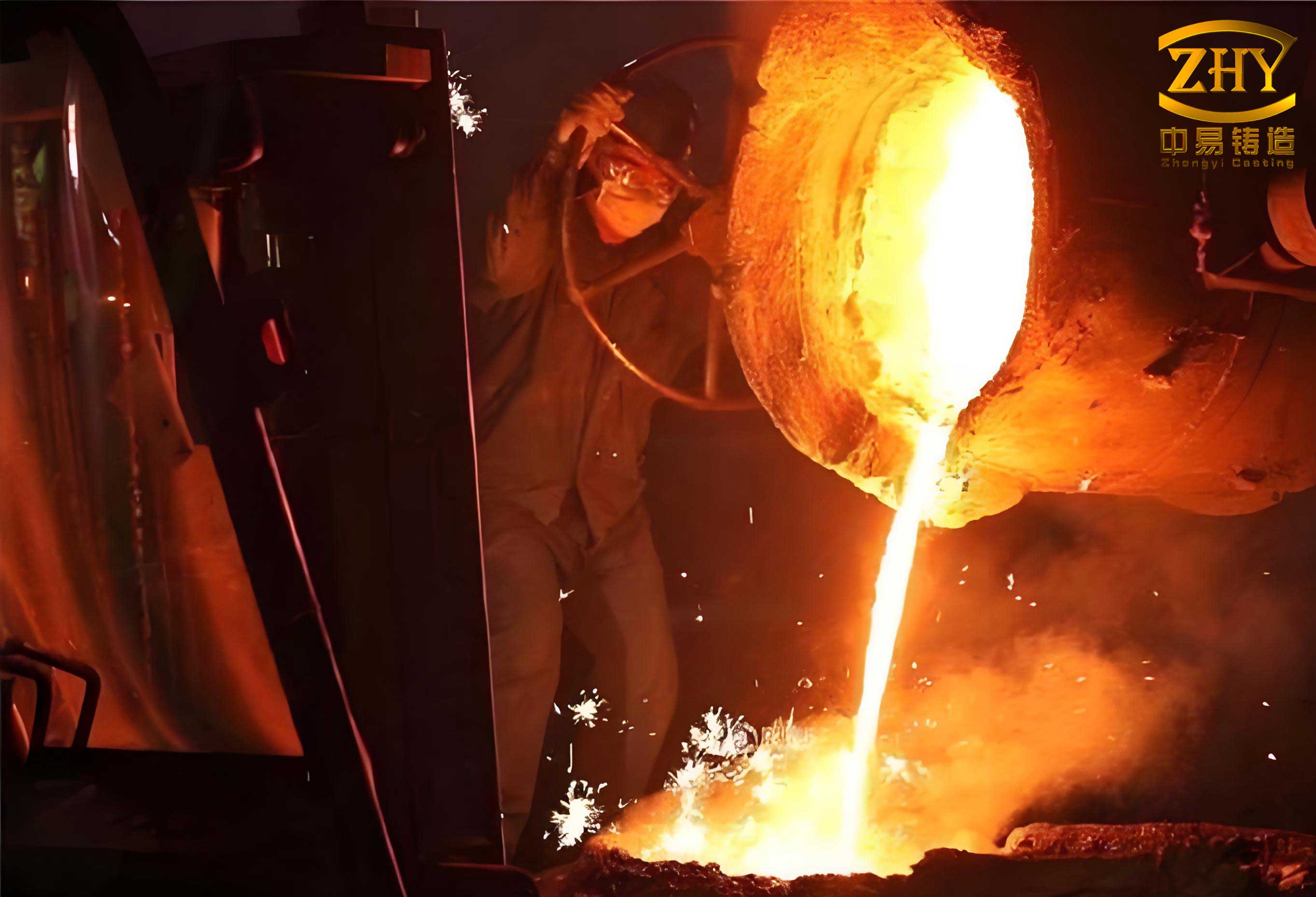
Before analyzing the mechanisms, it is vital to accurately identify endogenous reaction porosity. In my observations across numerous sand castings production runs, these defects exhibit a consistent set of visual traits that differentiate them from shrinkage cavities, subsurface blowholes, or dispersed microporosity.
| Characteristic | Description | Distinguishing Feature from Other Defects |
|---|---|---|
| Size and Shape | Pores are relatively large, often several millimeters in diameter. Shapes are irregular: spherical, elongated, or complex cavities. | Larger than typical hydrogen microporosity; more irregular than neat spherical bubbles from mold gas. |
| Distribution | Dispersed or clustered throughout the entire cross-section of the casting. They are truly internal defects. | Not localized to hot spots (like shrinkage) or just below the surface (like some blowholes). |
| Pore Wall Appearance | Walls are smooth and often exhibit a bright, metallic luster, though oxidation can occur if exposed. | Smoother than the dendritic walls of shrinkage cavities. |
| Location | Primarily internal. They are frequently revealed only after machining, appearing as a honeycomb pattern on the machined surface. | Contrasts with surface-breaking defects. A full cross-section check confirms it’s not just subsurface. |
| Pattern of Occurrence | Exhibits “heat-wide” or “ladle-wide” characteristics. All sand castings poured from the same heat or ladle of metal tend to be affected. | Indicates a problem intrinsic to the melt chemistry, not random mold variables. |
| Associated Phenomena | Risers or sprue tops may show a raised or “cauliflower” head due to gas evolution during solidification. | Similar to defects caused by gas precipitation, but pore size is key differentiator. |
This defect is a so-called “running defect,” meaning its root cause lies in the molten metal batch. Therefore, whether green sand or dry sand molds are used for these sand castings, the defect will manifest if the metal condition is wrong. Misdiagnosis is common, so careful analysis against Table 1 is essential.
The core of the problem lies in the chemical reactions during the solidification stage of sand castings. As the metal cools and crystals form, solute elements are rejected into the remaining liquid, enriching it. If certain reactive species are present in high concentrations, they can interact to form gases that are essentially insoluble in the solidifying metal. Two primary reactions dominate this phenomenon in ferrous and non-ferrous sand castings respectively.
Formation Mechanism: Endogenous CO Reaction Porosity
This type is most prevalent in steel sand castings, though it can also occur in low-carbon-equivalent white iron castings. The fundamental cause is inadequate deoxidation of the steel melt before pouring.
During solidification of sand castings, the solubility of gases like oxygen and carbon decreases sharply. In a poorly deoxidized steel, the dissolved oxygen content [O] is high. At the solid-liquid interface, the liquid ahead of the front becomes enriched with both carbon [C] and oxygen [O]. When their concentration product exceeds the equilibrium constant for the formation of carbon monoxide at the solidification temperature, the following reaction is triggered in the liquid enriched zone:
$$ [C] + [O] \rightarrow CO_{(g)} $$
Carbon monoxide gas has negligible solubility in steel. Nucleation of CO bubbles readily occurs at imperfections like interdendritic grooves. Once nucleated, other dissolved gases like hydrogen [H] and nitrogen [N] diffuse into the bubble, promoting its growth. Since this occurs during the advanced stages of solidification in the sand casting mold, the bubbles are trapped, forming large, dispersed pores. The reaction is often represented in a simplified form involving iron oxide:
$$ [C] + FeO_{(dissolved)} \rightarrow Fe_{(l)} + CO_{(g)} $$
The severity is linked to initial oxygen content. Electric arc furnace steel, for example, can have dissolved oxygen levels of 30-300 ppm, whereas well-deoxidized steel might have less than 10 ppm. The higher the [O] and [C] in the final liquid, the more vigorous the CO evolution. This reaction is also possible in certain copper-nickel alloy sand castings where carbon is present as an impurity or intentional addition.
Formation Mechanism: Endogenous Water Vapor (H₂O) Reaction Porosity
This form plagues copper-based sand castings, especially pure copper and certain tin bronzes (e.g., gunmetals). The culprit is a combination of dissolved cuprous oxide (Cu₂O) and hydrogen [H] in the melt.
During melting, copper can react with water vapor in the furnace atmosphere: $$ 2Cu + H_2O \rightleftharpoons Cu_2O + 2[H] $$ Both products dissolve into the copper. Electrolytic copper cathode can also introduce hydrogen. If the melt is not properly deoxidized to remove Cu₂O, then during solidification of the sand casting, the reverse reaction occurs, generating water vapor bubbles within the casting:
$$ Cu_2O + 2[H] \rightleftharpoons 2Cu + H_2O_{(g)} $$
The equilibrium constant for this reaction is temperature-dependent, favoring the right side (gas formation) as temperature drops during solidification. The generated H₂O gas bubbles, like CO, become trapped, creating the characteristic large, shiny pores. The problem is exacerbated in sand castings because the mold atmosphere can sometimes contribute moisture, but the primary source is the melt itself.
To further illustrate the conditions leading to these defects, consider the following summary table of causative factors specific to sand castings:
| Metal System | Critical Dissolved Species | Triggering Reaction | Critical Influence Factors |
|---|---|---|---|
| Steel & High-C Iron Sand Castings | High [O], High [C] | $$ [C] + [O] \rightarrow CO $$ | Deoxidation practice, Final Al content, Pouring temperature. |
| Copper & Bronze Sand Castings | High Cu₂O, High [H] | $$ Cu_2O + 2[H] \rightarrow 2Cu + H_2O $$ | Furnace atmosphere (moisture), Use of wet charge materials, Deoxidation practice. |
| Aluminum Sand Castings* | High [H], Oxide Inclusions | $$ 2Al + 3H_2O \rightarrow Al_2O_3 + 6[H] $$ (Hydrogen pickup) Reaction with moisture to form pores. | Melt humidity, Fluxing efficiency, Degassing treatment. |
*Note: While aluminum sand castings are more prone to hydrogen precipitation porosity, reaction with oxides can also contribute to endogenous-type pores.
Having established the mechanisms, the focus shifts to prevention and cure. The strategies are proactive, aimed at controlling melt chemistry before the metal ever enters the sand casting mold.
Preventive Measures for CO Reaction Porosity in Steel Sand Castings
The goal is to reduce the dissolved oxygen content to a level where the product [%C][%O] remains below the equilibrium value throughout solidification. This is achieved through sequential deoxidation.
- Primary Deoxidation: Use strong deoxidizers like ferrosilicon (FeSi) and ferromanganese (FeMn) in the ladle. These form stable oxides (SiO₂, MnO) that float out as slag.
- Final (Killing) Deoxidation: Add aluminum just before tapping or in the ladle. Aluminum is a powerful deoxidizer: $$ 2[Al] + 3[O] \rightarrow Al_2O_3_{(s)} $$ The alumina particles must be given time to float out or be trapped by the slag. Residual dissolved aluminum of 0.02-0.06% is common to ensure “killed” steel. This can lower dissolved oxygen to 2-5 ppm, effectively suppressing the CO reaction in subsequent sand castings.
- Process Control: Avoid re-oxidation during tapping and pouring. Use ladle shrouds and protective atmospheres. Control pouring temperature—too high a temperature can increase gas solubility and shift equilibria unfavorably.
A useful empirical relationship for the equilibrium in liquid iron is: $$ K_{CO} = \frac{a_{CO}}{a_{[C]} \cdot a_{[O]}} \approx \frac{P_{CO}}{[\%C] \cdot [\%O]} $$ Where at a given temperature, K_CO is constant. For a CO partial pressure of 1 atm, the product [%C][%O] is fixed. Deoxidation aims to lower [%O] so this product is never exceeded in the solidifying sand casting.
Preventive Measures for H₂O Reaction Porosity in Copper Alloy Sand Castings
The strategy here is dual: remove hydrogen and remove oxygen (as Cu₂O). A unique approach for pure copper and some alloys is “oxidation-deoxidation.”
- Oxidative Refining (Dehydrogenation): For alloys not containing easily oxidized elements like Al or Si, an oxidizing flux can be used. The flux, containing compounds like CuO or MnO₂, releases oxygen into the melt. This oxygen combines with dissolved hydrogen to form water vapor, which escapes:
$$ Cu_2O + 2[H] \rightarrow 2Cu + H_2O_{(g)} \quad \text{(driven to the right by excess O)} $$
Or via manganese oxides:
$$ 2MnO_2 \rightleftharpoons Mn_2O_3 + [O] $$
$$ Mn_2O_3 + 2[H] \rightleftharpoons 2MnO + H_2O_{(g)} $$
This process “boils” the melt, removing hydrogen. The cover flux also helps remove other impurities. - Deoxidation: After skimming the oxidizing slag, the melt now has high Cu₂O content. It must be deoxidized using phosphorus-copper (Cu-P) or lithium. For example: $$ 5Cu_2O + 2P \rightarrow 10Cu + P_2O_{5(g)} $$ The P₂O₅ gas escapes. This yields a melt low in both [H] and Cu₂O, safe for pouring into sand castings.
- Alternative Methods: For alloys containing Al, Si, etc., oxidative refining cannot be used. Instead, inert gas flushing (e.g., nitrogen or argon) or vacuum degassing are employed to remove hydrogen. Subsequently, careful deoxidation is performed. Always use dry, preheated charge materials and tools to minimize hydrogen pickup in all copper sand castings operations.
To synthesize these complex procedures, the following table offers a step-by-step guide for melt treatment targeting defect-free sand castings.
| Alloy Type for Sand Castings | Stage 1: Melting & Initial Condition | Stage 2: Refining / Degassing | Stage 3: Final Deoxidation & Adjustment | Stage 4: Pouring Practice |
|---|---|---|---|---|
| Carbon & Low-Alloy Steel | Melt under controlled atmosphere. Aim for low initial oxygen. | Slag off oxidizing slag after melting. Consider argon stirring for homogenization. | Add FeSi, FeMn, then Al for final kill. Aim for 0.03-0.05% residual Al. | Pour quickly without turbulence. Use hot molds to reduce thermal gradient. |
| Pure Copper & Sn-Pb Bronzes | Melt clean, dry charge. Can start with slightly oxidizing conditions. | Add oxidizing flux (CuO/MnO₂ + flux). Hold for “boiling” to remove H₂. Skim slag completely. | Deoxidize with P-Cu (0.02-0.04% P residual) or Li. Check with a reduced test bar. | Pour immediately after deoxidation. Maintain ladle cover. |
| Aluminum Bronze, Silicon Bronze | Melt under neutral/ slightly reducing cover (charcoal). | Degas with dry nitrogen or argon lance. Flux to remove oxides. | Deoxidize if necessary (for Cu₂O), but often the alloying elements (Al, Si) act as deoxidizers. | Standard sand casting practice. Ensure mold venting is adequate. |
The principles of thermodynamics govern these reactions. For the CO reaction in steel sand castings, the equilibrium constant is: $$ \log K_{CO} = \log \left( \frac{P_{CO}}{a_C \cdot a_O} \right) = -\frac{1160}{T} – 2.003 $$ where T is in Kelvin, a_C and a_O are activities of carbon and oxygen. Practically, this means that at a typical steel pouring temperature of 1600°C (1873 K), the product [%C][%O] for P_CO = 1 atm is approximately 0.0025. If the local concentrations in the solidifying liquid exceed this, pore formation is imminent. Effective deoxidation pushes the actual [%O] far below this threshold.
Similarly, for copper sand castings, the equilibrium for the water vapor reaction is: $$ K_{H_2O} = \frac{P_{H_2O}}{a_{Cu_2O} \cdot (a_H)^2} $$ The value of K increases with temperature, meaning the reaction producing H₂O is favored at lower temperatures—exactly during solidification. Therefore, reducing both Cu₂O activity (by deoxidation) and hydrogen activity (by degassing) is essential to lower P_H₂O below the critical pressure for bubble formation in the constrained sand casting mold.
Beyond these core reactions, other endogenous gas reactions can occur in specialized sand castings. For instance, in ductile iron, reactions involving magnesium vapor or sulfide/oxide inclusions can create pores. In aluminum sand castings, the reaction between aluminum and water vapor to form hydrogen and alumina is a primary source of hydrogen pickup, which can then precipitate as pores. The governing reaction is: $$ 2Al + 3H_2O \rightarrow Al_2O_3 + 6[H] $$ The hydrogen then recombines and precipitates during solidification. While often classified as precipitation porosity, the initial chemical reaction is endogenous in nature. Control involves using dry tools, efficient degassing with rotary impellers or salts, and avoiding overly turbulent transfer of the metal into the sand casting mold.
Implementation of these measures requires robust process control. In modern foundries producing sand castings, techniques like spectral analysis for chemistry, reduced pressure tests (for aluminum hydrogen content), and thermal analysis are used to monitor melt quality before pouring. For critical sand castings, computer simulations of solidification coupled with thermodynamic databases can predict regions where solute enrichment might trigger gas reactions, allowing for design modifications like chilling or optimized risering.
It is also worth discussing the role of the mold itself in the broader context. While endogenous porosity originates in the melt, the sand mold’s properties—permeability, binder type, moisture content—influence the back-pressure against which any internally generated gas must expand. A low-permeability mold in sand castings can increase the local pressure, potentially suppressing pore formation slightly, but it is never a substitute for proper melt treatment. Conversely, a mold with high gas generation from binders can add exogenous gas pressure, complicating the defect morphology.
In conclusion, the battle against endogenous reaction porosity in sand castings is won at the melting and holding stages. The key takeaways from my analysis are: First, accurate identification based on visual characteristics is paramount to diagnose the specific reaction type. Second, the root cause always traces back to an imbalance in the dissolved reactive species in the melt—oxygen and carbon in ferrous sand castings, or cuprous oxide and hydrogen in copper-based sand castings. Third, prevention is strictly metallurgical, involving sequenced deoxidation, degassing, and careful control of furnace atmosphere and charge materials. There is no effective remedial action once the sand casting has solidified; the focus must be on proactive melt quality management. The production of sound, high-integrity sand castings demands a deep understanding of these underlying chemical principles and their practical application. By integrating thermodynamic knowledge with disciplined foundry practice, manufacturers can consistently produce sand castings free from the costly and hazardous defects of endogenous reaction porosity.