
As a researcher in the field of metal casting, I have extensively studied the challenges associated with producing high-quality components via sand casting processes. In this article, I will delve into the optimization of sand casting for brake discs, a critical automotive part where internal integrity is paramount. Sand castings are widely utilized due to their cost-effectiveness and flexibility for various production scales, but they often contend with defects like gas porosity and shrinkage cavities. Through first-person insights, I will explain how numerical simulation tools, specifically Procast, can be employed to analyze and refine sand casting processes, ensuring that sand castings meet stringent quality standards. The focus will be on brake discs, which require defect-free working surfaces for safety and performance. I will incorporate tables and formulas to summarize key aspects, and emphasize the term ‘sand castings’ throughout to underscore its relevance.
The automotive industry’s demand for brake discs has surged, necessitating efficient and reliable manufacturing methods. Sand castings are a preferred choice for these components because of their adaptability to complex geometries and material versatility. However, sand castings can exhibit typical defects such as gas entrapment and shrinkage, which are unacceptable in brake discs due to safety concerns. In my work, I address these issues by leveraging simulation-based optimization. The brake disc in question, used in recreational vehicles, features thin walls averaging 20 mm and a hub with protrusions, making it challenging for sand casting processes. The constraints of a continuous casting line further complicate the gating design, as vertical pouring is mandated with limited space for risers and chills. Thus, optimizing sand castings for this application requires meticulous analysis.
To begin, I employed Procast software for numerical simulation of the filling and solidification stages in sand castings. This approach allows for visualizing defect formation and understanding underlying causes. The initial process involved designing a gating system with ingates positioned at the bottom of the brake disc at a 45-degree angle, incorporating easy-cut runners to reduce machining costs. The material was HT250 cast iron, poured at 1,410°C into resin sand molds at room temperature. Key parameters, such as the heat transfer coefficient between the mold and casting set at 530 W/(m²·K), were defined. The simulation revealed critical issues: turbulence in the runner led to gas entrainment, and the thin-walled geometry caused rapid solidification at the edges, trapping gas and creating porosity on the working surface. Additionally, shrinkage defects were predicted in the thicker hub region due to unfavorable solidification sequences. These findings align with experimental observations, where gas holes were found on the brake disc’s working surface, validating the simulation’s accuracy for sand castings.
Based on this analysis, I proposed an optimized gating system for sand castings. The modifications included elongating the runner to reduce sudden width changes and reorienting the ingates from a 45-degree upward angle to a horizontal entry. This design promotes smoother metal flow and enhances gas venting, addressing the root cause of defects in sand castings. The simulation of the optimized process showed平稳 filling without gas entrainment, as depicted in the flow field results. Solidification analysis indicated that the hub remained the last-to-freeze area, but porosity levels were within acceptable limits (below 0.098 porosity fraction). Experimental trials confirmed that the optimized sand casting process eliminated gas defects on the working surface, producing brake discs that met quality requirements. This demonstrates the efficacy of simulation-driven optimization for sand castings.
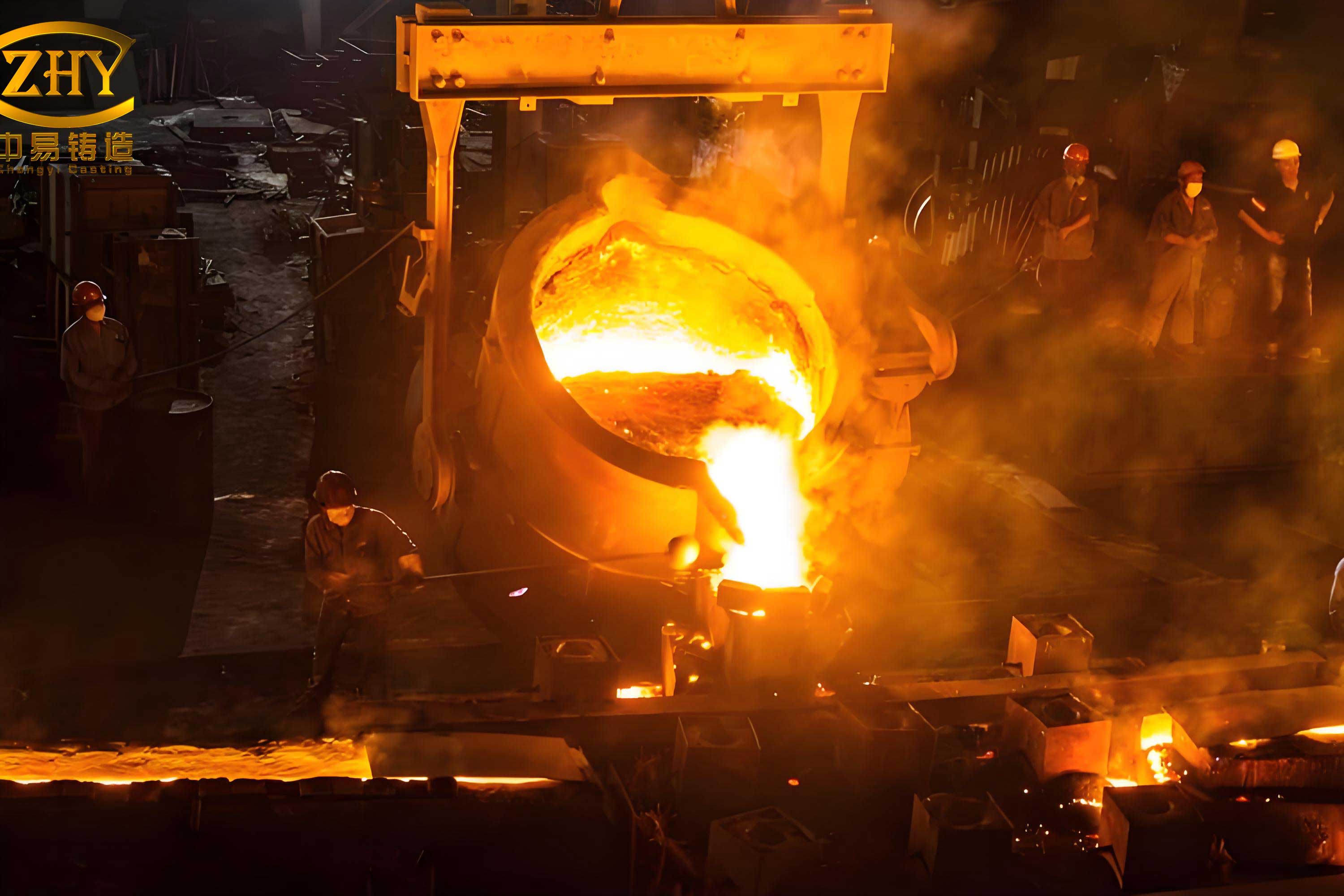
To quantify the improvements, I have summarized key material properties and process parameters in tables. For instance, Table 1 outlines the properties of HT250 used in sand castings, while Table 2 compares original and optimized gating dimensions. These tables highlight how adjustments in sand casting processes impact defect formation. Additionally, mathematical models play a crucial role in simulating sand castings. The heat transfer during solidification can be described by Fourier’s law, where the temperature distribution T(x,t) satisfies the partial differential equation: $$ \frac{\partial T}{\partial t} = \alpha \nabla^2 T $$ Here, $\alpha$ is the thermal diffusivity, which depends on material properties specific to sand castings. For porosity prediction, the Niyama criterion is often applied, expressed as: $$ G / \sqrt{R} \leq C $$ where G is the temperature gradient, R is the cooling rate, and C is a constant threshold. In sand castings, this criterion helps identify shrinkage-prone regions. By integrating such formulas into simulations, we can optimize sand casting parameters to minimize defects.
| Property | Value | Unit |
|---|---|---|
| Density | 7,200 | kg/m³ |
| Thermal Conductivity | 46 | W/(m·K) |
| Specific Heat | 500 | J/(kg·K) |
| Liquidus Temperature | 1,150 | °C |
| Solidus Temperature | 1,100 | °C |
Further details on process conditions are provided in Table 2, which contrasts the original and optimized sand casting setups. This comparison underscores the importance of gating design in sand castings. The optimized runner length increased from 100 mm to 150 mm, and the ingate angle changed from 45° to 0° (horizontal). These alterations reduced flow velocity and promoted degassing, critical for high-quality sand castings. Simulation results for defect propensity are summarized in Table 3, showing a significant reduction in gas porosity and shrinkage in the optimized sand casting process. Such data-driven approaches are essential for refining sand castings in industrial applications.
| Parameter | Original Process | Optimized Process |
|---|---|---|
| Runner Length | 100 mm | 150 mm |
| Ingate Angle | 45° upward | 0° horizontal |
| Ingate Cross-Section | Rectangular, 20 mm × 10 mm | Rectangular, 20 mm × 10 mm |
| Pouring Temperature | 1,410°C | 1,410°C |
| Mold Material | Resin Sand | Resin Sand |
The solidification behavior in sand castings can be modeled using energy conservation principles. The total heat released during phase change is given by: $$ Q = m \cdot L_f $$ where m is the mass of the casting and L_f is the latent heat of fusion. For sand castings, this heat must be dissipated through the mold, influencing cooling rates. In the brake disc case, the thin walls lead to high cooling rates, which can be approximated by: $$ R = \frac{T_p – T_m}{t_s} $$ where R is the cooling rate, T_p is the pouring temperature, T_m is the mold temperature, and t_s is the solidification time. Optimizing sand castings involves balancing these rates to avoid defects. My simulations incorporated these equations to predict temperature fields and defect locations, guiding the redesign of the gating system for sand castings.
| Defect Type | Original Process Severity | Optimized Process Severity |
|---|---|---|
| Gas Porosity on Working Surface | High (visible holes) | Negligible |
| Shrinkage in Hub Region | Moderate (porosity ~0.15) | Low (porosity <0.098) |
| Turbulence in Runner | Significant | Minimal |
In my experience, sand castings require continuous improvement to address evolving industry demands. The optimization process for brake discs involved iterative simulations, each refining the gating design to enhance metal flow and solidification patterns. For example, I evaluated different ingate configurations using Procast’s fluid dynamics module, which solves the Navier-Stokes equations for incompressible flow: $$ \rho \left( \frac{\partial \mathbf{v}}{\partial t} + \mathbf{v} \cdot \nabla \mathbf{v} \right) = -\nabla p + \mu \nabla^2 \mathbf{v} + \mathbf{f} $$ where $\rho$ is density, $\mathbf{v}$ is velocity, p is pressure, $\mu$ is viscosity, and $\mathbf{f}$ represents body forces. In sand castings, minimizing velocity gradients reduces turbulence and gas entrapment. The optimized horizontal ingates yielded lower velocities, as calculated from simulation data, proving beneficial for sand castings.
Moreover, the thermal analysis of sand castings considers the mold’s role as a heat sink. The heat flux across the mold-casting interface is expressed as: $$ q = h (T_c – T_m) $$ where q is the heat flux, h is the heat transfer coefficient (530 W/(m²·K) in this case), T_c is the casting surface temperature, and T_m is the mold temperature. For sand castings, varying h can simulate different mold materials or coatings. In my work, I maintained constant h to focus on gating effects. The results showed that the optimized design promoted directional solidification toward the hub, reducing isolated hot spots and mitigating shrinkage in sand castings.
To further elaborate on sand castings, I discuss the importance of venting in mold design. Gas evolution during pouring can originate from binder decomposition in resin sand, a common issue in sand castings. The ideal gas law relates pressure and volume: $$ PV = nRT $$ where P is pressure, V is volume, n is moles of gas, R is the gas constant, and T is temperature. In sand castings, inadequate venting increases P, forcing gas into the molten metal. My optimized gating system included larger vents near the ingates, calculated based on simulated gas accumulation rates. This practical adjustment, derived from simulation insights, significantly improved the quality of sand castings.
The economic implications of optimizing sand castings are also noteworthy. By reducing defect rates, manufacturers can lower scrap costs and enhance productivity. For brake discs, each casting must undergo machining, so minimizing defects saves time and resources. My optimized process reduced gas porosity to near zero, as confirmed by radiographic testing of experimental castings. This aligns with industry trends toward lean manufacturing and sustainable sand castings. Additionally, simulation tools like Procast enable virtual prototyping, cutting down on physical trials and material waste in sand castings.
In conclusion, my first-person analysis demonstrates that numerical simulation is a powerful tool for optimizing sand casting processes. For brake discs, the original gating design caused gas entrainment and shrinkage due to turbulence and unfavorable solidification. By reconfiguring the runner and ingates to promote平稳 flow and better venting, the optimized sand casting process eliminated defects on the working surface and controlled shrinkage in the hub. Tables and formulas presented here summarize key parameters and theoretical foundations, reinforcing the importance of data-driven approaches. Sand castings, when properly designed and simulated, can achieve high integrity and performance, meeting the stringent requirements of automotive applications. This work underscores the value of continuous innovation in sand castings to drive quality and efficiency in manufacturing.
Looking ahead, I plan to explore advanced materials and cooling techniques for sand castings, such as using exothermic sleeves or controlled cooling rates. The integration of artificial intelligence with simulation software could further automate optimization for sand castings. As the demand for lightweight and durable components grows, sand castings will remain a vital process, and my research aims to contribute to its evolution. Through persistent refinement and simulation-backed design, sand castings can continue to deliver reliable solutions for complex parts like brake discs.