
The industrial landscape is replete with components operating under severe thermochemical and mechanical stress, demanding materials and manufacturing processes that transcend conventional limits. One such critical application involves large-diameter piping systems for high-temperature gas conveyance, where traditional materials like gray iron or fabricated steel often succumb to premature failure. This narrative details my first-hand experience and methodological approach in developing a robust solution: the production of large-diameter, thin-wall ductile iron pipes via sand casting technology. The journey underscores the intricate interplay between material science, process engineering, and the unique capabilities of sand castings to meet extraordinary service demands.
The operational challenge was starkly clear. The piping system, with an internal diameter exceeding 500 mm and a wall thickness of only 12 mm, was subjected to a punishing regime. It carried abrasive, ash-laden semi-water gas at temperatures around 300°C, interspersed with periodic water quenching for process control. This cyclic thermal shock, coupled with inherent corrosion, led to frequent fatigue cracking in the original gray iron sand castings. Subsequent trials with welded steel pipes lined with refractory materials also failed, typically within a year, due to lining degradation and shell penetration. The resultant maintenance overhead, production losses, and safety concerns necessitated a fundamental redesign of both material and manufacturing approach.
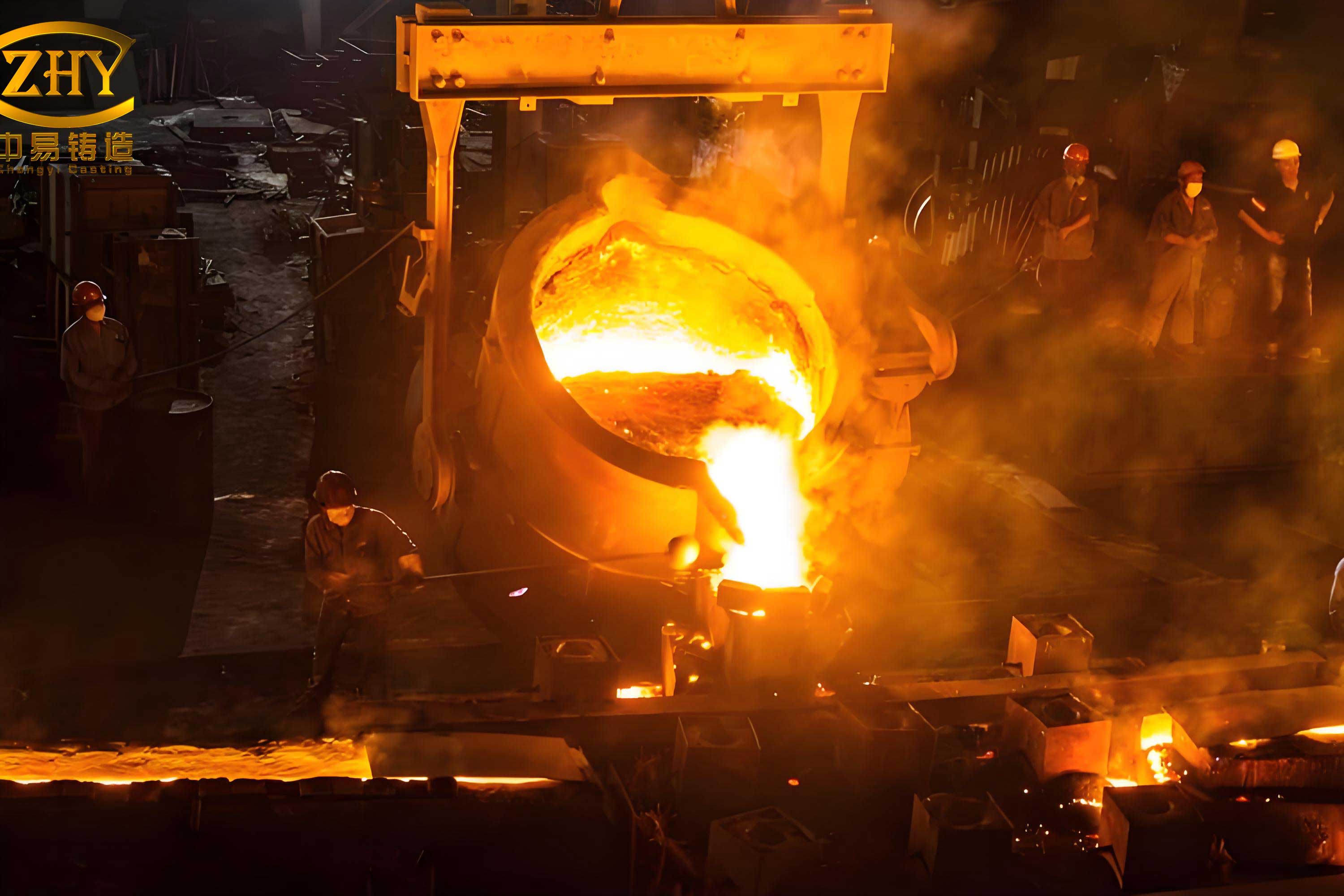
1. Material Selection: The Case for As-Cast Ductile Iron
The selection of ductile iron (nodular graphite iron) was driven by a comparative analysis of material properties relevant to the failure modes. Gray iron, while possessing good castability and damping capacity, has limited tensile strength, negligible ductility, and poor fatigue resistance due to the stress-concentrating nature of its flake graphite. Carbon steel offers superior strength and toughness but is generally more susceptible to uniform corrosion in such environments, and fabricating thin-wall, large-diameter sections with consistent properties presents its own challenges.
Ductile iron emerges as the optimal compromise, offering a synergistic combination of properties ideal for sand castings in demanding service:
- High Strength and Modulus: The spherical graphite nodules blunt crack initiation, yielding tensile strengths comparable to many cast steels.
- Substantial Ductility and Toughness: Elongation values typically between 10-18% in the ferritic-pearlitic grades provide tolerance for thermal strain and minor mechanical abuse.
- Superior Fatigue Resistance: The rounded graphite morphology significantly improves fatigue life over gray iron under cyclic loading.
- Excellent Corrosion and Wear Resistance: The high carbon content and graphite phase can offer better resistance to certain types of corrosive and abrasive wear compared to steel.
- Inherent Castability: The fluidity and shrinkage characteristics of ductile iron are well-suited for producing complex, thin-section sand castings.
To maximize economic efficiency and minimize process steps, the target was set to achieve the required mechanical properties directly in the as-cast condition, eliminating the need for a separate hardening or normalizing heat treatment. This placed stringent demands on the entire production chain, from charge makeup to pouring.
2. Foundry Process Design for Thin-Wall Sand Castings
The geometry—a pipe of significant diameter but minimal wall thickness—presented classic foundry challenges: achieving complete mold fill without cold shuts, managing solidification to prevent shrinkage defects, and minimizing distortion. A greensand molding process was selected for its flexibility, cost-effectiveness for low-to-medium volume production, and ability to accommodate large patterns. A high-quality graphite-based coating was applied to the mold surfaces and thoroughly dried using gas burners to improve surface finish and prevent metal penetration.
The gating and feeding system was critical. A bottom-gating system with a semi-open choke design was employed to ensure a calm, progressive fill of the mold cavity, minimizing turbulence and oxide formation. The high surface-area-to-volume ratio of thin-wall sand castings promotes rapid heat loss, necessitating a high pouring temperature (> 1350°C) and a fast but controlled pouring rate to maintain fluidity until the mold is completely filled.
Feeding thin sections is notoriously difficult. While the pipe wall itself, due to its geometry, largely solidifies directionally from the mold wall inward, the heavier flanges at each end posed a risk of micro-shrinkage. To address this, side risers (feeder heads) were placed adjacent to the pipe flanges to provide a reservoir of liquid metal. Additionally, multiple venting risers were positioned along the top of the pipe core to allow gases to escape and to act as thermal sinks, aiding directional solidification. The solidification modulus (Volume/Surface Area) for key sections was calculated to guide riser placement. For a thin-wall cylinder, the modulus is approximated by:
$$ M_{wall} \approx \frac{\pi D t L}{2 \pi D L} = \frac{t}{2} $$
where \(D\) is the average diameter, \(t\) is the wall thickness, and \(L\) is the length. For a flange, the modulus is larger, justifying the need for a riser:
$$ M_{flange} \approx \frac{V_{flange}}{A_{flange}} $$
A riser is designed such that \(M_{riser} > 1.2 \times M_{flange}\) to ensure it remains liquid longer.
| Process Parameter | Target / Specification | Rationale |
|---|---|---|
| Molding Method | Greensand, Graphite Coated | Flexibility, surface finish, cost for large parts. |
| Pouring Temperature | > 1350°C | Counteracts rapid heat loss in thin-wall sand castings. |
| Gating System | Semi-open, Bottom Gating | Promotes tranquil fill, reduces turbulence and dross. |
| Feeding | Side Risers on Flanges, Vent Risers on Pipe | Feeds heavy sections, promotes directional solidification. |
| Pattern Draft | 1.5° minimum | Ensures clean pattern extraction from sand molds. |
3. Metallurgical Control: Melt Processing for As-Cast Properties
The cornerstone of producing high-integrity ductile iron sand castings, especially in the as-cast state, is absolute control over the chemical composition and treatment process. The target chemistry was designed to promote a ferritic-pearlitic matrix with a high nodule count and minimal intercellular carbides, directly from the mold.
| Element | Base Iron Target (%) | Treated Iron Target (%) | Purpose & Control Rationale |
|---|---|---|---|
| C | 3.6 – 3.9 | 3.5 – 3.7 | Ensures graphitization potential, provides fluidity. High carbon equivalent reduces chilling tendency. |
| Si | 1.4 – 1.6 | 2.4 – 2.7 | Powerful graphitizer. Increased via inoculation. Balances matrix ferrite content. |
| Mn | < 0.3 | < 0.3 | Kept low to minimize segregation and stabilize pearlite only where needed; promotes ferrite formation. |
| P | < 0.05 | < 0.05 | Kept to an absolute minimum to avoid brittle phosphide networks in thin walls. | S | < 0.02 | < 0.01 | Low base sulfur is critical for efficient, reproducible magnesium treatment and high nodule count. |
| Mg (residual) | – | 0.035 – 0.050 | Essential for graphite spheroidization. Tight control prevents flake graphite or excessive carbides. |
| CE | ~4.3 – 4.4 | ~4.3 – 4.4 | Carbon Equivalent (CE = C + 1/3 Si). Maintained high to favor graphite precipitation and reduce chill. |
The melt practice was rigorously defined. A hot-blast cupola was used as the primary melting unit, with the addition of carbonaceous materials (like broken electrodes) to the bed charge to boost tap temperature and carbon pickup. Charge materials were strictly controlled: high-purity pig iron, certified low-manganese steel scrap, and clean ductile iron returns. This discipline ensured a consistent, low-residual base iron—a non-negotiable prerequisite for quality sand castings.
The treatment process employed a sandwich method with a partitioned reaction chamber in the transfer ladle. A rare-earth-bearing magnesium ferrosilicon alloy was placed in the well, covered with mild steel punchings. The treatment reaction was vigorous but controlled. The key to achieving the desired as-cast microstructure was a robust, two-stage inoculation practice:
- Primary Inoculation: A portion of a potent Sr/FeSi inoculant was added to the treatment alloy in the ladle.
- Post-Inoculation: The majority of the inoculant was added using a tundish cover during the tap from the treatment ladle to the pouring ladle. This late addition maximized the nucleation potential, crucial for achieving a fine, uniform distribution of graphite nodules in the rapidly solidifying thin-wall sand castings.
The efficacy of inoculation fades with time (fade effect). Therefore, the time interval from treatment to complete pour was strictly managed to be under 10 minutes. The pouring temperature was maintained above 1320°C to compensate for heat loss during handling and to ensure adequate fluidity for the thin sections.
4. Quality Outcomes and Performance Validation
Adherence to this controlled process yielded consistent and reproducible results. The mechanical properties of the sand castings met the targets for a ferritic-pearlitic ductile iron grade (akin to EN-GJS-500-7 or similar) directly in the as-cast condition.
| Property | Average Result | Specification Target | Metallographic Analysis |
|---|---|---|---|
| Tensile Strength | 520 – 580 MPa | > 500 MPa | Graphite: Nodularity >85% (ISO 16112 Type VI), Size: 6-7 (ASTM). Matrix: 40-60% Pearlite, balance ferrite. Carbides: < 2% (in wall center). |
| Yield Strength (0.2%) | 320 – 360 MPa | > 300 MPa | |
| Elongation | 10 – 15% | > 7% | |
| Hardness (HBW) | 170 – 210 | 160 – 220 |
In rare instances where elongation was slightly below the 7% minimum (e.g., 5-6%), often correlating with a higher pearlite fraction or slight carbide formation at the extreme thin edges, a simple sub-critical annealing heat treatment at 720-740°C for 2-4 hours was sufficient to decompose carbides and soften the matrix, restoring ductility without significant impact on strength. This served as a reliable corrective action, though the primary process aim was to avoid its necessity.
The theoretical underpinning for the achieved strength can be linked to models for ductile iron. One simplified relationship considers the matrix strength and the graphite dispersion:
$$ \sigma_{DI} \approx \sigma_m (1 – f_g) + \beta $$
where \(\sigma_{DI}\) is the tensile strength of the ductile iron, \(\sigma_m\) is the strength of the metallic matrix (a function of its pearlite/ferrite ratio), \(f_g\) is the volume fraction of graphite (~10-12%), and \(\beta\) is a strengthening term from the nodule dispersion. Our process aimed to maximize \(\sigma_m\) through controlled cooling and silicon content while ensuring a high, uniform nodule count to optimize the \(\beta\) effect.
5. Field Performance and Concluding Reflections
The ultimate validation of any engineering solution lies in its service performance. The ductile iron pipes produced via this sand casting methodology were installed and have been in continuous, demanding service for multiple years. They have far exceeded the lifecycle of their predecessors, demonstrating exceptional resistance to thermal fatigue cracking and corrosion. The reduction in unplanned maintenance, associated costs, and production downtime has delivered a compelling return on investment.
This project serves as a definitive case study in the potent synergy of advanced material selection and precision foundry engineering. It demonstrates that sand castings are not merely a traditional or low-tech option but a highly capable manufacturing route for sophisticated components. By leveraging a deep understanding of ductile iron metallurgy—controlling residuals, implementing effective inoculation, and managing solidification—it is entirely feasible to produce large, complex, thin-wall geometries with properties that meet severe service requirements directly in the as-cast state. The success hinges on a holistic, controlled process where every variable, from charge material to final pour, is treated as a critical link in the chain of quality. For engineers facing similar challenges, this pathway offers a proven blueprint: embrace the versatility of ductile iron and the adaptable art of sand casting, but govern the process with the rigor of a metallurgical science.