
In my extensive experience with foundry operations, I have witnessed a significant shift toward green sand casting for steel components, driven by the need to reduce production costs, enhance sand reclamation rates, and minimize environmental impact. Our company, like many others, traditionally relied on sodium silicate sand and resin sand processes for critical parts such as bogie frames, side frames, connecting rods, and couplers. However, to address economic and ecological concerns, we embarked on a trial production study using clay-bonded green sand molding, incorporating both shooting and vibration molding methods. This transition presented numerous challenges, particularly in controlling casting defects, but by leveraging advanced quality control practices from domestic and international sources, we successfully mitigated these issues. This article delves into the intricacies of green sand castings, outlining common defects, their root causes, and effective preventive measures, all from a first-person perspective as a practitioner in the field.
The clay-bonded green sand casting process is renowned for its applicability to a wide range of metals and high-volume production. Since it foregoes binders like resins or sodium silicate, it stands as one of the most economical molding methods, with lower initial and recycling costs compared to other sand systems. Historically, green sand castings were primarily used for iron castings or products with lenient dimensional tolerances. However, modern molding machines have revolutionized this arena, enabling the production of precise, tight-tolerance green sand castings even for steel applications. Coupled with accurately controlled sand supply systems, green sand retains a pivotal role in manufacturing steel castings and high-precision components. The primary advantages include production flexibility, high productivity, short cycles, ease of流水线 integration, and facilitation of mechanization and automation. Material costs are reduced, and there is no need for drying equipment, saving fuel, power, and floor space. Additionally, mold flask life is extended. Nevertheless, green sand castings are prone to specific defects such as sand inclusions, blowholes, shrinkage porosity, surface burns, cracks, and mold wall movement, often leading to increased welding repairs and higher finishing costs. To enhance profitability, it is imperative to improve product quality by controlling defects across all production stages, thereby reducing cleanup efforts.
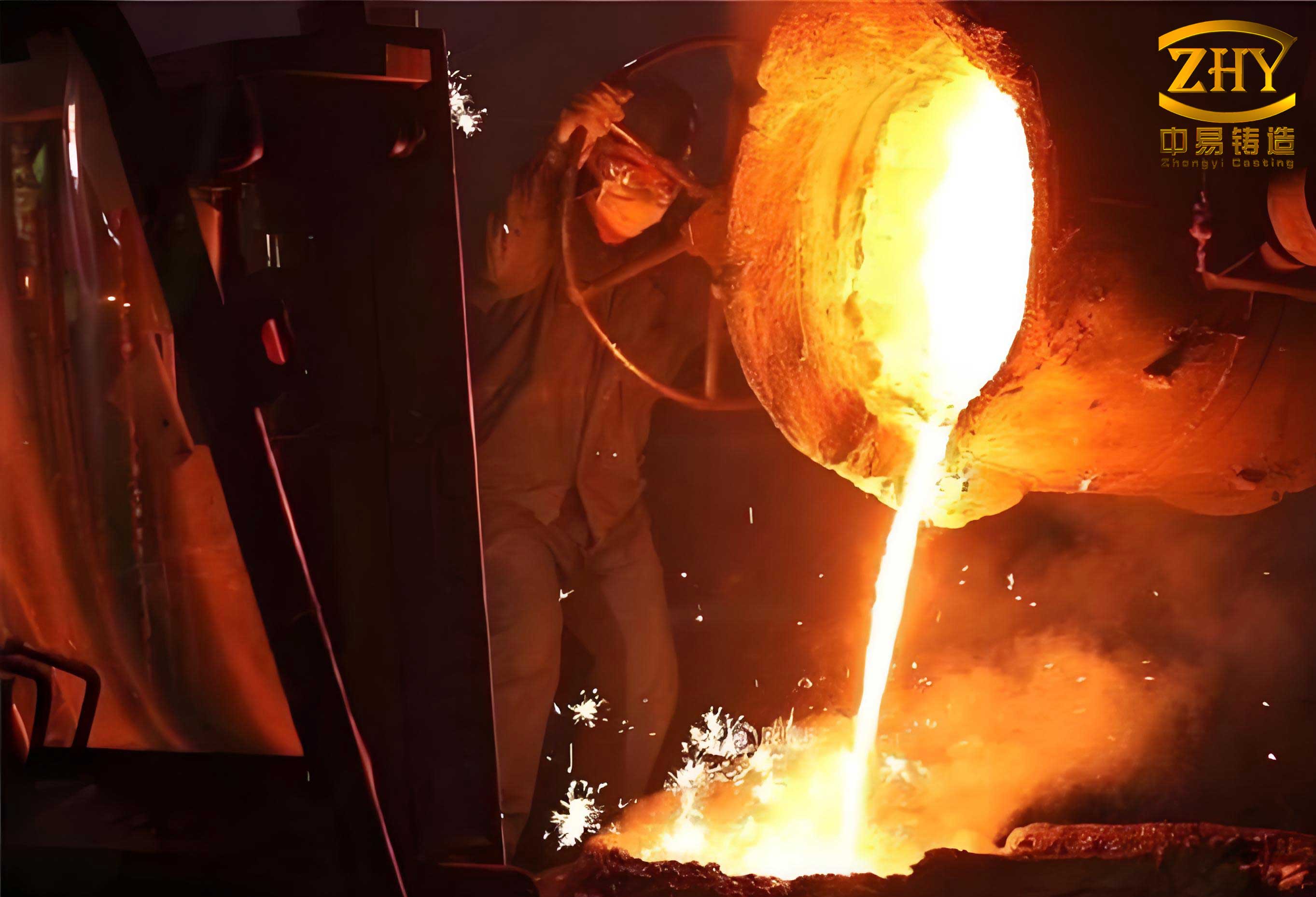
Defects in green sand castings arise from complex interactions between mold materials, process design, and operational parameters. Below, I analyze key defects, their causes, adverse effects, and control strategies, emphasizing practical insights gained through trial production.
Sand Inclusions and Sand Holes: These defects manifest as embedded sand particles or cavities in the casting surface, typically on upper and lateral planes, especially in large-area sections. The primary cause is thermal expansion of the mold surface layers. Due to low thermal conductivity of green sand, steep temperature gradients develop within the mold wall, causing differential expansion and compressive stresses. Other factors include inadequate sand strength or moisture, non-uniform mold compaction, poorly designed venting systems, and improper gating that leads to erosion. The repercussions are substantial: increased cleanup labor, higher consumption of materials and energy, and potential scrap if defects are severe. In my practice, ensuring optimal sand properties and mold integrity is crucial for defect-free sand castings.
Blowholes and Gas Porosity: These smooth-walled cavities form from gas entrapment during solidification. They can be classified as invasive (from mold or core gases) or precipitative (from dissolved gases in the melt). Causes involve inappropriate base sand selection, high moisture content in molds, inadequate venting, poor core ventilation, or un-dried charge materials. High pouring temperatures exacerbate gas dissolution. The impact varies: non-critical blowholes can be repaired by welding, but hidden internal pores pose safety risks and may cause rejection. Thus, controlling gas sources is vital for reliable sand castings.
Shrinkage Cavities and Porosity: These defects result from insufficient feeding during solidification, often due to flawed riser design or incorrect use of chills, chromite sand, or other激冷 materials. They are more prevalent during new product or process trials. The consequences are dire: internal shrinkage can lead to scrap and安全隐患, demanding thorough工艺 optimization.
Surface Burns and Penetration: This defect occurs where coating is insufficient or absent, particularly on vertical mold faces. It stems from low refractoriness of base sand, often due to low quartz content or high levels of fluxing oxides (e.g., Na2O, K2O, FeO) that form low-melting compounds. Prolonged exposure to high-temperature metal, such as around large risers, can also cause sintering. Surface burns dramatically increase finishing difficulty, especially in complex internal cavities, complicating other defect repairs in sand castings.
Cracks: Although green sand offers better collapsibility and cooling properties, cracks can still occur due to material composition, process design, or molding material selection. For high-carbon steels with poor weldability, crack repair is challenging and recurrence rates are high. Unaddressed cracks compromise component performance.
Mold Wall Movement (Swelling): A common issue in green sand castings, this defect arises from insufficient mold hardness or flawed tooling design, causing dimensional overshoots, weight excess, and potential scrap.
To systematically address these defects, I have developed a multifaceted approach focusing on sand formulation, process design, and operational control. The following tables summarize defect causes and countermeasures, while subsequent sections delve into technical details.
| Defect Type | Primary Causes | Preventive Measures | Impact on Sand Castings |
|---|---|---|---|
| Sand Inclusions | Thermal expansion, low sand strength, uneven compaction, poor venting, erosive gating | Use finer sand, improve compaction, optimize vents, design gentle gating | Increased cleanup, potential scrap |
| Blowholes | High moisture, inadequate venting, wet charge materials, high pouring temperature | Control sand moisture, enhance venting, dry charge, degas melt | Welding repairs, hidden defects risk |
| Shrinkage Porosity | Inadequate risering, lack of chills | Optimize riser design, use chills and exothermic materials | Scrap, safety hazards |
| Surface Burns | Low sand refractoriness, insufficient coating, fluxing oxides | Apply refractory coatings, use high-purity sand, add anti-burn additives | Difficult cleanup, surface quality loss |
| Cracks | Material issues, stress concentration, poor collapsibility | Adjust alloy composition, improve mold yield, optimize cooling | Repair challenges, performance issues |
| Mold Swelling | Low mold hardness, weak tooling | Increase compaction, reinforce flasks | Dimensional errors, weight excess |
For green sand castings to excel, the molding sand must possess specific properties: good flowability, plasticity, toughness, non-stickiness, adequate permeability, low hygroscopicity, minimal gas evolution, sufficient strength, high refractoriness, thermal stability, low expansion and contraction, good collapsibility, disintegration, and durability. The selection and proportioning of sand constituents are critical. In my trials, I have found that using finer base sand (e.g., AFS grain fineness number >70) enhances flowability and mold density, reducing surface porosity. The addition of anti-penetration additives, such as coal dust or proprietary compounds, forms carbon films or sintered layers that minimize metal oxidation and wetting. Moreover, blended binders like starch and bentonite significantly improve sand toughness and surface strength, curtailing sand inclusions and burns. The optimal mix can be expressed through a sand performance index $SPI$:
$$ SPI = k_1 \cdot S + k_2 \cdot B + k_3 \cdot A $$
where $S$ is sand fineness, $B$ is bentonite content (%), $A$ is additive content (%), and $k_1$, $k_2$, $k_3$ are empirical coefficients. For instance, a typical green sand mixture for steel castings might comprise 85-90% silica sand, 6-10% bentonite, 2-4% water, and 1-2% additives, with permeability around 100-150 AFS units and compressive strength of 0.15-0.25 MPa.
Process design is the cornerstone of quality sand castings. Each new product requires rigorous validation via simulation software or prototype trials. Key aspects include:
- Venting: Proper placement of vents and exhaust channels to ensure gas escape during pouring, reducing blowholes. The vent area $A_v$ can be estimated as:
$$ A_v = \frac{Q_g}{v_g} $$
where $Q_g$ is gas generation rate (cm³/s) and $v_g$ is permissible gas velocity (cm/s).
- Riser Design: Adequate riser dimensions and safe height margins (20-30 mm) to ensure feeding. Modulus method can be applied:
$$ M_{riser} = 1.2 \cdot M_{casting} $$
where $M$ is geometric modulus (volume/surface area).
- Gating System: Layout to minimize turbulence and erosion. The gating ratio (sprue:runner:gate) should be optimized, e.g., 1:2:1.5 for steel sand castings.
- Tooling Reinforcement: Increasing flask rib height and density improves mold hardness.
Operational control is equally vital. During molding, consistent compaction is essential; we use automatic machines to achieve hardness >85 on B-scale. Pattern withdrawal must be smooth, and molds handled carefully to avoid damage. Coatings play a pivotal role: I recommend refractory coatings (e.g., zircon-based) with high wetting resistance, applied evenly at 0.1-0.3 mm thickness, thicker in hot spots like riser bases. The coating effectiveness $C_e$ can be related to viscosity $\eta$ and application method:
$$ C_e \propto \frac{1}{\eta} \cdot e^{-k t} $$
where $k$ is a constant and $t$ is drying time.
Melting practices must ensure charge dryness and degassing. We pre-heat charge materials to 200°C and use rotary impeller degassing for 10-15 minutes with inert gas. Pouring temperature and speed are controlled; for medium steel castings, pouring at 1560-1580°C with a fill time of 10-30 seconds depending on weight reduces defects. Statistical process control (SPC) charts help monitor key parameters, as shown below for sand moisture and casting quality correlation.
| Batch No. | Sand Moisture (%) | Mold Hardness (B-scale) | Defect Rate (%) | Remarks |
|---|---|---|---|---|
| 1 | 3.2 | 82 | 5.1 | High blowholes |
| 2 | 3.5 | 88 | 2.3 | Optimal |
| 3 | 4.0 | 85 | 3.8 | Some sand inclusions |
| 4 | 2.8 | 80 | 6.7 | Low strength, cracks |
| 5 | 3.6 | 90 | 1.9 | Best performance |
Through iterative improvements, we reduced defect rates from over 10% to below 3% in green sand castings. The integration of real-time sand property monitors and automated adjustment systems further stabilizes production. For instance, continuous measurement of compactability and moisture allows instant feedback to mixers, ensuring consistent sand quality. The relationship between sand properties and defect occurrence can be modeled using regression analysis. Let $D$ be defect index (a composite score), then:
$$ D = \alpha_0 + \alpha_1 M_s + \alpha_2 H + \alpha_3 P + \epsilon $$
where $M_s$ is moisture content, $H$ is mold hardness, $P$ is permeability, and $\alpha_i$ are coefficients derived from historical data.
In conclusion, mastering defect control in green sand castings demands a holistic approach encompassing material science, process engineering, and meticulous execution. By optimizing sand formulations, refining工艺 designs, and enforcing stringent operational controls, foundries can harness the economic benefits of green sand while delivering high-quality steel castings. This journey, rooted in practical experience, underscores that green sand castings are not only cost-effective but also capable of meeting rigorous performance standards when managed proactively. As technology advances, ongoing innovation in sand additives, coating technologies, and process automation will further elevate the potential of green sand castings in the manufacturing landscape.