
The pursuit of wear-resistant materials that can withstand severe abrasive and impact conditions is a constant endeavor in mechanical engineering. Among existing options, white cast iron has garnered significant attention due to its exceptional hardness and wear resistance. Its microstructure, typically comprising ledeburite (a eutectic mixture of austenite and cementite) in the as-cast state, grants it a high elastic modulus and compressive strength comparable to steel. However, this very microstructure, along with inherent casting defects like shrinkage porosity and micro-voids, renders conventional white cast iron notoriously brittle, with very low impact toughness. This brittleness severely limits its application in components subjected to substantial impact loads, such as grinding balls, hammers, and crusher liners.
Traditionally, the path to improving the toughness of white cast iron has leaned heavily on high-alloying and sophisticated heat treatments. Internationally, nickel-chromium, high-chromium, and high-vanadium white cast irons have been developed, offering a better combination of hardness and toughness. Domestically, high-chromium white cast irons like Cr15Mo3 have found use in grinding balls. However, reliance on significant amounts of strategic alloying elements like nickel, chromium, and molybdenum is not always economically viable or resource-efficient. Meanwhile, heat treatment methods, including austempering and high-temperature carbide spheroidization, have shown promise but often fall short of delivering the leap in impact toughness required for high-impact applications.
The core challenge lies in the inherent contradiction between wear resistance (dominated by hard carbides) and impact toughness (dominated by a continuous, ductile metallic matrix). The interconnected network of brittle carbides in as-cast white cast iron acts as a ready path for crack propagation. This research explores an alternative, process-intensive route: hot forging. The premise is that controlled hot deformation can fundamentally alter the deleterious as-cast structure. Forging can potentially eliminate casting porosity, refine the coarse as-cast grains, and most critically, break up the continuous carbide network into isolated, finely dispersed particles. This microstructural modification holds the promise of dramatically enhancing impact toughness while preserving, or even enhancing, the intrinsic wear resistance of the white cast iron matrix. This article details my investigation into the forgeability of low-alloy white cast iron, the evolution of its microstructure and properties after forging, and the practical development and testing of forged grinding balls.
Forgeability and Post-Forging Characteristics of White Cast Iron
Temperature-Dependent Plasticity
The first critical step was to establish whether white cast iron possesses sufficient plasticity for hot working. I conducted a series of upsetting tests using cylindrical specimens to construct a temperature-plasticity diagram. Specimens of various low-alloy white cast iron compositions were heated to specific temperatures and freely upset between flat dies until surface cracking occurred. The critical deformation at the onset of cracking, denoted as $\varepsilon$, was used as a measure of plasticity at that temperature, calculated as:
$$\varepsilon = \frac{\Delta H}{H_0} = \frac{H_0 – H_f}{H_0}$$
where $H_0$ is the initial height and $H_f$ is the final height at cracking.
The chemical compositions of the white cast irons used in this phase are summarized in Table 1.
| Group Designation | C (%) | Si (%) | Mn (%) | P (%) | S (%) | Cr (%) | Mo (%) | Cu (%) |
|---|---|---|---|---|---|---|---|---|
| Group A | 2.8 – 3.2 | 0.6 – 1.0 | 0.6 – 1.0 | <0.1 | <0.1 | 0.3 – 0.6 | 0.2 – 0.4 | 0.4 – 0.8 |
| Group B | 2.5 – 2.9 | 1.0 – 1.4 | 0.8 – 1.2 | <0.1 | <0.1 | 0.8 – 1.2 | 0.3 – 0.5 | 0.5 – 0.9 |
The resulting temperature-plasticity curve revealed four distinct regions:
- Below 750°C: Plasticity is extremely poor. The microstructure consists of pearlite and cementite, offering little capacity for deformation without fracture.
- 750°C to 900°C: Plasticity increases sharply with temperature. This coincides with the transformation of pearlite to more ductile austenite and the beginning of dissolution of secondary cementite into the matrix. However, cracking in this regime typically occurs via shear bands at approximately 45° to the compression axis.
- 900°C to 1150°C: This is the optimal forging window. Plasticity reaches its peak, with a maximum critical deformation ($\varepsilon_{max}$) observed around 1050°C. The matrix is fully austenitic, more carbide has dissolved, and incipient spheroidization and coalescence of primary cementite occur. Cracking in this range is typically via tensile cracks on the specimen’s free surface. The high-temperature softening of cementite and reduced hardness difference between matrix and carbide likely contribute to this improved forgeability.
- Above 1150°C: Plasticity drops catastrophically due to grain coarsening, incipient melting at grain boundaries, or other overheating/overburning phenomena.
It was also noted that higher carbon and silicon contents generally reduced plasticity, while elements like chromium and molybdenum had a marginally beneficial effect. The practical forging temperature range for this low-alloy white cast iron is therefore narrow, approximately 1000°C to 1150°C, compared to most steels.
Forging Process Characteristics
Forging white cast iron requires careful attention to process parameters due to its inherent brittleness and microstructural sensitivity.
- Heating: A slow heating rate is essential up to about 700°C to avoid thermal shock cracking, given the material’s low thermal conductivity. After this preheat, faster heating to the forging temperature (1050-1100°C) is acceptable. Soaking time at the high temperature must be sufficient for through-heating but minimized to prevent excessive grain growth and, more critically, the precipitation of graphite, which would severely degrade mechanical properties.
- Stress State Sensitivity: White cast iron is highly sensitive to tensile and shear stresses due to its cast defects and carbide network. Operations like stretching a round bar on flat dies can induce longitudinal or even cruciform cracks. Therefore, forging should follow principles similar to those for high-alloy steels: use of compressive stress states, avoidance of heavy blows in a single location, and employment of closed-die or swaging operations where possible. The “light-heavy-light” forging sequence is often beneficial.
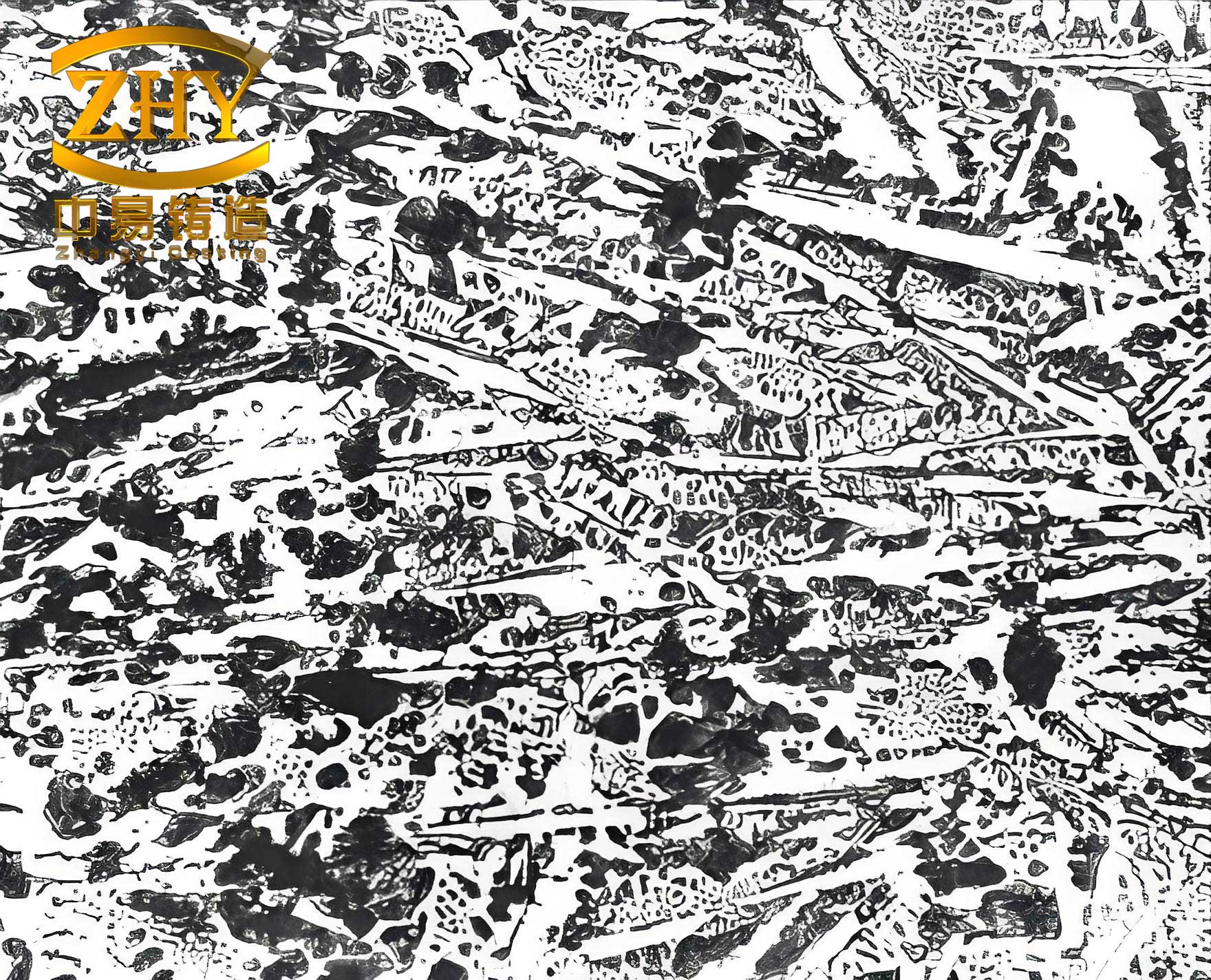
The image above illustrates a typical white iron casting. The challenge of forging is to transform this brittle, defect-prone structure into a refined and toughened one.
Microstructural and Property Evolution After Forging
To systematically study the effect of forging, specimens of varying cross-sections (simulating different forging ratios) were subjected to unidirectional stretch forging. The forging ratio, $F_r$, is defined as the ratio of initial to final cross-sectional area: $F_r = A_0 / A_f$. The impact toughness ($a_k$) and hardness (HRC) were measured for specimens processed under different forging ratios and post-forging cooling regimes.
1. Elimination of Casting Defects: Scanning Electron Microscope (SEM) analysis of fracture surfaces provided stark evidence. The as-cast fracture surface showed extensive micro-voids, shrinkage porosity, and cracks propagating along carbide/matrix interfaces. After forging (e.g., $F_r = 3$), the fracture surface became much denser, with casting voids largely welded shut due to the combined action of plastic flow, high temperature, and triaxial compressive stresses during deformation.
2. Grain Refinement and Carbide Modification: This is the most transformative effect. Forging shatters the coarse, dendritic structure of the primary austenite grains, replacing it with fine, equiaxed recrystallized grains. Concurrently, the continuous network of ledeburitic and secondary cementite is broken down. The progression is clear:
- At low forging ratios ($F_r < 2$), the carbide network is only partially broken, retaining some interconnected characteristics.
- As $F_r$ increases to 3-5, the network is completely destroyed, replaced by isolated blocks and increasingly spheroidized particles of cementite uniformly dispersed in the matrix.
- At high forging ratios ($F_r > 5$), the carbides become fine, well-dispersed spheroids. The deformation increases dislocation density, promoting diffusion and providing nucleation sites for carbide precipitation during subsequent cooling, leading to a more uniform dispersion.
This breakdown of the brittle network is the primary reason for the dramatic improvement in toughness.
3. Formation of Fiber Texture: Despite recrystallization, non-uniformities and insoluble inclusions align along the metal flow direction, creating a fibrous microstructure. This induces anisotropy, enhancing longitudinal mechanical properties (like impact toughness in the forging direction) at the expense of transverse properties.
4. Influence of Forging Ratio and Cooling: The properties of forged white cast iron are highly dependent on both the amount of deformation ($F_r$) and the subsequent cooling path. Key findings are summarized below and in Figure 1.
- Air Cooling: $a_k$ increases significantly with $F_r$, while hardness shows a slight, steady decrease. This is attributed to greater carbide spheroidization and matrix softening.
- Isothermal Treatment (e.g., in salt bath): Properties depend strongly on composition and holding time. Generally, both $a_k$ and hardness can be optimized through this controlled transformation.
- Direct Oil Quenching (from forging heat): This combines deformation and quenching to produce a very hard martensitic matrix with dispersed carbides. For some compositions, $a_k$ and hardness both increase with $F_r$ up to a point, showcasing the benefit of ausforming.
The data unequivocally shows that forging can increase the impact toughness of white cast iron by more than an order of magnitude (e.g., from ~2 J/cm² to over 20 J/cm²), a feat difficult to achieve by alloying or heat treatment alone, while maintaining a high hardness level (HRC 50-60). A forging ratio in the range of 3 to 5 is generally optimal for balancing property enhancement and processing efficiency.
Figure 1: Schematic influence of forging ratio ($F_r$) and cooling method on properties.
(Air Cooling): $a_k \uparrow$ sharply, HRC $\downarrow$ slightly with increasing $F_r$.
(Isothermal): $a_k$ and HRC show complex, composition-dependent trends with $F_r$.
(Oil Quench): $a_k$ and HRC $\uparrow$ with $F_r$ to an optimum, then may decline.
Forging Process for Low-Alloy White Cast Iron Grinding Balls
Grinding balls are consumables used in massive quantities in mining, cement, and ceramics industries. They endure severe abrasive wear and repeated impact. Common materials include forged medium-carbon steel (wear-resistant but not hard enough), high-chromium cast iron (hard but brittle and expensive), and martensitic cast steel. A low-alloy forged white cast iron ball offers a potential solution combining high hardness, superior wear resistance from the carbide phase, and dramatically improved toughness from the forging process.
Process Design
- Blank Selection: Cast cylindrical bars of Group A composition (see Table 1) were used. Diameters were chosen based on final ball size (e.g., Ø40 mm, Ø60 mm, Ø80 mm), accounting for forging shrinkage and scale loss. The weight of the blank $W_b$ is calculated as:
$$W_b = W_f \cdot (1 + \delta_{loss})$$
where $W_f$ is the final forging weight and $\delta_{loss}$ accounts for scaling and other losses (~5-8%). - Forging Method: For productivity, die forging on a free-forging hammer was adopted. A simple two-part die with a hemispherical cavity was used. The process involves: (a) upsetting the preheated bar to remove scale, (b) transferring it to the die cavity, and (c) forging with multiple blows and repositions to fully fill the cavity. The ball is typically completed in one heating cycle.
- Heating & Cooling: The established heating protocol was followed: slow heat to ~700°C, then rapid heat to 1050-1100°C, with minimal soak time. Post-forging, the balls were air-cooled (normalized) or fan-cooled to achieve a microstructure of fine pearlite/sorbite with spheroidized carbides, followed by a tempering treatment to relieve stresses. This leverages the forging heat and provides a good balance of toughness and hardness.
Field Trial and Performance Analysis
A batch of forged white cast iron balls (Ø40, Ø60, Ø80 mm) was tested in a silicon carbide grinding mill, a highly abrasive environment. Their wear loss was compared against standard forged steel balls over a total operating time exceeding 500 hours. Results are summarized in Table 2.
| Ball Material | Initial Avg. Weight (g) | Weight Loss after 500 hrs (g) | Relative Wear Rate (Steel = 1.0) | Breakage/Failure Rate |
|---|---|---|---|---|
| Forged Medium-Carbon Steel | ~500 (Ø80mm) | ~150 | 1.0 (Baseline) | Very Low |
| Forged Low-Alloy White Cast Iron | ~500 (Ø80mm) | ~45-55 | 0.3 – 0.37 | Low (< 1%) |
Key Outcomes:
- Superior Wear Resistance: The forged white cast iron balls exhibited wear rates only one-third that of the standard steel balls. This translates directly to longer service life, reduced downtime for ball replenishment, and lower contamination of the ground product by iron wear debris.
- Adequate Toughness: The breakage rate was very low (<1%), confirming that the forging process successfully imparted sufficient impact resistance for this application. The few failures were traced to processing flaws like insufficient deformation in certain balls or localized overheating.
Mechanisms for Performance: The outstanding performance stems from the forged microstructure:
- The hard, spheroidized cementite particles act as numerous wear-resistant “islands” in the tough metallic matrix, resisting abrasion effectively.
- The dense, refined structure prevents large-scale spalling or fracture.
- During service, the balls undergo work-hardening from mutual impacts, and any retained austenite may transform to martensite, further enhancing surface hardness and wear resistance in a dynamic manner.
Technical and Economic Viability
An economic assessment is favorable. While the raw material (low-alloy white cast iron melt) costs slightly more than common steel scrap, the total estimated production cost for forged white iron balls is competitive, especially if melting is done in a cupola. The decisive factor is the 3x increase in service life. This reduces direct consumption costs, minimizes production stoppages for ball changes, and improves product purity by reducing iron contamination. The process offers a resource-efficient alternative to high-alloy cast irons, utilizing domestically abundant elements.
Conclusion
This research demonstrates conclusively that low-alloy white cast iron, traditionally considered unweldable and unforgeable, possesses a viable hot-working window between approximately 900°C and 1150°C. Hot forging is not merely a shaping operation but a potent microstructural engineering tool for this material. It effectively eliminates casting defects, refines the grain structure, and—most importantly—fragments and spheroidizes the continuous brittle carbide network that is the source of its poor toughness.
The resultant microstructure is a dispersion of hard carbide particles in a toughened metallic matrix, reconciling the classical wear resistance-toughness dichotomy. Applied to grinding ball production, this process yields components with wear resistance approximately three times greater than conventional forged steel balls, coupled with adequate impact resistance for demanding milling operations. The technical and economic benefits are significant, offering a sustainable and effective solution for a high-consumption industrial component. This work establishes hot forging as a transformative and promising pathway for expanding the application landscape of white cast iron beyond its traditional cast forms, opening new avenues for the development of high-performance, cost-effective wear-resistant materials.