
In my extensive research and practical development work within the foundry industry, I have focused on optimizing the production of critical wear-resistant components. Among these, grinding balls represent a massively consumable part in sectors such as cement manufacturing, mining, chemical processing, and building materials production. The annual demand reaches hundreds of thousands of tons globally. The operational cost of grinding processes is profoundly influenced by the quality and durability of these balls. Therefore, enhancing their wear resistance through superior material selection and advanced manufacturing techniques is a paramount engineering challenge. My work has led me to conclude that high-chromium white cast iron is the most suitable material for this application, and its production via metal mold casting is the optimal manufacturing route.
The exceptional service performance of high-chromium white cast iron stems directly from its unique microstructure. Unlike other grades of white cast iron which contain the brittle M3C-type carbides (e.g., cementite, Fe3C), the high-chromium variant precipitates hard, discontinuous (Cr,Fe)7C3 carbides within a metallic matrix that can be tailored to be martensitic or austenitic. This structure provides an outstanding combination of hardness and toughness, resulting in dramatically reduced wear rates. The transition in carbide type is a function of chromium content, which can be described by the chromium-to-carbon ratio (Cr/C). A high ratio, typically above 5, promotes the formation of the desired M7C3 carbides. The volume fraction of these carbides ($V_c$) is crucial for wear resistance and can be estimated from the composition:
$$ V_c \approx \frac{C_{total} – C_{in\ solution}}{K} $$
where $C_{total}$ is the total carbon content, $C_{in\ solution}$ is the carbon retained in the metallic matrix (usually very low after heat treatment), and $K$ is a constant related to the stoichiometry of the carbide. For M7C3, $K$ is approximately 0.06 to 0.07. This fundamental relationship guides the alloy design.
For the production of grinding balls, the chemical composition of the high-chromium white cast iron must be precisely controlled. My developed alloy formulation is presented in Table 1.
| C | Cr | Si | Mn | Mo | Cu | P | S | RE* |
|---|---|---|---|---|---|---|---|---|
| 2.2 – 2.6 | 12.0 – 13.0 | 0.3 – 0.8 | 0.5 – 0.8 | 0.8 – 1.0 | 0.4 – 0.6 | < 0.10 | < 0.05 | Trace |
*RE: Rare Earth elements for inoculation and modification.
Carbon and chromium are the primary drivers for carbide formation and hardenability. Molybdenum and copper are added to suppress the formation of pearlite during cooling, ensuring a hard martensitic matrix even in thicker sections. Silicon and manganese are balanced for deoxidation and sulfide control, while impurities like phosphorus and sulfur are minimized to preserve toughness.
The choice of metal mold (or permanent mold) casting over conventional sand casting is deliberate and offers significant advantages for mass-producing grinding balls. The high thermal conductivity and heat capacity of the metal mold lead to rapid solidification and cooling. This results in a finer, more refined microstructure with superior density and mechanical properties. Typically, the tensile strength and impact toughness can be 15-20% higher compared to sand-cast equivalents. Furthermore, metal molds impart excellent dimensional accuracy and low surface roughness, reducing the need for post-casting machining. Process stability is high, scrap rates are low, and the overall yield (percentage of poured metal that becomes usable casting) is improved. Perhaps most importantly for industrial production, metal mold processes are highly amenable to mechanization and automation, drastically increasing productivity. While the high cooling rate of a metal mold can be a challenge for some alloys, for high-chromium white cast iron, it is beneficial as it helps achieve the desired metastable matrix structures. Any potential issues with complex geometries or hot tearing can be effectively mitigated through the strategic use of sand cores within the metal mold assembly.
The design of the mold itself is critical. For cost-effectiveness and sufficient thermal fatigue resistance in high-volume production, I selected an alloyed gray iron as the mold material. Plain gray iron has limited strength and exhibits “growth” at sustained temperatures above 450°C due to graphite oxidation, leading to microcracking and failure. The addition of chromium, copper, and molybdenum enhances its high-temperature strength, refines the graphite morphology, and improves overall durability. The specified mold composition is detailed in Table 2.
| C | Si | Mn | P | S | Cr | Other Alloys |
|---|---|---|---|---|---|---|
| 2.8 – 3.4 | 1.5 – 2.5 | 0.7 – 1.1 | < 0.15 | 0.05 – 0.10 | 0.4 – 0.8 | Cu, Mo (Trace) |
The core of the manufacturing challenge lies in the mold cavity and gating system design for multi-cavity casting. Producing multiple balls per mold cycle is essential for economic viability. Two primary layouts were evaluated: a linear horizontal arrangement and a circular arrangement. The horizontal layout, while simpler to machine, presents significant drawbacks. It requires longer, more complex runners, leading to lower metal yield and increased heat loss. More critically, it provides poor feeding (risering) conditions, making it difficult to compensate for the substantial solidification shrinkage inherent to high-chromium white cast iron, which can exceed 4-5% in volume. This often results in shrinkage porosity within the cast balls.
In contrast, the circular arrangement, where cavities are positioned around a central sprue, is demonstrably superior. This radial symmetry creates more uniform thermal conditions and allows for the implementation of an efficient, thermally managed gating and feeding system. The central sprue feeds into a circular runner, which in turn feeds each cavity through individual ingates. This design shortens the flow path to each cavity, minimizing temperature drop and ensuring more simultaneous filling. Most importantly, it enables the placement of effective feeder heads (risers) at the top of each cavity to supply liquid metal during solidification, effectively eliminating shrinkage defects. Therefore, the circular cavity layout was adopted.
The gating system design is specifically tailored for the challenging casting characteristics of high-chromium white cast iron—namely its poor fluidity and high shrinkage. A semi-pressurized system was chosen. In this design, the cross-sectional area of the sprue base is the smallest (choke), the runner is the largest, and the ingate is intermediate. This configuration helps to slow down and calm the metal flow in the runner, reducing turbulence and oxide formation, while still allowing the system to fill completely. The ingates are taken off from the side of the ball cavity at its mid-height (a “parting-line” or “step” gate), which provides a balance between the smooth filling of a bottom gate and the effective temperature gradient of a top gate, suitable for the compact shape of a grinding ball.
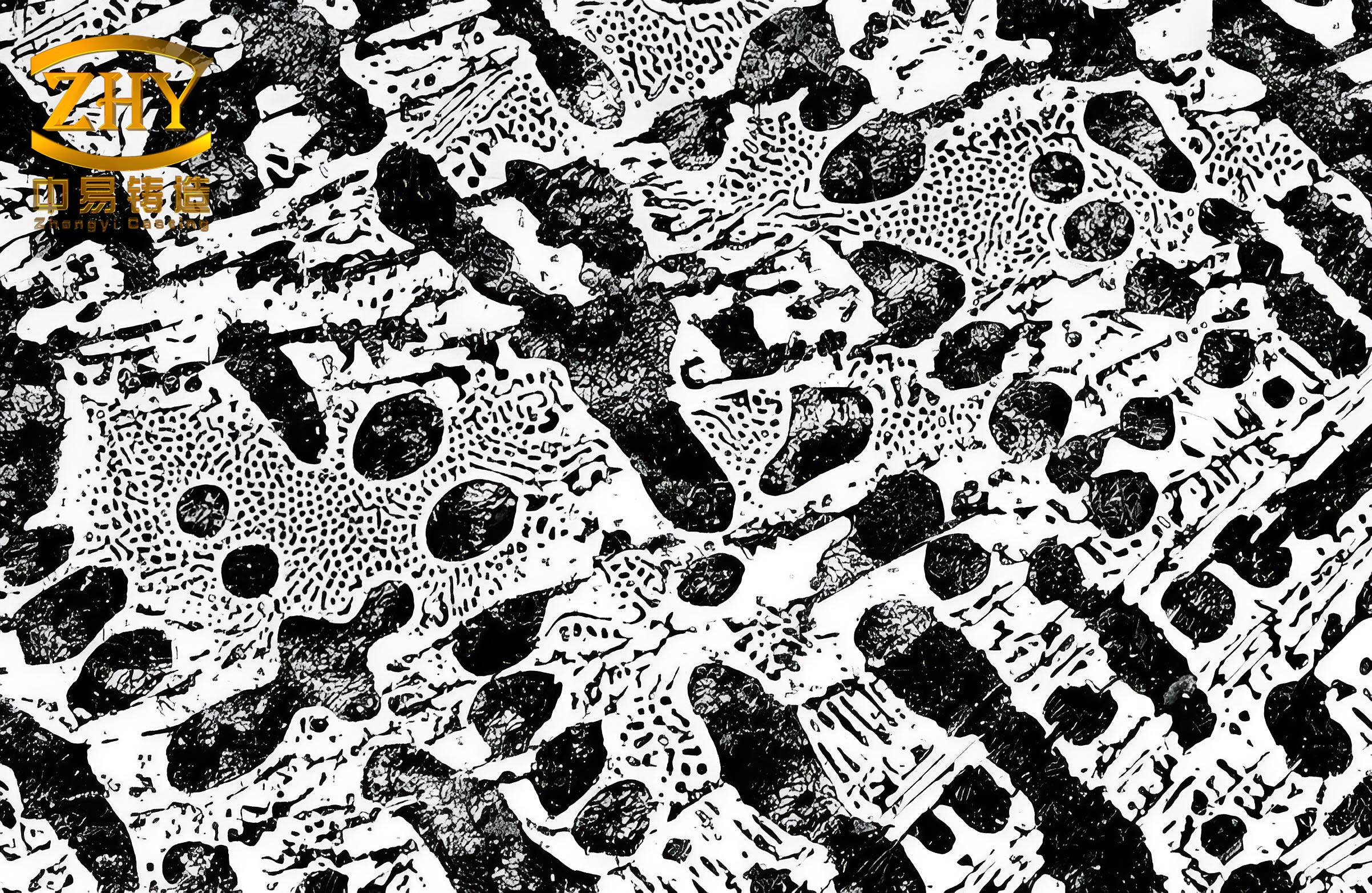
The microstructure of the final high-chromium white cast iron product, as suggested by the image, is characterized by the hard, rod-like or hexagonal M7C3 carbides embedded in a tough metallic matrix. Achieving this structure consistently is the goal of the entire process. To manage heat and ensure proper feeding, the system incorporates insulated sand cores at strategic locations, particularly within the feeder heads. These cores are made using a pre-formed sand core process, which offers high reusability of core boxes, excellent dimensional consistency, and good permeability. The core boxes themselves are manufactured from metal for durability in high-volume production. Complex contours are achieved through CNC-machined inserts assembled into a main box frame, as detailed in the structural decomposition diagram.
A critical, often overlooked aspect of mass production with metal molds is the need for specialized fixtures to handle the heavy mold halves during core setting, clamping, and mold indexing. I designed a dedicated auxiliary夹具 for this purpose. Its key features include: 1) A robust base with support plates and locating pins that engage with the mold’s external features, providing a secure six-point定位. 2) A rapid-action screw clamping mechanism to firmly hold the mold in place during operations. 3) An integrated manual indexing (分度)装置. This allows the operator to precisely rotate the mold to a series of fixed positions, ensuring accurate alignment for tasks like machining the spherical cavities into the mold block or for setting multiple sand cores. This夹具 is essential for maintaining precision, ensuring operator safety, and achieving high production rates.
The solidification mechanics can be modeled to optimize the process. The solidification time ($t_f$) for a spherical casting in a metal mold can be approximated using Chvorinov’s rule, but must account for the mold’s high chilling power:
$$ t_f = B \cdot \left( \frac{V}{A} \right)^n $$
where $V$ is the volume of the ball, $A$ is its surface area, $B$ is a mold constant that is much smaller for a metal mold than for a sand mold, and $n$ is an exponent typically around 1.5 to 2 for chill casting. The rapid extraction of heat is what refines the microstructure of the white cast iron. Furthermore, the required volume of a feeder ($V_{feeder}$) to compensate for shrinkage can be estimated by:
$$ V_{feeder} = \frac{\beta \cdot V_{casting}}{1 – \alpha – \beta} $$
where $\beta$ is the volumetric shrinkage of the white cast iron (approximately 0.04 to 0.05), $V_{casting}$ is the volume of the ball, and $\alpha$ is the fraction of the feeder volume that itself suffers from shrinkage (requiring a feeder on the feeder, or exothermic padding to prevent this). These principles directly informed the sizing of the feeding heads in the circular layout.
In summary, the successful metal mold casting of high-chromium white cast iron grinding balls is a synergistic integration of advanced material science and precision engineering. It begins with the meticulous formulation of the high-chromium white cast iron alloy to guarantee the formation of the wear-resistant M7C3 carbides. This is coupled with the design and fabrication of a durable alloyed iron mold featuring a radially-symmetric multi-cavity layout. A semi-pressurized gating system with insulated sand feeders is engineered to handle the metal’s poor fluidity and high shrinkage. Finally, the implementation of specialized handling and indexing fixtures transforms the process into a reliable, high-productivity manufacturing system. This comprehensive approach ensures the production of grinding balls with exceptional and consistent wear performance, directly contributing to reduced operational costs in grinding-intensive industries. The entire methodology stands as a testament to the capabilities of modern metal casting technology applied to high-performance white cast iron components.