
In my analysis of wear-resistant materials, I have extensively studied low-chromium white cast iron, a cost-effective and versatile alloy widely used in abrasive wear applications. This type of white cast iron, often containing around 2% chromium, is particularly suited for medium-stress and medium-impact conditions, such as in mining, cement production, and mineral processing equipment. The key to optimizing its performance lies in understanding the wear mechanisms, tailoring the composition, and implementing effective strengthening and toughening processes. Through this article, I aim to provide a comprehensive examination of the technological aspects that enhance the durability and toughness of low-chromium white cast iron, leveraging models, tables, and empirical data to underscore critical insights.
Abrasive wear is a predominant failure mode in industrial settings, and white cast iron alloys are frequently employed to combat it. The wear behavior can be categorized into low-stress abrasion, high-stress abrasion, and impact abrasion, depending on the operational conditions. For instance, components like chutes handling ores or slag experience low-stress abrasion, while rollers crushing coal or stones undergo high-stress abrasion, and hammer heads in crushers or grinding balls in ball mills face impact abrasion. In all cases, the wear mechanism involves the removal of material particles due to friction with hard abrasives, either from external sources or from the workpiece itself. Based on this, a simplified wear model can be derived to relate wear rate to applied pressure and material properties. According to foundational studies, the wear layer thickness \( h \) over a friction distance \( L \) is given by:
$$ \frac{h}{L} = K \frac{P_a}{P_T} $$
where \( P_a \) is the nominal pressure, \( P_T \) is the yield pressure of the material, and \( K \) is a proportionality constant. Under identical friction distances and pressures, comparing the wear of a material to a standard sample yields the relative wear resistance \( \epsilon \), which is proportional to the yield pressure:
$$ \epsilon \propto P_T $$
In practice, the Vickers hardness \( H \) is often used as a proxy for yield pressure in heat-treatable steels and cast irons. For heat-treated white cast iron, the relationship can be expressed as:
$$ \epsilon = \epsilon_0 + C_1 (H – H_0) $$
Here, \( \epsilon_0 \) and \( H_0 \) represent the wear resistance and hardness of an annealed reference material, while \( C_1 \) is a coefficient. This equation highlights that increasing hardness through heat treatment significantly enhances wear resistance. However, for white cast iron, the microstructure—particularly the carbide morphology and matrix composition—plays a crucial role in determining both hardness and toughness.
The suitability of low-chromium white cast iron for specific service conditions depends heavily on the hardness of the abrasive media. Abrasives vary widely in hardness, from soft materials like calcite (HV ~140) to extremely hard ones like alumina (HV ~1800). In white cast iron, the carbide phase, typically (Fe,Cr)₃C with a hardness of HV 1060–1240, provides wear resistance, while the matrix (e.g., pearlite, martensite) supports these carbides. If the matrix is too weak, carbides can detach under stress, leading to accelerated wear. Therefore, selecting the appropriate matrix is essential. For abrasives with hardness below HV 500, such as cement clinker, a pearlitic matrix in white cast iron may suffice. For harder abrasives in the range of HV 500–1200, a martensitic matrix is preferable to prevent carbide pull-out. This underscores the importance of microstructure control in low-chromium white cast iron.
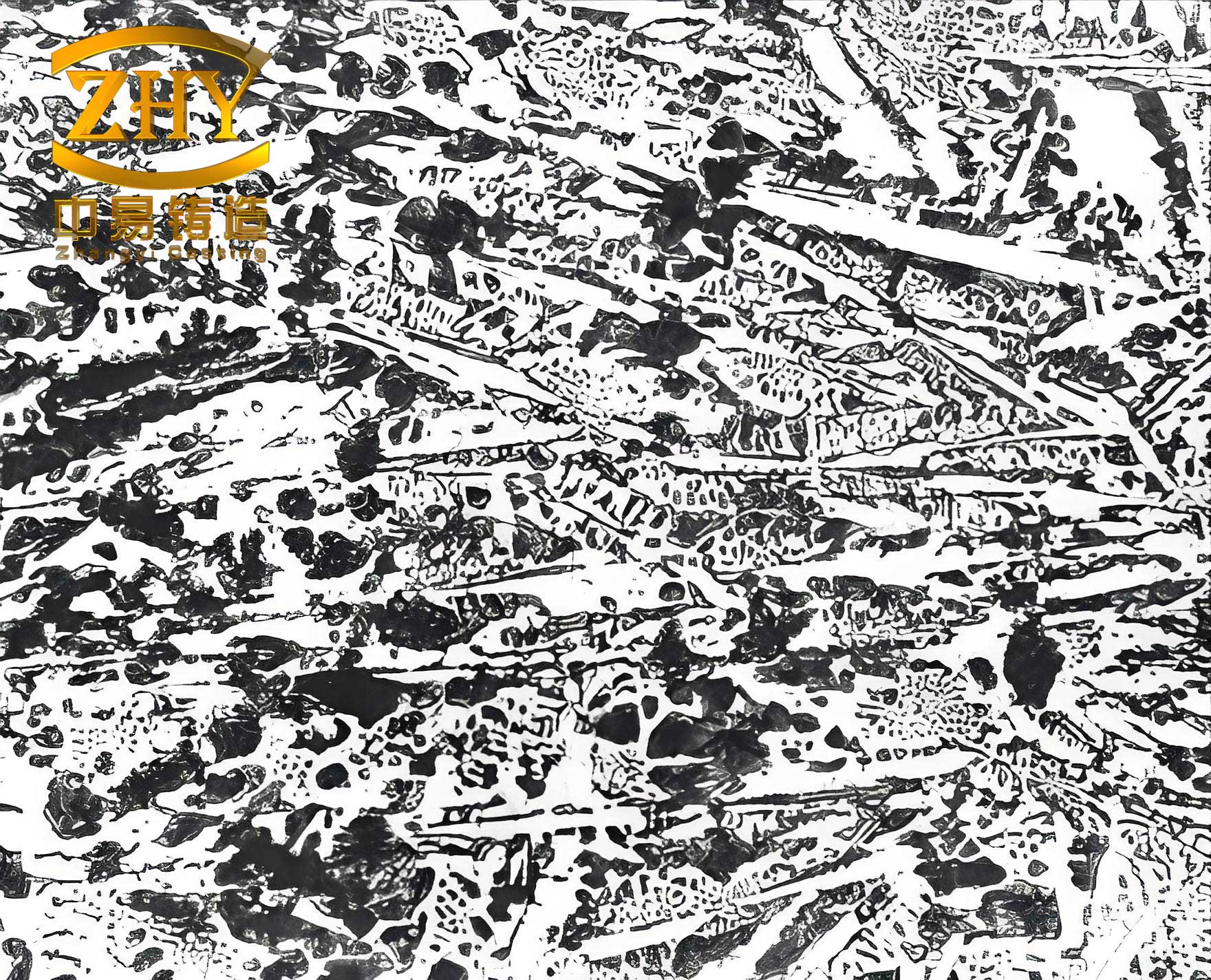
The composition of low-chromium white cast iron is a critical factor in its performance. Chromium, usually around 2%, primarily forms (Fe,Cr)₃C carbides, which increase hardness but can also embrittle the material in the as-cast state. Carbon content directly influences carbide volume and hardness; higher carbon boosts wear resistance but reduces impact toughness. For applications requiring higher toughness, carbon should be minimized, though too low carbon can impair castability and wear resistance. Manganese enhances hardenability, making it useful for achieving a martensitic matrix after heat treatment. Additionally, small additions of elements like copper, vanadium, or titanium can modify carbide shape and matrix structure, further improving properties. In my experience, a balanced composition is key to optimizing the white cast iron for specific wear conditions.
Strengthening and toughening processes are vital to overcome the inherent brittleness of as-cast low-chromium white cast iron. In the as-cast condition, carbides often form a continuous network that severely cracks the matrix, leading to low impact resistance. Through inoculation (modification) and heat treatment, this carbide network can be broken into isolated blocks or spheroidal forms, reducing stress concentrations and enhancing toughness. Inoculation involves adding agents like rare-earth silicides or vanadium-titanium compounds during melting, which refine the carbide structure. Heat treatment, such as quenching and tempering, transforms the matrix from pearlite to martensite or other harder phases. The crack propagation resistance improves significantly after these treatments, as evidenced by da/dN-ΔK curves showing slower crack growth in toughened white cast iron compared to as-cast material.
To quantify the effects of different compositions and processes, I have compiled data from various studies on low-chromium white cast iron. The table below summarizes key chemical compositions, treatment methods, and resulting mechanical properties. This comparison illustrates how strategic modifications enhance both hardness and impact toughness.
| No. | Chemical Composition (%) | Modification | Heat Treatment | Hardness (HRC) | Impact Toughness (J/cm²) | Microstructure* |
|---|---|---|---|---|---|---|
| 1 | C: 2.42–2.80, Si: 0.60–0.80, Mn: 0.50–1.00, P: 0.37, S: <0.03, Cr: 2.00–2.50, Cu: – | Vanadium-titanium pig iron melting, rare-earth silicon inoculation | As-cast | 52.5 | 5.4 | P + Kn |
| 2 | C: 3.00–3.50, Si: 1.00–1.40, Mn: 0.40–0.80, P: <0.06, S: <0.06, Cr: 0.40–0.60, Cu: – | Composite modifier inoculation | 500–550°C tempering | 51.5 | 3.8 | P + Kn |
| 3 | C: 2.70, Si: 0.56, Mn: 0.63, P: 0.03, S: 0.05, Cr: 1.50, Cu: 2.50 | Rare-earth silicon inoculation | 950°C normalizing | 49.7 | 11.8 | L + S + Kn |
| 4 | C: 2.86, Si: 0.97, Mn: 1.20, P: 0.03, S: 0.03, Cr: 1.50, Cu: 2.00 | – | 820°C air quenching | 51.0 | 14.7 | P + Kk |
| 5 | C: 3.50, Si: 1.80 (final), Mn: 1.00, P: <0.03, S: <0.03, Cr: 0.50, Cu: – | Nodularization and inoculation | 820–880°C quenching + 250–350°C tempering | 63.0 | 8.8 | M + γres + G + Kn |
| 6 | C: 2.80, Si: 0.44–0.75, Mn: 6.00, P: <0.08, S: <0.01, Cr: 2.00, Cu: – | Rare-earth + vanadium inoculation | 1050°C air cooling | 53.5 | 10.0 | M + Kk |
* Microstructure abbreviations: P – pearlite, L – ledeburite, S – sorbite, M – martensite, γres – retained austenite, G – graphite nodules, Kn – discontinuous carbides, Kk – blocky carbides.
From the table, it is evident that inoculation and heat treatment dramatically improve the impact toughness of low-chromium white cast iron. For instance, sample 4, with air quenching, achieves an impact toughness of 14.7 J/cm², while sample 5, with quenching and tempering, reaches a high hardness of 63 HRC and moderate toughness. These properties make such white cast iron suitable for medium-impact abrasive wear scenarios. The transformation of carbides from a continuous network to discrete forms is the primary reason for this enhancement. In my assessment, white cast iron with an impact toughness above 7 J/cm² generally performs well in medium-stress applications, such as grinding balls in ball mills, where economic efficiency and durability are paramount.
The wear resistance of white cast iron can be further analyzed through the hardness of its constituents. Below is a summary of typical abrasive and material hardness values, which informs the selection of white cast iron for specific duties.
| Material/Abrasive | Hardness (Knoop/HV) | Material/Constituent | Hardness (Knoop/HV) |
|---|---|---|---|
| Calcite | 130 / 140 | Ferrite | 230 / 70–200 |
| Fluorite | 170 / 190 | Pearlite (unalloyed) | – / 250–320 |
| Glass | 455 / 500 | Pearlite (alloyed) | – / 300–460 |
| Feldspar | 550 / 600–750 | Austenite (12% Mn) | 305 / 170–230 |
| Quartz | 840 / 900–1280 | Austenite (low-alloy) | – / 250–350 |
| Carbide slag | 2585 / 2600 | Austenite (high-chromium iron) | – / 300–600 |
| Corundum | 2020 / 1800 | Martensite | 500–800 / 500–1010 |
| – | – | Cementite (Fe₃C) | 1025 / 840–1100 |
| – | – | (Fe,Cr)₇C₃ | 1735 / 1200–1600 |
| – | – | (Fe,Cr)₃C | – / >1000 |
This table reinforces that low-chromium white cast iron, with (Fe,Cr)₃C carbides, is effective against abrasives up to HV 1200, especially when supported by a martensitic matrix. For softer abrasives, pearlitic white cast iron remains economical. The choice ultimately depends on a trade-off between wear resistance and toughness, which can be optimized through processing.
In terms of strengthening mechanisms, the relationship between carbide morphology and fracture toughness is paramount. The crack growth rate in white cast iron can be modeled using fracture mechanics principles. For example, the stress intensity factor range ΔK influences the crack propagation rate da/dN, with toughened white cast iron showing lower rates due to deflected cracks around blocky carbides. A simplified expression for wear life under cyclic loading might incorporate these factors, though in practice, empirical testing is essential. From my review, the most successful toughening treatments for low-chromium white cast iron involve medium-temperature quenching (e.g., 820–880°C) followed by tempering, which refines the matrix without excessive carbide coarsening. This process balances hardness and toughness, making the white cast iron viable for a broader range of applications.
Economically, low-chromium white cast iron offers significant advantages over high-alloy alternatives like high-chromium or nickel-hard white cast irons. By using inexpensive alloying elements and simple heat treatments, it reduces production costs while maintaining adequate performance. In cement ball mills, for instance, toughened low-chromium white cast iron grinding balls have shown service lives up to 10 times longer than forged steel balls, with ball consumption rates as low as 50 grams per ton of cement produced. This demonstrates the practical benefits of optimizing white cast iron through strengthening and toughening.
To summarize, the performance of low-chromium white cast iron hinges on a deep understanding of abrasive wear dynamics and microstructural engineering. The wear model $$ \epsilon = \epsilon_0 + C_1 (H – H_0) $$ provides a framework for predicting wear resistance based on hardness, but real-world applicability requires careful selection of matrix and carbide structures. Through inoculation and heat treatment, the brittle as-cast white cast iron can be transformed into a durable material with enhanced impact toughness. My analysis indicates that for abrasives with hardness below HV 500, pearlitic white cast iron is sufficient, while for HV 500–1200 abrasives, martensitic white cast iron is preferable. The key is to achieve a carbide morphology that minimizes matrix cracking, often via processes that yield blocky or discontinuous carbides.
In conclusion, low-chromium white cast iron is a versatile and cost-effective material for abrasive wear applications. Its strengthening and toughening through compositional control and thermal processing enable it to meet the demands of medium-stress and medium-impact conditions. By leveraging models, empirical data, and microstructural insights, engineers can tailor this white cast iron for optimal performance. Future advancements may focus on novel inoculation agents or hybrid heat treatments to further push the boundaries of toughness in white cast iron, but the current technologies already offer robust solutions for industrial wear problems.