
My investigation into the performance of materials for slurry handling components, such as those in pumps for mining and chemical processing, has consistently highlighted a critical yet complex degradation mode: corrosion-erosion. This synergistic process, where mechanical wear accelerates chemical attack and vice-versa, leads to catastrophic failure rates in many industrial applications. Among candidate materials, chromium-containing white cast iron stands out due to its inherent wear resistance imparted by hard carbides embedded in a metallic matrix. However, its behavior under combined chemical and mechanical assault is not monolithic; it varies dramatically with environmental conditions and the material’s own microstructure. In this comprehensive analysis, I will examine the tribo-corrosive behavior of white cast iron, focusing on how chromium content, matrix structure, and service environment dictate the dominant failure mechanism and ultimately guide the logical selection of this versatile alloy family.
The fundamental challenge in analyzing corrosion-erosion of white cast iron lies in deconvoluting the contributions of pure corrosion, pure erosion, and their interaction. The interaction term is often the most significant, where erosion removes protective scales or passive films, exposing fresh, active metal to the corrosive medium, and corrosion roughens the surface or creates pits that become nucleation sites for erosive particle attack. The behavior can be mapped into distinct regimes based on the aggressiveness of the environment, primarily defined by pH.
| Environmental Regime | Dominant Mechanism | Key Material Property | Observed Surface Morphology |
|---|---|---|---|
| Strong Acidic (pH < 3) | Corrosion-dominated. Severe uniform and localized attack. | Corrosion resistance of the matrix. | Deep corrosion pits, isolated and undercut carbides. |
| Weak Acidic (pH 3-6) | Strong synergy between corrosion and erosion. | Ability to form/maintain a passive film under shear. | Mixed features: shallow pits and abrasive grooves. |
| Neutral/Alkaline (pH > 7) | Erosion-dominated. Minimal chemical contribution. | Bulk hardness and carbide resistance to cutting. | Predominantly abrasive scratching and micro-cutting. |
This regime classification provides the foundational framework for understanding the experimental data on white cast iron. The transition between regimes is governed by the electrochemical stability of the matrix. The corrosion current density $i_{corr}$ is a critical parameter, often described by the Tafel equation when activation-controlled:
$$ \eta = a + b \log(i) $$
where $\eta$ is the overpotential, and $a$ and $b$ are Tafel constants. In acidic environments, $i_{corr}$ is high, leading to substantial material loss even without mechanical action. The total material loss $W_{total}$ in a synergistic process can be expressed as:
$$ W_{total} = W_{corr} + W_{wear} + \Delta W_{synergy} $$
where $W_{corr}$ is the loss from pure corrosion, $W_{wear}$ from pure erosion, and $\Delta W_{synergy}$ is the additional loss due to interaction. In strong acids, $\Delta W_{synergy}$ is extremely large and positive.
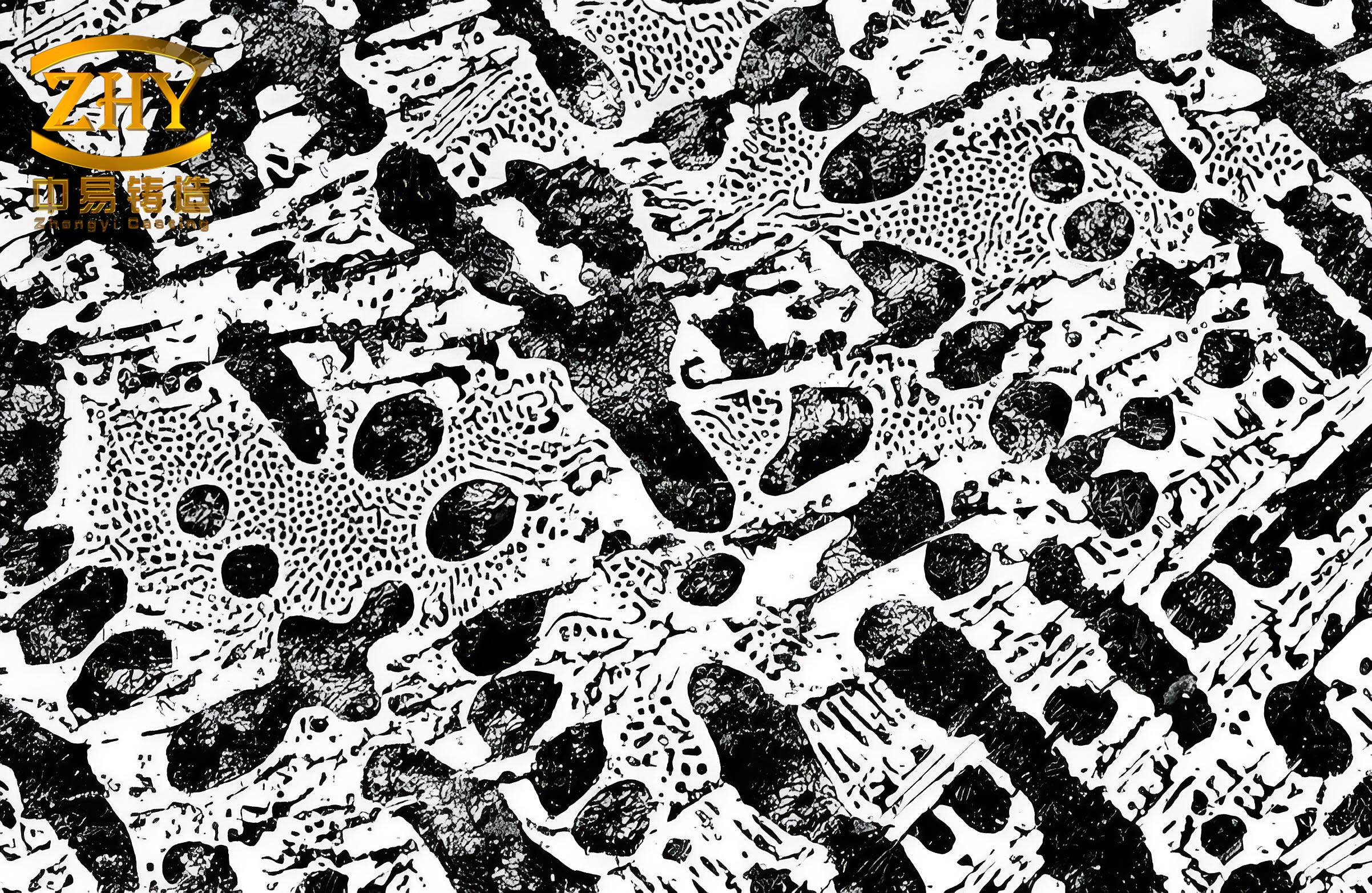
The microstructure of white cast iron is pivotal. It consists of hard, brittle (Fe,Cr)7C3 carbides within a metallic matrix (austenite, martensite, or pearlite/sorbitic ferrite). The volume fraction of carbides $V_c$ is primarily controlled by the carbon content, while the matrix composition and structure are governed by the chromium content and heat treatment. Chromium plays a dual role: it partitions into the carbides, enhancing their hardness and stability, and it remains in the matrix, improving its corrosion resistance. The chromium-to-carbon ratio (Cr/C) is a crucial metric. A high Cr/C ratio ensures that sufficient chromium remains in the matrix after carbide formation to promote passivation.
In the strong acidic regime, the corrosion potential $E_{corr}$ of the matrix is in the active dissolution region. The matrix corrodes rapidly, and the cathodic carbides can accelerate this process through galvanic coupling. The most damaging effect is interfacial corrosion at the carbide-matrix boundary. This localized attack severely undermines the mechanical support for the carbides. The erosive action of slurry particles then easily plucks out entire carbide clusters along with the corroded surrounding matrix. In this regime, the carbides are not an asset but a liability. My analysis shows that the primary strategy is to maximize the matrix’s inherent corrosion resistance. This is best achieved with a high-chromium, single-phase austenitic matrix. Austenite, being a homogeneous solid solution, generally exhibits a higher $E_{corr}$ and more stable passive film formation kinetics than multi-phase structures like martensite (which contains fine carbides) or pearlite (with ferrite and cementite lamellae). Therefore, for white cast iron in very low pH environments, the optimal composition favors a high Cr/C ratio to retain chromium in the matrix and promote an austenitic as-cast structure. The wear loss component $W_{wear}$ is almost irrelevant here compared to the massive synergistic loss.
The weak acidic regime represents the most complex and practically significant condition. Here, the corrosion kinetics are slower, and the matrix has the potential to form a protective passive film. The growth of such a film can be described by a logarithmic or inverse logarithmic law:
$$ \text{Logarithmic: } y = k_1 \ln(t) + k_2 $$
$$ \text{Inverse Logarithmic: } 1/y = k_3 – k_4 \ln(t) $$
where $y$ is film thickness and $t$ is time. However, the erosive particles continuously impinge on the surface, mechanically removing this nascent film. The system is in a dynamic competition between film formation and film removal. The performance of white cast iron in this regime is highly sensitive to both composition and microstructure, as shown in the following summary.
| Material Condition | Cr/C Ratio & Matrix | Behavior in Weak Acid | Rationale |
|---|---|---|---|
| Low Cr/C, As-cast | Low ratio, Pearlitic/Sorbitic | High loss. Matrix is active and soft. | Poor passivation, low erosion resistance. |
| Low Cr/C, Heat Treated | Low ratio, Martensitic | Moderate loss. Improved erosion resistance. | Harder matrix resists cutting, but corrosion rate is still significant. |
| High Cr/C, As-cast | High ratio, Austenitic | Low loss at moderate pH. Excellent passivation. | Stable passive film forms readily, protecting the matrix. |
| Very High Cr/C, Heat Treated | Very High ratio, Martensitic | Very low loss. Best combined performance. | Sufficient Cr for passivation, plus high hardness of martensite to resist film removal. |
The transition in optimal matrix structure from austenite to martensite with increasing Cr/C or pH is a key finding. For a white cast iron with just enough chromium to passivate, the austenitic structure is superior because it passivates more easily. However, for a white cast iron with a very high Cr/C ratio, the corrosion resistance is so robust that the dominant factor limiting material loss becomes the mechanical erosion of the now-protected surface. In this case, the harder martensitic matrix provides superior resistance to abrasive cutting, making it the better choice. The synergistic term $\Delta W_{synergy}$ in this regime is strongly negative when effective passivation occurs, as the film reduces the wear rate.
In neutral and alkaline media, the electrochemical driving force for corrosion is minimal. The corrosion potential is usually in the passive or immune region, and the corrosion rate is controlled by oxygen diffusion, which is very slow. The total material loss $W_{total}$ approximates the pure erosion loss $W_{wear}$. The governing equation for erosive wear in a ductile matrix containing hard phases can be modeled as:
$$ W_{wear} = K \cdot \rho_p \cdot V_p^n \cdot f(\alpha) \cdot \frac{1}{H} $$
where $K$ is a constant, $\rho_p$ is particle density, $V_p$ is velocity, $n$ is a velocity exponent (typically ~2.5 for ductile materials), $f(\alpha)$ is a function of impact angle, and $H$ is material hardness. For white cast iron, the hardness $H$ is a composite of the hard carbides and the matrix. Therefore, maximizing bulk hardness through a martensitic transformation and a high volume fraction of carbides is the unequivocal strategy. The exceptional erosion resistance of martensitic high-chromium white cast iron in neutral slurry service is well-documented and aligns perfectly with this mechanistic understanding.
Alloying elements beyond chromium can further tailor properties. A prime example is copper. Copper does not form carbides but dissolves in the matrix. Its influence is almost entirely electrochemical. Copper raises the corrosion potential $E_{corr}$ of the matrix and, more importantly, lowers the critical current density $i_{crit}$ required for passivation. This means the white cast iron can form a stable passive film in less oxidizing (i.e., more acidic) environments and do so more rapidly. The effect can be significant, shifting the passive region to lower pH by 1-2 units. This directly translates to reduced material loss in the weak acidic regime, as the dynamic repassivation after film removal by erosive particles is more efficient. The benefit of copper diminishes in neutral/alkaline regimes where passivation is already facile.
| Element | Primary Role | Effect on Corrosion | Effect on Erosion | Net Impact on Corrosion-Erosion |
|---|---|---|---|---|
| Chromium (Cr) | Carbide former & Matrix fortifier | Dramatically improves passivity. Increases $E_{pass}$. | Increases carbide hardness; enables hard martensite matrix. | Beneficial in all regimes. The most critical element. |
| Copper (Cu) | Matrix alloying element | Promotes passivation. Lowers $i_{crit}$, stabilizes passive film. | Negligible direct effect on hardness. | Highly beneficial in acidic regimes. Minimal effect in neutral. |
| Molybdenum (Mo) | Carbide former & Matrix strengthener | Improves pitting resistance in chloride media. | Enhances hardenability and secondary hardening. | Beneficial in acidic/neutral regimes, especially with chlorides. |
Based on this mechanistic breakdown, a rational selection strategy for chromium-containing white cast iron emerges, moving away from a one-size-fits-all approach:
- For Strong Acidic Service (pH < ~3): Prioritize corrosion resistance. Select a white cast iron with a high Cr/C ratio (>12) to ensure an austenitic or highly alloyed austenitic matrix in the as-cast condition. Consider additions like copper to enhance passivation. Understand that carbide volume is detrimental; a lower carbon content may be beneficial despite its effect on hardness.
- For Weak Acidic Service (pH ~3-6): Balance is key. The ideal choice is a white cast iron with a very high Cr/C ratio (≥15-20) that is heat treated to a martensitic structure. This provides both the chromium reservoir for excellent repassivation capability and the high matrix hardness to resist abrasive film removal. Copper is a highly valuable addition here.
- For Neutral/Alkaline Service (pH > 7): Prioritize hardness and microstructural stability. A martensitic high-chromium white cast iron with a high volume fraction of carbides is optimal. The Cr/C ratio must be sufficient to avoid pearlite formation but can be lower than in acidic service. Alloying for corrosion resistance is of secondary importance to achieving maximum bulk hardness and carbide resilience.
In conclusion, the corrosion-erosion behavior of chromium-containing white cast iron is not a fixed property but a multifaceted response dictated by a complex interplay between environment and microstructure. The transition from corrosion-dominance to erosion-dominance as pH increases mandates a strategic shift in material design philosophy—from maximizing electrochemical nobility to maximizing mechanical hardness. The pivotal role of chromium in enabling both strategies cannot be overstated, while elements like copper offer fine-tuning for challenging acidic environments. By applying this regime-based understanding, engineers can move beyond trial-and-error and make informed, optimal selections of white cast iron grades for specific slurry-handling duties, ultimately leading to significant improvements in component longevity and operational reliability.