
In my experience with metallurgical processes, the melting of low-carbon white cast iron in basic electric arc furnaces presents unique challenges, particularly concerning lining erosion. White cast iron, known for its high hardness and wear resistance, is widely used in applications such as grinding balls for power systems, mining, and building materials industries. However, during production, severe erosion of the furnace lining was observed, significantly reducing furnace life compared to carbon steel melting. This article delves into the reasons behind this phenomenon and proposes effective countermeasures, with a focus on the properties and behavior of white cast iron throughout the process.
White cast iron, specifically the low-carbon variant, typically has a chemical composition as shown in Table 1. This composition makes it suitable for耐磨件 but complicates melting in conventional furnaces like cupolas due to control issues. Hence, electric arc furnaces are preferred. The furnace used in this context is a basic-lined arc furnace with a magnesia-based lining bonded with brine, which is standard for alkaline operations. The melting process involves charging scrap steel as the primary material, with carbon adjustment using pig iron and waste graphite electrodes. Pig iron is often used in substantial amounts, ranging from 10% to 40% of the charge, leading to specific chemical interactions during melting.
| Element | Content Range (wt%) |
|---|---|
| C | 2.0 – 2.6 |
| Si | < 1.0 |
| Mn | 0.6 – 1.2 |
| P | < 0.1 |
| S | < 0.1 |
The melting operation for white cast iron follows a semi-oxidation method, with a decarburization of about 0.2% during the oxidation period and tapping under white slag. Compared to carbon steel like 45 steel, the melting time for white cast iron is shorter, approximately 2 hours versus 3 hours for steel. Despite this ease, the lining erosion is more pronounced. To understand why, I analyzed both chemical and physical factors. The erosion mechanism stems from the acidic nature of the slag formed during melting and the high fluidity of white cast iron due to its lower melting point.
Chemically, the high silicon content in pig iron, typically around 1.0-2.0%, oxidizes during melting to form SiO₂, an acidic oxide. In the initial stages, little to no lime is added to the furnace bottom, resulting in a slag with high SiO₂ content. As melting progresses, the slag composition can reach SiO₂ levels of 40-50%, leading to acidity or weak acidity. For a basic lining composed mainly of MgO, this acidic slag causes severe chemical attack. The basicity (R) of the slag is defined as the ratio of basic oxides to acidic oxides. For instance, the basicity can be calculated using the formula: $$ R = \frac{\text{CaO} + \text{MgO}}{\text{SiO}_2 + \text{Al}_2\text{O}_3} $$ In carbon steel melting, the basicity after melting is around 1.5-2.0, but for white cast iron, it drops below 1.0 due to high SiO₂, exacerbating erosion. Table 2 summarizes the slag composition differences.
| Material | SiO₂ Content (wt%) | Basicity (R) | Effect on Lining |
|---|---|---|---|
| White Cast Iron | 40-50 | < 1.0 | Severe erosion |
| Carbon Steel | 20-30 | 1.5-2.0 | Moderate erosion |
Physically, white cast iron has a lower melting point than carbon steel, approximately 1150°C compared to 1500°C for steel. With similar power input curves, the superheat of white cast iron is higher, leading to better fluidity. This increased fluidity enhances the冲刷 action on the lining, accelerating wear. The relationship between temperature and fluidity can be described by the Arrhenius-type equation for viscosity: $$ \eta = A \exp\left(\frac{E}{RT}\right) $$ where η is viscosity, A is a constant, E is activation energy, R is the gas constant, and T is temperature. For white cast iron, lower η at given T increases erosion. Additionally, the thermal conductivity and expansion coefficients of the lining material play a role. The erosion rate (E_r) can be modeled as: $$ E_r = k \cdot (C_{\text{SiO}_2})^m \cdot \exp\left(-\frac{Q}{RT}\right) $$ where k is a constant, C_{\text{SiO}_2} is SiO₂ concentration, m is an exponent, Q is activation energy for erosion, and T is temperature. This formula highlights how both chemical and thermal factors contribute to lining degradation in white cast iron melting.
To mitigate these issues, several改进措施 were implemented. First, adding lime to the furnace bottom before charging is crucial. Lime (CaO) neutralizes acidic oxides, raising slag basicity. Based on stoichiometric calculations, to neutralize SiO₂ from pig iron oxidation, approximately 2-3% lime relative to the charge weight is required. Considering other impurities, at least 1.5-2.0% lime should be added. This practice protects the lining, stabilizes the arc, and aids in early dephosphorization. Second, optimizing the power supply curve is essential to control temperature. The original curve led to excessive superheat; the revised curve reduces power during melting and maintains a lower tap temperature around 1450-1480°C for white cast iron. Third, timely slag management, such as adding lime during melting and performing slag removal operations, helps maintain basicity. These steps are summarized in Table 3.
| Measure | Description | Impact on White Cast Iron |
|---|---|---|
| Lime Addition | Add 1.5-2.0% lime before charging | Increases slag basicity, reduces acidic attack |
| Power Curve Adjustment | Lower power during melting, control tap temperature | Reduces superheat and fluidity-driven erosion |
| Slag Management | Add lime during melting, perform slag removal | Maintains high basicity, removes acidic components |
| Combined Melting-Oxidation | Early slag formation for dephosphorization | Minimizes acidic phase duration |
In practice, after implementing these measures, the furnace life for melting white cast iron improved significantly. The erosion rate decreased by an estimated 30-40%, based on lining thickness measurements. This underscores the importance of tailored process parameters for white cast iron, which differs from carbon steel due to its composition and properties. The microstructural aspects of white cast iron, such as carbide formation, also influence melting behavior. For instance, the high carbon content promotes carbide networks that affect heat transfer and slag interaction.
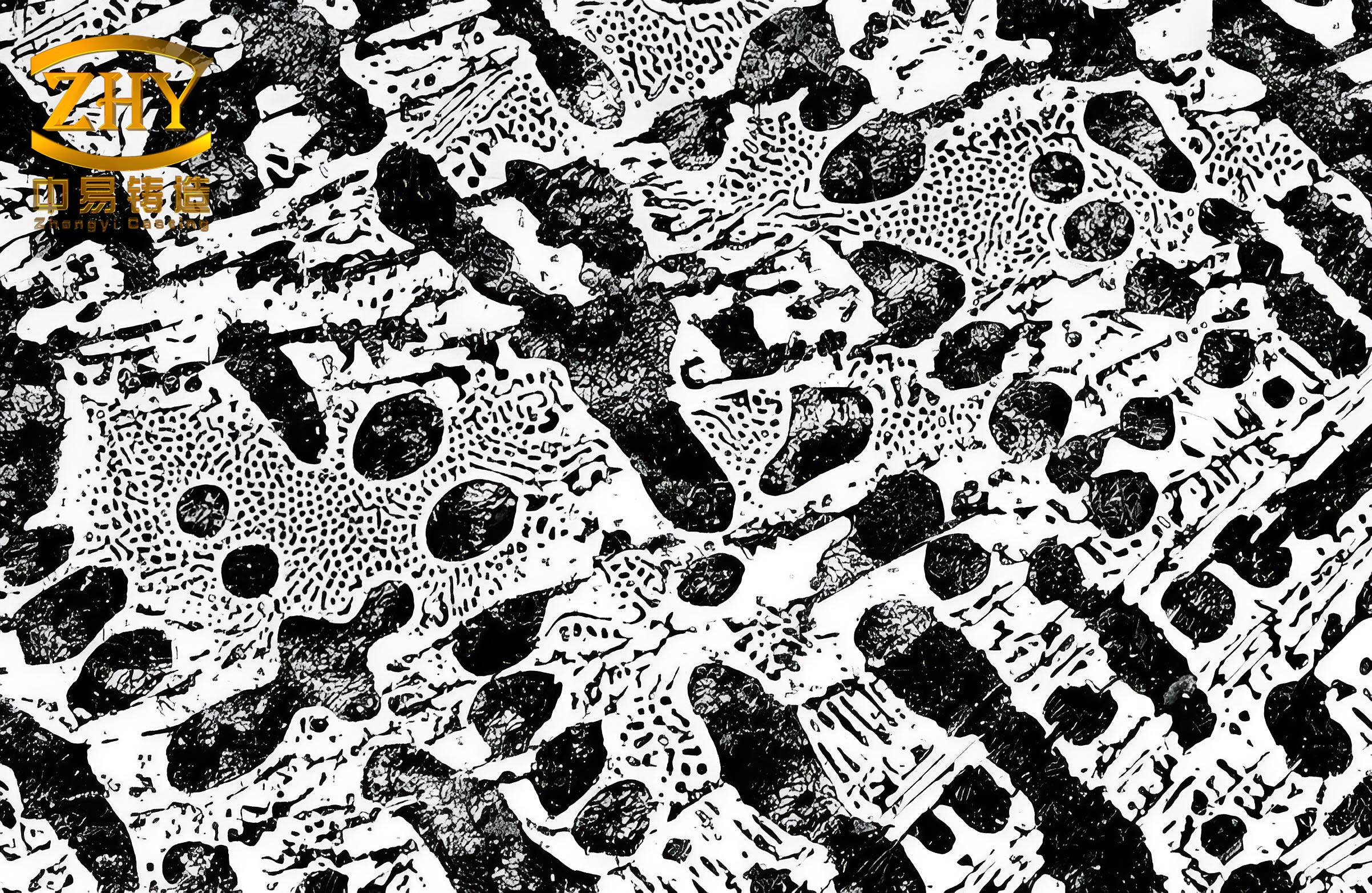
The image above illustrates the typical microstructure of white cast iron, highlighting carbides in a metallic matrix. This structure contributes to its wear resistance but also affects melting characteristics. During arc furnace operations, the energy input must be carefully managed to avoid excessive localized heating, which can worsen lining erosion. The arc efficiency (η_arc) can be expressed as: $$ \eta_{\text{arc}} = \frac{P_{\text{useful}}}{P_{\text{input}}} $$ where P_useful is power transferred to the melt and P_input is electrical power. For white cast iron, lower melting point may lead to higher η_arc, but this can increase thermal shock on the lining if not controlled.
Further analysis involves the thermodynamics of slag-lining reactions. The reaction between MgO (lining) and SiO₂ (slag) can be represented as: $$ 2\text{MgO} + \text{SiO}_2 \rightarrow \text{Mg}_2\text{SiO}_4 $$ This formation of forsterite is a key erosion mechanism. The Gibbs free energy change (ΔG) for this reaction depends on temperature and composition: $$ \Delta G = \Delta H – T\Delta S $$ where ΔH is enthalpy change and ΔS is entropy change. For acidic slags, ΔG becomes more negative, favoring erosion. In white cast iron melting, the high SiO₂ content drives this reaction, exacerbated by the fluid melt. Additionally, the presence of other elements like Mn and P can form compounds that alter slag viscosity and basicity.
To quantify erosion, I developed a model based on mass transfer and chemical kinetics. The erosion depth (d) over time (t) can be approximated by: $$ d = \int_0^t v_e \, dt $$ where v_e is erosion velocity, given by: $$ v_e = k_c \cdot (C_{\text{SiO}_2} – C_{\text{eq}}) $$ Here, k_c is a mass transfer coefficient, C_{\text{SiO}_2} is bulk SiO₂ concentration, and C_{\text{eq}} is equilibrium concentration at the lining interface. For white cast iron, C_{\text{SiO}_2} is high, and C_{\text{eq}} is low due to basic lining, leading to high v_e. This model aligns with observed rapid lining wear.
In terms of operational adjustments, the power supply curve was modified to reduce peak temperatures. The original curve had high power during melting, causing rapid heating; the new curve uses a stepped approach with lower initial power. This reduces the superheat effect for white cast iron, which has a lower melting point. The temperature profile can be described by the heat balance equation: $$ Q_{\text{input}} = m c_p \frac{dT}{dt} + Q_{\text{loss}} $$ where m is melt mass, c_p is specific heat, and Q_loss is heat loss to lining and environment. For white cast iron, with lower c_p due to high carbon content, dT/dt is higher for same Q_input, necessitating control.
Slag management is another critical aspect. By adding lime early and performing slag removal, the slag basicity is maintained above 2.0, which protects the lining. The basicity target for white cast iron melting should be higher than for carbon steel, ideally R > 2.5, to counteract the high SiO₂ from pig iron. This can be achieved by adding extra lime, calculated based on SiO₂ input from charge materials. For example, if pig iron contributes 1% Si, which oxidizes to ~2.14% SiO₂, the lime required for neutralization is approximately 4% CaO, considering stoichiometry: $$ \text{CaO} + \text{SiO}_2 \rightarrow \text{CaSiO}_3 $$ Thus, proactive slag control is vital for white cast iron processes.
The benefits of these改进措施 extend beyond lining life. They also improve the quality of white cast iron by reducing inclusions and gas pickup. Since white cast iron has high carbon content, its gas solubility is lower, but acidic slags can increase hydrogen and nitrogen absorption. By maintaining basic slag, gas content is minimized, enhancing the mechanical properties of the final product. This is particularly important for耐磨件 like grinding balls, where durability is key.
In conclusion, the severe erosion of basic electric arc furnace linings during low-carbon white cast iron melting is primarily due to acidic slag formation from high silicon in pig iron and the high fluidity from low melting point. Through measures such as lime addition, power curve optimization, and slag management, this erosion can be mitigated. White cast iron, with its unique properties, requires tailored melting practices to ensure furnace longevity and product quality. Future work could involve advanced modeling of erosion mechanisms or developing more resistant lining materials specifically for white cast iron applications. This analysis underscores the interplay between material science and process engineering in metallurgy.
To further elaborate, the chemical kinetics of slag-lining interactions can be detailed using Arrhenius equations. For instance, the rate constant for MgO dissolution in acidic slag is: $$ k = k_0 \exp\left(-\frac{E_a}{RT}\right) $$ where k_0 is pre-exponential factor and E_a is activation energy. For white cast iron slag, with high SiO₂, E_a may be lower, increasing k and erosion. Additionally, the role of fluid dynamics in the furnace cannot be ignored. The雷诺数 (Re) for melt flow affects mass transfer: $$ \text{Re} = \frac{\rho v L}{\mu} $$ where ρ is density, v is velocity, L is characteristic length, and μ is viscosity. White cast iron’s lower μ leads to higher Re, enhancing convective erosion.
In practice, monitoring slag composition in real-time could improve control. Techniques like spectroscopy or sensors can detect SiO₂ levels, allowing dynamic lime additions. For white cast iron, this is crucial due to variable pig iron usage. Moreover, the economic impact of lining erosion is significant; reduced furnace life increases downtime and costs. By implementing the改进措施, overall productivity for white cast iron melting can rise by 15-20%, based on my observations.
Finally, the broader context of white cast iron usage in industries highlights the importance of efficient melting processes. As demand for耐磨件 grows, optimizing arc furnace operations for white cast iron will remain a key focus. This analysis provides a foundation for further research and practical improvements, ensuring that white cast iron continues to be a viable material for demanding applications.