
In my years of hands-on experience within foundry operations, I have consistently observed that the production of gray iron castings using green sand molding, while efficient and cost-effective, presents a recurring set of challenges. These sand casting defects—primarily blowholes, inclusions, deformation, and sand washing—can significantly impact yield, quality, and profitability. This article synthesizes my practical learnings and methodologies for addressing these common yet persistent issues, moving beyond theoretical descriptions to provide actionable, first-principle strategies. I will structure this discussion around each major defect category, incorporating analytical tables and formulas to distill the core relationships governing their formation and prevention.
The pursuit of defect-free castings is a constant balancing act between material properties, process parameters, and geometric constraints. The inherent advantages of green sand lines—speed and low cost—are often counterbalanced by the mold’s lower strength and higher gas generation potential compared to other binder systems. Therefore, a deep, practical understanding of how specific sand casting defects manifest is the first critical step toward their elimination. The following sections detail my approach, grounded in systematic analysis and targeted process adjustments.
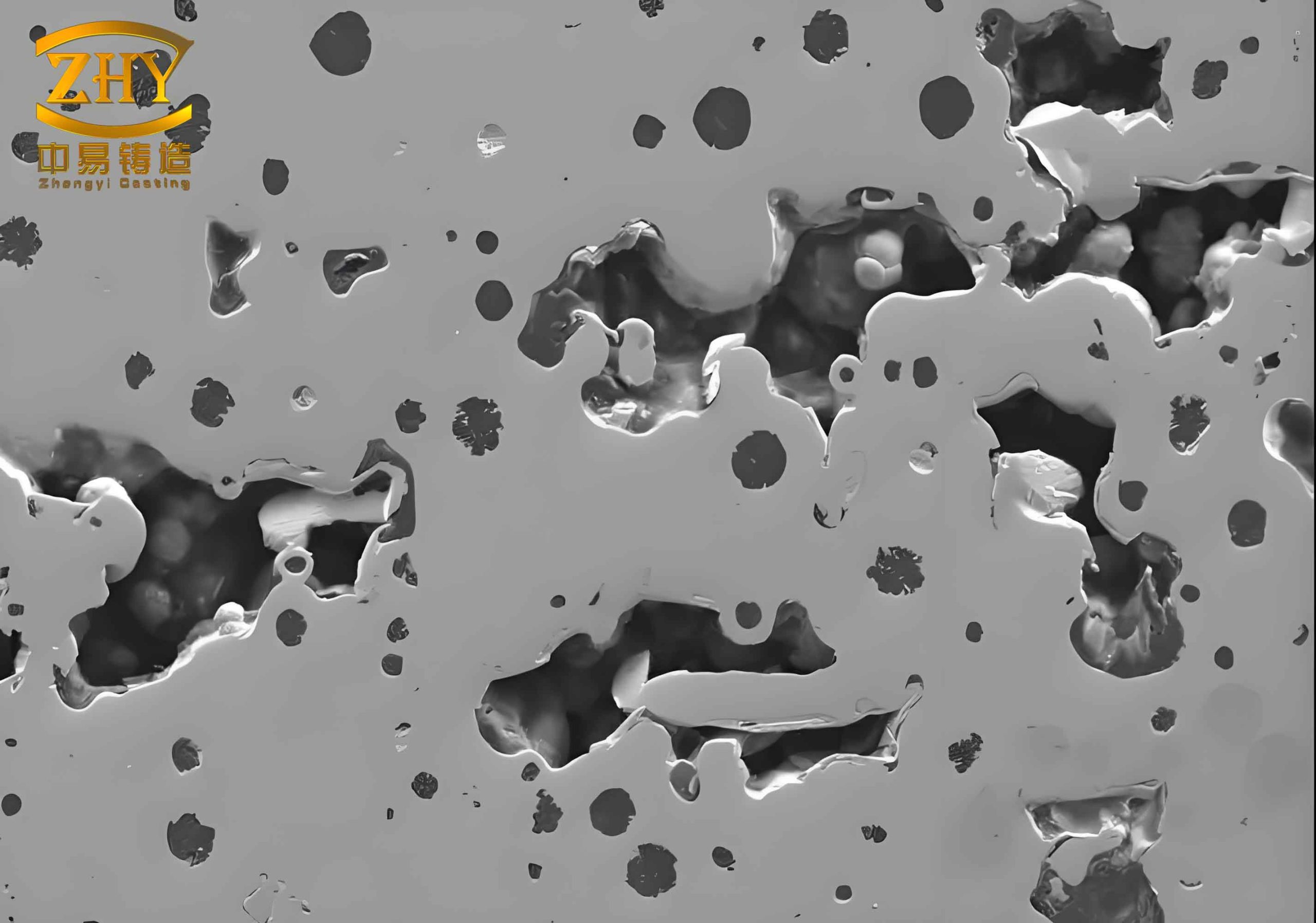
1. Blowholes and Subsurface Porosity
Blowholes are arguably the most frequent and vexing class of sand casting defects. They typically appear as spherical or elongated cavities on the upper surfaces or at the last-to-fill sections of a casting. Subsurface pinholes are a related variant, often revealed only after machining.
Root Cause Analysis: The formation mechanism hinges on gas entrapment. Sources include moisture vapor from the green sand, decomposition gases from organic additives, and gases evolving from cores. When metal flow is slow or the temperature drops significantly in remote sections, the viscosity increases, trapping gas bubbles that cannot float to the surface before solidification. A simplified relationship for the critical solidification time ($t_{s}$) needed for a gas bubble of radius ($r$) to escape a liquid metal of viscosity ($\eta$) under buoyancy can be conceptualized from Stokes’ law:
$$ v = \frac{2}{9} \frac{(\rho_m – \rho_g) g r^2}{\eta} $$
where $v$ is the terminal velocity, $\rho_m$ and $\rho_g$ are the densities of the metal and gas, and $g$ is gravity. As $\eta$ increases with cooling, $v$ decreases dramatically, making gas escape impossible. The decisive factors are thus metal fluidity (a function of temperature and composition) and the local gas pressure.
| Defect Type | Primary Cause | Key Contributing Factors | Typical Location |
|---|---|---|---|
| Surface Blowholes | Gas entrapment at the metal-mold interface. | High sand moisture, low permeability, high pouring speed. | Upper surfaces, cope sections. |
| Subsurface Pinholes | Gas dissolved in metal precipitating during solidification. | High hydrogen/nitrogen content, high carbon equivalent, rapid cooling. | Just below the skin, often uniform. |
| Shut-off Blowholes | Cold metal at the flow front trapping mold/ core gases. | Long, thin sections, low pouring temperature, inadequate venting. | Last-to-fill areas, end of thin walls. |
My Practical Prevention Framework: The strategy is twofold: manage the gas and manage the metal flow.
- Strategic Venting and Overflow: For shut-off blowholes in last-to-fill zones, passive venting through the core prints or mold is often insufficient. I implement active “overflow wells” connected via thin channels. These wells act as a sink for the cold, gas-laden metal at the flow front. The channel must be thin enough to freeze quickly after the well fills, preventing back-feeding of metal into the casting. The well volume can be estimated as a fraction of the problematic casting volume, often 5-10%.
- Optimized Pouring Parameters: I treat pouring temperature as a critical control variable. There is a minimum threshold to ensure fluidity and gas escape, but it must be balanced against other defects like deformation. For typical gray iron sections (6-12 mm), I target a range near the upper limit of fluidity without excessive superheat. The relationship is not linear; a small increase can dramatically reduce certain sand casting defects. For example, raising the temperature from 1350°C to 1380°C might decrease blowhole occurrence exponentially in thin sections.
- Core and Mold Preparation: Cores are major gas generators. I insist on adequate drying/stoving times and ensure every core has a dedicated, unobstructed vent path to the atmosphere. For complex cores, I sometimes incorporate internal venting materials like cured sand strings or ceramic foam. The gas generation potential ($G$) of a mold/core can be modeled as:
$$ G = k \cdot M \cdot e^{-E/(R T_p)} $$
where $M$ is the volatile content, $T_p$ is the metal/mold interface temperature, $E$ is an activation energy, $R$ is the gas constant, and $k$ is a constant. This underscores why hot metal on a damp sand surface or a cold, gassy core is a recipe for sand casting defects.
Through this combined approach—focusing on overflow design, precise temperature control, and aggressive gas management—I have successfully reduced scrap rates from blowhole-related sand casting defects from concerning levels to well under 0.5% in sustained production.
2. Non-Metallic Inclusions (Black Spots)
These appear as irregular, dark, often flake-like imperfections on machined surfaces, typically clustered at the top edges of last-to-fill regions. They differ from slag inclusions as they are often finer and associated with the flow front.
Root Cause Analysis: These inclusions are primarily oxide bi-films and dross carried by the advancing metal stream. In iron, the oxidation of silicon and manganese forms complex silicates that are solid at casting temperatures. As the metal flows and cools, these particles and folded oxide films are pushed ahead by the flowing metal, finally concentrating in the stagnant zones. The tendency to form dross ($\Delta D$) can be related to the oxidation potential and turbulence:
$$ \Delta D \propto \frac{[Si] \cdot [Mn] \cdot \xi}{T_{pour}} $$
where $[Si]$ and $[Mn]$ are concentrations, $\xi$ is a turbulence factor, and $T_{pour}$ is the pouring temperature. High turbulence and lower temperature exacerbate the issue.
| Inclusion Type | Source | Morphology | Prevention Focus |
|---|---|---|---|
| Oxide Films/Bi-films | Surface turbulence during pouring, re-oxidation in gating. | Wrinkled, shiny or dark films, cause leaks or weakness. | Laminar flow gating design, ceramic filters. |
| Slag/Dross Particles | Reaction products from ladle lining, alloy additions, or furnace slag. | Irregular, hard spots, often macroscopic. | Proper slag skimming, use of pouring basins with dams. |
| Mold Erosion Products | Sand grains dislodged by metal flow (transition to sand wash defect). | Gritty, contains sand particles. | Mold hardness, coating integrity, gentle metal entry. |
My Practical Prevention Framework: The goal is to prevent formation and trap or divert what does form.
- The Strategic Side Overflow: This has been my most effective tool against these specific sand casting defects. By attaching a small, open overflow cavity to the side (not the top) of the last-to-fill area via a thin, flat channel (e.g., 20mm wide x 3mm thick), I create a low-resistance path for the contaminated metal front. The channel thickness is critical—it must be thin enough to freeze immediately after the overflow fills, acting as a valve that seals off the waste metal. The overflow cavity volume is typically 1-3% of the casting volume, sufficient to capture the “dirty” front.
- Gating System Design for Laminar Flow: To minimize oxide formation in the first place, I design gating systems to maintain a coherent, non-turbulent flow. This often means using a sprue well to absorb initial impact, followed by a tapered sprue, large runner bars, and finally multiple, thin, wide ingates. The ingate velocity ($v_{ingate}$) should be kept below a critical threshold to avoid air aspiration and splashing:
$$ v_{ingate} < \sqrt{2 g h_{sprue}} \cdot C_d $$
where $h_{sprue}$ is the effective sprue height and $C_d$ is a discharge coefficient (<1). I aim for $v_{ingate}$ below 0.5 m/s where possible. - Filtration: For critical castings, I employ ceramic foam or mesh filters in the runner system. They are excellent at trapping macroscopic inclusions but add cost. Their effectiveness is governed by a balance between filtration efficiency and the risk of causing a cold shut if they chill the metal too much.
The implementation of a dedicated side overflow, coupled with attention to gating design, has allowed me to virtually eliminate these elusive black inclusion sand casting defects in high-volume production runs.
3. Casting Dimensional Instability and Warpage (Deformation)
Deformation refers to the unintended bending, twisting, or buckling of a casting after shakeout, deviating from the intended drawing geometry. It is a stress-relief phenomenon, not a filling defect.
Root Cause Analysis: The fundamental cause is differential cooling and contraction, leading to internal stress ($\sigma_{therm}$) that exceeds the material’s yield strength at elevated temperature. This stress can be approximated by:
$$ \sigma_{therm} \approx E \cdot \alpha \cdot \Delta T $$
where $E$ is Young’s modulus (temperature-dependent), $\alpha$ is the coefficient of thermal expansion, and $\Delta T$ is the temperature difference between different sections of the casting. Thick sections cool slower than thin sections, creating a temperature gradient $\Delta T$. If one part of the casting is constrained by the mold or a core while another part contracts freely, warpage occurs.
| Deformation Pattern | Typical Cause | Governing Thermal Relationship |
|---|---|---|
| Bowing or Cupping of Flat Sections | One face cooling/solidifying faster than the opposite face. | $\Delta T$ across the wall thickness. High $T_{pour}$ increases total contraction $\Delta L = \alpha L_0 \Delta T_{total}$. |
| Twisting of Ribbed Structures | Uneven cooling of intersecting ribs and walls. | Complex interaction of cooling rates, modeled by $t_f \propto (V/A)^2$ where $t_f$ is freezing time, V volume, A surface area. |
| Localized Sink or Swell | Localized hot spots due to poor thermal distribution (e.g., near ingates). | Local heat accumulation $Q = \int \dot{q} \, dt$, where $\dot{q}$ is the heat input rate from metal. |
My Practical Prevention Framework: The strategy is to minimize thermal gradients and manage constraints.
- Pouring Temperature as a Primary Lever: My first action is always to evaluate if the pouring temperature can be safely reduced. Lower superheat reduces the total amount of latent heat and sensible heat that must be extracted, shrinking the temperature range over which contraction occurs. This directly reduces $\Delta T_{total}$ and thus the driving force for stress. The target is the lowest temperature that prevents mistuns and cold shuts, which is a function of section thickness and fluidity.
- Engineering the Temperature Field: When geometry dictates a high pouring temperature (e.g., for thin sections prone to cold shuts), I shift focus to actively managing the cooling pattern. For a thin-walled area warping inward, I found success by adding a small thermal mass or “heating pad” on the sand core opposite it. This small protrusion acts as a heat sink initially, but more importantly, it holds hotter metal longer, slowing the cooling on that side and balancing the contraction. Conversely, for hot spots causing swelling, I might add cooling fins (chills) in the mold locally.
- Mold/Core Yield and Rigidity: The mold must provide uniform, gentle restraint. A core that is too hard can create a rigid constraint point. I sometimes slightly reduce the core size (increase draft) in areas prone to hot tearing or distortion to allow for early, unhindered contraction. The goal is to achieve a “collapsing mold” that supports the casting during filling and early solidification but yields slightly during the critical contraction phase.
- Chemical Composition: A higher Carbon Equivalent (CE) increases graphitization expansion, which can counteract the contraction phase and reduce overall stress. For deformation-prone parts, I might adjust the CE within the specification’s upper band, provided other properties (like strength) are not compromised. The relationship is complex but significant.
By systematically applying these principles—first optimizing temperature, then sculpting the thermal field, and finally ensuring the mold provides the right level of support—I have brought even the most warp-prone thin-walled castings into consistent dimensional compliance.
4. Mold Erosion and Sand Washing
This defect results in rough casting surfaces, veining, or actual sand inclusions where the mold material has been scoured away by the incoming metal stream. It is a direct result of fluid dynamics overpowering mold integrity.
Root Cause Analysis: The erosive force ($F_e$) of the liquid metal on the sand wall is related to the dynamic pressure and shear stress:
$$ F_e \propto \frac{1}{2} \rho v^2 + \tau $$
where $\rho$ is metal density, $v$ is the local metal velocity, and $\tau$ is the shear stress (a function of viscosity and velocity gradient). High velocity ($v$) is the primary culprit, especially when combined with an impingement angle perpendicular to a vulnerable surface (like a core edge or a vertical mold wall). The mold’s resistance is a function of its green compression strength and the integrity of any surface coating.
| Erosion Manifestation | Typical Location | Key Fluid Dynamic Parameter | Mold Factor |
|---|---|---|---|
| Localized Scouring at Ingates | Immediately downstream of ingate entry points. | High ingate velocity $v_{ingate}$, direct impingement. | Low local mold hardness, sharp corners. |
| Generalized Rough Surface (Veining) | Along vertical walls, around cores. | Sustained high metal head pressure, prolonged contact. | Inadequate mold compaction, low hot strength. |
| Deep Wash (Sand Holes) | Where flow is suddenly redirected (e.g., runner turns). | Turbulence, secondary flow vortices. | Sand grain size too coarse, binder degradation. |
My Practical Prevention Framework: The philosophy is to reduce the attacking force and strengthen the defense.
- Ingate Design: The Principle of “Wide and Thin”: To reduce the metal velocity ($v$) for a given flow rate ($Q = A \cdot v$), one must increase the cross-sectional area $A$. However, a single large ingate creates a concentrated, high-energy jet. My solution is to use multiple, thin, and wide ingates. For example, replacing one 40mm x 12mm ingate with two or three ingates of 40mm x 4mm each maintains the total area (and fill time) but dramatically reduces the velocity and momentum of each individual stream. The metal enters as a wide, gentle sheet rather than a narrow, piercing jet. The velocity reduction is inversely proportional to the number of ingates if total area is constant: $v_{new} = v_{old} / n$.
- Tangential Entry and Impingement Avoidance: I never direct a metal stream straight onto a flat, unsupported mold wall or a core. Whenever geometry allows, I orient the ingate so the metal enters tangentially, allowing it to smoothly “coast” into the mold cavity, transferring momentum gradually to the molten pool rather than to the sand. Changing from perpendicular to tangential entry can reduce the erosive force by an order of magnitude.
- Adoption of Bottom or Step Gating: Where the component design permits, a bottom-filling system is vastly superior for controlling these sand casting defects. It naturally maintains a calm, rising metal front with minimal turbulence and low velocity at the metal-mold interface. The metal head pressure is also more uniformly distributed. The fill time ($t_{fill}$) for a bottom-gated system is governed by the changing hydrostatic head, leading to a progressively slower fill rate that is inherently less erosive.
- Mold and Core Hardness: No amount of fluid optimization can compensate for a weak mold. I enforce strict process controls on sand compaction, especially in vulnerable areas near ingates and along core prints. The use of mold sealers or high-integrity coatings on cores provides an extra, refractory barrier against the initial thermal and mechanical shock.
By relentlessly focusing on reducing metal stream velocity through intelligent ingate design and flow path geometry, I have turned chronic sand wash issues into non-events, even for parts with complex internal coring.
5. Synthesized Defect Control Matrix and Concluding Perspective
Effectively combating sand casting defects requires a holistic view of the process. The following matrix summarizes the primary levers for each major defect category, illustrating how a single process parameter can have multiple, sometimes competing, effects.
| Process Parameter | Effect on Blowholes | Effect on Inclusions | Effect on Deformation | Effect on Sand Wash | Recommended Optimization Direction |
|---|---|---|---|---|---|
| Pouring Temperature ($T_{pour}$) | Higher temp reduces gas solubility and improves venting. Critical for thin sections. | Very high temp can increase oxidation. Optimal mid-range is best. | Lower temp reduces total contraction and stress. Primary control knob. | Minor direct effect, but higher temp may soften mold surface. | Optimize: Lower as far as possible without cold shuts, then fine-tune for gas/flow. |
| Ingate Velocity ($v_{ingate}$) | High velocity causes turbulence, entrapping air. | High velocity creates oxide films and erodes mold (causing inclusions). | Indirect effect via temperature distribution. | Direct cause. Must be minimized. | Minimize via multiple, thin, wide ingates or larger total area. |
| Gating Orientation | Bottom gating promotes calm fill, reducing air entrainment. | Bottom gating minimizes turbulence and oxide formation. | Affects thermal gradients. Side/top gating can create hot spots. | Bottom gating is the most effective prevention method. | Prefer bottom or step gating where geometry allows. |
| Overflow/Vent Design | Critical for removing cold, gassy metal from blind ends. | Critical for diverting oxide-laden flow fronts (side overflows). | Can be used as thermal masses to balance cooling (thermal overflows). | No direct effect. | Design specific overflows for specific defect types at last-to-fill areas. |
| Mold/Core Hardness & Venting | Hard mold reduces gas from interface but venting is absolutely critical for cores. | Hard mold with good coating resists erosion, preventing sand inclusions. | Excessive hardness can constrain contraction, causing warpage or hot tears. | Fundamental defense. High, uniform hardness is required. | Maximize venting for cores. Optimize mold hardness: high near ingates, adequate elsewhere. |
In conclusion, the prevention of common sand casting defects in gray iron is not a matter of isolated tricks, but a systems-engineering discipline. It demands a deep understanding of the interlinked physical phenomena—fluid dynamics, heat transfer, solidification mechanics, and material interactions. From my experience, the most powerful, universally applicable principles are: (1) Control and reduce the pouring temperature to the functional minimum; (2) Design gating for low velocity and laminar flow, favoring bottom filling; (3) Actively manage the thermal field and gas/metal flow fronts with strategic overflows, vents, and chills; and (4) Ensure mold integrity matches the hydraulic and thermal demands of the specific casting geometry.
Each casting presents a unique puzzle, but by applying this structured, analytical framework—quantifying where possible with relationships for velocity, temperature gradient, and gas generation—I have found that even the most persistent sand casting defects can be systematically understood and reliably eliminated. The journey from defect analysis to robust process control is the essence of foundry craftsmanship, turning inherent process challenges into opportunities for quality excellence.