
In my extensive work with abrasion-resistant materials, the processing of high-chromium white cast iron stands out as a particularly intricate challenge. The development of components, such as those for dredge pumps handling sand-laden flows, demands a material that offers an exceptional combination of hardness, fracture toughness, and castability. This white cast iron variant, exemplified by grades like KmTBCr26, achieves this through a sophisticated balance of alloying elements and strict process control. The journey from raw charge to a sound, high-performance casting hinges on a deep understanding of the metallurgical principles governing its solidification and transformation. Success is not merely about meeting a chemical specification; it is about orchestrating the interplay between carbon, chromium, molybdenum, copper, and nickel to elicit a specific microstructure dominated by hard carbides in a supportive matrix. This article details the critical considerations in alloy design, the pivotal role of the chromium-to-carbon ratio, and the precise melting practices required to reliably produce this superior class of white cast iron.
Fundamentals and Alloying Philosophy of High-Chromium White Cast Iron
The exceptional wear resistance of high-chromium white cast iron is fundamentally derived from its microstructure. Unlike common gray irons where graphite provides lubrication, or even standard white irons with cementite (Fe3C), this alloy family forms a network of hard, complex chromium carbides. Specifically, when the chromium content is sufficiently high (typically above 10-12%), the favored carbide becomes (Cr,Fe)7C3. This carbide possesses a hexagonal or pseudo-hexagonal crystal structure and a microhardness in the range of HV 1200-1800, significantly harder than cementite (HV ~800-1100). These carbides act as the primary defense against abrasive particles. However, a microstructure composed solely of brittle carbides would be unusable. Therefore, the alloy design must simultaneously engineer a matrix that is both tough enough to support the carbides without premature fracture and hard enough to prevent wear of the matrix itself, which would lead to carbide protrusion and eventual pull-out.
The matrix in the as-cast condition is typically austenitic, a result of the high chromium and carbon content in solid solution. This austenite can be subsequently transformed via heat treatment—through destabilization at high temperature followed by quenching—into martensite, providing a very hard supporting phase. The entire challenge of alloying this white cast iron revolves around optimizing the volume fraction, morphology, and distribution of the (Cr,Fe)7C3 carbides while ensuring the austenitic/martensitic matrix has adequate hardenability, especially in heavier sections. The key elements involved are summarized in Table 1.
| Element | Primary Function | Secondary Effects & Considerations | Typical Range for Section-Sensitive Castings (%) |
|---|---|---|---|
| Carbon (C) | Controls total carbide volume fraction. Forms (Cr,Fe)7C3. | Increases hardness and wear resistance but decreases toughness and hardenability. Affects casting fluidity and shrinkage. | 2.6 – 2.8 |
| Chromium (Cr) | Carbide former ((Cr,Fe)7C3). Imparts corrosion/oxidation resistance. Increases hardenability in matrix. | Must be balanced with carbon via Cr/C ratio. Partitions between carbides and matrix. | 23.0 – 25.0 |
| Molybdenum (Mo) | Powerful hardenability agent. Retards pearlite formation. | Partially dissolves in matrix and carbides. Has minor effect on lowering Ms temperature. | 0.4 – 0.6 |
| Copper (Cu) | Improves hardenability, especially when combined with Mo. | Limited solubility in austenite (<2%). Can promote surface enrichment. | 0.8 – 1.2 |
| Nickel (Ni) | Austenite stabilizer and hardenability agent. | Fully dissolves in austenite. Strongly lowers Ms temperature, potentially retaining residual austenite. | 0.6 – 0.8 |
| Manganese (Mn) | Austenite stabilizer. Mitigates sulfur’s harmful effects. | Lowers Ms significantly. Content must be controlled to avoid excessive retained austenite. | 0.5 – 1.0 |
| Silicon (Si) | Deoxidizer. Can raise Ms temperature. | Generally reduces hardenability. Kept low to avoid graphitization. | ≤ 0.8 |
Rational Design of Chemical Composition
The specification for a grade like KmTBCr26 provides a permissible range for each element. The art of production lies in selecting the precise aim points within these ranges to suit the specific casting geometry, section size, and service conditions.
Carbon and Chromium: The Foundational Pair
The selection of carbon content is a primary decision. From a wear perspective, a higher carbon content increases the volume fraction of the hard (Cr,Fe)7C3 carbides. This can be visualized using the lever rule on a simplified Fe-Cr-C phase diagram slice. The relationship between carbon content and approximate carbide volume fraction (CVF) can be estimated for a fixed chromium level. Furthermore, carbon significantly influences the eutectic point. In high-chromium white cast iron systems, the carbon content at the eutectic is elevated. Aiming for a composition near this eutectic (typically around 3.3-3.6% C for ~25% Cr) improves casting characteristics such as fluidity and feedability, reducing shrinkage defects. However, excessive carbon leads to excessive carbide connectivity, embrittling the material and severely reducing its fracture toughness and hardenability. For components requiring a balance of wear resistance and impact loading, I find an optimal carbon range of 2.6% to 2.8% provides a carbide volume sufficient for wear resistance while maintaining manageable brittleness and allowing for subsequent heat treatment transformation.
Chromium serves a dual role. Its primary function is to combine with carbon to form the desirable M7C3 carbides. The remaining chromium dissolves in the austenite matrix, enhancing its hardenability and corrosion resistance. While higher chromium generally increases wear and corrosion resistance, it also raises cost and can alter carbide morphology if not balanced with carbon. For a given carbon content in the 2.6-2.8% range, a chromium level at the lower end of the specification (23-25%) is often sufficient to ensure full formation of (Cr,Fe)7C3 over other carbides like (Cr,Fe)23C6, while still providing adequate matrix alloying. This balance is best described by the critical Chromium-to-Carbon ratio (Cr/C).
The Critical Role of the Cr/C Ratio
The Cr/C ratio is arguably the most important single parameter in designing this white cast iron’s microstructure and properties. It directly influences the type of carbides formed, their morphology, and the composition of the matrix.
$$ \text{Cr/C Ratio} = \frac{\text{Weight \% Cr}}{\text{Weight \% C}} $$
When the Cr/C ratio is very high (>10), the carbon content is relatively low for the amount of chromium present. This favors the formation of (Cr,Fe)23C6 carbides, which are less hard than M7C3 and can result in a microstructure with a higher proportion of austenite/martensite and lower overall wear resistance. Conversely, a very low Cr/C ratio (<6) pushes the composition towards hypereutectic structures with primary M7C3 carbides that are large, blocky, and highly detrimental to toughness.
For a hypoeutectic structure with a continuous eutectic carbide network—which offers the best compromise for many abrasion applications—the target Cr/C ratio typically lies between 7 and 9. At a ratio around 8, with C=2.7% and Cr=22-23%, the white cast iron solidifies with a fine, well-distributed network of eutectic M7C3 carbides in an austenitic matrix. This refined as-cast structure is not only beneficial for wear resistance but also responds better to heat treatment, as the finer carbides allow for more effective carbon diffusion during the destabilization stage. Research has shown a correlation between Cr/C ratio and fracture toughness (KIc), with an optimum often observed within this range, as the microstructure avoids the extremes of either excessive brittle carbide or large, soft matrix areas.
| Cr/C Ratio Range | Expected Carbide Type & Morphology | Matrix Phase (As-Cast) | Implications for Properties |
|---|---|---|---|
| High (>10) | Mainly (Cr,Fe)23C6. Lower carbide volume fraction. | High-Austenite, potentially coarser. | Lower wear resistance, higher toughness, better machinability in as-cast state. |
| Optimal (~7-9) | Predominantly eutectic (Cr,Fe)7C3 in a fine, interconnected network. | Austenite, finer grain size. | Excellent balance of wear resistance and toughness. Good response to heat treatment. |
| Low (<6) | Primary, large (Cr,Fe)7C3 crystals + eutectic. High carbide volume. | Austenite surrounding large carbides. | Very high wear resistance but very low impact toughness. Poor machinability. |
Hardenability Additions: Mo, Cu, and Ni
The formation of a substantial network of carbides unfortunately depletes the matrix of both carbon and chromium, reducing its inherent hardenability. This makes the white cast iron prone to forming soft pearlite instead of martensite during cooling, especially in thicker casting sections. To counteract this, alloying elements that enhance hardenability must be added.
Molybdenum is the most effective and commonly used. It dissolves in the austenite matrix and strongly retards the diffusion-controlled transformation to pearlite, allowing the cross-section to cool to a temperature where martensite can form. Its effect on lowering the martensite-start (Ms) temperature is moderate, which helps minimize retained austenite after quenching. Copper acts synergistically with molybdenum. While its individual effect on hardenability is modest and its solubility in austenite is limited, it significantly boosts the effectiveness of molybdenum. Nickel is a potent austenite stabilizer and also improves hardenability. However, it substantially lowers the Ms temperature. While this can be beneficial for reducing quench cracking, it may lead to high levels of soft, retained austenite in the final microstructure, compromising hardness. Therefore, nickel is often used judiciously and in combination with other elements. For typical castings with sections under 50 mm, a balanced addition of 0.5% Mo, 1.0% Cu, and 0.7% Ni has proven highly effective in ensuring a fully martensitic or martensitic-austenitic matrix upon air quenching or even slower cooling.
The Imperative of Controlled Melting Practice
Precise alloy design is futile without equally precise melting control. The production of high-quality high-chromium white cast iron is non-negotiable in its requirement for an electric furnace—be it induction or arc. The use of cupolas is precluded due to the severe and uncontrollable oxidation (burning) of chromium in the intense, oxidizing environment of the coke bed. Furthermore, direct contact with carbonaceous fuel makes it impossible to control the final carbon content accurately.
An electric furnace provides an inert or reducing atmosphere, allowing for predictable and low element recovery rates. It also enables excellent temperature control, which is vital for both chemistry and casting quality.
Determination of Element Recovery Rates
To hit the precise aim composition in the ladle, one must account for the losses that occur during melting. These recovery or yield rates are primarily a function of melting temperature, slag basicity, and element reactivity. Based on controlled melts, typical recovery rates for key elements in an electric furnace operating at an optimal temperature of 1500-1520°C are presented in Table 3. Melting significantly above 1550°C increases oxidation losses for Cr, Mn, and Mo, while temperatures below 1480°C risk poor dissolution of the alloys and higher viscosity.
| Element | Typical Recovery Rate (%) | Notes on Charge Material & Practice |
|---|---|---|
| Carbon (C) | ~97-100% | Controlled by initial charge; minor oxidation. Use of graphite electrodes can cause pickup. |
| Chromium (Cr) | ~95-97% | Loss is minimal in electric furnace. Charged as High-Carbon Ferrochrome (HC FeCr) for efficiency. |
| Molybdenum (Mo) | ~95-98% | Charged as Ferromolybdenum. Low loss. |
| Copper (Cu) | ~100% | Charged as pure cathode copper. Essentially no loss. |
| Nickel (Ni) | ~100% | Charged as pure nickel. Essentially no loss. |
| Manganese (Mn) | ~85-90% | Higher loss due to oxidation. Charged as Ferromanganese. |
| Silicon (Si) | ~90-95% | Charged as Ferrosilicon. Loss occurs through oxidation and slag reactions. |
Melting and Pouring Procedure
A logical charging sequence promotes efficient melting and uniform composition. The following sequence is effective:
- Base Charge: Steel scrap (low in residuals like S and P) and/or returns (gates, risers, scrap castings) of the same composition are charged first to form a molten pool.
- Alloy Addition: Once the base is molten, high-carbon ferrochrome is added. This allows the Cr and C to dissolve efficiently. The heat from the bath aids in dissolving this large alloy addition.
- Minor Alloys: After the ferrochrome is fully dissolved and the temperature recovers, the nickel, copper, and molybdenum (as FeMo) are added. These have higher melting points but dissolve readily in the hot, alloyed bath.
- Final Adjustments: Ferromanganese and ferrosilicon are added last to minimize oxidation losses. A final check and adjustment of temperature and chemistry (using a rapid analyzer) are made.
- De-slagging and Pouring: The slag is thoroughly removed before tapping. The white cast iron is tapped at 1480-1520°C and poured into molds at a temperature appropriate for the casting geometry—typically between 1380°C and 1420°C for medium-section castings in green sand molds. Too high a pouring temperature increases shrinkage and grain size; too low a temperature risks mistruns and poor surface finish.
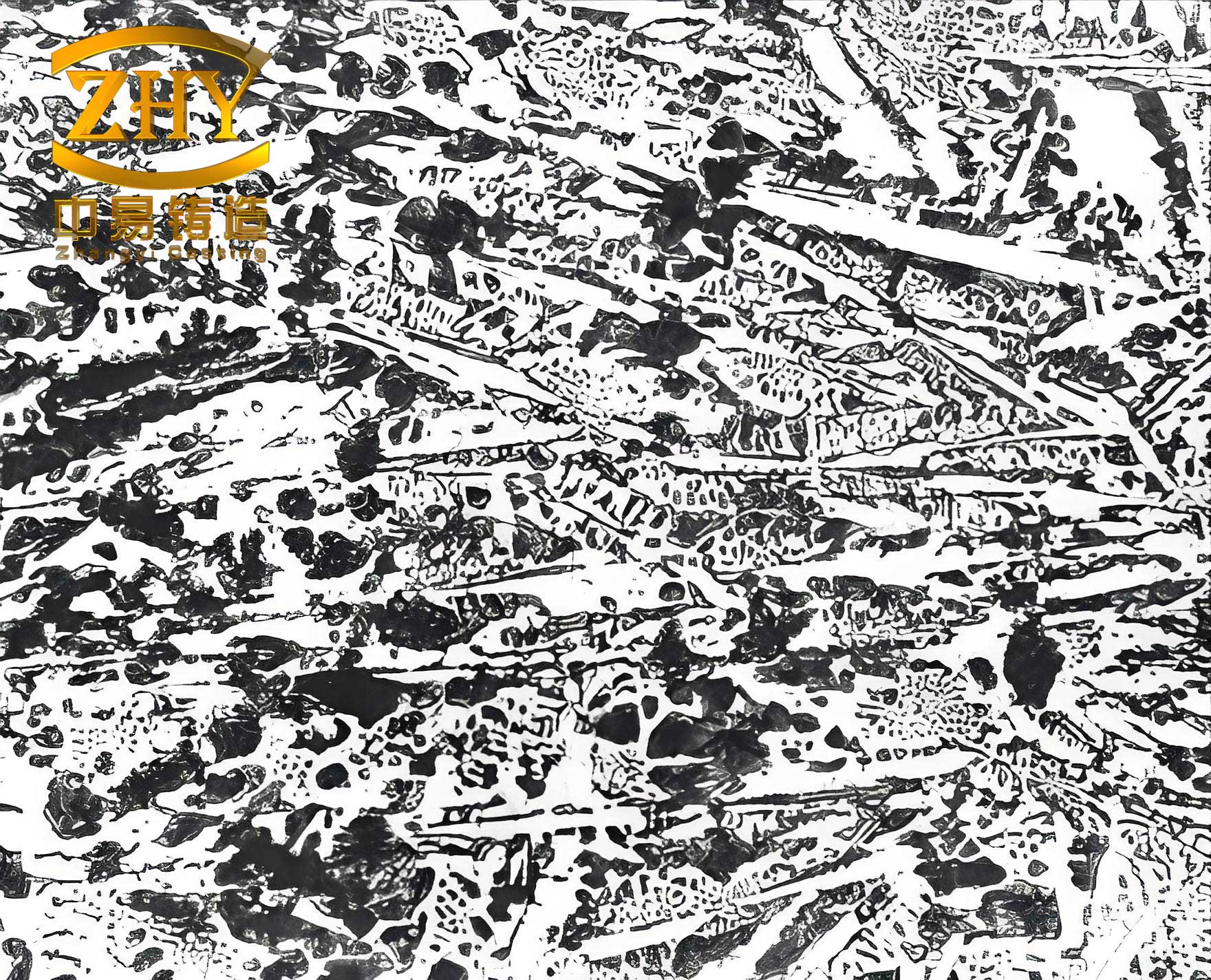
Microstructural Evolution and Property Relationships
The final properties of the white cast iron are a direct consequence of its microstructure. In the as-cast condition, with the recommended chemistry and Cr/C ratio, the microstructure consists of austenitic dendrites surrounded by a eutectic mixture of austenite and (Cr,Fe)7C3 carbides. The hardness in this state typically ranges from 45 to 55 HRC, primarily dictated by the carbide volume and the solid-solution strengthening of the austenite.
For maximum abrasion resistance, a heat treatment is employed. This involves a “destabilization” hold at 950-1050°C. During this treatment, secondary carbides (rich in Cr and Mo) precipitate within the austenite grains. This depletes the austenite of carbon and chromium, raising its Ms temperature. Upon subsequent air quenching or even furnace cooling (depending on section size and hardenability additives), this destabilized austenite transforms to martensite. The final microstructure is thus a network of primary eutectic carbides, secondary precipitated carbides, and a martensitic matrix, often with some retained austenite. This structure can achieve hardness levels of 58-65 HRC or more. The secondary carbides within the martensitic laths provide additional wear resistance and strengthen the matrix further.
The relationship between carbide volume fraction (CVF) and hardness can be approximated, though it is matrix-dependent. A simple rule of mixtures gives a first-order estimate:
$$ H_{composite} \approx V_{carbide} \cdot H_{carbide} + (1 – V_{carbide}) \cdot H_{matrix} $$
where \( H_{composite} \) is the bulk hardness, \( V_{carbide} \) is the volume fraction of carbides, and \( H_{carbide} \) and \( H_{matrix} \) are the hardness of the carbide and matrix phases, respectively. For a white cast iron with 25% CVF of M7C3 (HV~1500) in a martensitic matrix (HV~700-800), the estimated bulk hardness would be in the upper range of what is measured.
Conclusion
The successful production of high-performance, high-chromium white cast iron components is a testament to applied metallurgy. It requires a synergistic approach where composition, ratio control, and processing are inseparably linked. The use of electric furnace melting is fundamental to achieving precise and reproducible chemistry. The intelligent design of the alloy, focusing on an optimal Cr/C ratio between 7 and 9 and balanced hardenability additions of Mo, Cu, and Ni, dictates the development of a refined, eutectic carbide network within a transformable matrix. This white cast iron, when processed with this understanding, transcends being merely a hard material; it becomes a reliable engineering solution for the most demanding abrasion-intensive applications, offering an unparalleled combination of wear life and structural integrity. The principles outlined here for grades like KmTBCr26 form the cornerstone for manufacturing a wide range of abrasion-resistant white cast iron components that perform reliably under severe service conditions.