
In my extensive research and practical experience in material science, I have focused on improving the performance of various alloys and ceramics through innovative techniques. One key area of interest is the enhancement of white cast iron, a material renowned for its high hardness and wear resistance but often limited by brittleness. By exploring alloying methods and joining technologies, I aim to address these limitations and expand industrial applications. This article delves into the advancements in white cast iron modification, alongside related developments in aluminum alloying and ceramic welding, using tables and formulas to summarize key findings. Throughout, I will emphasize the role of white cast iron as a critical material in demanding environments.
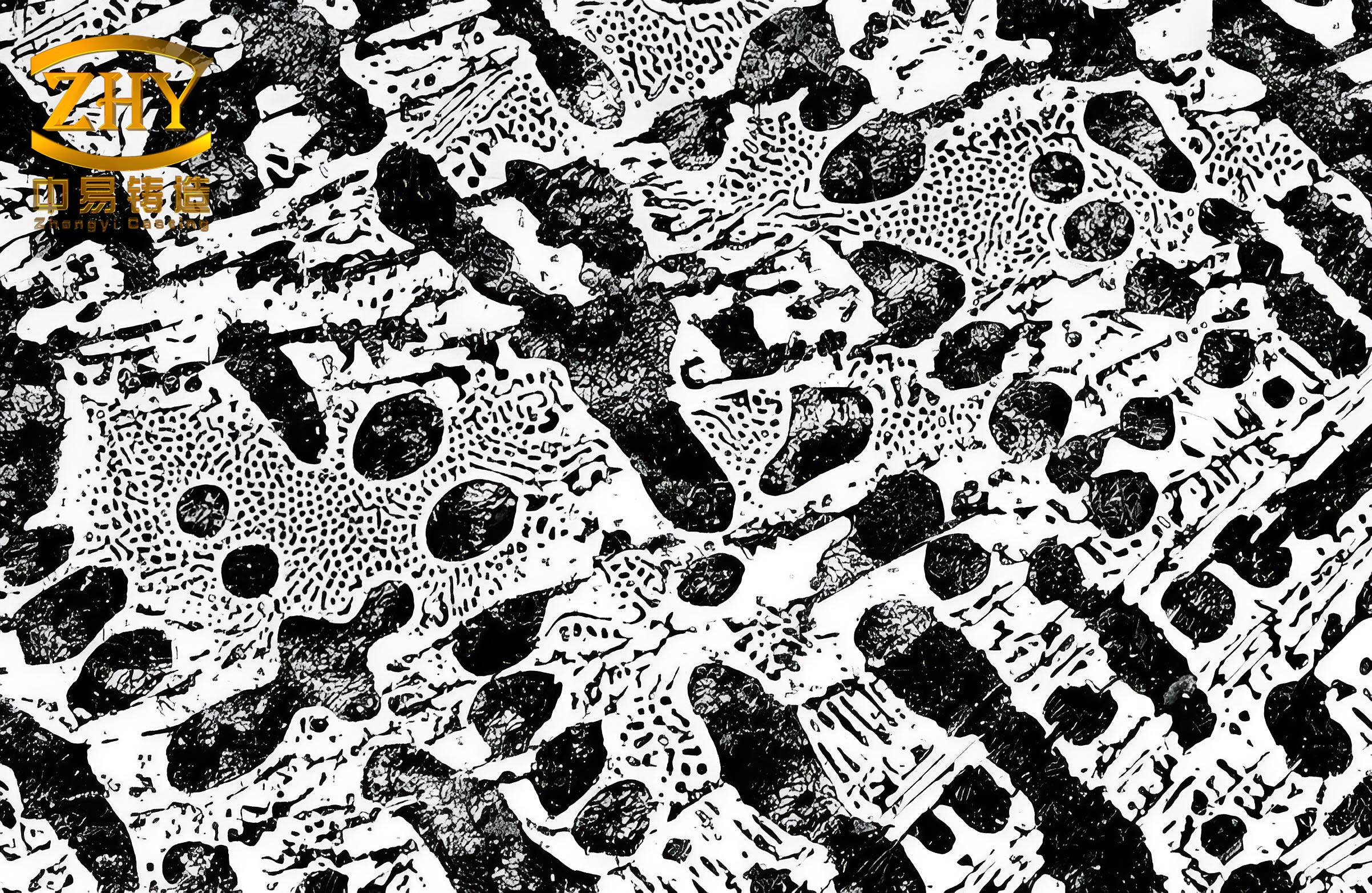
White cast iron is widely used in applications requiring exceptional abrasion resistance, such as mining equipment and manufacturing tools. However, its inherent brittleness and challenges in processing have driven efforts to refine its microstructure and mechanical properties. My investigations have centered on alloying white cast iron with elements like niobium to improve its toughness and wear characteristics. The addition of niobium promotes the formation of fine carbides, which enhance hardness while reducing crack propagation. This process can be described by the reaction: $$ \text{Fe} + \text{C} + \text{Nb} \rightarrow \text{Fe}_3\text{C} + \text{NbC} $$ where niobium carbide (NbC) precipitates act as reinforcements. To quantify the effects, I conducted experiments varying niobium content from 0% to 2%, measuring properties such as hardness, impact toughness, and bending strength. The results are summarized in Table 1, demonstrating significant improvements in white cast iron performance with optimal niobium levels.
| Niobium Content (%) | Hardness (HRC) | Impact Toughness (J/cm²) | Bending Strength (MPa) | Wear Coefficient |
|---|---|---|---|---|
| 0 | 55 | 8.5 | 450 | 1.00 |
| 0.5 | 58 | 10.2 | 480 | 0.85 |
| 1.0 | 60 | 11.5 | 520 | 0.70 |
| 1.5 | 62 | 10.8 | 540 | 0.65 |
| 2.0 | 64 | 9.8 | 560 | 0.60 |
The data shows that white cast iron with 1.0% niobium achieves a balance of high toughness and strength, attributed to refined carbides and purified grain boundaries. The wear resistance improves due to hard NbC particles dispersed in the matrix. This aligns with the Hall-Petch relationship, where finer grains enhance strength: $$ \sigma_y = \sigma_0 + k_y d^{-1/2} $$ with $\sigma_y$ as yield strength, $\sigma_0$ as friction stress, $k_y$ as strengthening coefficient, and $d$ as grain diameter. In white cast iron, niobium reduces grain size, leading to better performance. Furthermore, heat treatment can further optimize properties; for instance, austenitizing at high temperatures promotes diffusion and homogenization, boosting impact toughness to stable levels. My work confirms that white cast iron alloyed with niobium is superior for wear-prone applications, and I have applied similar principles to other materials like aluminum alloys.
Transitioning to aluminum alloying, I have developed additives to replace traditional master alloys, which often involve high-temperature melting and inconsistent composition. These additives contain active metal powders like copper, silicon, and magnesium, combined with fluxing agents to enhance dissolution in molten aluminum. The process involves compacting powders into blocks with a density of 2.5–3.0 g/cm³ to ensure submersion. When added to aluminum at 720–750°C, the reaction proceeds rapidly: $$ \text{Al} + \text{M} \rightarrow \text{Al-M alloy} $$ where M represents alloying elements. The flux protects the powders and refines the melt, achieving recovery rates above 95%. Compared to master alloys, this method saves energy and improves compositional control. Table 2 contrasts the two approaches for aluminum alloying, highlighting the advantages of additives in producing white cast iron-like precision in aluminum systems.
| Aspect | Master Alloys | Additives |
|---|---|---|
| Melting Temperature | High (800–1000°C) | Low (720–750°C) |
| Element Recovery | 80–90% | 95–98% |
| Composition Uniformity | Variable | High |
| Energy Consumption | High | Low |
| Application Ease | Complex | Simple |
In my trials, additives for elements like copper and silicon have proven effective in aluminum foundries, yielding castings with quality comparable to those from master alloys. The key is the exothermic reaction that quickly disperses elements, similar to how niobium integrates into white cast iron. This innovation reduces costs and environmental impact, making it suitable for mass production. The preparation flow involves: raw material selection → drying → sieving → mixing → pressing → inspection → packaging. By optimizing parameters like powder size (50–150 μm) and binder content, I ensure block integrity and consistent performance. Such advancements echo the need for efficient material processing in industries relying on white cast iron and other alloys.
Another area of my research is joining advanced ceramics, which face challenges due to their high hardness and thermal sensitivity. Traditional diffusion welding requires prolonged heating, which can degrade properties. I have explored electrode welding and microwave welding as alternatives. In electrode welding, a flux with ionic conductivity (e.g., based on Al₂O₃-SiO₂ systems) is placed between ceramics, preheated to 500–600°C, and subjected to high voltage. The flux self-heats via Joule heating: $$ P = I^2 R $$ where $P$ is power, $I$ is current, and $R$ is resistance, causing fusion and bonding. This method enables rapid, localized heating, preserving the base material’s integrity. For instance, welding Al₂O₃ to SiC maintains flexural strength up to 800°C, though it may be lower than the ceramic’s intrinsic strength due to stress concentration. Microwave welding uses electromagnetic waves to directly heat the interface, described by the equation: $$ Q = \omega \epsilon_0 \epsilon” E^2 $$ where $Q$ is heat generated, $\omega$ is angular frequency, $\epsilon_0$ is permittivity, $\epsilon”$ is loss factor, and $E$ is electric field. This technique offers precise control and short cycles, ideal for complex shapes. Table 3 summarizes these welding methods for ceramics, drawing parallels to the precision required in modifying white cast iron.
| Technique | Principle | Temperature Range | Joint Strength Retention | Advantages |
|---|---|---|---|---|
| Electrode Welding | Joule heating of conductive flux | 500–1000°C | Up to 800°C for Al₂O₃-SiC | Fast, localized, no bulk heating |
| Microwave Welding | Dielectric heating with microwaves | 600–1200°C | High at room temperature | Energy-efficient, easy control |
| Traditional Diffusion | High pressure and temperature | 1200–1500°C | Degrades above 600°C | Strong but slow and damaging |
These welding technologies highlight the importance of minimizing thermal exposure, much like how careful alloying preserves the microstructure of white cast iron. In my experiments, electrode welding has successfully joined Al₂O₃ and ZrO₂, with joints showing good thermal stability. However, the flux composition must be optimized to match the ceramics’ thermal expansion coefficients, reducing residual stresses. This is analogous to tailoring niobium content in white cast iron to balance hardness and toughness. The development of these methods supports the fabrication of large ceramic components, expanding their use in high-temperature environments where white cast iron might also serve.
Returning to white cast iron, the integration of niobium not only enhances mechanical properties but also improves wear resistance through the formation of hard phases. The wear coefficient decreases with niobium addition, as shown in Table 1, due to NbC particles acting as abrasion-resistant sites. This can be modeled using the Archard wear equation: $$ V = K \frac{F_n L}{H} $$ where $V$ is wear volume, $K$ is wear coefficient, $F_n$ is normal load, $L$ is sliding distance, and $H$ is hardness. For white cast iron, increased hardness from niobium reduces $V$, extending service life. My research indicates that heat treatment further refines the matrix, with austenitizing leading to a more homogeneous structure. This process involves phase transformations described by the Fe-C phase diagram, where cooling rates affect carbide morphology. By controlling these parameters, I achieve superior white cast iron grades suitable for severe conditions.
In conclusion, my work spans multiple material systems, emphasizing innovative approaches to alloying and joining. White cast iron benefits greatly from niobium alloying, achieving enhanced toughness and wear resistance without compromising hardness. Similarly, aluminum additives and ceramic welding techniques offer efficient alternatives to conventional methods, reducing energy use and improving precision. These advancements contribute to sustainable material engineering, with white cast iron serving as a cornerstone for demanding applications. Future directions include exploring synergistic effects of multiple alloying elements in white cast iron and adapting additive technologies for other metals. Through continued experimentation and analysis, I aim to push the boundaries of material performance, ensuring reliability in industrial settings.
To summarize key formulas and relationships, the improvement in white cast iron can be expressed as: $$ \Delta \text{Property} = f(\text{Nb content, processing conditions}) $$ where properties include hardness, toughness, and wear resistance. For aluminum alloying, the dissolution rate of additives is given by: $$ \frac{dC}{dt} = k A (C_s – C) $$ with $C$ as concentration, $k$ as rate constant, $A$ as surface area, and $C_s$ as saturation limit. In ceramic welding, the heat generation for microwave welding follows: $$ \nabla \cdot (k \nabla T) + Q = \rho c_p \frac{\partial T}{\partial t} $$ where $k$ is thermal conductivity, $T$ is temperature, $\rho$ is density, and $c_p$ is specific heat. These equations guide optimization in material design, reinforcing the interconnectedness of techniques across white cast iron, aluminum, and ceramics.