
In the pulverized coal preparation systems of thermal power generation, the grinding media, primarily balls, are subjected to extremely harsh conditions. Historically, medium-manganese nodular cast iron grinding balls, following standards such as DL104-81, have been widely adopted. However, these materials increasingly reveal significant limitations under actual service environments. The grinding process involves not only high-stress abrasive wear from coal particles—including crushing and gouging modes—but also corrosive wear. The raw coal typically contains 0.35% to 5.0% sulfur (often as pyrite, FeS₂) and 10% to 15% moisture due to open-air storage. This combination promotes electrochemical and chemical reactions, leading to accelerated metal loss from the grinding media. Consequently, the consumption of grinding balls for producing one ton of coal powder ranges from 450 to 950 grams, substantially increasing operational costs. To address these challenges, we embarked on developing a novel alloyed white cast iron material, specifically a chromium-manganese-copper (Cr-Mn-Cu) alloyed white cast iron, aiming to enhance both wear resistance and corrosion resistance in coal milling applications. This study presents a detailed exploration of its design, processing, properties, and performance.
The fundamental approach involved alloying white cast iron with strategic elements to modify its microstructure and properties. White cast iron, characterized by its high carbon content forming cementite (Fe₃C) carbides, inherently possesses high hardness but limited toughness. The addition of chromium, manganese, and copper is intended to refine the carbide morphology, enhance matrix strength, and improve corrosion resistance. We employed orthogonal experimental design to optimize the chemical composition, considering the individual and synergistic effects of these elements. Chromium tends to form hard, stable carbides (e.g., (Fe,Cr)₃C) and increases corrosion resistance by promoting passivation. Manganese stabilizes austenite, influences transformation kinetics, and can contribute to solid solution strengthening. Copper, while having limited solubility in iron, enhances corrosion resistance, particularly in acidic environments, and promotes pearlite formation. After numerous trials, the optimal composition range was established, as summarized in Table 1.
| Element | Carbon (C) | Manganese (Mn) | Chromium (Cr) | Silicon (Si) | Copper (Cu) | Phosphorus (P) | Sulfur (S) | Modifier |
|---|---|---|---|---|---|---|---|---|
| Content | 2.6 – 3.6 | 2.0 – 3.5 | 0.8 – 2.0 | ≤ 1.0 | 0.5 – 1.2 | ≤ 0.10 | ≤ 0.10 | Appropriate Amount |
The melting and casting processes were conducted using both a medium-frequency coreless induction furnace (GW-0.15 type) and a 2-ton/hour cupola furnace to ensure industrial relevance. Heat treatment experiments were performed in box-type (RX-8-10) and car-bottom (RX-75-12) resistance furnaces. The primary heat treatment investigated was normalizing, involving austenitizing followed by air cooling, aimed at achieving a favorable balance between hardness and toughness. Specimens for metallography, hardness, and impact testing were extracted from cast and heat-treated samples. Mechanical testing adhered to GB229 (impact) and GB230 (hardness) standards, with Rockwell C scale (HRC) used for hardness and unnotched Charpy impact energy (αₖ) measured in J/cm².
Abrasive wear tests were conducted on a unidirectional reciprocating wear testing machine. Test samples, with a diameter of 60 mm, were machined from the actual grinding balls. The abrasive medium was silica sand. Wear resistance was evaluated by the weight loss method, calculating the relative wear resistance (ε) as the ratio of the weight loss of a standard sample (medium-manganese nodular cast iron) to that of the test sample. Thus, a higher 1/ε value indicates better wear resistance. The formula is:
$$ \epsilon = \frac{\Delta W_{\text{test}}}{\Delta W_{\text{standard}}}, \quad \text{Wear Resistance Coefficient} = \frac{1}{\epsilon} $$
where $\Delta W$ represents weight loss.
Corrosion resistance was assessed using an accelerated electrochemical corrosion test. The medium was a 20% sulfuric acid (H₂SO₄) solution, stirred electromagnetically to simulate flow conditions. Specimens (25 mm diameter, 5 mm thickness) of three materials—45 carbon steel, medium-manganese nodular cast iron, and normalized Cr-Mn-Cu white cast iron—were immersed for 72 hours. Weight loss per unit surface area was measured to determine corrosion rates. The relative corrosion loss rate was calculated compared to 45 steel.
The as-cast microstructure of the Cr-Mn-Cu alloyed white cast iron primarily consists of ledeburite (a eutectic mixture of austenite/pearlite and cementite) and pearlite, as shown in the micrograph. The cementite network, characteristic of white cast iron, is continuous and surrounds the pearlitic colonies. This structure provides high hardness but limited ductility.
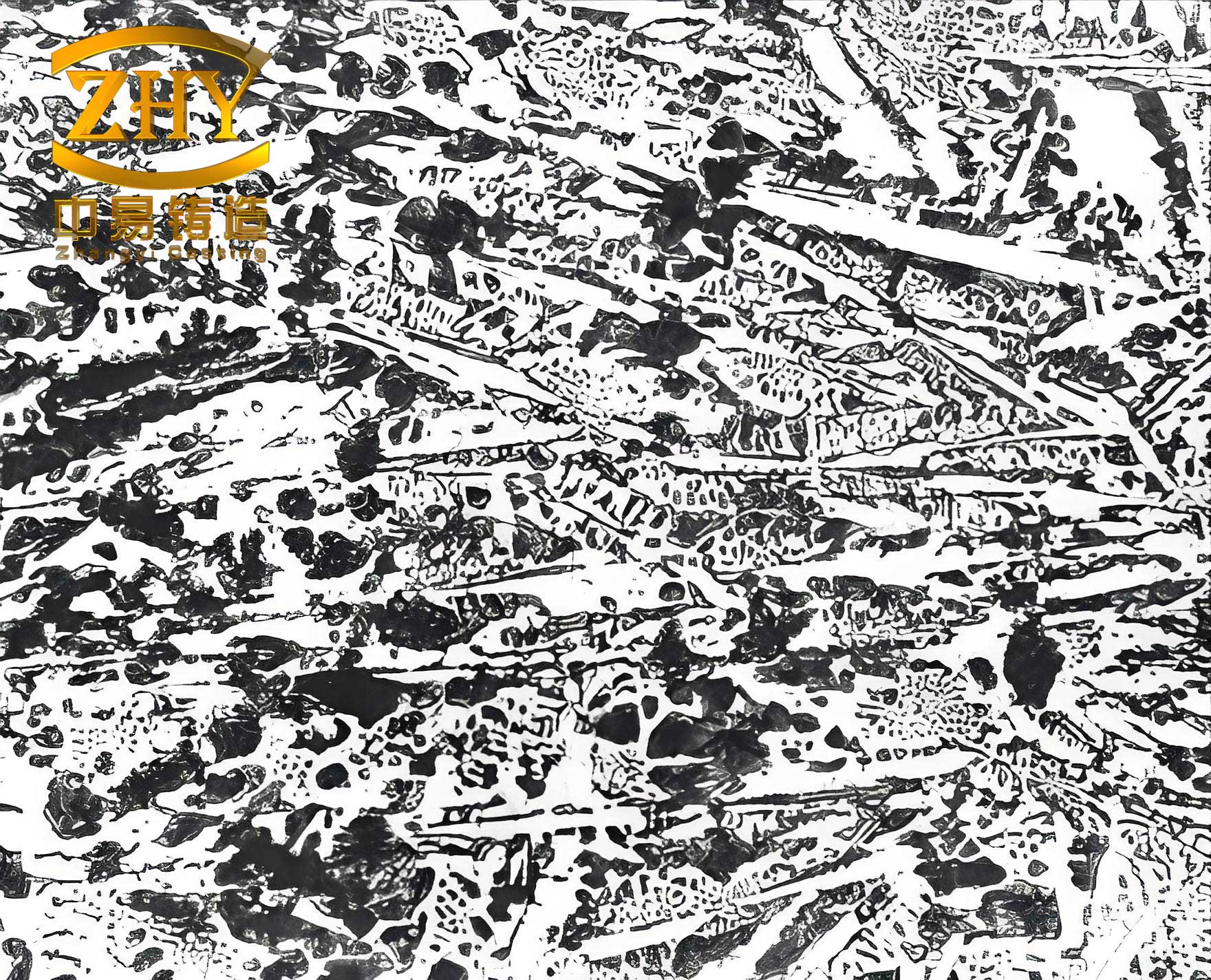
Heat treatment, specifically normalizing within the range of 930°C to 1050°C, significantly alters the microstructure. The normalized structure comprises eutectic carbides, pearlite, and finely dispersed secondary carbides precipitated within the matrix. The morphology of the eutectic carbides becomes somewhat rounded, and their volume fraction slightly decreases due to partial dissolution during austenitizing. The pearlite is alloyed, and the secondary carbides contribute to dispersion strengthening. This modified microstructure in heat-treated white cast iron is crucial for enhancing toughness while retaining high hardness. The transformation can be described by considering the dissolution of carbides during heating and subsequent precipitation during cooling. The volume fraction of carbides ($V_c$) can be estimated using the lever rule approximation for the Fe-C-X system, though exact calculations require ternary phase diagrams. An empirical relation for secondary carbide precipitation kinetics might follow an Avrami-type equation:
$$ V_{c,\text{sec}}(t) = 1 – \exp(-k t^n) $$
where $k$ and $n$ are temperature-dependent parameters, and $t$ is time during cooling.
The mechanical properties of the white cast iron in both as-cast and heat-treated conditions were extensively characterized. Statistical analysis was performed on large sample sets to ensure reliability. Table 2 summarizes the as-cast properties, while Table 3 presents the properties after optimal normalizing treatment.
| Property | Average Value | 95% Confidence Interval (Range Method) | Sample Size |
|---|---|---|---|
| Hardness (HRC) | 57.0 | 54.0 – 60.0 | 780 specimens |
| Impact Toughness, αₖ (J/cm²) | 3.43 | 2.35 – 4.51 | 263 specimens |
The as-cast white cast iron exhibits very high hardness but moderate impact toughness. The heat treatment process successfully improves toughness with a minor sacrifice in hardness.
| Property | Average Value | 95% Confidence Interval | Sample Size / Source |
|---|---|---|---|
| Test Bar Hardness (HRC) | 55.5 | 52.5 – 58.5 | 1062 measurements |
| Test Bar Impact Toughness, αₖ (J/cm²) | 5.98 | 4.21 – 7.74 | 354 specimens |
| Grinding Ball Hardness (HRC) | 55.0 | 52.0 – 58.0 | 267 balls |
The increase in impact toughness (from ~3.43 J/cm² to ~5.98 J/cm²) is significant and vital for applications involving impact loading. The hardness remains above 55 HRC, which is excellent for abrasive wear resistance. This combination is a key advantage of this engineered white cast iron.
Abrasive wear test results provided a direct comparison. Table 4 details the weight loss data for three materials under identical test conditions.
| Material | Condition | Initial Weight (g) | Final Weight (g) | Weight Loss, ΔW (g) | Relative Wear, ε | Wear Resistance Coefficient, 1/ε |
|---|---|---|---|---|---|---|
| Medium-Manganese Nodular Cast Iron | As-cast (heat-released) | 913.82 | 911.61 | 2.21 | 1.00 (Reference) | 1.00 |
| Cr-Mn-Cu White Cast Iron | As-cast | 956.63 | 953.20 | 3.43 | 1.552 | 0.644 |
| Cr-Mn-Cu White Cast Iron | Normalized (1000°C) | 947.91 | 947.22 | 0.69 | 0.312 | 3.203 |
The normalized Cr-Mn-Cu white cast iron demonstrated a wear resistance approximately 3.2 times higher than that of the medium-manganese nodular cast iron reference. This underscores that superior wear resistance in white cast iron is not solely a function of hardness; improved toughness plays a critical role in preventing micro-cracking and spalling of hard phases under abrasive stress. A simplified model for abrasive wear volume ($V$) often follows the Archard or Rabinowicz relations, modified for brittle materials:
$$ V = K \frac{P \cdot L}{H} + \beta \cdot \frac{P^{3/2} \cdot L}{K_{Ic}^{1/2} \cdot H^{5/8}} $$
where $P$ is load, $L$ is sliding distance, $H$ is hardness, $K_{Ic}$ is fracture toughness, and $K$, $\beta$ are material constants. The second term accounts for fracture-dominated wear, highlighting the importance of toughness.
Corrosion test results were equally compelling. The aggressive 20% H₂SO₄ environment simulates the acidic conditions that can develop in coal mills. The reactions involved include the oxidation of pyrite and subsequent formation of sulfuric acid:
$$ 4FeS_2 + 15O_2 + 8H_2O \rightarrow 2Fe_2O_3 + 8H_2SO_4 $$
The generated acid then attacks the iron matrix:
$$ Fe + H_2SO_4 \rightarrow FeSO_4 + H_2 $$
Further oxidation can lead to more complex corrosion products. The weight loss data per unit surface area is presented in Table 5.
| Material | Specimen ID | Weight Loss (g) | Weight Loss per Unit Area (g/m²) | Relative Loss Rate (vs. 45 Steel) | Corrosion Resistance Multiplier (vs. 45 Steel) | Corrosion Resistance Multiplier (vs. Medium-Mn Nodular Iron) |
|---|---|---|---|---|---|---|
| 45 Carbon Steel | 1-1 | 10.6014 | 7713.19 | 1.00 | 1.00 | — |
| 1-2 | 9.7216 | 7073.08 | 0.92 | 1.09 | — | |
| Medium-Mn Nodular Cast Iron | 2-1 | 5.6638 | 4120.78 | 0.56 | 1.79 | 1.00 |
| 2-2 | 6.3676 | 4632.83 | 0.65 | 1.54 | 1.00 | |
| Normalized Cr-Mn-Cu White Cast Iron | 3-1 | 4.3471 | 3162.79 | 0.45 | 2.22 | 1.29 |
| 3-2 | 3.6031 | 2621.48 | 0.37 | 2.70 | 1.57 |
The normalized Cr-Mn-Cu white cast iron shows a corrosion resistance 1.2 to 1.7 times higher than 45 steel and 29% to 57% higher than medium-manganese nodular cast iron. This enhancement is attributed to several factors inherent to this alloyed white cast iron. Firstly, the alloying elements chromium and copper increase the electrode potential of the metallic matrix, reducing the driving force for electrochemical corrosion. The corrosion current density ($i_{corr}$) in an acidic medium can be related to the overpotential and alloy composition via the Butler-Volmer equation. Secondly, white cast iron has a much lower graphite content compared to nodular cast iron. Graphite, being cathodic to the ferritic matrix, forms numerous galvanic cells in nodular iron, accelerating corrosion. The absence of significant graphite in white cast iron minimizes such micro-galvanic corrosion. The corrosion rate might be approximated by:
$$ \text{Corrosion Rate} \propto \frac{i_{corr}}{nF\rho} $$
where $n$ is the number of electrons transferred, $F$ is Faraday’s constant, and $\rho$ is density. Alloying reduces $i_{corr}$.
Microstructural analysis using optical microscopy and microhardness testing provided further insights. The normalized white cast iron microstructure exhibits alloy pearlite with a microhardness of HV 428–483, significantly higher than conventional pearlite (HV 250–300). The alloy carbides, both eutectic and secondary, have a microhardness range of HV 1040–1342, compared to ~HV 1000–1100 for plain cementite. These values confirm the strengthening effect of chromium and manganese in carbides. The dispersion of fine secondary carbides within the pearlitic matrix contributes to precipitation strengthening, which can be described by the Orowan strengthening mechanism:
$$ \Delta \sigma_{\text{orowan}} \approx \frac{Gb}{\lambda} $$
where $G$ is shear modulus, $b$ is Burgers vector, and $\lambda$ is inter-particle spacing. This strengthening, combined with the high hardness of the carbides, underpins the exceptional wear resistance of this white cast iron.
To validate laboratory findings under real industrial conditions, a large-scale production and field trial were conducted. Approximately 60.47 tons of Cr-Mn-Cu alloyed white cast iron grinding balls were produced via metal mold casting using a cupola furnace. These balls were installed in two DTM287/410 type coal mills at a thermal power plant. The mill operated at 18.6 rpm. Over a continuous run of 1642 hours, 39,092 tons of coal powder were ground. The total consumption of grinding balls was 6.3 tons, resulting in a specific consumption of only 161 grams per ton of coal. The breakage rate was less than 0.5%. This performance is dramatically superior to the previously used medium-manganese nodular cast iron balls, which typically exhibited consumptions above 450 g/ton. The field trial conclusively demonstrates that this chromium-manganese-copper alloyed white cast iron material meets the stringent demands of coal milling systems, offering exceptional longevity and cost-effectiveness.
The success of this white cast iron material can be further discussed through the lens of its synergistic properties. In coal milling, wear and corrosion are interdependent; corrosion can create pits and roughness that accelerate abrasive wear, and wear can remove protective layers, exposing fresh metal to corrosion. This is often termed “corrosion-wear synergy.” The total material loss rate ($T$) can be expressed as:
$$ T = W_0 + C_0 + \Delta S $$
where $W_0$ is the pure wear rate, $C_0$ is the pure corrosion rate, and $\Delta S$ is the synergistic term (positive or negative). The developed white cast iron minimizes both $W_0$ (via high hardness and toughness) and $C_0$ (via alloying), likely resulting in a reduced $\Delta S$. The material’s ability to resist both mechanisms makes it ideal for such complex environments.
Furthermore, the heat treatment window (930–1050°C) is relatively broad, which is beneficial for industrial processing consistency. The tempering behavior was also investigated; it was found that tempering in the range from room temperature to 300°C did not significantly alter the mechanical properties. This is advantageous because grinding balls in service can reach temperatures of 100–200°C, and this thermal stability ensures property retention during operation.
In summary, this comprehensive study on chromium-manganese-copper alloyed white cast iron has yielded a material with a finely tuned microstructure and outstanding performance. The optimized chemical composition, coupled with a normalizing heat treatment, produces a structure of eutectic carbides, alloy pearlite, and dispersed secondary carbides. This engineered white cast iron exhibits an excellent balance of high hardness (55–58 HRC) and improved impact toughness (~6 J/cm²). Laboratory tests confirmed its wear resistance to be over three times that of standard medium-manganese nodular cast iron and its corrosion resistance to be significantly superior. The mechanisms are rooted in the hard, alloyed carbides, the strengthened matrix, the reduced electrochemical activity due to chromium and copper, and the absence of graphitic carbon. The successful field trial, with a specific consumption of 161 g/ton coal, validates the material’s suitability for harsh coal milling applications. This development of a high-performance white cast iron represents a substantial advancement in grinding media technology, promising reduced operational costs and improved efficiency in thermal power generation and similar industries.
The future potential of this white cast iron alloy extends beyond grinding balls. It could be adapted for other components subject to combined abrasion and corrosion, such as slurry pump parts, crusher liners, and mineral processing equipment. Further research could explore variations in carbide volume fraction through carbon content adjustment, the effect of other micro-alloying elements like vanadium or niobium, and advanced heat treatment cycles like austempering to possibly achieve even better toughness. The fundamental principles demonstrated here—tailoring microstructure via alloying and heat treatment to combat specific wear-corrosion synergies—provide a robust framework for developing next-generation white cast iron materials for extreme environments.