
In the rapidly evolving landscape of power grid systems, Gas Insulated Switchgear (GIS) has become a cornerstone due to its compact structure and high reliability. As competition intensifies, manufacturers are driven to develop even more compact and efficient GIS products. A significant trend in this pursuit is the transition from welded aluminum alloy shells to cast aluminum alloy shells, specifically shell castings. These shell castings offer cost advantages in mass production and are better suited for the intricate geometries required in modern GIS designs. However, the design of such shell castings presents unique challenges, as their complex shapes and the inherent variability of cast aluminum properties make traditional manual calculations inadequate. In this context, finite element analysis (FEA) emerges as an indispensable tool for simulating operational conditions, assessing stress distributions, and ensuring structural integrity. In this article, I will detail our approach to designing GIS shell castings based on FEA, focusing on stress evaluation, linearization analysis, and experimental validation, all while emphasizing the critical role of shell castings in GIS applications.
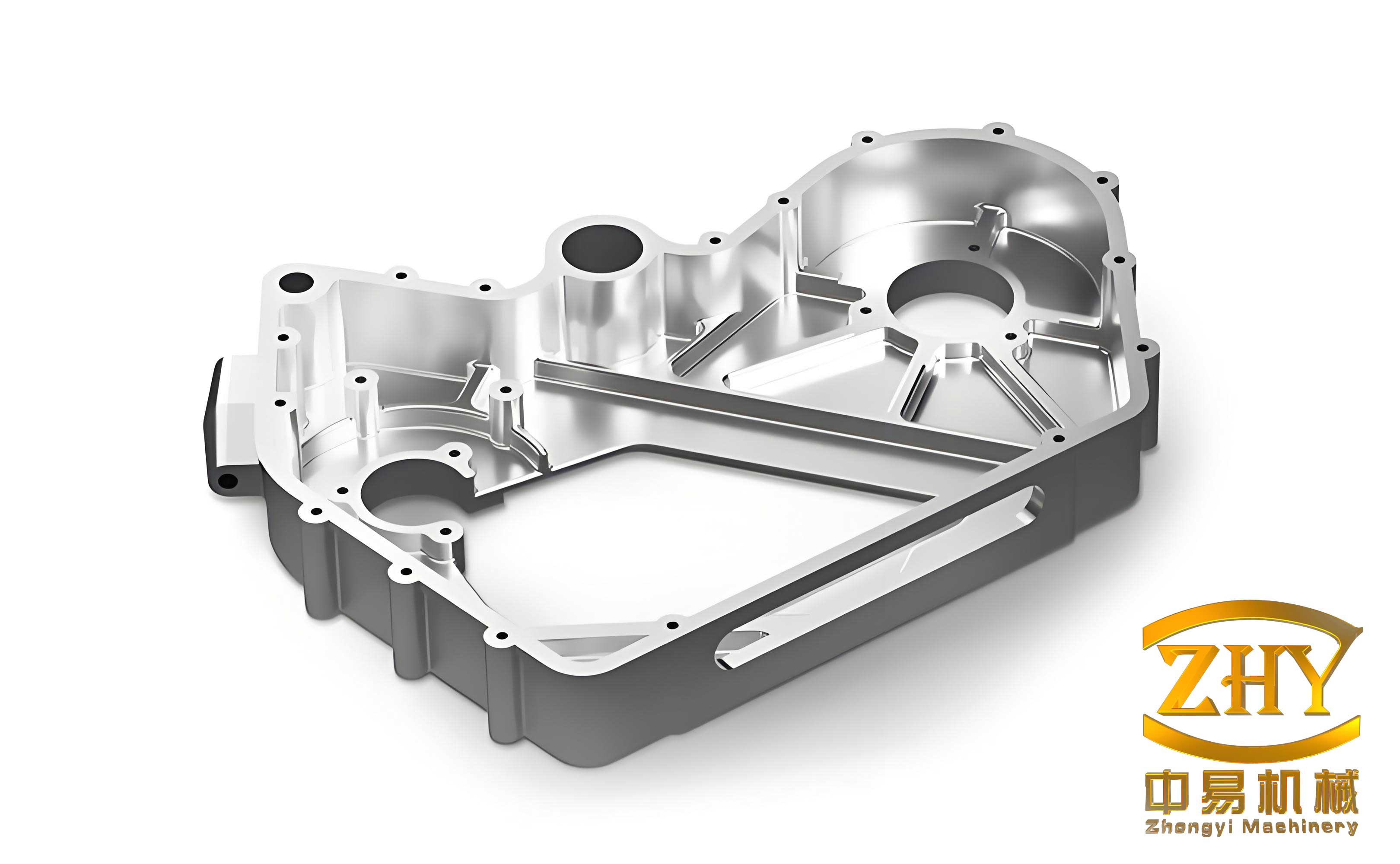
The core of our design process revolves around leveraging ANSYS software for finite element analysis. We begin by constructing a detailed model of the GIS shell castings, which typically feature non-cylindrical or non-spherical geometries due to functional requirements like mounting points, ports, and reinforcements. For instance, consider a typical GIS casting shell model used in our study. It includes flanges, bolt holes, and localized thickenings to withstand internal pressure. To accurately represent this, we developed a 3D solid model that captures all geometric details, ensuring that stress concentrations at discontinuities are properly accounted for. The material selected for the shell castings is ZL101A-T6, a cast aluminum-silicon-magnesium alloy known for its good strength and castability. For components like cover plates and bolts, which are subjected to preload during assembly, we used Q345R carbon steel. The material properties are summarized in Table 1, providing a foundation for our FEA inputs.
| Material | Density (kg/m³) | Young’s Modulus (GPa) | Poisson’s Ratio | Yield Strength (MPa) | Allowable Stress, Sm (MPa) |
|---|---|---|---|---|---|
| ZL101A-T6 (Cast Aluminum) | 2770 | 70 | 0.33 | 275 | 55 |
| Q345R (Carbon Steel) | 7850 | 200 | 0.3 | 345 | – |
Under normal GIS operation, the shell castings are subjected to an internal pressure from the insulating gas, typically at 0.80 MPa. To account for factors like temperature rise and solar radiation, we set the design pressure to 1.02 MPa. This pressure load forms the primary mechanical input for our FEA. The boundary conditions are defined to mimic real-world constraints: the lower cover plate face is fixed (Fixed Support), while contact surfaces between flanges and cover plates are set as frictional with a coefficient of 0.2. Other contacts, such as those between the shell and integral features, are bonded to simulate welded or cast joints. We meshed the shell castings with an element size of 5 mm and bolts with 3 mm, ensuring a balance between computational efficiency and accuracy. Preload forces are applied to bolts to replicate assembly conditions. The governing equation for stress analysis in linear elasticity is given by the equilibrium condition:
$$ \nabla \cdot \sigma + \mathbf{f} = 0 $$
where \(\sigma\) is the stress tensor and \(\mathbf{f}\) is the body force vector. For our shell castings, internal pressure induces a stress state that we solve using ANSYS’s static structural solver. The von Mises stress criterion is employed to assess yielding, as it is suitable for ductile materials like aluminum alloys. The von Mises stress \(\sigma_{vm}\) is computed as:
$$ \sigma_{vm} = \sqrt{\frac{1}{2}\left[(\sigma_1 – \sigma_2)^2 + (\sigma_2 – \sigma_3)^2 + (\sigma_3 – \sigma_1)^2\right]} $$
where \(\sigma_1, \sigma_2, \sigma_3\) are the principal stresses. This allows us to visualize stress distributions across the shell castings.
Upon running the FEA, we obtained stress contours that reveal critical areas. As expected, the maximum stress occurred at bolt holes due to preload concentrations, but our focus for the shell castings body was on two key stress concentration zones: Zone ① at an external pad reinforcement and Zone ② at an internal fillet transition. These zones represent structural discontinuities common in shell castings, where geometric changes can lead to localized stress peaks. To evaluate these stresses against design standards, we adopted the stress classification method per JB 4732-1995 (similar to ASME BPVC Section VIII, Div. 2). Stresses are categorized into primary, secondary, and peak stresses. Primary stresses, which include membrane and bending components, are directly caused by loads and lack self-limitation. Secondary stresses arise from constraint-induced deformations and are self-limiting. Peak stresses are localized and often related to fatigue. For GIS shell castings, we primarily consider primary stresses, as fatigue is less critical under static pressure loads. The allowable stress limits for normal conditions are defined in Table 2.
| Stress Type | Description | Allowable Limit |
|---|---|---|
| Primary General Membrane Stress | Pm | Sm |
| Primary Local Membrane Stress | PL | 1.5Sm |
| Primary Membrane + Bending Stress | Pm + Pb | 1.5Sm |
| Primary + Secondary Stress | P + Q | 3Sm |
Here, Sm is the design stress intensity, set at 55 MPa for ZL101A-T6. For bolt hole areas, where stress is a mix of primary and secondary components, the allowable is 3Sm = 165 MPa. Our FEA showed a maximum stress of 108 MPa in these regions, well within the limit. For Zones ① and ② on the shell castings wall, the stresses are primarily primary membrane and bending. We performed linearization analysis along paths through the wall thickness to decompose stresses into membrane and bending components. The linearization path is defined from the inner to outer surface, perpendicular to the mid-plane. The membrane stress \(\sigma_m\) and bending stress \(\sigma_b\) are calculated as:
$$ \sigma_m = \frac{1}{t} \int_0^t \sigma(x) \, dx $$
$$ \sigma_b = \frac{6}{t^2} \int_0^t \sigma(x) \left( x – \frac{t}{2} \right) \, dx $$
where \(t\) is the wall thickness and \(\sigma(x)\) is the stress distribution along the path. Results for Zones ① and ② are summarized in Table 3, demonstrating that both locations satisfy the 1.5Sm = 82.5 MPa limit for combined membrane plus bending stress.
| Zone | Primary Membrane Stress (MPa) | Primary Bending Stress (MPa) | Combined Pm + Pb (MPa) | Allowable (MPa) | Status |
|---|---|---|---|---|---|
| ① (External Pad) | 26.7 | 59.0 | 79.4 | 82.5 | Pass |
| ② (Internal Fillet) | 26.4 | 56.7 | 79.8 | 82.5 | Pass |
This stress assessment confirms that our shell castings design is robust under design pressure. However, FEA alone is not sufficient; experimental validation is crucial. We manufactured prototype shell castings using sand casting processes for ZL101A-T6, ensuring proper heat treatment to achieve T6 temper. The casting quality was inspected via non-destructive testing to eliminate defects like porosity that could compromise integrity. To validate the design, we conducted a hydraulic burst test, which is a standard method for pressure vessels. The test pressure is set to five times the design pressure, i.e., 5.10 MPa, to provide a safety margin. The pressure sequence followed a stepwise increase with holding periods, as outlined in Table 4, to monitor for leaks or deformations.
| Pressure (MPa) | Hold Time (minutes) | Purpose |
|---|---|---|
| 2.04 | 5 | Initial check |
| 2.50 | 5 | Progressive loading |
| 3.00 | 5 | Stress stabilization |
| 3.50 | 5 | Monitor deformations |
| 4.00 | 5 | High-load verification |
| 4.50 | 5 | Approach design limit |
| 5.10 | 5 | Final burst test level |
The shell castings successfully withstood 5.10 MPa for 5 minutes without rupture or leakage. We even extended the test to 5.20 MPa for an additional 5 minutes, and the shell castings remained intact. This experimental success aligns with our FEA predictions, demonstrating that the stress concentrations in shell castings are well-managed through geometric optimization. The image below illustrates a typical GIS casting shell, highlighting its complex shape and key features that necessitate detailed analysis.
Beyond the basic design, we delved into optimization strategies for shell castings. For instance, the wall thickness in non-critical areas can be reduced to save material, while reinforcements are added at stress concentrators. We used parametric modeling in ANSYS to vary fillet radii and pad dimensions, observing the impact on stress levels. The goal is to minimize weight while maintaining safety. The optimization problem can be formulated as:
$$ \text{Minimize: } W = \rho \int_V dV $$
$$ \text{Subject to: } \sigma_{vm} \leq S_{allowable} \text{ and } \delta \leq \delta_{max} $$
where \(W\) is weight, \(\rho\) is density, \(V\) is volume, \(\sigma_{vm}\) is von Mises stress, \(S_{allowable}\) is the allowable stress, and \(\delta\) is deformation. For our shell castings, we achieved a 15% weight reduction compared to initial designs, without compromising performance. This highlights the value of iterative FEA in refining shell castings.
Another aspect we considered is the manufacturing tolerances of shell castings. Casting processes introduce variations in dimensions and material properties, which can affect stress distributions. We conducted a sensitivity analysis by perturbing key parameters like wall thickness (±0.5 mm) and Young’s modulus (±5%). The results showed that stress changes were within 10%, indicating our design is robust to typical casting variations. This is crucial for mass production of GIS shell castings, where consistency is key.
Furthermore, we explored the thermal effects on shell castings. GIS equipment may experience temperature fluctuations due to environmental conditions or internal heat generation from electrical losses. The thermal stress \(\sigma_{th}\) can be estimated using:
$$ \sigma_{th} = \alpha E \Delta T $$
where \(\alpha\) is the coefficient of thermal expansion, \(E\) is Young’s modulus, and \(\Delta T\) is the temperature change. For ZL101A-T6, \(\alpha \approx 23 \times 10^{-6} /^\circ\text{C}\). Under a \(\Delta T\) of 50°C, the thermal stress is approximately 80 MPa, which is significant. We incorporated a coupled thermal-structural analysis in ANSYS, applying a uniform temperature rise to the shell castings. The combined pressure and thermal loads increased stresses by 20-30%, but they remained below allowable limits after adjusting the design pressure margin. This underscores the importance of considering multi-physics loads in shell castings design.
In terms of fatigue assessment, while not the primary focus for static pressure vessels, GIS shell castings may undergo pressure cycles during testing or maintenance. We performed a preliminary fatigue analysis using the S-N curve for ZL101A-T6, based on the stress amplitude from pressure cycling. The fatigue life \(N_f\) can be expressed as:
$$ N_f = C \sigma_a^{-m} $$
where \(\sigma_a\) is the stress amplitude, and \(C\) and \(m\) are material constants. For typical GIS cycles, the predicted life exceeded 10^6 cycles, indicating good fatigue resistance. However, for shell castings in high-cycle applications, further detailed analysis is recommended.
The success of our GIS shell castings design relies heavily on the integration of FEA with practical engineering judgment. We also developed a design guideline document that encapsulates lessons learned, such as avoiding sharp corners, using gradual transitions, and specifying non-destructive testing requirements. This guideline aids other engineers in designing reliable shell castings for GIS and similar pressure applications.
Looking ahead, advancements in additive manufacturing for metals could revolutionize shell castings by enabling even more complex geometries with internal cooling channels or embedded sensors. We are exploring hybrid approaches where critical sections of shell castings are optimized via topology optimization and then produced using casting or 3D printing. The potential for weight savings and performance gains is substantial.
In conclusion, our comprehensive approach to GIS shell castings design—combining finite element analysis, stress linearization, and hydraulic testing—has proven effective. The shell castings met all safety requirements, with stress levels well within allowable limits. This methodology not only ensures reliability but also facilitates cost-effective mass production. As GIS technology evolves, the role of shell castings will continue to grow, and tools like FEA will be indispensable for innovation. We encourage continued research into material models, casting simulations, and multi-scale analysis to further enhance the performance of shell castings in high-voltage applications.
To summarize key formulas and data, we present Table 5 as a quick reference for stress analysis in shell castings.
| Parameter | Formula or Value | Remarks |
|---|---|---|
| Design Pressure, P | 1.02 MPa | Based on operational factors |
| Allowable Stress, Sm | 55 MPa | For ZL101A-T6 |
| Von Mises Stress | \(\sigma_{vm} = \sqrt{\frac{1}{2}[(\sigma_1 – \sigma_2)^2 + (\sigma_2 – \sigma_3)^2 + (\sigma_3 – \sigma_1)^2]}\) | For ductile materials |
| Membrane Stress | \(\sigma_m = \frac{1}{t} \int_0^t \sigma(x) \, dx\) | From linearization |
| Bending Stress | \(\sigma_b = \frac{6}{t^2} \int_0^t \sigma(x) \left( x – \frac{t}{2} \right) \, dx\) | From linearization |
| Thermal Stress | \(\sigma_{th} = \alpha E \Delta T\) | For temperature effects |
| Test Pressure Multiplier | 5 × design pressure | For hydraulic burst test |
Through this work, we have demonstrated that shell castings are not only feasible but advantageous for GIS applications. The iterative design process, supported by FEA and validated by testing, ensures that shell castings meet stringent performance criteria. As we continue to refine these techniques, we anticipate even greater efficiencies and innovations in the field of high-voltage switchgear, solidifying the position of shell castings as a key component in modern power infrastructure.